 Skip to content
Last reviewed: September 22, 2026.
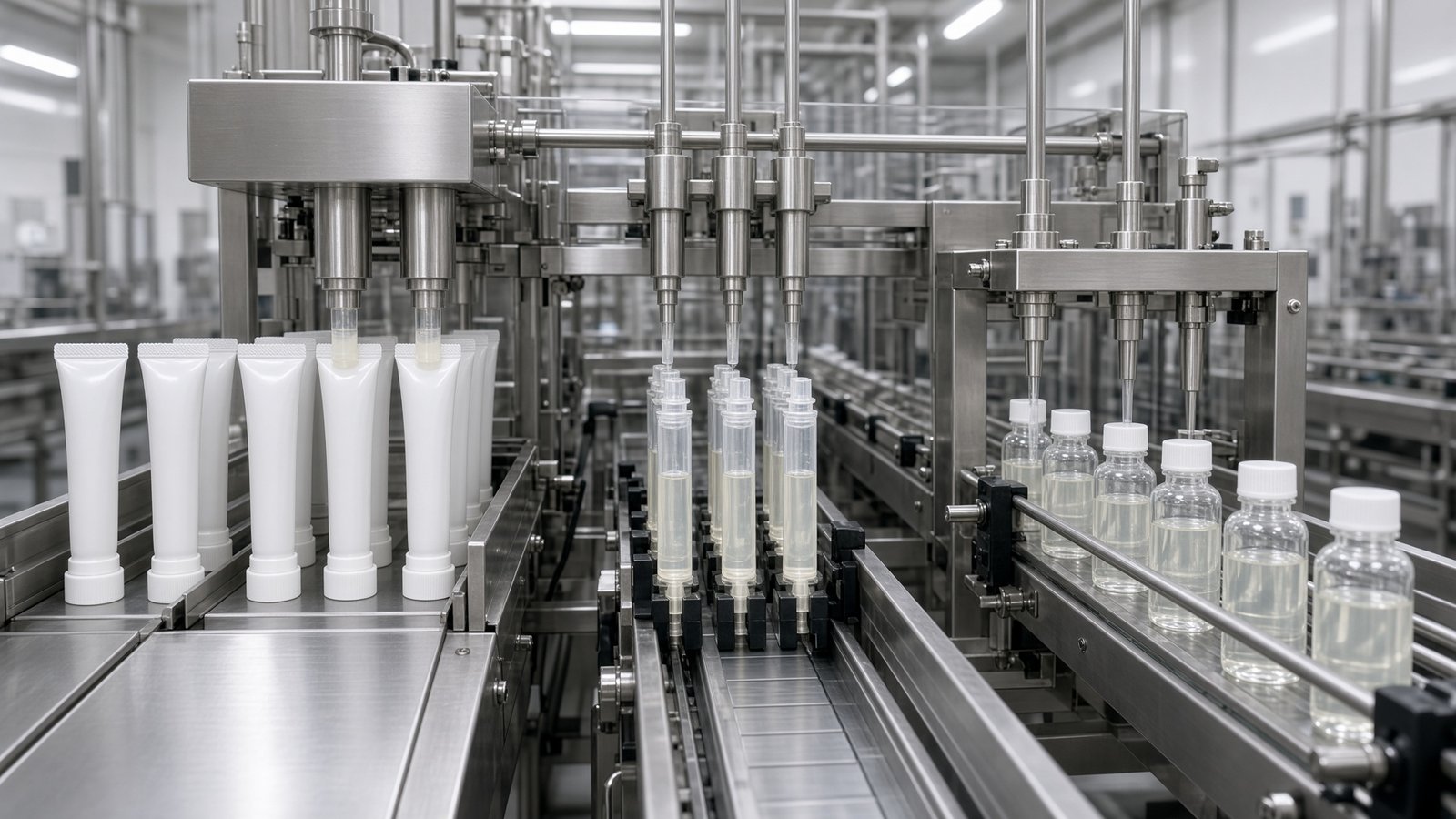
The package for an oral gel is part of the dosing system, not a decorative decision made after formulation. A collapsible tube, a dosing syringe and a bottle expose the gel to different flow paths, residual volume, reclosure behavior, barrier conditions and consumer actions. The same gel may fill cleanly in one format yet string, trap air or deliver an inconsistent user dose in another.
This page owns the oral-care package-format decision. It does not cover injectable prefilled syringes, and it does not replace a full toothpaste line guide. The existing high-viscosity tube engineering guide explains thick-product tube mechanics; this comparison decides when a tube, oral dosing syringe or bottle route deserves a product trial.
Quick answer: Choose the format by the intended use and dose, gel yield stress and recovery, consumer dispensing force, barrier requirement, package-contact compatibility, fill range, output, cleaning and changeover burden. Tubes suit repeated squeeze dispensing and broad decoration options. Dosing syringes suit measured or directed application when the product and regulatory position support that presentation. Bottles fit pourable or pumpable gels only when the closure and dip-tube system can prime, recover and dispense consistently. Run package-specific filling, storage, transport and use tests before freezing the machine concept.
Compare the Three Packaging Routes
Direct answer: A useful comparison begins with the dose and product behavior, then tests the package as a complete delivery system.
Define whether the consumer needs an approximate ribbon, a marked measured dose, a directed application or repeated pump actuation. Record target net content, smallest and largest practical dose, frequency of use, likely storage orientation and whether the package must be reclosed after every use. These inputs narrow the format before speed is discussed.
Characterize the gel at realistic production and filling temperatures. Record density, yield stress or a justified proxy, shear-thinning and recovery behavior, stringing, air sensitivity and any suspended material. A single viscosity value without method, temperature and shear history is not a transferable equipment input.
Use the same representative gel and controlled component lots for comparative trials. Measure fill mass, air, tail or nozzle cleanliness, residual product, dispensing force or actuation, delivered dose, package recovery and appearance after storage. Rank formats with agreed evidence rather than preference.
| Decision factor | Tube | Dosing syringe | Bottle or pump |
|---|---|---|---|
| User dose | Ribbon or approximate amount | Marked or directed dose | Pour, squeeze or actuation |
| Gel behavior | Good for shape-retaining pastes | Needs controlled plunger force and cutoff | Needs reliable priming and dip-tube flow |
| Closing step | Heat seal or fold plus cap | Plunger, tip closure and cap | Cap, pump or fitment application |
| Main trial risk | Tail contamination or weak seal | Air, plunger force or closure fit | Foam, stringing, prime loss or residual |
Define Intended Use Before Selecting Equipment
Direct answer: Claims and instructions can change the product's regulatory route, so intended use should be fixed before packaging qualification.
In the United States, FDA explains that intended use and claims can determine whether an oral-care product is a cosmetic, a drug, both, or in some cases another regulated category. Fluoride anticaries gels and rinses are addressed in the applicable OTC monograph. Other products may follow different routes. The brand owner should obtain qualified regulatory advice for each market rather than asking the filling-machine supplier to classify the product.
Translate the approved claim and directions into packaging inputs: dose statement, applicator geometry, child-related warnings where applicable, tamper evidence, label area, lot and expiry coding, and instructions for cleaning or reclosure. Do not assume a syringe-shaped pack can use medical-device language or that a bottle can omit dose-control features.
Freeze the intended consumer interaction early enough to inform drawings and trials. A change from general topical placement to measured application can alter the package, component controls, labeling and line qualification. Keep the equipment URS aligned with the approved presentation.

Match Rheology to the Fill and Dispense Path
Direct answer: The best format is the one that the gel can enter, store in and leave without unacceptable air, separation, stringing or consumer force.
Oral gels and toothpaste-like pastes can show yield stress, shear thinning, thixotropy and wall slip. These behaviors mean pressure loss and cutoff cannot be predicted from one low-shear viscosity number. Provide the supplier with the complete test method, temperature, sample history and representative product, then compare pump and nozzle results.
Map every restriction: feed hose, valve, dose chamber, nozzle, tube neck, syringe barrel and tip, or bottle neck and dip tube. A narrow outlet may improve placement but increase pressure and stringing. A wide outlet may reduce pressure while delivering an uncontrolled ribbon. Product recovery after shear influences whether the gel holds shape or drips.
Record pressure or motor-load trends during a controlled trial and inspect the package after filling. Do not use water or a low-viscosity surrogate to approve high-viscosity performance. Published toothpaste extrusion research supports treating flow history, die geometry and wall slip as material inputs rather than relying on nominal viscosity alone.
| Observed behavior | Likely interface | Trial evidence |
|---|---|---|
| Long filament after cutoff | Gel recovery, tip and shutoff | High-speed video and tail length |
| Intermittent air pocket | Feed, transfer or refill state | Density, sectioning and timeline |
| High plunger or squeeze force | Rheology, outlet and package stiffness | Conditioned dispensing-force test |
| Pump loses prime | Dip tube, check valve and air path | Multi-actuation and orientation test |
Choose a Tube Filling and Sealing Route
Direct answer: Tubes are strong candidates for repeated gel dispensing when the product can be filled cleanly and the tube construction can be sealed and stored reliably.
Confirm plastic, laminate or aluminum construction, internal coating where relevant, neck and orifice, cap, decoration, tail length and sealing method. The cream tube filling guide provides broader tube-machine context; this page keeps the decision centered on oral gel behavior and consumer dosing.
Trial bottom-up filling, nozzle cutoff, lift motion and product level. Inspect stringing and the sealing zone before adjusting heat or fold settings. Product on the tail can create a package defect that appears to be only a sealer problem. Run the package supplier's approved integrity and appearance tests across representative component lots.
Evaluate squeeze force, recovery, residual product, cap contamination and use after repeated openings. Tubes can support high output and a compact line, but each diameter, length, artwork mark and material family may require change parts and a qualified recipe. Include actual changeover and cleaning work in the comparison.
Choose an Oral Dosing Syringe Route
Direct answer: A dosing syringe is appropriate only when controlled or directed application creates real user value and the gel, barrel, plunger and tip closure work as one system.
Separate oral dosing syringes from sterile injectable prefilled syringes. Define barrel material, nominal and usable volume, graduation requirement, plunger and piston system, tip geometry, cap or closure, orientation and whether components arrive assembled. Do not borrow injectable acceptance criteria without a product-specific rationale.
Filling may occur from the front or rear depending on the component system and process concept. Compare air control, nozzle access, plunger insertion, cap application, residual volume and cleaning. A gel can appear accurately filled by mass yet dispense poorly because of air, piston friction or material recovery.
Condition samples across intended storage temperatures and orientations. Measure plunger force, initial breakaway where applicable, delivered mass at relevant marks, leakage, cap retention and residual product using approved methods. A visually correct graduation is not evidence of delivered-dose performance.
| Syringe input | Question for the supplier | Evidence |
|---|---|---|
| Barrel and tip drawing | Can the nozzle reach and withdraw cleanly? | Component fit trial |
| Piston/plunger system | How is air and insertion force controlled? | Force and air data |
| Dose marks | How is delivered mass verified? | Mark-by-mark dispense study |
| Tip closure | How is leakage and cap retention tested? | Conditioned package tests |
Choose a Bottle Filling Route
Direct answer: A bottle route fits oral gels that can enter the bottle and dispense through a cap, reducer, squeeze nozzle or pump without losing prime or creating unacceptable residue.
Define bottle material, neck finish, shoulder geometry, bottom shape, fill range, closure, liner, dip tube, pump or reducer, and consumer orientation. A nominally wide neck may simplify filling but the dispensing system can remain the controlling restriction.
Use a positive-displacement concept when product trials show it is appropriate, with a nozzle and shutoff designed for the gel. Test bottom-up motion where air or surface disturbance matters. The KING PACK filling-machine family gives equipment context for bottle formats, while the package trial establishes the actual metering and cutoff route.
After filling and capping, evaluate prime, actuation-to-actuation dose, stringing, leakage, closure torque or fit, and residual product. Test low fill, high fill, restart and batch-end conditions. Bottle and pump systems can add component-feeding and inspection work that should be included in line capacity and changeover estimates.
Qualify Barrier and Contact Compatibility
Direct answer: Package compatibility must cover every product-contact component and the full intended storage period, not only a short visual check.
List tube layers, barrel or bottle resin, piston elastomer, cap, liner, pump path, inks, adhesives and any internal coating. Request component compliance evidence appropriate to the target market, but do not treat a supplier certificate as proof of compatibility with the finished formulation.
Design a stability and compatibility protocol with the product owner. Observe mass change, leakage, swelling, stress cracking, discoloration, odor or flavor change, ingredient loss, extractable or leachable risk where applicable, and package function after storage. Include intended and justified stress orientations.
Re-test after component, formula or process changes that could affect contact or barrier performance. A different flavor, solvent, surfactant or active can change compatibility even when the base gel appears similar.
| Compatibility area | Tube focus | Syringe focus | Bottle focus |
|---|---|---|---|
| Product contact | Inner layer and cap | Barrel, piston, tip and cap | Bottle, liner, dip tube and pump |
| Barrier | Wall and seal | Barrel and tip closure | Wall and closure system |
| Functional aging | Squeeze and reclosure | Plunger force and leakage | Prime, dose and torque |
| Change trigger | Material or seal recipe | Elastomer or tip change | Pump, liner or neck change |
Define Accuracy, Air and Stringing Tests
Direct answer: Accuracy criteria should reflect the saleable fill and intended consumer dose, while air and stringing require separate measurements.
Define net content sampling with controlled tare, calibrated balance and representative line states. A mass target does not by itself prove delivered dose from a marked syringe or pump. Conversely, a dosing device study does not replace net-content control. Name each measurement and acceptance owner.
Map startup, steady run, refill, stop/restart and batch end. Analyze results by filling head or lane. Inspect air with a justified density, sectioning or other approved method. Record gel temperature and hold time because they can change flow and cutoff.
For stringing, use images or video at the nozzle and package. Measure the effect of shutoff, back-suction, tip geometry and withdrawal without causing air intake or underfill. Confirm any correction across the relevant format and operating window.
Compare Cleaning and Changeover Burden
Direct answer: The format with the fastest nominal filler is not necessarily the lowest-risk choice when product recovery, cleaning and component changeover are included.
Create a product-contact map for hopper, pump, hoses, valves, nozzles and format-specific parts. Define drainability, disassembly, cleaning chemistry, rinse endpoints, drying and inspection. High-viscosity gel trapped in a hose, piston or pump can dominate downtime and carryover risk.
Run an observed changeover using production-like product and trained operators. Measure safe shutdown, residual recovery, gross clean, disassembly, wash, rinse, drying, reassembly, inspection, recipe setup, component loading and first-good output. Record manual decisions and tools.
If several flavors or actives share the line, build a justified campaign and cleaning strategy. FDA cosmetic GMP guidance emphasizes suitable, clean equipment and written processing, transfer and filling controls; the manufacturer must define its own validated or verified cleaning program for the product category.

Run a Format Trial and Supplier Evaluation
Direct answer: A defensible purchase uses the same gel, controlled components and agreed evidence to compare all shortlisted routes.
Issue a common trial protocol with product quantity, conditioning, package lots, fill range, target output, sample plan and test methods. Include startup, refill, stop/restart, batch end, cleaning and at least one component change. Record assumptions and items deferred to site qualification.
Ask for a process and instrumentation diagram, product-contact materials, pump and nozzle rationale, component-handling concept, guarding, controls, change-parts list, utility data, layout, manuals, recommended spares and FAT protocol. Review CE or other evidence only when relevant to the target market and contract.
Use a weighted score tied to business needs. Keep product quality and package function as gates; do not let a speed advantage compensate for leakage, air or poor dispensing. The final URS should state what the supplier must prove and what remains the manufacturer's responsibility.
| Trial gate | Pass evidence | Owner |
|---|---|---|
| Fill and air | Head-by-head mass and air results | Manufacturer quality/process |
| Package function | Seal, force, leakage and dispense data | Packaging/product team |
| Changeover | Observed steps and elapsed time | Operations/engineering |
| Documentation | Drawings, materials, FAT and open-item list | Project team |
Review Oral Gel Filling with KING PACK
Direct answer: KING PACK can compare tube, dosing-syringe and bottle routes using actual gel and component evidence.
KING PACK Machinery is a China-based manufacturer of pharmaceutical, veterinary, cosmetic and liquid filling and packaging equipment, with core solutions covering tube filling and sealing, vacuum emulsifying, liquid filling, pet spot-on filling and syringe production systems. The KING PACK tube-filling equipment page connects the format decision to a core machine family.
A project review can compare product feed, metering, air control, nozzle cutoff, component handling, closing, inspection, cleaning and changeover. KING PACK can propose testable configurations and an FAT evidence plan; the product owner remains responsible for classification, formula, component approval and acceptance criteria.
Send gel rheology and density with methods, target dose and fill range, package drawings and samples, closure details, output, changeover mix and site utilities through the KING PACK contact page. The goal is to select the best-supported route, not force every gel into one format.
Frequently Asked Questions
Is a dosing syringe automatically more accurate than a tube?
No. It can support marked dosing, but delivered-dose performance depends on air, graduation, piston friction, gel recovery and the validated use method.
Can the same pump fill tubes, syringes and bottles?
Sometimes one metering principle can serve several formats, but the feed, valve, nozzle, component handling and cleaning concept usually change and must be trialed.
Which viscosity value should be sent to a supplier?
Send the approved method, temperature, shear history and a representative flow or rheology curve when available, not one unexplained number.
Why does an oral gel string after cutoff?
Stringing can reflect gel recovery, extensional behavior, nozzle geometry, shutoff, back-suction, temperature and withdrawal timing.
Can a water trial qualify an oral gel filler?
No. Water can check utilities and basic controls but cannot prove high-viscosity metering, air, cutoff, plunger force or package dispensing.
What compatibility work is needed?
Evaluate every product-contact material and package function over the justified storage and transport conditions using an approved protocol.
Should output be compared before or after changeover?
Compare saleable output after startup, rejects, component replenishment, cleaning and changeover are included.
What should be sent to KING PACK?
Send gel properties, dose, package drawings and samples, closure system, output, cleaning needs and site utilities for a format review.
