
Last reviewed: September 18, 2026.
A pharmaceutical ointment tube filler is validated as part of a defined product, package and site process. A supplier's demonstration that a machine can fill and seal tubes does not prove that the commercial process will consistently meet a manufacturer's approved attributes. Fill quantity, air inclusion, cutoff, fold or weld quality, coding and reject handling have different causes and require different evidence.
This guide maps those decisions into critical quality attributes (CQAs), candidate critical process parameters (CPPs) and IQ/OQ/PQ tests. It stays with pharmaceutical ointment tubes rather than repeating the general tube-seal explanation or the broader pharmaceutical tube-machine buying guide. The manufacturer defines product specifications and validates its own process; no universal fill or seal limit is supplied here.
Quick answer: Create a product-and-package risk matrix, then connect every relevant CQA to a process input, measurement and test stage. Qualify the installed filler and utilities at IQ; challenge the justified low, normal and high settings, alarms and rejects at OQ; and demonstrate the approved ointment-and-tube process at the site during PQ with sampling across heads, time and operating states. Supplier FAT can retire design risks, but it cannot replace site-specific qualification, product testing or quality-unit approval.
Build the Validation Map from Product Risk
Direct answer: The validation map begins with the ointment, tube and approved product specifications, not an equipment feature list.
Define whether the product is sterile or nonsterile, its route of administration, formulation behavior, fill quantity, allowable air, microbiological controls, tube material and closure design. A topical skin ointment and an ophthalmic ointment may require different contamination-control and package evidence. Do not label a line 'aseptic' solely because it has stainless steel or a cover.
List the attributes that matter to patient use and product quality: identity, assay or content uniformity where applicable, net content, appearance, extrudability, package integrity, legible and correct coding, and absence of unacceptable contamination. The manufacturer must identify which are true CQAs for its product and approved filing. Supplier discussion can help translate those attributes into machine challenges without deciding clinical or regulatory acceptance.
Trace each attribute to possible causes at bulk preparation, transfer, hopper, dosing, cutoff, tube handling, sealing, cooling, coding, inspection and rejection. Include the product's temperature- and shear-dependent behavior. This map identifies what must be controlled at the filler and what depends on upstream formulation or downstream testing.
| Potential CQA | Possible process influence | Evidence owner |
|---|---|---|
| Net content | Dose setting, feed condition, nozzle cutoff | Manufacturer test method and machine record |
| Air/appearance | Bulk deaeration, transfer, filling profile | Product test and line-state samples |
| Seal integrity | Tube material, heat/fold process, contamination | Validated package method |
| Correct code | Recipe, print verification and reject logic | Line challenge and batch reconciliation |
Fix the Product and Tube Operating Envelope
Direct answer: Qualification is meaningful only within a documented range of products, tubes and operating states.
Provide the ointment's rheology over relevant temperature and shear conditions, density when converting mass and volume, particle or active distribution concerns, allowable hold time and cleaning sensitivity. If bulk is mixed upstream, establish the handoff conditions and homogeneity evidence. A filler cannot correct a segregated batch or unapproved bulk hold period.
Provide tube drawings and tolerances: material, diameter, length, shoulder, orifice, cap, orientation mark and tail style. Aluminum folding, laminate hot-air sealing and plastic ultrasonic or hot-air sealing require different tooling and challenge sets. Use actual supplier lots for FAT and qualification where feasible; a neat sample tube alone is not a representative tolerance study.
Record the intended fill range, planned speeds, tube feed method, head count, room conditions, startup and batch-end behavior, cleaning method and changeover frequency. Mark untested future formats as design allowances rather than validated products. The ophthalmic ointment tube-sealing article provides application context but does not substitute for a specific validation matrix.
Link Candidate CPPs to Measurable CQAs
Direct answer: A setting is a candidate CPP when variation within a plausible range can affect a product CQA; its criticality requires evidence and rationale.
For dosing, examine product temperature, feed pressure or hopper level, mixing state, piston stroke or pump setting, nozzle motion, back-suction and line speed. For seal formation, examine tube tail cleanliness, fold geometry or heat input, pressure, dwell, cooling and tooling condition as relevant to the chosen material. For coding, examine recipe identity, print position, readability and verification response.
Do not equate a displayed setpoint with delivered conditions. A set temperature may not represent the material's actual heat exposure; an indicated dose may not reflect material retained on a nozzle. Select measurable outputs and sampling methods that can connect the setting to the finished tube. Identify measurement uncertainty and the method used for destructive seal tests.
The matrix should show normal operating range, planned challenge range, CQA, test method, sampling point, decision rule and owner. Limits come from development, component qualification and the manufacturer's approved strategy. A supplier may propose a starting window, but qualification must show that the selected window meets product requirements under site conditions.
| Candidate CPP | Possible CQA effect | OQ/PQ observation |
|---|---|---|
| Feed pressure or level | Fill mass and air | Dose by head and line state |
| Nozzle cutoff/back-suction | Smearing and tail contamination | Tail inspection and seal result |
| Heat, pressure, dwell or fold | Seal strength or leak behavior | Defined seal test and appearance |
| Coding/vision threshold | Correct identification and reject | Known-defect challenge and reconciliation |
Specify IQ Evidence Before Delivery
Direct answer: IQ establishes that the installed filler, utilities, instruments and documentation match the approved design.
Create a traceability list from URS and drawings to machine tag, product-contact materials, surface finish where specified, seals, hoses, nozzle set, tube-change parts, guards, utilities and software version. Verify installation against approved documents, including pressure, air quality, electrical supply, extraction or cooling where the process needs them. Record deviations and their disposition rather than treating the presence of a document as a pass.
Identify instruments whose readings support process control or release decisions. Confirm calibration status, range, location, data path and access role. Include maintenance and cleaning documentation, spare parts, tooling identification, backup/restore strategy and supplier training records. The site should determine which documents become controlled records under its quality system.
A FAT report can support IQ by providing design and as-built information, but site installation may differ. Compare the delivered machine and software to the accepted baseline, then evaluate changes. FDA process-validation guidance and EU GMP Annex 15 place equipment qualification within a lifecycle approach, not as a one-time certificate detached from operation.
Challenge the Filling Window at OQ
Direct answer: OQ tests the justified operating boundaries and failure responses before the commercial process is claimed to be capable.
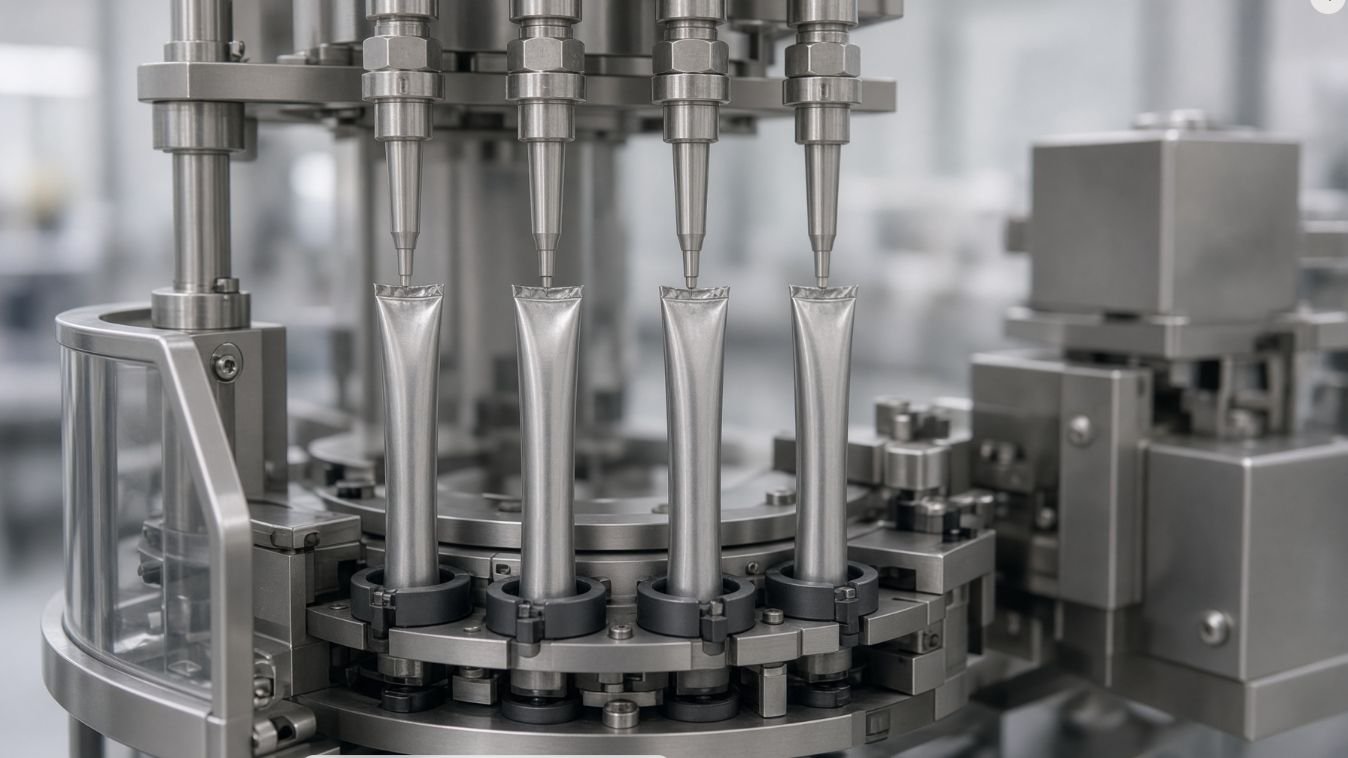
Use a planned design that challenges low, normal and high settings or other justified edges for fill quantity, speed, feed condition and product temperature. With actual ointment or a justified surrogate, measure each head across startup, steady state, hopper refill, planned stop, restart and batch end. Record product lot, tube lot, recipe, environment and sample sequence. Do not hide weak edge results in an overall mean.
Observe nozzle cut-off, stringing, smears on the tail, trapped air and tube damage. Measure the final tube under the approved method, not a convenient machine display alone. If weight is converted to volume, verify density assumptions for the actual product and temperature. Define the response when a head drifts or a nozzle needs adjustment during a batch.
Challenge missing tube, blocked nozzle, low feed, out-of-range dose, recipe mismatch and power or air interruptions. Confirm the affected-unit window, reject action and recovery condition. Record raw data, deviations and rationale for selected routine limits. The objective is a defensible process window, not simply a series of green check marks.
Validate Air Control and Cutoff Behavior
Direct answer: Air entrainment and tail contamination can compromise appearance, delivered content or sealing, so they need explicit tests.
Map where air can enter: bulk transfer, hopper refill, suction stroke, product recirculation and nozzle withdrawal. Compare product before and after transfer if the formulation is sensitive, and sample from each head across the line states most likely to change air content. A vacuum emulsifying or deaeration step upstream may help the bulk, but the filling path can reintroduce air if poorly managed.
For cutoff, evaluate nozzle position, withdrawal profile, back-suction or shutoff action, viscosity change and residual bead. Tail contamination may be intermittent and can vary with tube length or machine speed. Use photographed challenge samples and a defined inspection method; do not decide from one attractive tube produced at steady speed.
Tie observations to release-critical attributes only where the product risk assessment supports that link. An air bubble may be a cosmetic issue for one preparation and a dose or barrier issue for another. Set the acceptance criterion in the manufacturer's approved protocol and investigate whether upstream product behavior or machine mechanics is driving a failure.
Establish the Seal, Coding and Reject Window
Direct answer: A tube seal must be evaluated as a formed package feature under the actual material, product and line conditions.
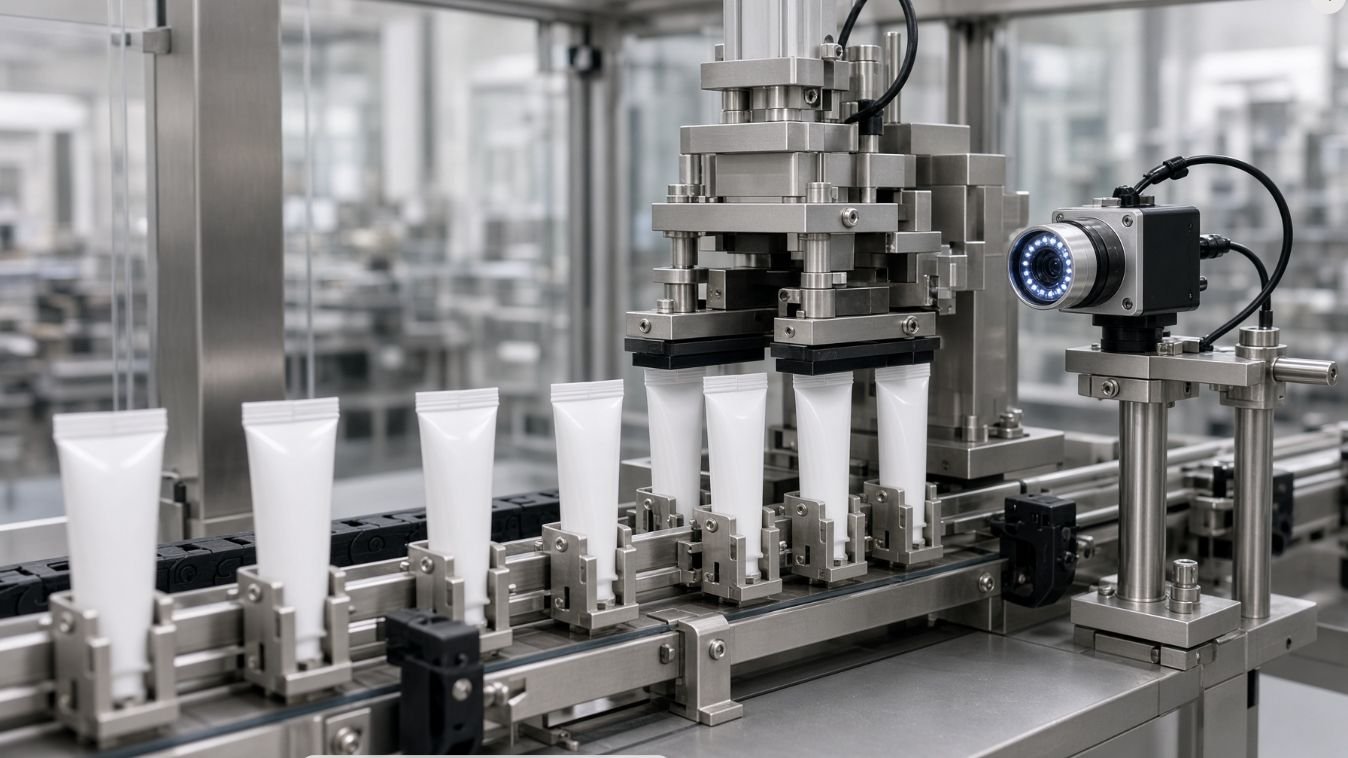
For aluminum tubes, examine fold count and geometry, deformation and tail cleanliness. For laminate or plastic tubes, examine the relevant heat or ultrasonic energy, pressure, dwell, alignment and cooling. The appropriate seal method may include visual inspection, physical strength or leak testing as justified for the product and package. A visually uniform tail alone does not prove the required barrier.
Challenge a meaningful matrix of tube-material lots, speeds, startups, restarts, seal-tool settings and worn or misaligned tooling where safe. Record results by lane or head. Determine how a contaminated tail, missing cap, unreadable code or defective seal is detected and removed, and what happens if inspection or reject confirmation fails.
Coding must match the approved batch and market requirements. Verify correct print content, position, legibility and rejection of wrong or missing codes. Do not assert a universal serialization requirement for every ointment tube. The general tube-seal process guide provides technology context, while the validation protocol owns the product-specific evidence.
| Failure mode | OQ challenge | Disposition evidence |
|---|---|---|
| Underfill or overfill | Head and operating-edge samples | Sample results and reject boundary |
| Weak or contaminated seal | Material and process-edge challenge | Seal test, image and investigation |
| Wrong or unreadable code | Known-defect print samples | Vision decision and reconciliation |
| Reject system failure | Blocked or unconfirmed ejector | Safe stop and affected-unit count |
Plan PQ Around the Real Commercial Process
Direct answer: PQ demonstrates that the integrated product, trained people, approved materials, machine and procedures perform at the site.
The site quality unit should approve a protocol with products and strengths, tube materials and sizes, batch size, operators, shift or time coverage, sampling points, test methods, acceptance criteria, deviations and report rules. Include startup, steady production, expected interventions and batch end. Sampling by head, lane and time can reveal drift that a single composite sample misses.
Distinguish equipment qualification from process performance qualification. A supplier FAT may show that a filler can dose and seal samples under agreed conditions. IQ verifies installation; OQ demonstrates the operating window and response to faults; PQ establishes the actual manufacturer's process with its ointment, tube, operators and quality controls. FDA guidance describes a lifecycle that continues into routine verification.
Avoid a universal promise that any fixed number of batches is sufficient. The extent of evidence follows product risk, process knowledge and the applicable regulatory strategy. Define how ongoing trends in fill, seals, rejects, alarms and maintenance will identify drift after initial qualification. If a major intervention occurs during PQ, document its impact rather than silently excluding the affected data.
Control Cleaning, Changeover and Requalification
Direct answer: A validated filling process includes the condition in which one product or tube format ends and the next begins.
List every product-contact path from bulk outlet through transfer hose, hopper, dosing chamber, valves and nozzle. Distinguish CIP, clean-out-of-place, manual and disposable components. The manufacturer establishes cleaning agents, residue or microbial limits, hold times and sampling sites. The supplier should prove access, drainage, disassembly and repeatable reassembly under the intended procedure.
A tube-size or material change may require new parts, seal tooling, code position and inspection recipe. A formulation change may alter viscosity, air behavior and cleaning. Record the exact validated envelope and make a risk-based assessment of the change. New settings outside it require appropriate testing before routine use; a saved recipe does not confer qualification.
Keep a change-control baseline of product, tube, tooling, machine version, process window, method and qualification result. Reassess after significant repairs or a changed component supplier. FDA's SUPAC-SS guidance is relevant to specified postapproval changes for nonsterile semisolid topical products; it is not a blanket rule for every sterile or ophthalmic ointment.
Prepare a Supplier and Protocol Checklist
Direct answer: A comparable supplier proposal should show how each risk becomes a testable machine function and an assigned evidence item.
Send product rheology and hold conditions, tube drawings and samples, fill range, intended speed, room and cleaning concept, approved CQA list and draft alarm philosophy. Ask for product-path and tube-handling drawings, change-part list, utility requirements, documentation package, calibration points, recipe permissions, inspection and reject logic, spares, service and commissioning scope. Require stated exclusions.
Agree FAT challenge pieces, actual or surrogate material, acceptance methods, raw-data output and deviation handling. Ask the supplier to show minimum and maximum formats and filling states, seal-tool adjustments, known-defect detection and reject confirmation. Identify which site tests remain open. A supplier's generic 'GMP ready' statement is not traceability from URS to test result.
Use a protocol checklist with columns for CQA, candidate CPP, rationale, range, method, sample, acceptance, test phase, owner and record location. During purchase review, compare suppliers on the ability to execute that evidence plan, not on a claimed performance percentage unsupported by representative product and tube trials.
Review an Ointment Tube Line with KING PACK
Direct answer: KING PACK can align tube-filler configuration and FAT challenges with the manufacturer's planned qualification scope.
KING PACK Machinery is a China-based manufacturer of pharmaceutical, veterinary, cosmetic and liquid filling and packaging equipment, with core solutions covering tube filling and sealing, vacuum emulsifying, liquid filling, pet spot-on filling and syringe production systems. The KING PACK tube filling equipment page shows the machine family; the pharmaceutical solutions page gives industry context.
For an ointment project, the joint review can cover product transfer, hopper and dosing design, air control, cutoff, tube handling, seal tooling, coding, rejects, cleaning and FAT evidence. KING PACK can propose testable machine functions and identify open data needs. Site QA remains responsible for CQA selection, acceptance criteria, qualification protocols and product release.
Send the ointment's measured process properties, tube specification and samples, fill range, target line states, cleaning limits and draft validation matrix through the KING PACK contact page. This enables a technical review before a quotation or protocol is finalized, without promising a universal process window.
Frequently Asked Questions
Can the supplier validate an ointment tube line alone?
The supplier can provide FAT, design and qualification support; the manufacturer must establish and approve the product-specific site process and validation conclusion.
Which tube-filling parameters may be critical?
Candidates include product feed and temperature, dose setting, nozzle cutoff, sealing energy or fold geometry, coding and reject settings. Criticality needs product-specific evidence.
Does a good-looking tube prove seal integrity?
No. Appearance is useful, but a justified package test must demonstrate the required seal performance.
How should OQ sample the machine?
Challenge justified operating edges and fault states, measuring each head or lane across startup, steady operation, restart and batch end.
Is FAT the same as PQ?
No. FAT checks agreed supplier functions; PQ demonstrates the approved product-and-package process at the site under its procedures.
Can one product qualify every tube size?
Only if a documented risk and bracketing rationale supports it and the relevant differences are tested. Do not assume automatic coverage.
When should requalification be considered?
Assess formulation, tube supplier or material, tooling, process-window, software, inspection and major repair changes against the validated baseline.
What inputs should KING PACK receive?
Send product properties, tube drawings and lots, fill range, approved quality limits, cleaning concept and the planned qualification matrix.