
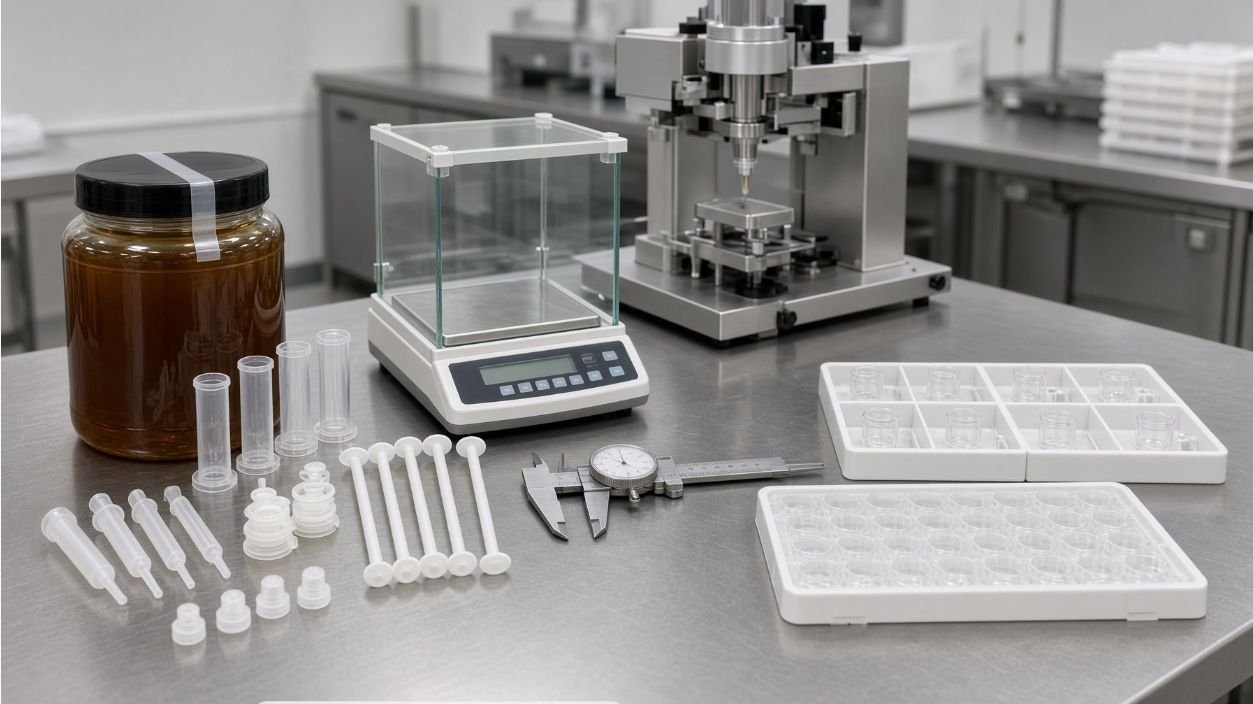
A gel bait syringe filling sample test answers one question: can this product, in this syringe, be filled to this dose at this output? That question cannot be answered from a description. It needs the actual paste, the actual syringe components, and a stated target. Buyers who send a screenshot of their product page and a fill weight usually receive a generic answer in return — not because the supplier is unwilling, but because there is nothing specific to test.
This checklist is written for the buyer’s side of that exchange. It covers what to identify about the product, what to send from the package, what targets to state, which defects the trial should investigate, and what records to expect so the trial result is usable in a purchasing decision. It deliberately stops at the trial: the factory acceptance test, which happens after the machine is built, is a different exercise with a different purpose.
What a Trial Is For — and What It Is Not
A sample trial is a feasibility and configuration step. It establishes that the product can be dosed and assembled into the package at all, that the proposed filling route suits the syringe, and that a configuration exists which produces an acceptable unit under defined conditions. Its output is engineering evidence: settings, measurements, photographs, and a list of unresolved questions.
A trial is not:
- A factory acceptance test. The FAT proves that the machine as built matches the agreed specification against the agreed protocol. A trial precedes the contract; a FAT follows the build.
- A production guarantee. A bench or pilot trial with a limited sample set does not predict long-run output, wear behaviour or spare-parts life.
- A substitute for the buyer’s own regulatory work. Package and label content requirements belong to the market where the product is sold, and the trial does not verify them.
Being clear about the boundary prevents the most common disappointment in this process: expecting a trial to produce acceptance numbers.
Start With the Product Identity
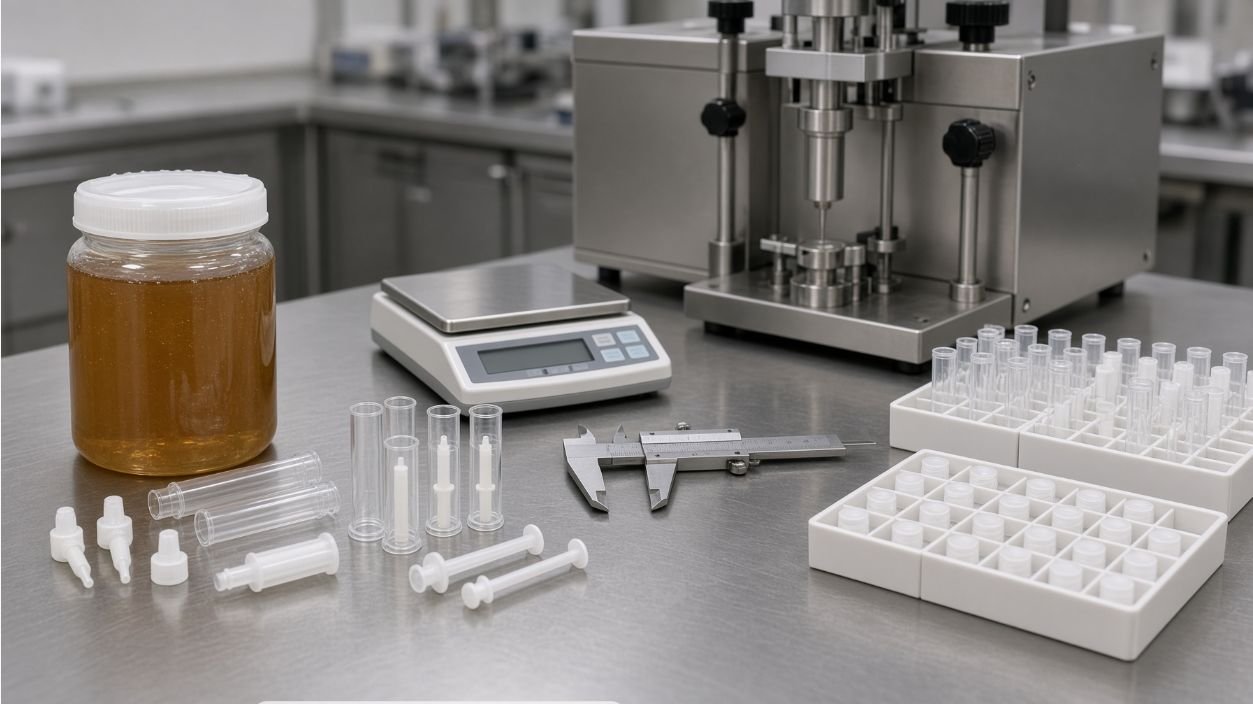
The material is the first input, and it is the one most often under-described. A supplier needs to know what is being pumped, in what state, and under what constraints.
Prepare the following before contacting anyone:
- Product identity and intended market. Product name or reference, the pest group it targets (for example, cockroach or ant gel bait), and the market it will be sold in. The market matters because package and label requirements differ by jurisdiction.
- Safety data sheet. A current SDS in the format required for the buyer’s own market. Where the workplace falls under US HazCom, the SDS is expected to follow the 16-section GHS-aligned format with the section headings in the prescribed order; the buyer should supply the SDS applicable to their own products and jurisdiction rather than a generic substitute.
- Technical data. Measured viscosity with the method and the temperature at which it was measured; filler or particle description; density; whether the product is shear-thinning or time-dependent; and any known handling limits such as maximum time or temperature in the bulk container.
- Storage and handling conditions. What the product expects before filling — ambient, chilled, temperature-restricted — and whether it is normally stirred, recirculated or left static in the bulk container.
- Restrictions. Anything the product must not be subjected to: temperature spikes, extended residence times, high shear, or contact with particular materials.
- Cleaning context. What the product is normally cleaned with, and whether other products share the intended line.
A note on occupational and product-safety documentation
Gel bait is a pesticide product in most markets. Two document streams are therefore relevant, and both are the buyer’s responsibility to provide rather than the supplier’s to invent:
- Worker-safety documentation covering the material being handled on the filling line — applicable in workplaces falling under the relevant occupational hazard-communication rules.
- Product registration and label documentation for the market where the filled syringe will be sold. Under the US FIFRA framework, for example, labeling is codified at 40 CFR Part 156 and must include elements such as net contents, the registration number, the ingredient statement, warning or precautionary statements and directions for use; advertising claims for a pesticide product must not contradict claims made in the product’s labeling. Some residential-use pesticides with a “danger” or “warning” signal word also fall under child-resistant packaging requirements (40 CFR Part 157). In the EU, biocidal products require authorisation under Regulation (EU) No 528/2012 before being made available, and labels must carry mandatory biocide-specific elements.
This article does not interpret those requirements for any specific product or market, and none of the statements above should be relied on as compliance advice. Confirm all labelling, packaging and registration obligations with a qualified regulatory professional for your target market. The purpose here is narrower: the filling trial should know whether the finished syringe must carry marking, whether a child-resistant closure is involved, and whether the closure type changes the assembly station in scope.
Send the Complete Package, Not a Representative One
Syringe components are interfaces. A barrel with the right nominal volume and a tip with the wrong bore are different problems, and a filling trial cannot see the difference unless it has the real parts.
| Component | What to send | Why the trial needs it |
| Barrel | Physical samples **and** dimensional drawing | Geometry, flange form and wall stiffness set the filling and support conditions |
| Piston | Samples in the state it is supplied (loose or pre-seated) | Determines whether piston insertion is a line station and what seal condition is achieved |
| Plunger rod | Samples if the finished unit carries one | Determines whether a rod assembly station is in scope |
| Tip / nozzle interface | Samples; state the fill route if already decided | Sets the restriction and the cut-off behaviour at the fill point |
| Cap / closure | Samples, including any child-resistant or special closure | Closure geometry drives the capping action, retention check and leak check |
| Finished reference unit | One or more commercial examples **if available** | Shows the target end state for the trial |
| Bulk supply format | Description of the container the material arrives in | Determines whether an upstream feed or transfer element is in scope |
Two practical points on this list. First, send samples in the same supply state the line will see them in — pre-assembled parts and loose parts are not the same starting point, and a trial run on the wrong state produces a result that cannot be used. Second, if a commercial reference unit is not available because the product is new, say so explicitly. A trial can work from components and a target, but the supplier needs to know that the end state is a specification rather than a sample to be copied.
Do not send a fixed, prescriptive number of samples as a default. The quantity required depends on how many test conditions will be run, the sampling plan, whether extended runs are included, and whether checks are destructive. Confirm the required sample quantity with the engineering team for your specific trial, based on the scope you agree.
State the Fill and Output Requirements
Requirements convert samples into a test plan. Vague requirements produce vague results.
- Target net content, in the unit the product is sold in. State the dose and the unit explicitly, and state whether the target is defined by mass or by volume. If the product is labelled by mass, the trial should verify by mass. Do not assume a mass target equals a volume setting.
- The tolerance the buyer intends to apply. State it, and state who sets it. This is the buyer’s decision, informed by the applicable market rules; the supplier runs the measurement.
- Good output target, not nominal speed. State the number of acceptable units required per shift or per hour, including realistic allowances. A nominal cycle rate is not an output.
- Format range. If more than one syringe size or dose will run on the line, list them all. Format range changes the dosing sizing decision.
- Batch and run structure. Typical batch size, number of formats per week, and changeover frequency. These influence how much of the trial should be spent on changeover checks.
- Environment assumptions. Available utilities, room conditions, and any constraints at the buyer’s site.
Define the Defects the Trial Should Investigate
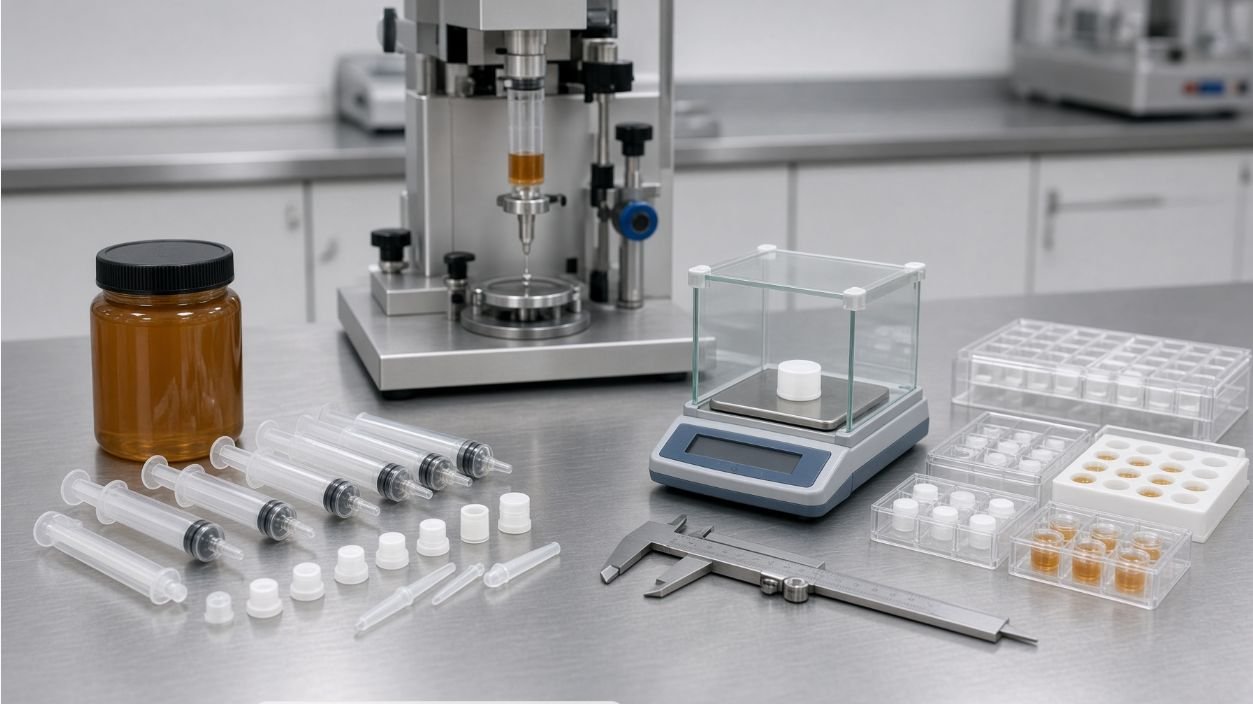
A trial without named defects drifts into a demonstration. Naming what you want investigated turns the session into evidence collection.
Typical gel bait defects worth naming, grouped by type:
| Defect group | Examples to name | What the trial should record |
| Dose | Short or over fill; drift within a run; first-unit deviation after a refill or restart | Measured values with sample numbers and time stamps |
| Material in the dose | Visible air pockets; voids under the piston; entrained air from the feed | Photographs of representative units, with the position of the void identified |
| Nozzle behaviour | Residue at the tip; stringing; dripping between cycles | Nozzle/exit images at defined intervals and after a stop |
| Assembly | Piston mis-seat or twisting; plunger rod not engaged; cap cross-threaded or not retained | Reject counts by cause and the station where each was seen |
| Package integrity | Barrel deformation; flange or tip damage; marking damage | Damage location and the stage at which it occurred |
| Process | Stops, restarts, manual interventions, alarms, cycle-time changes | Duration, cause, and whether the line recovered without operator action |
Buyers who bring photographs or video of an existing defect at this stage get more from the trial than buyers who describe it in the abstract. If you currently fill by hand and see a particular problem, bring the evidence.
Agree the Trial Records Before the Trial Runs
The value of a trial is in what it leaves behind. Agree in advance which records will be produced, in what format, and who signs them. A minimum set:
- Test protocol or trial plan, versioned and dated, covering settings, run duration, sampling plan and measurement method.
- Material and component references, with lot or batch identity for the paste and for each syringe component supplied.
- Measurement records — dose values, tolerances applied, the instrument used, and sampling frequency.
- Defect log — defect type, count, station, sample number, timestamp.
- Photographic record — the reference unit, the nozzle condition, and any defect observed.
- Unresolved questions and assumptions — the honest list of what the trial did not establish.
- Follow-up actions — what the supplier will confirm, what the buyer will supply, and by when.
That last block is the most useful part of the output for a purchase decision. A trial that establishes feasibility while clearly listing what remains unverified is more valuable than one that implies everything has been proven.
Common Risks and Mistakes
- Sending a description instead of a sample. Product photographs and a target gram figure do not constitute a trial input.
- Sending only the barrel. Piston, tip and closure geometry change the assembly scope; the trial cannot assess stations it has no parts for.
- Sending components in a different supply state than production. Pre-seated pistons and loose pistons lead to different line designs.
- Fixing a sample quantity by habit. Quantity follows from the trial scope and the sampling plan, which is why it should be confirmed with engineering rather than assumed.
- Mixing units. Confusing a mass target with a volume setting, or stating a dose without a unit, is a common cause of a trial that cannot be applied.
- Naming no defects. Without a defect list, the trial becomes a machine demonstration.
- Skipping the record agreement. If the record format was not agreed, the buyer leaves with impressions rather than data.
- Treating trial output as FAT acceptance criteria. A trial establishes feasibility; acceptance criteria belong in the FAT protocol, agreed separately.
- Assuming a trial transfers compliance. Package, label and registration obligations for the target market remain the buyer’s responsibility and remain unverified by a filling trial.
How King Pack Supports This Application
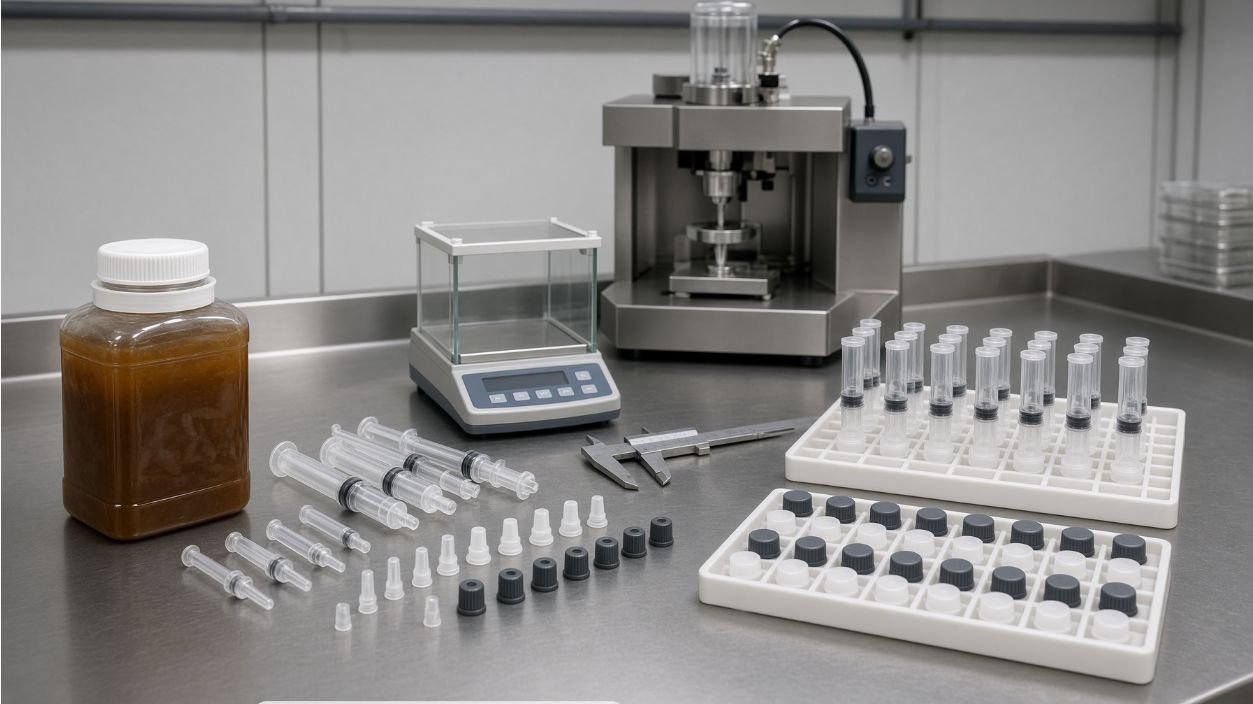
King Pack Machinery (Wuxi King-Pack / Wuxi Jingpai Machinery Co., Ltd., founded 2009, with a core technical and management team carrying more than 20 years of industry experience) handles syringe and applicator filling enquiries across pharmaceutical, veterinary, cosmetic, personal-care and high-value functional products. For a gel bait syringe trial enquiry, the relevant support is:
- Configuration developed against the supplied product and package. The trial is set up around the paste and syringe components the buyer provides, so the result describes the buyer’s product rather than a substitute material.
- A defined feasibility scope, stated up front. The buyer is told what the trial will and will not establish, so the output is used for the decision it can actually support.
- Assembly-scope clarity. Where piston insertion, plunger assembly, tip or closure stations are involved, the trial identifies which stations the buyer’s component supply state requires — this is where most of the hidden scope sits.
- Realistic production intent. The configuration aims at repeatable output with defined verification rather than a headline cycle rate.
- Documentation and follow-up. Trial records, agreed follow-up actions and technical documentation the buyer can use in an internal evaluation.
- Complete-line perspective. Where the project spans feed, dosing, assembly, inspection and end-of-line packaging, the interfaces are planned together with defined responsibility boundaries, and international component availability and spare-parts planning are considered from the start.
If your format is closer to a veterinary or applicator-type syringe, the existing application page describes how King Pack approaches syringe and applicator filling more broadly.
FAQ
Q1: What should I send before a gel bait syringe filling sample test?
Product documentation (SDS, viscosity with method and temperature, filler and density data), complete syringe components as physical samples plus drawings, the target net content and tolerance, the good-output requirement, the defects you want investigated, and a description of how the material arrives in bulk.
Q2: How many syringe samples do I need to send?
This is not a fixed number. It depends on the number of test conditions, the sampling plan, whether extended runs are included and whether any checks are destructive. Confirm the required quantity with the engineering team for your specific trial scope.
Q3: Is a sample trial the same as a FAT?
No. A trial establishes feasibility and informs configuration before the contract. A factory acceptance test verifies that the machine as built matches the agreed specification under an agreed protocol.
Q4: Can I get a quote without sending samples?
A price indication may be possible from requirements alone, but it will be based on assumptions rather than the product. A trial-based configuration produces a proposal that reflects the actual paste and package.
Q5: What if my product is new and I have no commercial reference unit?
Say so. The trial can work from components and a written target end state, but the supplier needs to know that the finished unit is a specification rather than an existing sample.
Q6: Do I need to disclose the formulation?
Not the formulation. You do need to disclose measurable behaviour: viscosity with method and temperature, filler content and particle size, density, and handling limits. These are process inputs, not trade secrets.
Q7: Should the trial include changeover between formats?
If multiple formats will share the line, include at least one changeover so that the required change parts and first-off checks are identified rather than assumed.
Q8: Whose responsibility are label and package compliance requirements?
The buyer’s. Under frameworks such as FIFRA in the United States and the Biocidal Products Regulation in the EU, labelling and packaging obligations sit with the registrant or authorisation holder. A filling trial does not verify them. Confirm all labelling, registration and packaging requirements with a qualified regulatory professional for your target market.
Q9: What is the most useful output of a trial?
The written record: settings, measured results, defect log, photographs, and the explicit list of what remains unverified. That list is what makes the trial usable in a purchasing decision.
Q10: Does a passed trial guarantee production performance?
No. It establishes feasibility under the conditions tested. Long-run output, wear behaviour and maintenance intervals are confirmed through further testing and the acceptance process.
Conclusion
A gel bait syringe filling sample test is only as specific as its inputs. Send the material with real measured properties, send the complete syringe component set in its production supply state, state the dose and output in unambiguous units, and name the defects you want investigated. Agree the record format before the trial runs so that what leaves the room is data. Do that, and the trial produces a configuration decision — not a hopeful impression.
Ready to arrange a feasibility trial? Send your product documentation, complete syringe samples and drawings, target net content and good-output requirement, and the defects you want the trial to investigate, and request a trial scope for your application.