
Last reviewed: August 28, 2026.
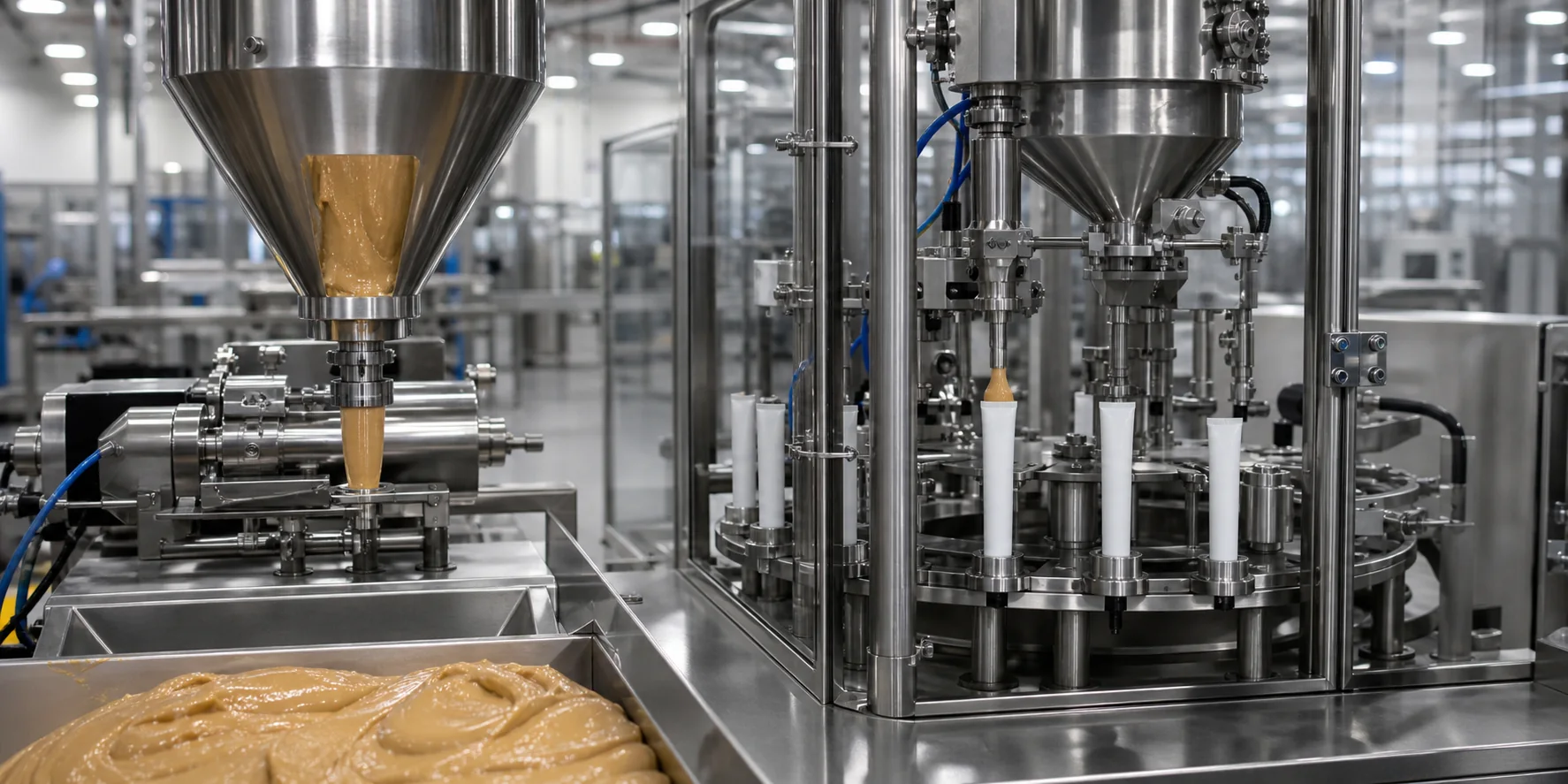
Pet nutritional paste tube defects rarely come from one isolated setting. Entrained air may begin in the mixer, an unvented transfer line can add another air pocket, a cold product can bridge in the hopper, and an oversized or badly timed nozzle can leave a string across the tube tail. Adjusting only the filler speed may hide one symptom while making another worse.
The practical solution is to treat mixing, deaeration, transfer, feed pressure, metering, nozzle cutoff, tube presentation and sealing as one product path. Teams should record the condition at each point, reproduce the defect under controlled conditions and change one justified variable at a time. The same method also prevents an equipment supplier from promising a generic fix before seeing the product and package.
This article is deliberately narrower than the existing high-viscosity tube filling equipment guide. It focuses on pet nutritional pastes, their animal-food or veterinary-product boundary, and a defect-to-test workflow for tube campaigns. It does not claim that every nutritional paste is a drug, sterile product or aseptic process.
Quick answer: Stop pet-paste tube filling defects by first defining the product category and acceptable limits, then stabilizing paste temperature and rheology, removing or preventing entrained air, maintaining a continuous low-pulsation feed to the metering system, matching nozzle bore and motion to the paste, and keeping the tube tail clean before sealing. Confirm the correction with start, middle, end, low-level and stop-restart samples using production-intent paste and tubes; do not rely on water or a thin substitute.
Start with a Defect Matrix, Not Random Adjustments
Direct answer: Classify the visible defect, record where it first appears and select a test that can separate product, feed, dosing, nozzle and sealing causes.
A tube with low net content can be caused by air inside the dose, incomplete pump filling, a slipping drive, inconsistent hopper pressure or an incorrect tare. A contaminated tail can result from nozzle stringing, tube bounce, overfill, splash during indexing or material squeezed upward when the package is handled. Those failure paths require different corrective actions.
Build the matrix from actual rejects. Photograph the tube before and after sealing, weigh it using an approved method, cut open selected units and note the bubble location, tail cleanliness and seal appearance. Record filling head, tube cavity, batch, product temperature, hopper level, line speed, stop duration and restart sequence. This creates evidence for a controlled trial instead of relying on operator memory.
FDA animal-food guidance emphasizes a product- and facility-specific hazard analysis rather than assuming that every example applies to every operation. Use the same disciplined logic for the equipment investigation: identify the condition, decide whether it affects safety, quality or process capability, and document the control that is actually needed.
| Observed symptom | Likely cause families | Separating check | First controlled action |
|---|---|---|---|
| Visible voids in dose | Air from mixing/transfer, nozzle air intake, incomplete pump charge | Cut-open pattern plus product-path inspection | Remove the air source before changing fill volume |
| Variable net content | Air, unstable feed, temperature drift, metering wear, tare error | Head-level trend with temperature and hopper level | Stabilize feed and verify measurement method |
| Long string after cutoff | Nozzle bore, paste elasticity, shutoff timing, weak suck-back | High-speed observation across justified temperature range | Adjust nozzle/cutoff as a matched system |
| Paste on tube tail | Stringing, splash, overfill, poor nozzle withdrawal, tube motion | Inspect tail before sealing and trace by station | Correct filling/handling before altering seal settings |
| Weak or leaking seal | Contaminated interface, wrong process window, tube/tool mismatch | Clean-tail challenge versus contaminated-tail sample | Separate contamination control from seal-window work |
Define Product Category, Rheology and Temperature Window
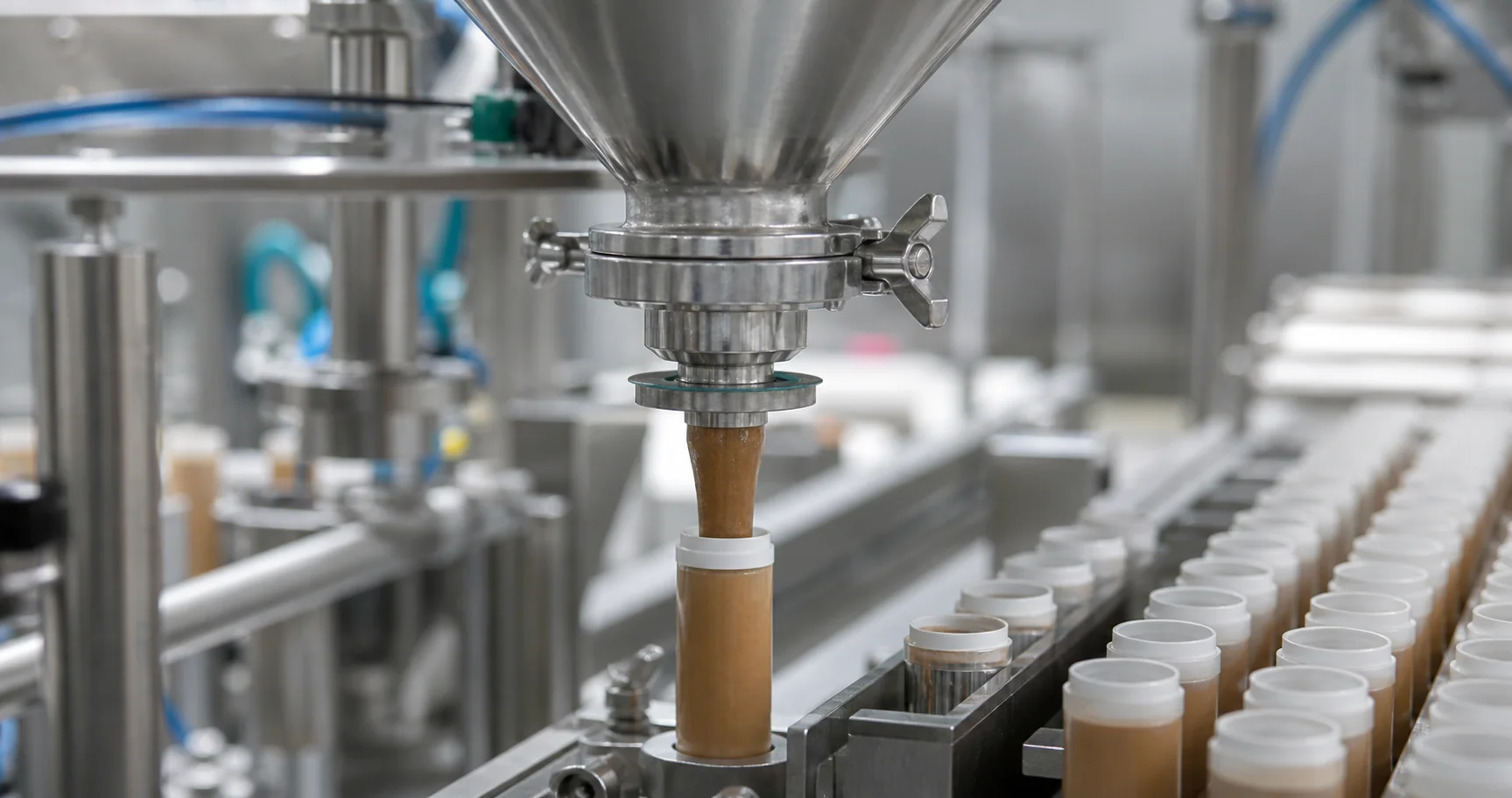
Direct answer: The filler should be specified from the finished paste at its actual processing temperature and regulatory category, not from the label 'nutritional gel' alone.
A pet paste may be animal food, a supplement-like product, a veterinary medicinal product or another category depending on composition, claims and destination market. The product owner must establish that classification because it drives hazard analysis, quality records, release testing and facility requirements. Equipment suppliers should design to the stated requirements but should not decide the product's legal status.
For an animal-food product in the United States, 21 CFR Part 507 Subpart B provides current good manufacturing practice requirements for personnel, sanitation, plant and equipment conditions. FDA CVM Guidance for Industry 245 explains hazard-analysis and preventive-control concepts and explicitly notes that not every hazard example applies to every animal food or facility. If the paste is a drug product, the applicable drug CGMP and market requirements must be assessed separately.
Describe rheology with the measurement method, spindle or geometry, shear history, temperature and time after manufacture. One viscosity number without a method is not a machine input. Record density, yield behavior, elasticity, tack, particle size where relevant, oil separation risk, maximum shear or temperature exposure, and the expected change during hold time.
Run the trial at the justified low, nominal and high filling temperatures. Warmer paste may flow more easily but could change stability, separation or stringing; colder paste may increase pressure and feed interruption. The acceptable window must come from product development and quality requirements, not from a generic filler recommendation.
Prevent Air Entrainment before the Paste Reaches the Filler
Direct answer: The most reliable way to control air pockets is to prevent or remove air during mixing and transfer rather than trying to compress it inside the dosing system.
Review powder addition, liquid charging, agitator position, homogenizer use, vacuum level, batch headspace and the endpoint for deaeration. High shear can be necessary during dispersion, but unnecessary late-stage shear or a vortex can pull air back into the product. Define when vacuum is applied, how foaming is controlled and how the endpoint is confirmed.
A vacuum mixer can help when the formulation and process support it, but the word vacuum does not prove that the finished paste is air-free. Verify product condition at the mixer outlet, after transfer and in the filler hopper. The KING PACK cream tube filling guide provides broader machine context; the pet-paste project still needs a formulation-specific deaeration and transfer trial.
On transfer, eliminate loose clamps, damaged gaskets, leaking pump seals and high points that trap air. Avoid running a positive-displacement pump dry or creating excessive suction at a restricted inlet. Prime the product path using a documented sequence and isolate the first units after priming or restart until the checks show stable condition.
Stop Hopper Bridging and Unstable Feed
Direct answer: A high-viscosity paste filler needs a continuous, predictable feed into the metering chamber; bridging, tunneling and pressure pulsation turn into dose variation and air intake.
Size and shape the hopper outlet around the product's actual flow behavior. A steep wall or agitator may help one paste and smear or separate another. Observe whether the material moves as a mass, forms a central channel, clings to the wall or leaves an air pocket above the pump inlet. A transparent trial hopper or safe inspection method can make the failure visible.
If assistance is required, compare gentle agitation, follower pressure, level control, jacket temperature and a short transfer pump. Define the operating range rather than a single setting. Excessive pressure can force paste past seals or alter cutoff behavior; insufficient pressure can starve the metering chamber. Keep the feed line short, supported, drainable where required and free of unnecessary restrictions.
Challenge the lowest planned hopper level because the line can perform well when full and become unstable near the end of the batch. Record dose results, inlet pressure where measured, air occurrence and product temperature. Define an end-of-batch cutoff or recovery rule instead of filling until the pump draws air.
Control Fill Variation at the Metering System
Direct answer: Metering repeatability depends on a fully charged product chamber, stable paste condition, suitable valves and seals, and a measurement method that distinguishes paste mass from trapped air.
A piston-based or other positive-displacement system can suit thick paste when the inlet, cylinder, valve passages and seals are sized and arranged for the product. The design should avoid pockets that retain air or product and allow disassembly or cleaning according to the user's procedure. Servo control can improve recipe repeatability, but it cannot compensate for an incompletely filled chamber.
Define whether acceptance is based on mass, volume or another product specification. Gravimetric checks can be useful, but tare variation, density and product temperature must be controlled when interpreting results. Do not copy an accuracy percentage from another veterinary gel article; set the limit from the approved product and process requirement, then demonstrate capability with the actual package and sampling plan.
Trend each filling head separately at startup, steady running, low hopper level, after a planned stop and at the end of the trial. If variability follows one head, inspect its valve, seals and drive. If all heads move together, investigate product temperature, feed pressure, air, batch condition or the measurement system.
Match Nozzle Bore, Motion and Suck-Back to the Paste
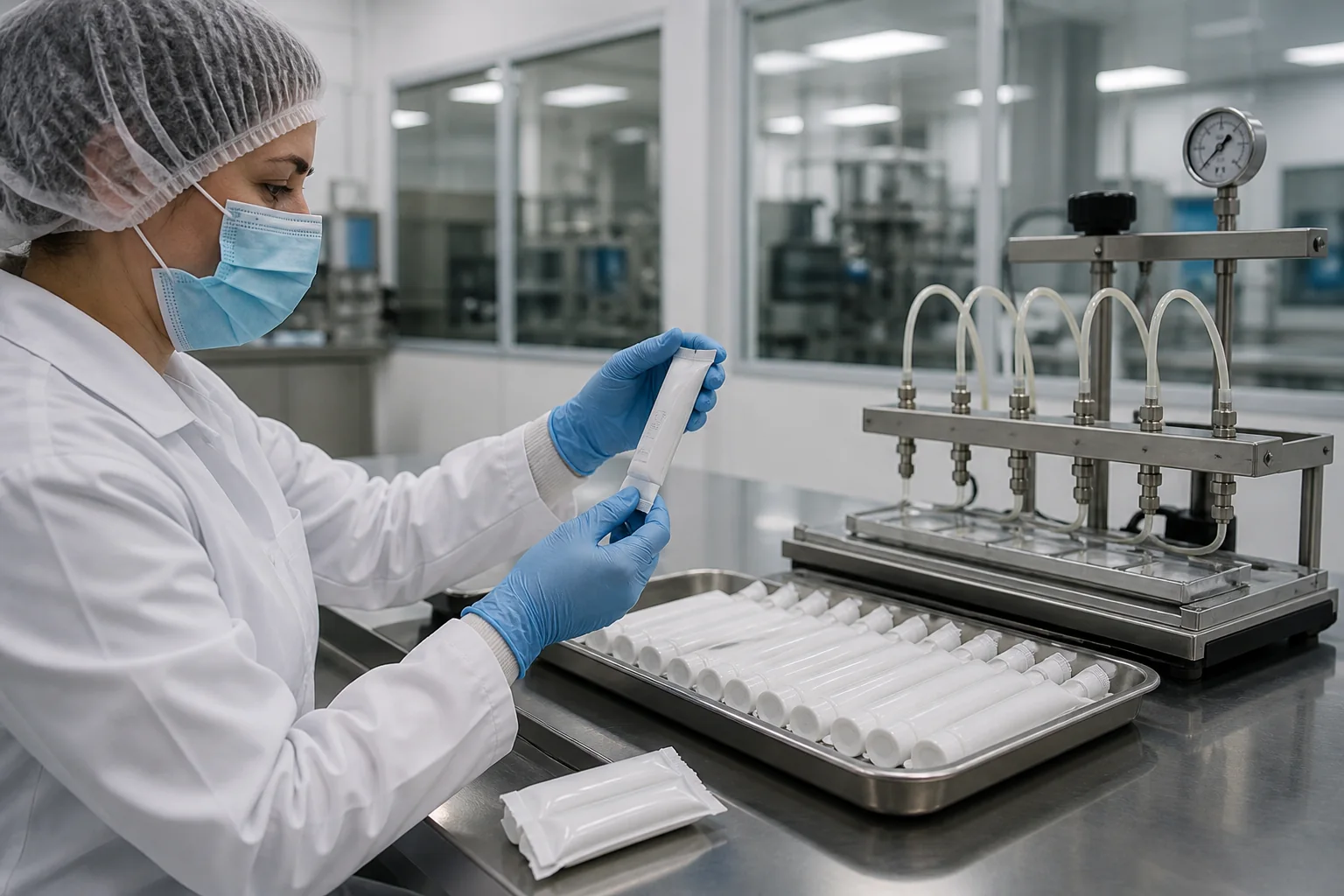
Direct answer: Stringing is controlled by the combined nozzle geometry, shutoff, vertical motion, paste elasticity, temperature and line timing, not by suck-back alone.
A larger passage can reduce pressure but may create a thick tail of product; a smaller passage can increase pressure and heating or prolong cutoff. A positive shutoff can reduce drip, while poorly tuned retraction can pull air into the nozzle or create a void at the next dose. The nozzle tip should not wipe product on the tube wall or rise so early that the stream stretches across the tail.
Use slow-motion video or a guarded observation method to watch the final part of the dose. Record the moment flow stops, the nozzle withdrawal profile, any filament break and tube index motion. Change one variable at a time within equipment and product limits. Confirm that an improvement at nominal temperature also holds at the approved boundaries.
The goal is a clean, repeatable cutoff with no air intake. A dramatic suck-back setting that hides the external string may create an internal bubble. Check both the nozzle and the cut-open filled tube before accepting the change.
Keep the Tube Tail Clean before Sealing
Direct answer: Inspect the tube tail immediately before sealing so the team can separate contamination caused by filling from defects caused by the sealing station.
Control fill height, nozzle centering, tube support, anti-drip timing and index acceleration. A tube that rocks after filling can move paste upward even when the nozzle cutoff is clean. Overfill or incorrect product displacement during handling can also push paste into the seal land.
For plastic or laminate tubes, develop the heat, pressure, dwell, alignment and cooling window with production-intent materials. For metal tubes, folding and crimping require their own tooling and checks. Do not treat a clean-fill defect as a temperature problem: raising heat may discolor or distort a tube while the contaminated interface still leaks.
Use coded samples that preserve the relationship between filling head, tube holder and sealing station. Compare clean empty-tube seals, deliberately controlled clean fills and naturally defective samples. Define the approved integrity method, visual criteria, trim condition and rejection response with the package owner.
Run a Representative Trial and FAT
Direct answer: A useful trial reproduces the paste, tube and worst justified operating conditions, while FAT converts those trials into traceable acceptance evidence.
- Provide production-intent paste or a justified simulant whose rheology, density, tack, air behavior and temperature sensitivity are documented.
- Supply tube drawings, material structure, dimensions, coding requirements, seal area and enough samples to run setup plus sustained challenges.
- Record batch age, product temperature, hopper level, filling head, tube station, line speed and all recipe changes for each sample group.
- Challenge startup, nominal running, low hopper level, planned stop, restart and end-of-batch recovery without silently discarding difficult conditions.
- Measure net content using the approved method and inspect cut-open doses, nozzle cutoff, tail cleanliness, seal appearance and package integrity.
- Demonstrate cleaning access, disassembly, drainage, recipe control, alarms, rejects, line clearance and format change using the agreed procedure.
- Document deviations, unstable settings and open items; acceptance should be based on the protocol, not on a short video of the best units.
How to Evaluate a Pet-Paste Tube Filling Supplier
Direct answer: Choose a supplier that can connect formulation and defect evidence to mixer, transfer, filler and sealer decisions and can prove the proposed configuration with representative samples.
- Ask for comparable references by rheology, tube material and defect type rather than by the word 'paste' alone.
- Review the proposed product path, hopper outlet, metering passages, nozzle shutoff, tube support and sealing station as one system.
- Request raw trial data by head and condition, including stop-restart and low-level results, not only average values.
- Verify drawings, material certificates, manuals, calibration evidence, spare-parts scope and qualification support required by the project.
- Check how the supplier will support cleaning trials, change parts, operator training, commissioning and defect troubleshooting after installation.
- Keep guarantees tied to defined paste, tube, environment, sampling and acceptance conditions; avoid unsupported universal output or accuracy claims.
How KING PACK Approaches Pet Nutritional Paste Projects
Direct answer: KING PACK starts with the paste, tube and observed defect, then configures preparation, feed, metering, cutoff and sealing around a representative sample trial.
KING PACK Machinery is a China-based manufacturer of pharmaceutical, veterinary, cosmetic and liquid filling and packaging equipment, with core solutions covering tube filling and sealing, vacuum emulsifying, liquid filling, pet spot-on filling and prefilled syringe production systems.
For a pet nutritional paste project, the technical scope may include vacuum mixing or deaeration, controlled transfer, a suitable hopper and feed method, positive-displacement dosing, tailored nozzle motion, tube positioning, heat sealing or folding, coding and inspection interfaces. The exact configuration depends on the product category, rheology, tube and cleaning requirements.
Review the KING PACK tube filling machine platform and the broader veterinary filling application page. To request a defect review and trial plan, send viscosity versus temperature, density, batch/hold information, tube drawings and samples, target fill, defect images, cleaning method and output through the KING PACK contact page.
Frequently Asked Questions
Why do air pockets keep returning after vacuum mixing?
Air can be reintroduced through a vortex, leaking transfer connection, dry-running pump, trapped high point or aggressive nozzle suck-back. Check the product at the mixer outlet, after transfer and at the filled tube to locate the first appearance.
Can I fix stringing by increasing suck-back?
Sometimes a modest change helps, but excessive suck-back can pull air into the nozzle and create a void in the next dose. Tune nozzle bore, shutoff, motion, temperature and suck-back together, then inspect both the cutoff and the internal dose.
Why does fill variation increase when the hopper is nearly empty?
Low level can reduce inlet pressure, expose a bridge or allow the pump to draw air. Challenge the minimum operating level and define an end-of-batch stop or recovery rule before instability begins.
Should pet nutritional paste be filled aseptically?
Not automatically. The required hygiene or aseptic controls depend on product classification, formulation, process, package, shelf-life strategy and market requirements. Do not call a line aseptic unless the complete system and validation support that claim.
Can water be used for the machine trial?
Water can verify basic motion but usually does not reproduce paste rheology, tack, air retention, pressure, cutoff or tail contamination. Use the product or a justified representative simulant for performance conclusions.
How do I know whether the seal or the filler causes a leak?
Inspect and code the tube tail before sealing. Compare clean-tail samples with naturally contaminated samples and clean empty-tube seals. This separates filling contamination, handling and sealing-window causes.
What data should be recorded during FAT?
Record product condition, temperature, hopper level, head and station identity, recipe, speed, stop duration, net-content result, air occurrence, cutoff, tail cleanliness and seal/integrity result for each sample group.
What should I send for a supplier trial?
Send product category, formulation-handling limits, viscosity method and temperature data, density, batch and hold conditions, target fill, tube drawings and samples, defect photos, cleaning method, output and acceptance criteria.