
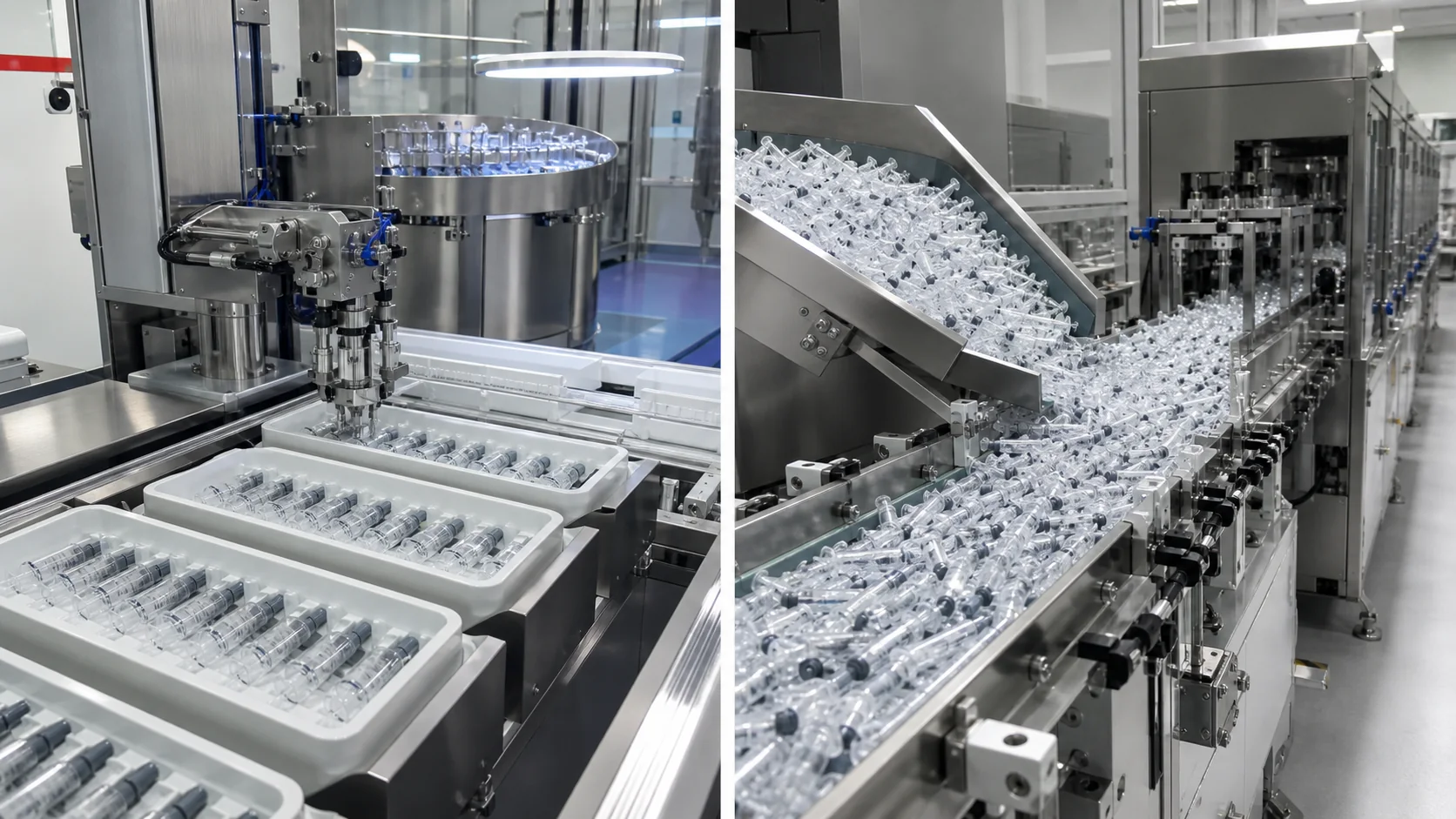
The first decision in a prefilled syringe filling project is not nominal speed. It is whether the line will receive sterilized, ready-to-use syringes in tubs and nests or process bulk barrels through washing, siliconization and depyrogenation before filling. That architecture changes the contamination-control strategy, room interfaces, utilities, validation scope, footprint and change parts.
Quick answer: nested processing usually suits multiproduct, clinical-to-commercial and moderate-output projects that value fewer container-handling steps. Bulk processing can be justified when very high volume, in-house container preparation or a tightly integrated upstream process outweighs the extra equipment and validation burden. The correct choice must be based on the actual syringe, nest count, batch profile and target output.
Decision table: nested or bulk?
| Decision factor | Nested ready-to-use syringes | Bulk syringe barrels |
|---|---|---|
| Incoming state | Sterilized subassemblies in tub and nest | Loose barrels requiring defined preparation |
| Upstream equipment | Debagging, tub opening and nest handling | Washing, siliconization, sterilization/depyrogenation and feeding may be required |
| Aseptic manipulations | Fewer container transfers before filling | More transfers and interfaces to qualify |
| Format change | Driven by tub, nest, barrel and stopper geometry | Driven by barrel feeding, transport and preparation tooling |
| Footprint/utilities | Usually lower | Usually higher |
| Best fit | Flexible portfolios and moderate scale | Stable, high-volume programs with justified upstream control |
How nested syringe processing works

Ready-to-use syringes arrive as sterilized subassemblies in a validated packaging system. ISO 11040-7:2024 specifically addresses packaging systems for sterilized subassembled syringes delivered ready for filling in tubs and nests. The filling line therefore begins with controlled removal of outer packaging, tub opening, liner removal where applicable, and transfer of the nest into the critical processing zone.
The advantage is not that risk disappears. It is that washing, siliconization and sterilization of the barrel are normally performed upstream by the component supplier. The project team must still qualify supplier controls, transport protection, package integrity, opening operations and every intervention around filling and stoppering.
Nested processing can use in-nest filling or denesting, depending on the equipment concept. In-nest handling limits glass-to-glass contact and preserves the supplier’s pitch. It also makes the tub and nest dimensions part of the machine specification. A proposal should list accepted nest counts, flange geometry, barrel sizes, stopper formats and the change parts required for each combination.
How bulk syringe processing works
Bulk processing begins with loose barrels. The complete route may include feeding, washing, siliconization, heat treatment or another validated preparation method, accumulation, filling and stoppering. The exact sequence depends on the barrel material and the manufacturer’s validated process; it must never be inferred from a generic line diagram.
This approach gives the manufacturer more direct control over container preparation and may support a stable, high-volume format. It also creates more product-contact and container-handling interfaces. Each transfer, buffer and preparation step needs defined acceptance criteria, cleaning or sterilization strategy, sampling and traceable records.
Handling and contamination-control implications
EU GMP Annex 1 requires a contamination control strategy and emphasizes reducing interventions in critical zones. FDA aseptic-processing guidance likewise notes that manipulation of sterilized components before and during aseptic assembly creates contamination risk and requires careful control. These principles do not prescribe nested or bulk architecture, but they make intervention count and open exposure important comparison inputs.
For a nested line, map debagging, tub opening, liner removal, nest transfer, filling and stoppering. For bulk, add every preparation and feeding operation. Classify planned and unplanned interventions, show how barriers support them, and confirm how rejected components leave without crossing clean material flow.
Filling and stoppering implications
The dosing system should be selected from product behavior, fill range, shear sensitivity, cleaning strategy and required control—not from the container presentation alone. Nested lines often use controlled vertical nozzle motion within fixed nest coordinates. Bulk lines may present barrels individually to a rotary or linear transport.
Stoppering is equally critical. Vacuum stoppering may reduce the need for an insertion tube and help control stopper placement, but the stopper, barrel, vacuum profile and product must be tested together. Define stopper-position criteria, acceptable residual headspace, reject logic and recovery after a brief stop.
Component presentation changes the machine interface
For a nested line, the machine must know where every syringe sits. Nest pitch, pocket tolerance, tub datum, missing-syringe condition and acceptable nest distortion all affect the handling recipe. The line also needs a defined response when a syringe is tilted, a flange is damaged, a nest is incomplete or a tub cannot be opened cleanly. A single out-of-position barrel can interfere with a nozzle or stopper tool and create an intervention in the critical zone.
Bulk processing replaces the nest-coordinate problem with orientation and singulation. Barrels must be separated without excessive contact, presented repeatably and transferred without damaging the flange, needle shield or tip closure. The design review should identify every guide, rail, star wheel and accumulation surface that touches the component. Ask how the machine detects a jam, how it clears one, and whether recovery can occur without exposing adjacent sterile units.
Product-contact path and dosing choice
Container presentation does not determine the best dosing technology. A low-viscosity solution, a shear-sensitive biologic and a suspension may require different product paths even when all three use the same syringe format. Compare pump principle, tubing or hard-pipe configuration, hold-up volume, priming loss, allowable shear, temperature control, cleaning method and single-use compatibility.
The RFQ should include minimum, nominal and maximum fill volumes as well as the smallest planned batch. A high-output system with a large manifold can waste an unacceptable share of a clinical batch during priming. Conversely, a very small product path may not support the sustained rate needed for a commercial campaign. Require the supplier to explain the assumptions behind the number of filling heads and the method used to keep head-to-head performance consistent.
Format range and change parts
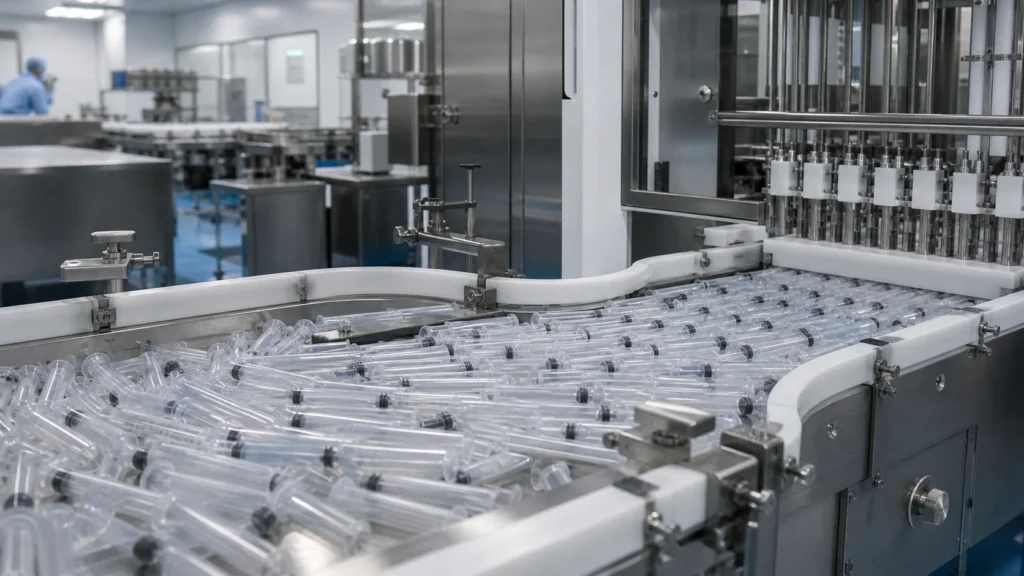
A claim that a line handles “multiple syringe sizes” is not enough. Build a format matrix with one row for every intended combination of barrel volume, material, flange style, tip system, nest count, tub, stopper and downstream device. Mark which parts are tool-less, which are recipe-controlled and which require mechanical replacement.
For nested processing, change parts may include tub locators, nest grippers, lift plates, nozzle arrays and stopper tooling. For bulk processing, add bowl or feeder parts, guides, timing components and preparation-line carriers. Confirm how change parts are identified, stored and verified before production. Where a wrong part could cause damage or a quality defect, consider keyed parts, barcode checks or recipe interlocks.
Changeover time should be measured from the last acceptable unit of one format to the first acceptable unit of the next, including clearance, cleaning, installation, recipe selection, verification and IPC approval. Quoting only the mechanical swap time understates the production impact.
Barrier system and line-layout impact
An isolator or restricted-access barrier system must be evaluated around the selected container route. Nested processing often concentrates operations at debagging, tub opening, nest transfer, filling and stoppering. Bulk processing adds upstream preparation and may require more interfaces between equipment with different environmental or thermal conditions.
During layout review, trace personnel, components, product, waste, tools and rejected units separately. Identify where gloves or robotic devices reach, where stopper replenishment occurs, how environmental-monitoring locations are protected and how a failed tub or jammed barrel exits. The shortest machine outline is not automatically the best cleanroom layout; maintenance access and intervention ergonomics can decide whether the barrier concept is operable.
Request dynamic airflow-visualization plans for representative operations and interventions. The team should know which motions will be studied, including tub opening, replenishment, sampling, jam recovery and line clearance. A supplier can support the study, but the site’s contamination-control strategy must own the rationale and acceptance process.
Validation workload and documentation
Compare architectures using a lifecycle document list: user requirements, risk assessment, design qualification inputs, component drawings, material certificates, software functions, alarm matrix, calibration list, FAT/SAT protocols, cleaning or sterilization evidence, media-fill support and performance qualification strategy.
Nested processing shifts important evidence to the RTU component and packaging supply chain. Bulk processing adds machine processes that the site must validate and maintain. Neither route is automatically easier; the burden sits in different places.
Capacity, footprint and total cost drivers
Do not compare filler nameplate speeds alone. Build a line model using good syringes per minute, nest loading/unloading time, stopper replenishment, IPC sampling, planned cleaning, format change, reject handling and downstream capacity. Include rooms, utilities, barrier equipment, component preparation and documentation effort.
Nested processing can reduce installed scope and accelerate changeover, while consumable and component economics may become more visible. Bulk processing can be efficient at sustained scale, but washing, preparation, utilities and extra qualification must be included in the investment case.
Use a line-capacity model, not one speed number
Calculate required net output from annual demand, campaign size, operating days, shifts, planned downtime and yield. Then compare that requirement with a station-by-station cycle model. For nested processing, include tub transfer, nest exchange and any indexing pauses. For bulk processing, include preparation throughput, accumulation limits and the slowest feeding or treatment step.
An illustrative model can use indexed assumptions without exposing confidential prices. Set one concept’s installed equipment cost to 100, then add site-specific indices for barrier scope, utilities, component preparation, validation labor and change parts. Apply the same categories to the other concept. The result shows which assumptions change the decision; it is not a quotation or a universal cost ratio.
Footprint should be measured as an operable envelope. Include open doors, glove access, maintenance withdrawals, component staging, transfer hatches, mobile equipment and safe aisles. Add the rooms and utilities needed for upstream preparation when comparing bulk processing. A smaller filler surrounded by extra support equipment is not a smaller project.
What to prove during trials and FAT
Use production-representative components and, when feasible, the actual product or a scientifically justified simulant. For nested processing, challenge tub and nest tolerances, incomplete nests, format recognition, transport stability and repeated starts. For bulk processing, challenge feeding, contact damage, accumulation recovery and upstream-to-filler balance.
The FAT protocol should record good-unit rate, rejects by reason, fill results by head, stopper-position results, alarm responses, recovery steps and recipe control. It should also verify that a rejected syringe cannot re-enter good product flow. Do not confuse a successful dry cycle with demonstrated process performance.
Before shipment, close the interface list: component specifications, material certificates, electrical and utility drawings, data points, calibration status, spare parts, change-part list, software backup, manuals and open deviations. Any site-only test should have an owner and acceptance criterion rather than being deferred as a vague SAT activity.
A practical architecture decision sequence
First, freeze the primary-container strategy with packaging, device, quality and manufacturing stakeholders. Confirm whether the intended syringe can be sourced in a qualified RTU configuration and whether the tub-and-nest presentation supports the required batch scale. If bulk preparation is being considered, document the business and technical reason instead of treating it as a default inherited from vial processing.
Second, create two boundary diagrams. The nested diagram should begin at receipt of packaged tubs and end at the agreed discharge condition. The bulk diagram should include every preparation and transfer operation, the utilities and environmental boundary of each step, and the point at which the barrel becomes ready for filling. Put inspection, reject and data handoffs on both diagrams.
Third, score each concept against weighted project criteria: patient and product risk, contamination-control complexity, component availability, smallest economical batch, maximum demand, format mix, footprint, utilities, operator interventions, cleaning, validation resources and expansion plan. Agree the weights before supplier quotations are opened; otherwise headline price or speed can quietly dominate the decision.
Finally, convert the selected concept into a user requirement specification. A decision is not complete until the assumptions appear in enforceable inputs: container drawings and tolerances, format list, output basis, barrier interfaces, good-unit definition, reject philosophy, data requirements, changeover target and test responsibilities. This prevents the procurement team from receiving technically different proposals that look comparable on a summary sheet.
The architecture should also be revisited when the product portfolio changes. Adding a new polymer syringe, a larger barrel, a different nest count or a much smaller campaign can change the preferred handling concept. Preserve the original scoring model so lifecycle decisions can be explained with evidence instead of restarting from supplier claims.
RFQ checklist
- Provide syringe drawings, material, flange style, fill range and stopper specification.
- State whether components arrive RTU in tubs/nests or as bulk barrels.
- List nest counts, tub dimensions and annual format mix.
- Define batch sizes, target net output and changeover frequency.
- Describe barrier concept, room interfaces and allowed interventions.
- Define fill, stopper-position and reject acceptance criteria.
- Request a complete line boundary, utility list and validation deliverables.
- Run product and component trials before freezing the design.
King Pack can review the format data and compare nested handling with a broader prefilled syringe filling machine concept. For projects centered on tubs and nests, see the robotic tub and nest handling guide. Share the syringe format, nest count, fill range and target output to receive a line recommendation through our pharmaceutical equipment page.
Frequently asked questions
Are nested syringes always the safer option?
No. They reduce upstream handling on the filling site, but package opening, transfer, filling and stoppering still require a validated contamination-control strategy.
When is bulk processing justified?
It is most credible when volume is high and stable, the site needs direct control of container preparation, and the added equipment and validation are supported by the business case.
Can one machine run different nest counts?
Sometimes, but each tub, nest, barrel and stopper combination must be checked for coordinates, tooling, transport stability and recipe control.
Does RTU mean no incoming inspection?
No. Supplier qualification, incoming controls, packaging integrity and defined handling conditions remain necessary.
What should be tested before purchase?
Test representative syringes, stoppers and product or a justified simulant at minimum and maximum fill volumes, including starts, stops and worst-case operating conditions.