
Last reviewed: August 31, 2026.
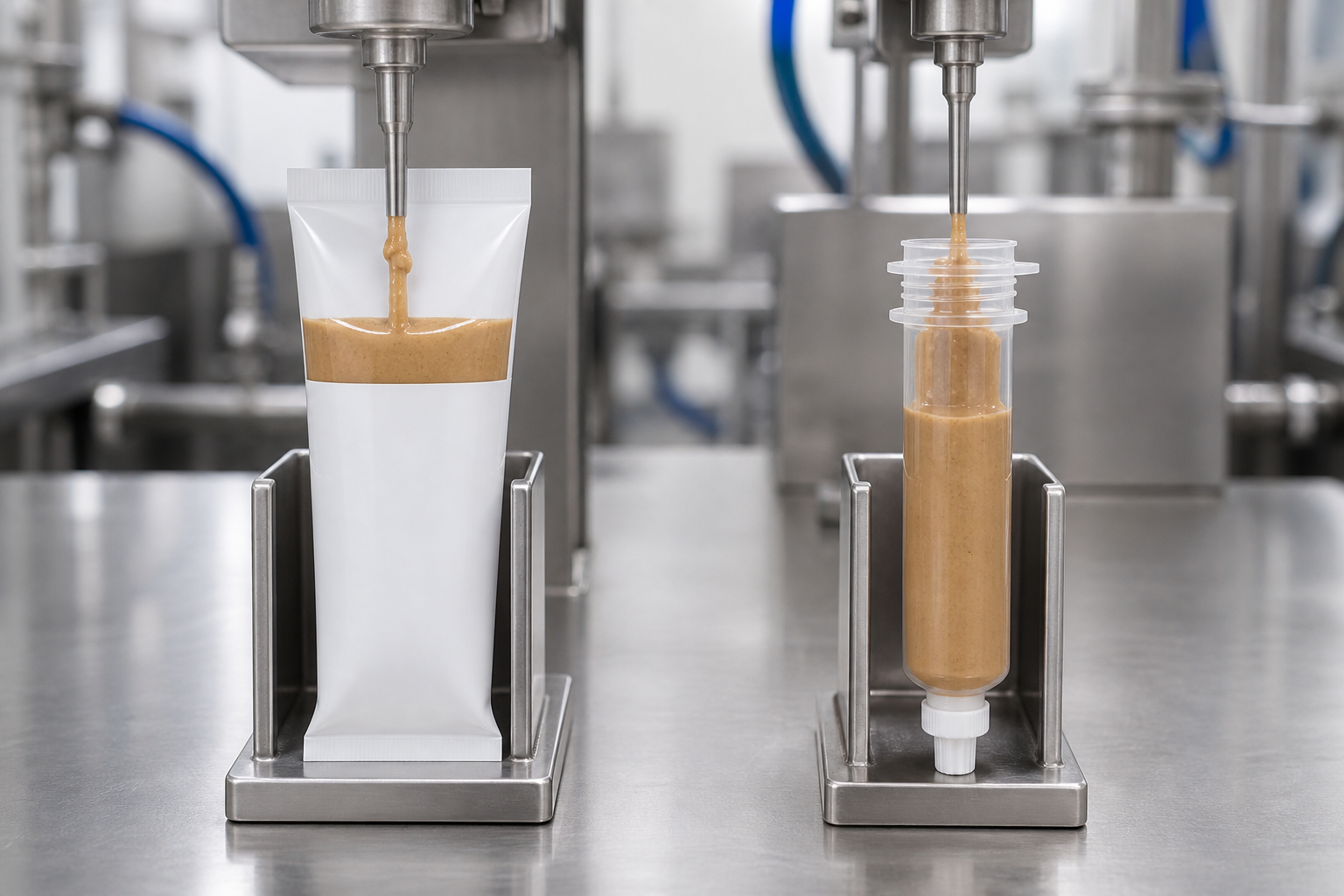
A tube and a dosing syringe can hold the same pet paste but create different products for the owner, the filling line and quality control. A tube is usually a collapsible reservoir that supports repeated dispensing or single-use formats through a sealed end. A dosing syringe combines a barrel, plunger and outlet closure and can make indexed delivery more intuitive, but the claimed dose depends on the complete package, product rheology, markings and instructions.
The choice should be made from dose architecture, administration steps, total pack volume, product residue, barrier and compatibility needs, filling behavior, closure process, inspection, changeover and total cost per usable dose. Selecting only from the nominal container price can create higher product loss, more components, longer changeover or a package that users cannot empty consistently.
This page compares oral or nutritional pet-paste packaging. It does not repeat the existing spot-on pipette-versus-applicator-tube comparison, which concerns a different route and package function. It also does not assume a veterinary dosing syringe is a sterile injectable prefilled syringe.
Quick answer: Choose a tube when the product is dispensed as a bead or portion, barrier and seal options fit the formulation, and simple repeated use or compact packaging is more important than indexed plunger delivery. Choose a dosing syringe when the owner must deliver a defined portion through a barrel-and-plunger interface and the product can be filled, closed and advanced without excessive air, leakage or plunger-force variation. Confirm the decision with dose definition, total pack volume, viscosity and temperature data, component drawings, user-administration studies, compatibility evidence and sample filling tests.
Start with Dose Architecture and Administration
Direct answer: Define what one dose means, how many doses are in the pack and exactly how the owner identifies and delivers each dose before comparing equipment.
Separate the prescribed or labeled dose from the machine fill quantity. The filler places a total mass or volume into the package; the owner may deliver all of it, a marked fraction or an approximate bead. For a multidose product, define the number of intended administrations, acceptable residual product, storage between uses, outlet cleaning and how the package is closed again.
A dosing syringe may use graduations, a ring, a stop, a dial or another indexing feature, but a marking does not by itself prove delivered-dose performance. Plunger force, paste compressibility, trapped air, barrel friction, outlet geometry and user technique can change what leaves the package. A tube may rely on length of ribbon, weight, spoon or another instruction, which creates a different verification problem.
Create a use sequence for each candidate: open, prepare, position, dispense, confirm the amount, close, store and repeat. Identify foreseeable mistakes such as removing the wrong cap, skipping a stop adjustment, contaminating the outlet, losing a small closure or squeezing from the middle of a tube. The product owner should validate instructions and administration with representative users and the final package.
Compare the Two Packaging and Filling Processes
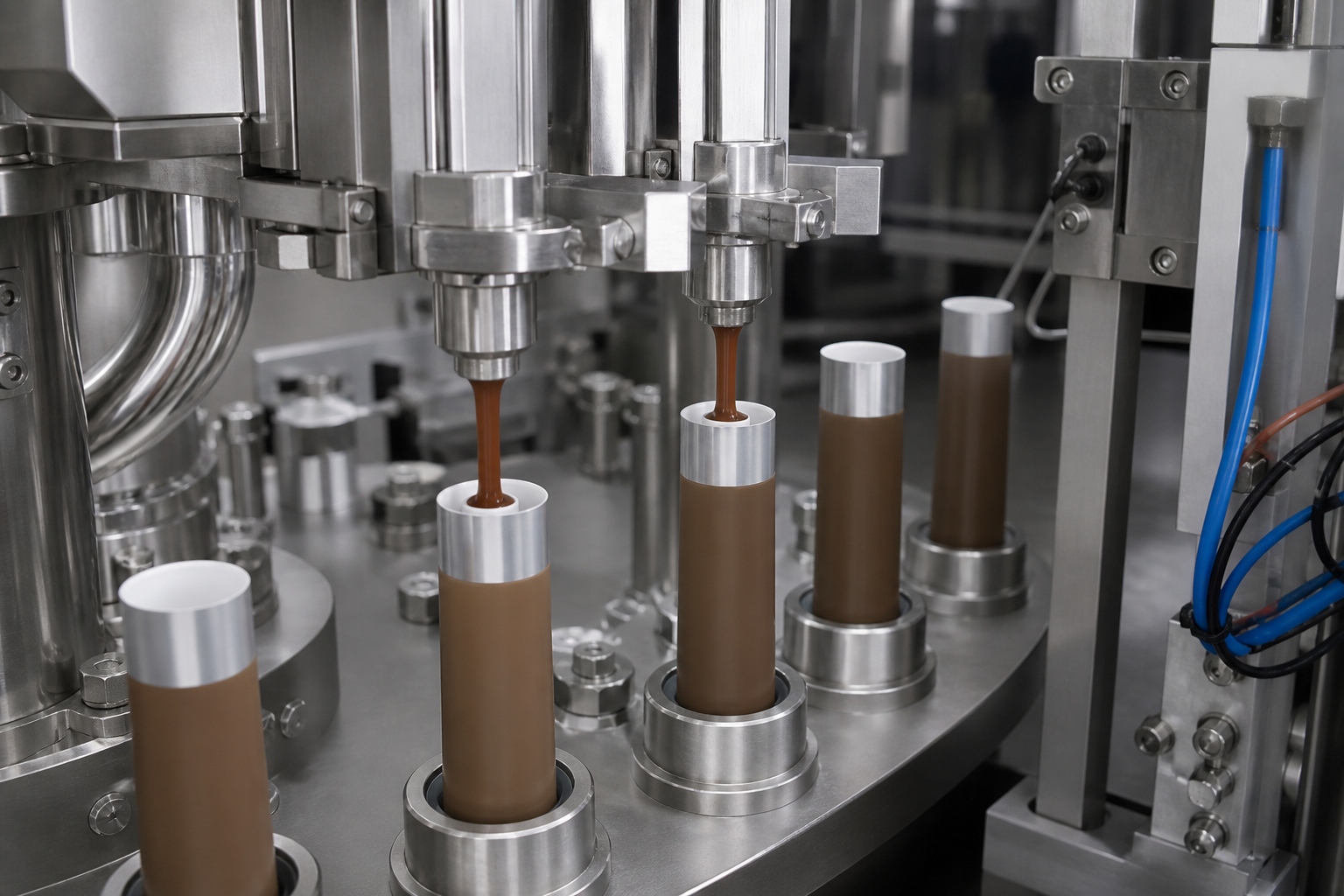
Direct answer: A tube line fills through the open tail and then seals or folds it; a dosing-syringe line fills a barrel and adds or positions the plunger and outlet closure in a controlled sequence.
For plastic or laminate tubes, the typical sequence is tube feeding, orientation where printing matters, filling from the open end, tail-zone cleaning or protection, heat sealing, coding or trimming and inspection. Aluminum tubes normally use folding or crimping rather than thermoplastic heat sealing. The process must match the tube construction and supplier specification.
For dosing syringes, the sequence depends on the component design. It can include barrel feeding, tip-cap or outlet-closure placement, filling, plunger or piston insertion, rod or dosing-stop assembly, marking inspection and secondary packaging. Filling direction and assembly order influence trapped air, product on sealing surfaces and residual volume.
The component count is often higher for a dosing syringe, while a tube may need stronger tail-seal development and print orientation. Both formats need controlled product cutoff, correct component presence, package protection and traceable rejection. Neither format is automatically simpler without the actual design.
| Decision factor | Tube | Dosing syringe | What the buyer must prove |
|---|---|---|---|
| User dose | Often bead, portion or full pack; may need an external measure | Can support indexed plunger delivery | Delivered-dose method and user study |
| Filling access | Open tail with seal zone above product | Barrel and outlet geometry constrain nozzle and assembly | Cutoff, air and wet-surface trials |
| Closure | Heat seal for plastic/laminate; fold/crimp for aluminum | Tip closure plus plunger/piston and other parts | Integrity and opening/reclosing evidence |
| Residue | Depends on tube shape, shoulder, viscosity and squeezing method | Depends on barrel, piston, outlet and plunger travel | Usable-dose and residual-mass study |
| Changeover | Tube holder, guides, orientation, fill nozzle and sealing tooling | Barrel handling, nozzle, piston/plunger, closure and feeder tooling | Format matrix and timed trial |
| Cost basis | Container, print, seal, secondary pack, filling loss | Multiple components, assembly, marking, secondary pack | Cost per released and usable dose |
Match Paste Rheology to the Filling Method
Direct answer: Both formats require the paste to reach the nozzle in a repeatable state and stop cleanly; measure rheology and temperature rather than using a single viscosity label.
Provide viscosity or rheology data with method, spindle or geometry, shear rate where applicable and temperature. Record yield behavior, thixotropic recovery, air sensitivity, particle size, density, temperature dependence and the time the product may remain in a hopper or hose. Two products described as high viscosity can behave very differently under pumping and cutoff.
A positive-displacement filling concept is a common candidate, but the final pump, valve and nozzle depend on product and dose. A wide tube tail can provide more nozzle access, while a syringe barrel or tip design may demand a slimmer nozzle and carefully controlled insertion. High pressure can warm the product, flex components or intensify stringing.
Control stringing through product condition, nozzle bore, positive shutoff, nozzle motion and carefully developed suck-back when appropriate. Excess suck-back can draw air into the dose. Any anti-stringing change must be checked for fill quantity, trapped air, package wetting and cleanability.
Control Air, Product Residue and Usable Dose
Direct answer: Evaluate the product the owner can actually dispense, not only the quantity placed into the package.
Air can enter during mixing, transfer, hopper replenishment or filling. In a tube, air may create an inconsistent first squeeze or interrupt a bead. In a syringe, a visible or compressible air pocket can change plunger travel and perceived dose. Use upstream deaeration or controlled filling only when formulation trials support it.
Measure initial fill mass, delivered mass over the labeled use pattern and residual mass after the package is considered empty. Record conditioning time, temperature, administration speed and operator or test fixture. A package with more nominal product can still provide less usable product if the outlet, shoulder, barrel or piston traps residue.
Residue also drives total cost and cleaning of the consumer interface. Compare overfill needed to meet the usable-dose claim, product left in rejected packages, line hold-up and startup waste. These factors may outweigh a small difference in empty-component price for a high-value formulation.
Evaluate Tube Barrier, Sealing and Inspection
Direct answer: A tube candidate must protect the formulation, run through the holder and form a repeatable tail closure without product in the seal zone.
Compare plastic, laminate and aluminum tubes using compatibility and stability evidence, moisture or oxygen protection where relevant, light protection, print and code needs, deformation, opening performance and recyclability obligations. The shoulder, outlet and cap are part of the container-closure system, not accessories outside the review.
The KING PACK tube filling and sealing platform covers plastic, laminate and aluminum-tube process families. For a project specification, provide the tube drawing, material structure, diameter and length range, registration mark, cap, tail allowance and supplier sealing recommendations. Use production-intent samples for trials.
Inspect relevant failure modes: missing or misoriented tube, incorrect fill, product in the seal zone, weak or distorted seal, poor crimp, tail code, trim, cap and cosmetic damage. The product owner must define the integrity test and acceptance criteria that connect the closure to storage and use conditions.
Evaluate Dosing-Syringe Components and Closure
Direct answer: Treat the barrel, piston or plunger, rod, outlet closure, dose-control feature and markings as one functional delivery package.
Freeze drawings, material specifications, dimensional tolerances, lubrication status if any, barrel markings, outlet geometry, piston position and assembly sequence. Determine which components arrive assembled and which the line must feed. A change in barrel supplier or elastomer can affect friction, sealing, fill access and residue.
The KING PACK syringe filling machine page provides the equipment-family context. For oral pet paste, the project should explicitly distinguish nonsterile dosing syringes from injectable prefilled syringes and avoid adding sterile-processing features that are not justified by product classification.
Inspect missing or damaged closures, piston position, leakage, trapped air, marking presence, plunger assembly and any dose-stop feature. Measure force and delivered-dose behavior using a method that represents the marketed package. Machine assembly success is necessary but does not validate owner administration.
Plan Change Parts, Cleaning and Cross-Format Flexibility
Direct answer: A dual-format strategy needs separate product-contact, handling, closure and inspection changeover maps; sharing one filler does not eliminate format tooling.
For tubes, list holders, infeed guides, orientation sensors, nozzle, sealing or folding tooling, trimming and coding parts. For syringes, list barrel guides or nests, nozzle, piston or plunger tooling, closure feeders, insertion parts and inspection recipes. Label parts and prevent installation of an incorrect set.
The product-contact path may be shared if compatibility, cleaning and validation support it. The handling and closure systems are usually format-specific. A line advertised as flexible should be reviewed station by station, including how unused modules are bypassed or protected and how control recipes prevent the wrong sequence.
Time a complete changeover during the sample or FAT program: removal, cleaning, inspection, assembly, recipe selection, sensor and feeder setup, first-piece checks and the first acceptable run. A quoted mechanical change time that excludes cleaning and quality release is not the operational downtime.
Compare Inspection and Quality Evidence
Direct answer: Define defects from the product and package risk assessment, then specify the sensor, test, sampling and reject response for each format.
Both lines may need container presence, fill verification, closure presence, code or marking checks and controlled rejection. Tubes add orientation and tail-closure concerns; syringes add piston/plunger position, outlet closure and dose-feature concerns. Not every defect is detectable online, so incoming component control and offline testing remain important.
FDA’s container-closure guidance for human drugs says suitability should be based on scientific principles and data for the specific formulation, dosage form and route. Although its scope is human drugs, the framework of protection, safety, compatibility and performance is useful for structuring veterinary package questions when clearly qualified.
If U.S. finished-drug CGMP applies, 21 CFR 211.94 addresses container and closure suitability and protection, while sections 211.110 and 211.165 address in-process control and testing. The manufacturer must confirm the applicable veterinary product and market requirements and write product-specific acceptance criteria.
Calculate Total Cost per Released and Usable Dose
Direct answer: Compare total packaging and operating cost after rejects, overfill, residue, changeover, labor and secondary packaging—not just the empty container price.
Build a cost model with component set, print or label, closure parts, secondary packaging, incoming inspection, filling loss, overfill, rejects, labor, utilities, tooling, maintenance and spare parts. Add the cost of product remaining in the package after normal use and the cost of batches or lots delayed by closure or component investigations.
Use a common annual volume and product value, then compare low, expected and high loss scenarios. Keep assumptions visible. Avoid claiming a format is cheaper without actual quotations, component count, product value, line concept and changeover frequency.
Capacity should be based on released units per shift after planned cleaning and changeover, not maximum mechanical speed. A slower format with lower loss and simpler validation may have a lower cost per usable dose; a higher-component syringe may still be justified when administration precision drives product value.
| Cost driver | Data needed | Tube sensitivity | Syringe sensitivity |
|---|---|---|---|
| Package components | Quoted parts, printing, closures and order quantity | Tube, cap, label/carton | Barrel, piston, rod, tip closure, stop and carton |
| Product loss | Startup, line hold-up, rejects, overfill and residual dose | Seal-zone rejects and shoulder/tail residue | Barrel/outlet residue and assembly rejects |
| Changeover | Formats, frequency, cleaning and release time | Holder and seal-tool changes | Multiple feeders and assembly-tool changes |
| Quality control | Online checks, offline tests and sampling | Seal and code verification | Closure, position, force and marking verification |
| Secondary packaging | Instructions, protection and tamper evidence | Folding/cartoning arrangement | Plunger protection and component retention |
Run a Two-Format Sample-Test Program
Direct answer: Use the same representative paste and decision criteria to test both packages under normal and boundary conditions.
FAT should reproduce the agreed product and package risks, but it cannot prove shelf-life compatibility or user performance by itself. Carry those studies in the product-development and validation plan. When a simulant is used, document which rheology, surface and cleaning properties it represents and which conclusions remain open.
- Freeze the dose definition, total fill, use sequence and package drawings for both candidates.
- Condition representative paste at justified low, nominal and high processing temperatures or rheology states.
- Fill production-intent components and record pressure, cutoff, air, wetting, fill quantity and reject observations.
- Complete tube sealing or syringe closure and assembly with proposed production settings.
- Test package integrity, opening, reclosing where applicable, delivered dose, residual product and user-critical functions.
- Challenge startup, stop/restart, low hopper level, component variation and planned changeover.
- Compare product loss, released output, changeover effort, inspection burden and cost assumptions.
- Document unresolved risks and assign product, packaging, equipment and quality owners before final selection.
How to Evaluate a Tube or Syringe Filling Supplier
Direct answer: Choose a supplier that can test the actual paste and components, explain each product-contact and handling choice and provide separate acceptance evidence for both formats.
- Share rheology, temperature, air sensitivity, dose, total fill and cleaning data before quotation.
- Ask for comparable applications, then compare product and package differences rather than accepting a generic reference.
- Review product-path drawings, component flow, closure sequence, inspection, reject logic and line balance.
- Require production-intent sample trials with recorded method, settings, observations and acceptance criteria.
- Review format tooling, changeover method, spare parts, manuals, calibration and IQ/OQ support.
- Confirm FAT/SAT responsibilities, commissioning, training and after-sales capability for the destination site.
- Verify the exact scope of CE, ISO or other documentation; certificates do not prove delivered-dose or product-package compatibility.
How KING PACK Supports the Format Decision
Direct answer: KING PACK can compare tube and oral dosing-syringe line concepts using the same product, dose, component and annual-demand inputs before the buyer freezes a packaging path.
KING PACK Machinery is a China-based manufacturer of pharmaceutical, veterinary, cosmetic and liquid filling and packaging equipment, with core solutions covering tube filling and sealing, vacuum emulsifying, liquid filling, pet spot-on filling and prefilled syringe production systems.
A complete pet-paste project can also include upstream preparation and deaeration where justified. The KING PACK emulsifying and mixing equipment page provides that upstream context, but the need for vacuum, homogenization or a particular transfer method must come from the formulation and sample tests.
Send the dose definition, total pack volume, rheology and temperature data, annual volume, tube and syringe drawings, representative samples, cleaning expectations and target output through the KING PACK contact page. KING PACK can prepare separate product-path, tooling, inspection, FAT and cost-driver checklists for the two options.
Frequently Asked Questions
Is a dosing syringe always more accurate than a tube?
No. It can support indexed administration, but delivered-dose performance depends on the complete package, markings or stops, paste behavior, trapped air, plunger force, outlet geometry and user technique. Test the final marketed system.
Which format is better for a single-use pet paste?
Either may work. Compare the intended administration, package protection, tamper evidence, residual product, component count, secondary packaging and the cost of the complete released unit.
Can one filler handle both tubes and dosing syringes?
A shared product-preparation or metering platform may be possible, but container handling, filling access, closure, assembly and inspection are format-specific. Evaluate each station and changeover task rather than accepting a broad flexibility claim.
Which format leaves less residual paste?
There is no universal winner. Tube shoulder and tail geometry, syringe piston and outlet geometry, paste rheology and the owner’s administration method determine residue. Run a controlled delivered-mass and residual-mass study.
Does a tube require heat sealing?
Plastic and laminate tubes commonly use developed heat-sealing processes. Aluminum tubes are normally folded or crimped. The closure method must match the actual tube construction and supplier requirements.
Does an oral dosing syringe need sterile processing?
Not automatically. Product classification, route, formulation and market requirements determine the hygiene or sterile strategy. Do not equate an oral dosing syringe with an injectable prefilled syringe.
What product data matter most for sample testing?
Provide rheology with test conditions, density, temperature range, air and stringing behavior, particles, dose and total fill, hold-time limits, cleaning information and representative production-intent components.
What is the best final selection rule?
Choose the format that delivers the intended dose and user experience while protecting the formulation and meeting verified filling, closure, inspection, changeover and total-cost requirements. Keep all assumptions visible and close them with data.