 Skip to content
Last reviewed: September 20, 2026.
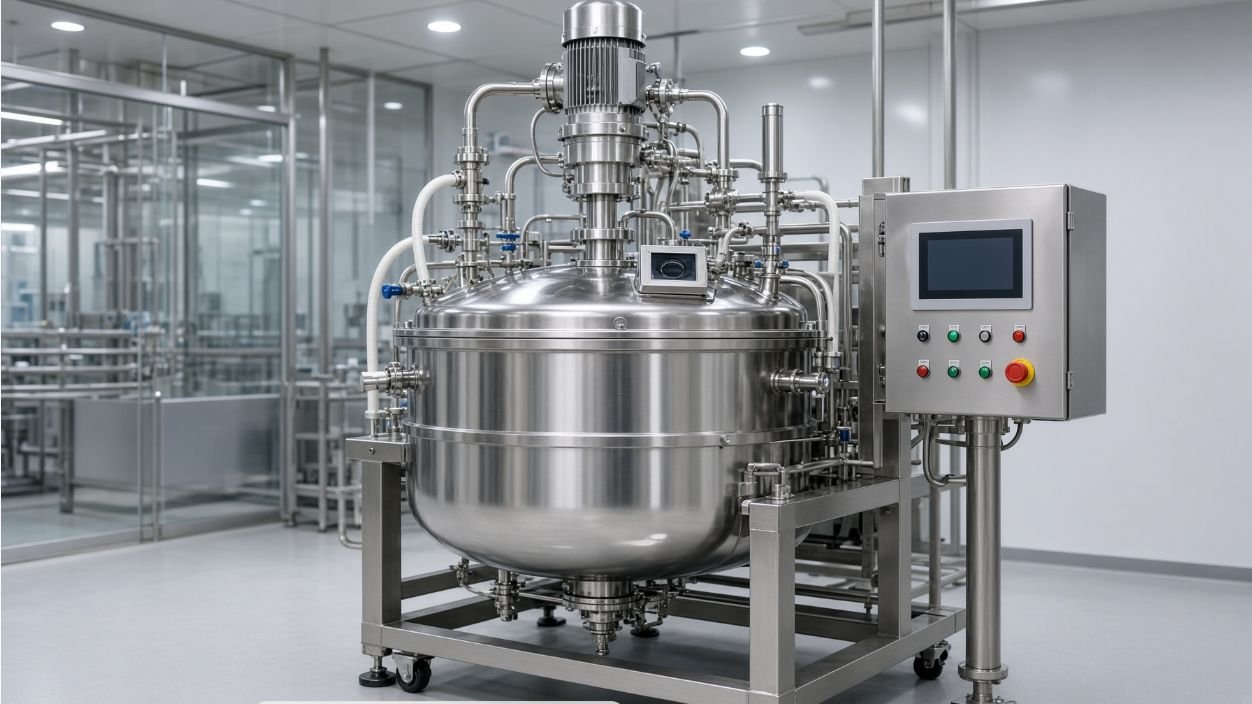
Scaling toothpaste production is not a matter of multiplying vessel dimensions or mixer speed. Toothpaste is a concentrated, shear-dependent paste whose final structure is influenced by powder wetting, binder hydration, abrasive dispersion, surfactant addition, vacuum history, temperature and the way the batch leaves the vessel. A larger batch changes circulation distance, heat-transfer area per unit volume, addition time, deaeration path and transfer pressure, even when the recipe percentages stay unchanged.
This guide owns the vacuum-mixer scale-up decision. The existing toothpaste production line overview explains the broad sequence; this page translates pilot evidence into commercial addition, shear, vacuum, temperature, endpoint and transfer controls. It does not prescribe a universal formula, rpm, vacuum level or batch time. Those values must be established with the actual formulation and approved quality methods.
Quick answer: Create a scale-up map that preserves the function of each step rather than copying one numerical speed. Record ingredient phase, order and addition rate; impeller and homogenizer role; product temperature; vacuum timing; batch mass; mixing power or torque trend; endpoint tests; and transfer conditions. Use pilot results to define a commercial trial with representative raw-material lots. Adjust one control at a time, compare samples from several vessel locations, and qualify the final operating window before routine production.
Build a Functional Scale-Up Map
Direct answer: Scale each operation by its purpose: wetting, dissolving, dispersing, hydrating, deaerating, cooling or transferring.
Break the master formula into liquid, humectant, binder, abrasive, active, surfactant, flavor and other phases as applicable. For every addition, record amount, physical form, temperature sensitivity, dust or lumping risk and the quality attribute it supports. Identify which steps can overlap and which require a completed endpoint before the next ingredient enters.
Map the pilot equipment: vessel geometry, working volume, impeller and homogenizer positions, recirculation if any, vacuum system, jacket, addition ports and discharge. Then map the proposed commercial equipment. Similar-looking vessels can create different circulation, dead zones and surface vortex behavior. Record differences explicitly instead of assuming proportional performance.
Define the scale-up questions before the trial: will powder addition exceed wetting capacity, will the larger jacket remove heat quickly enough, can vacuum reach the full product surface, and will transfer reintroduce air? The answers determine trial sampling and instrumentation, not merely motor size.
| Operation | Scale-up variable | Evidence to collect |
|---|---|---|
| Powder wetting | Addition rate and liquid circulation | Lump count, dispersion sample, torque |
| Hydration | Time, temperature and low-shear hold | Rheology and uniformity |
| Deaeration | Vacuum timing, surface renewal and batch depth | Density, visual air and vacuum trend |
| Transfer | Outlet, pump and backpressure | Residual mass, air and temperature |
Define Formula and Raw-Material Variability
Direct answer: A scale-up trial needs the actual formulation and realistic raw-material variation, not only nominal percentages.
Record water and humectant balance, binder type and grade, abrasive particle characteristics, surfactant system, actives, flavors and any temperature-sensitive or volatile components. Ingredient names alone are insufficient because grade, moisture, particle size and supplier lot may change wetting and rheology. Protect confidential formula details while still providing the supplier with the physical data needed to design the process.
Identify which raw materials require pre-dispersion or pre-dissolution and which may be introduced directly under vacuum. Confirm the approved water quality and actual starting temperatures. If the formulation uses a cold process, do not add heating merely to shorten mixing without assessing its effect on hydration, flavor and finished properties.
Plan a representative trial lot with the same packaging state and handling conditions expected in production. Keep retained samples and record lot identities. A successful run with unusually easy-to-wet powder is not sufficient evidence for the operating window.
Control Powder Wetting and Addition
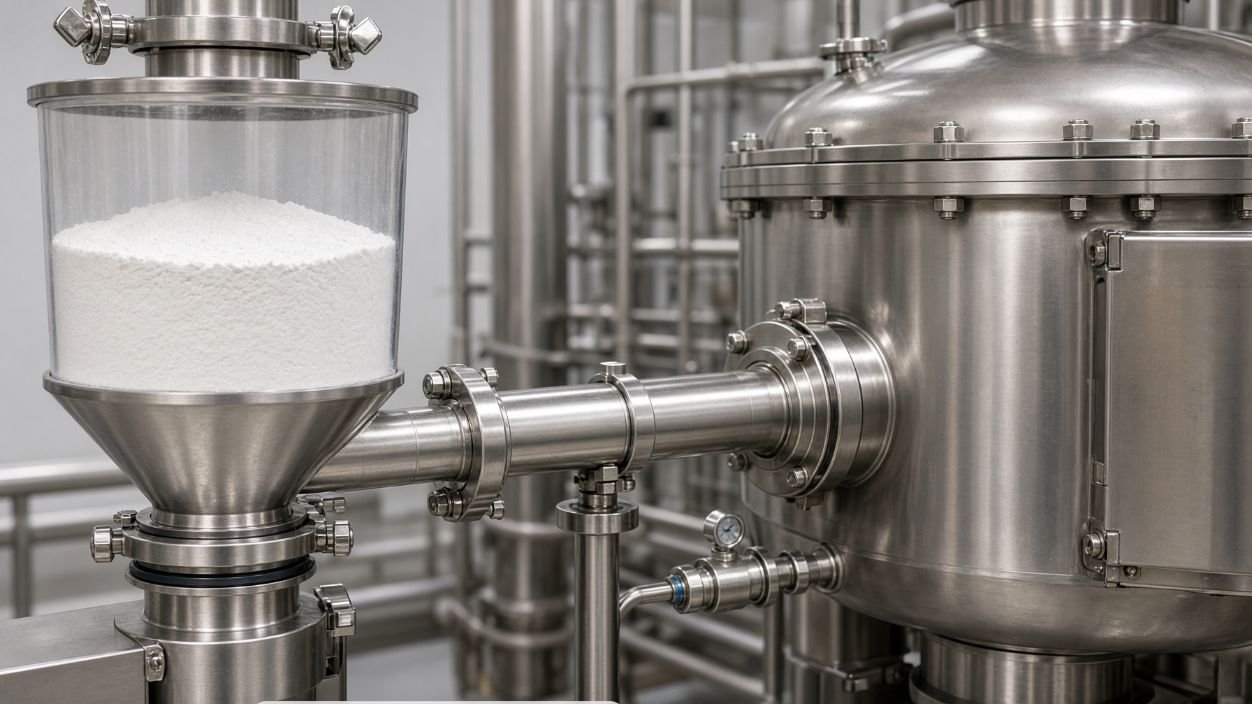
Direct answer: Powder addition should stay below the mixer's ability to wet and circulate solids without forming persistent agglomerates.
Binder added too quickly can form gel-coated lumps that protect dry material inside. Abrasive addition can overload circulation or trap dry islands at the vessel wall. Compare addition route, port position, screen or induction device, liquid level and impeller state. The best sequence depends on formulation and equipment; do not present one order as universal.
At commercial scale, addition takes longer and the first material may hydrate while the last is still entering. Record start, finish and interruption times for every phase. If powder is drawn under vacuum, monitor the effect on air, dust, feed consistency and vessel pressure. Validate that the addition method does not pull packaging debris or unapproved air into the product path.
Use samples and observations that reveal incomplete wetting: particle or lump inspection, sieve or dispersion check where justified, local viscosity, vessel-wall inspection and torque trend. Sample from more than one location before declaring uniformity. The toothpaste equipment overview provides system context while the scale-up protocol owns the endpoints.
Separate Agitation from Homogenization
Direct answer: The anchor or sweep and the high-shear homogenizer perform different jobs and should not be scaled by one common rpm rule.
The main agitator moves bulk product, renews wall contact and supports uniform temperature. A homogenizer creates intense local shear for dispersion or deagglomeration. Tip speed, power per volume, circulation time and shear exposure do not scale identically. Ask the supplier to explain the proposed impeller geometry and the process function of each speed range.
Run high shear only where development shows it is needed. Excessive exposure can raise temperature, alter binder structure, incorporate air before vacuum is effective or change particle interactions. Conversely, inadequate circulation can leave pockets untouched by the homogenizer. Use product data and representative sampling to establish the sequence.
Record motor load or torque, speed, duration and product temperature alongside quality results. These trends can provide a reproducible process signature, but they do not replace finished-product tests. Investigate a changed load profile before simply extending time.
Manage Addition Sequence and Shear History
Direct answer: Toothpaste structure depends on the path taken through the process, so sequence and shear history must be reproducible.
Write the batch instruction with clear start and end conditions for every phase. State whether the vessel is open or under vacuum, which mixer runs, the permitted temperature band, addition rate and the endpoint that releases the next step. Avoid instructions such as 'mix until smooth' unless a defined observation and trained decision are attached.
Scale-up may require a different duration to achieve the same function, but the change should be evidence-based. Compare rheology, density, appearance, active distribution and other approved tests at planned intervals. Use small adjustments during development, document them, and freeze the commercial procedure after the operating window is established.
When rework is permitted, define where and how it enters, its allowable quantity and its effect on hydration and shear history. Do not assume a reworked batch follows the same endpoint curve as a fresh one. The quality unit should approve any rework strategy.
Establish Vacuum Deaeration Conditions
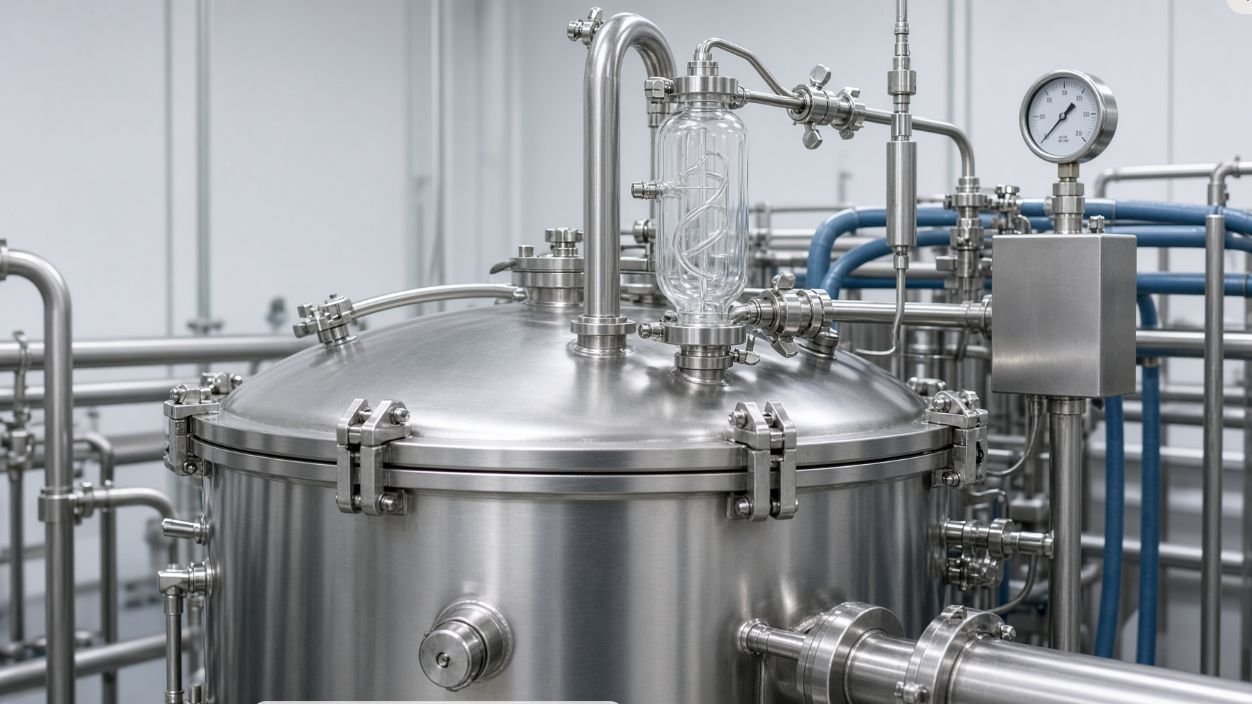
Direct answer: Vacuum is effective only when the paste surface is renewed and the process avoids uncontrolled foaming, boiling or volatile loss.
Apply vacuum at a stage where entrained air can migrate and be exposed, while agitation continues to renew the surface. The useful pressure, ramp and hold depend on formulation, temperature, batch depth and vessel design. A gauge setpoint alone does not prove deaeration; also record achieved pressure, time, mixer state and product response.
Watch for expansion, foaming, carryover to the vacuum line and unstable pressure. A sudden full vacuum may make some formulas rise or pull volatile flavor components. Use a controlled ramp or staged addition when development supports it. Protect the vacuum system with appropriate traps or separators and define cleaning and recovery procedures.
Measure the endpoint through justified density, air-content, appearance or filling behavior tests. Sample after pressure is restored and after transfer if transfer can reintroduce air. A clear sight glass near the surface helps operation but is not a complete batch-release test.
| Deaeration symptom | Possible process cause | Confirmation |
|---|---|---|
| Persistent bubbles | Poor surface renewal or short hold | Density and multi-location samples |
| Batch foaming | Ramp too fast or surfactant stage | Vacuum trend and visual record |
| Flavor loss | Temperature or vacuum exposure | Approved analytical/sensory test |
| Air returns after transfer | Pump or leaking connection | Pre- and post-transfer comparison |
Control Temperature and Cooling Capacity
Direct answer: Temperature affects hydration, viscosity, flavor retention and the mixer's power demand, so heat generation and cooling must be scaled together.
Record raw-material temperatures, jacket inlet and outlet conditions, product temperature at more than one point where feasible, mixer load and time. Shear and motor energy can heat a batch even when no steam is applied. A larger vessel often has less heat-transfer area per unit volume, so copying the pilot cooling time can miss the intended discharge condition.
Define maximum and minimum product temperatures for each sensitive phase through formulation development. Add flavors, surfactants or actives only under their approved conditions. If cooling is part of binder hydration or structure development, specify its rate and endpoint instead of treating it as an idle wait.
Ask the supplier for jacket area, utility demand, design pressure and proposed temperature-sensor locations. Confirm site chilled-water or cooling-water capability under realistic seasonal conditions. At FAT, utilities may differ from site conditions, so close that gap during commissioning and qualification.
Define Batch Endpoints and Sampling
Direct answer: A fixed time is useful for scheduling, but a qualified endpoint must also demonstrate that the batch meets defined in-process properties.
Choose tests relevant to the formulation: appearance, dispersion or lump check, density, pH, viscosity or rheology under a controlled method, temperature, active uniformity and air content where applicable. Record instrument, geometry, sample conditioning and test temperature. Toothpaste is shear-dependent, so an uncontrolled viscosity number can be misleading.
Create a sampling map for top, middle, bottom, recirculation or discharge points as the equipment permits. Assess whether sample collection itself introduces air or changes temperature. During scale-up, compare locations and time points; once uniformity is demonstrated, the routine plan may be simplified through an approved rationale.
Set rules for an out-of-trend result, an unplanned extension and adjustment. Continuing to mix until a number passes can change the product and conceal an unstable process. Document investigation and quality approval before any reprocessing or additional addition.
Design Transfer as Part of Scale-Up
Direct answer: The batch is not successfully scaled until it can leave the mixer and reach the filler without unacceptable air, temperature change or residual loss.
Map outlet size, valve, hose or pipe length, elevation, transfer pump, buffer vessel and filler feed. Toothpaste yield behavior can create high pressure or intermittent flow. Select a pump and line diameter through product trials and pressure calculations, then confirm compatibility and cleanability. Avoid sharp restrictions and uncontrolled suction that may create cavitation or air entry.
Measure loaded batch, saleable transfer, samples, line residual and disposal. Record temperature and density before and after transfer. If the filler depends on a controlled feed pressure or hopper level, include that interface in the trial. The mixer and filler cannot be qualified as isolated modules when transfer changes product behavior.
Plan batch-end recovery without compromising quality. Scraping, air push or displacement may add contamination or air risk and must be justified. Define what recovered material may be used and how it is identified.
Run a Commercial Scale-Up and Supplier Trial
Direct answer: A useful trial tests the proposed commercial process with agreed materials, records and decision rules rather than demonstrating only that the motor turns.
Give each supplier the same formula-phase data, pilot record, target batch, utility limits, endpoint methods and transfer requirements. Request a process flow, impeller and homogenizer rationale, addition devices, vacuum-system design, jacket data, instrumentation, cleaning approach, sampling access and FAT protocol. Label assumptions and exclusions. The toothpaste manufacturing GMP guide provides related equipment, cleaning and validation context.
During the trial, collect the actual addition timeline, speeds, loads, pressure, temperatures, vacuum trend, observations, sample results and deviations. Challenge start, stop and restart where safe. Compare the commercial result with the pilot endpoint and filling behavior, not a visual impression alone.
Use a staged plan: water or cleaning test, safe surrogate if needed, then representative product. A surrogate may verify circulation or controls but cannot prove final rheology, flavor retention or filling performance. Carry untested items into site qualification with named owners.
Review Toothpaste Scale-Up with KING PACK
Direct answer: KING PACK can translate pilot and formula-phase data into a vacuum-mixer configuration and evidence plan.
KING PACK Machinery is a China-based manufacturer of pharmaceutical, veterinary, cosmetic and liquid filling and packaging equipment, with core solutions covering tube filling and sealing, vacuum emulsifying, liquid filling, pet spot-on filling and syringe production systems. The vacuum emulsifying mixer overview provides equipment-family context.
For toothpaste, a project review can compare vessel geometry, anchor and homogenizer roles, powder addition, vacuum capacity, jacket and cooling, sampling, discharge and transfer. KING PACK can propose testable machine functions and a trial protocol; the formulation owner retains responsibility for formula, endpoint methods and final process approval.
Send formula phases, ingredient physical data, pilot batch record, target batch, utilities, endpoint tests and transfer-to-filler constraints through the KING PACK contact page. The result should be a scale-up hypothesis with measurable trials and open risks, not a guarantee based on nominal capacity.
Frequently Asked Questions
Can toothpaste mixer speed be scaled directly by vessel volume?
No. Agitation, homogenization, heat transfer and vacuum surface renewal scale differently; preserve process function and verify with trials.
When should binder be added?
Use the formulation's developed phase and wetting method. Control order, addition rate, mixer state and temperature rather than relying on a universal recipe.
Does a deeper vacuum always remove more air?
No. Pressure, surface renewal, temperature, foam behavior and hold time interact. Use a justified endpoint and protect volatile ingredients.
Why does commercial cooling take longer?
Larger vessels often have less heat-transfer area per product volume and more shear heat; verify utilities and product temperature profiles.
Which rheology value should be used?
Use an approved method with controlled sample history, geometry, temperature and shear conditions; one uncontrolled viscosity number is not enough.
Can water trials prove toothpaste performance?
They can verify utilities and some controls, but not high-viscosity circulation, hydration, deaeration or transfer performance.
Should the filler be included in scale-up?
Yes. Transfer and feed conditions can reintroduce air or change temperature and pressure, so test the mixer-to-filler interface.
What should be sent to KING PACK?
Send formula phases, pilot data, target batch, utilities, endpoint methods and transfer constraints for a process review.
