
Last reviewed: August 27, 2026.
An isoxazoline spot-on project cannot be specified from the active-ingredient family name alone. The finished formulation may contain carriers or solvents that influence hose swelling, seal compatibility, static risk, evaporation, temperature control, metering behavior and the integrity of the pipette heat seal. Those formulation properties, not the marketing claim of the medicine, drive the filling-line design.
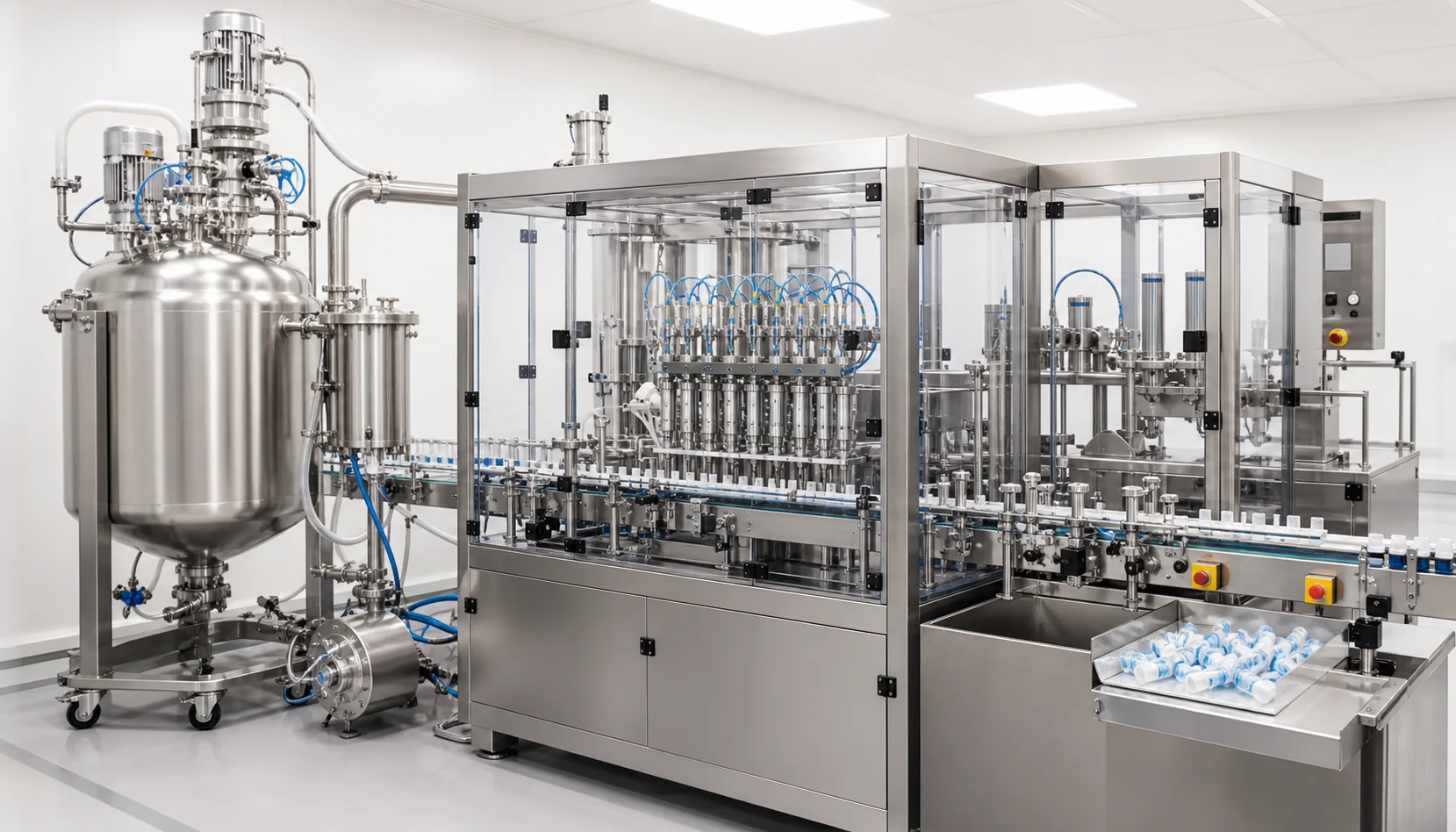
The first engineering task is therefore to define the process boundary from the preparation vessel to the closed package. The buyer and supplier need to agree who owns mixing, filtration, product transfer, buffer feeding, dosing, pipette positioning, sealing, leak testing, cleaning and waste handling. A gap at any interface can create dose drift, seal contamination, unplanned vapor release or an uncleanable product hold-up point.
This guide stays deliberately within equipment and process inputs. It does not discuss isoxazoline efficacy, dosage instructions or veterinary treatment claims. It explains what evidence a manufacturer should provide and what must be confirmed through compatibility review, risk assessment and representative sample testing before purchasing an isoxazoline-compatible pet drops filling line.
Quick answer: Specify an isoxazoline spot-on filling line only after the final formulation and package are defined. At minimum, provide the SDS, full product-contact composition or justified compatibility data, viscosity and density across the filling-temperature range, dose range, pipette material and drawing, seal specification, target output, cleaning chemistry and site hazardous-area assessment. Then verify wetted parts, transfer stability, dose repeatability, seal-zone cleanliness and leak-test performance with production-intent samples.
Define the Product and Regulatory Boundary First
Direct answer: The word isoxazoline identifies a pharmacological class, not a universal formulation or machine configuration, so the equipment decision must be based on the finished product and destination-market requirements.
Two products associated with the same active-ingredient class can use different carriers, solvent systems, concentrations, dose volumes and pipette structures. Those differences can change vapor behavior, density, viscosity, wetting, elastomer compatibility and sealing performance. A supplier should never infer a universal pump, gasket, hose or sealing temperature from the active name alone.
The product owner must also determine whether the project is regulated as a veterinary medicinal product, pesticide, parasiticide or another category in each target market. That classification can affect facility, validation, labeling and safety obligations. Equipment suppliers can provide design evidence and test support, but they should not make the customer's regulatory determination.
Before technical selection begins, freeze the intended presentation: nominal and allowable dose, number of pipette formats, primary-pack material, break-tip or opening design, secondary pack, coding position and acceptable leakage criteria. Record which inputs are final and which remain subject to formulation or packaging change control.
Build the Equipment Input Package
Direct answer: A useful RFQ combines formulation, package, process, safety and production information in one controlled data package rather than sending only a fill volume and target speed.
If the final product cannot be shipped for an early trial, define a simulant by the properties that matter: viscosity, density, surface tension, volatility, conductivity and package wetting. Water should not be treated as representative merely because it is convenient. The protocol must state which conclusions the simulant supports and which still require the actual formulation.
- Current SDS plus the formulation components that determine wetted-part, vapor and cleaning compatibility, shared under an appropriate confidentiality arrangement.
- Viscosity, density, surface behavior and temperature limits, including the measurement method and the expected condition at filling.
- Minimum, nominal and maximum dose, acceptance method, sampling plan and any product-loss constraint caused by high unit value.
- Pipette drawing, resin or laminate structure, tolerance, seal land, opening feature, coding area and production-intent samples.
- Batch size, preparation sequence, filtration purpose, hold time, transfer distance, line elevation and ownership of the buffer vessel.
- Cleaning agents, rinse limits, campaign strategy, changeover frequency and the planned residue or carryover acceptance rationale.
- Target output by format, expected OEE assumptions, operator model, utilities and the site's electrical or hazardous-area classification.
- Required FAT/SAT, drawings, material certificates, instrument calibration records, software records, spare parts and qualification support.
Screen Wetted Parts, Hoses and Seals for Compatibility
Direct answer: Every product-contact material should be justified against the actual formulation, cleaning chemicals, temperature, pressure and contact time, including transient contact during stops and cleaning.
For drug-product equipment in the United States, 21 CFR 211.65 states that product-contact surfaces must not be reactive, additive or absorptive in a way that alters product quality. The rule has a specific human-drug scope, so a veterinary manufacturer must confirm the legal requirements that apply to its product and market. As an engineering principle, it supports a documented material compatibility matrix rather than a generic 'stainless steel machine' statement.
The review should cover tank surfaces, pump heads, valve seats, diaphragms, O-rings, hose liners, filters, nozzle seals, adhesives and any temporary sampling or transfer connections. Stainless-steel grade alone does not resolve the compatibility of polymers or elastomers. Ask for material declarations, supplier data and exposure testing where formulation knowledge indicates a risk.
Compatibility is not only visible swelling. Look for mass or dimensional change, softening, cracking, extraction, adsorption, permeability, loss of mechanical properties and changes after repeated cleaning cycles. Record the tested concentration, temperature and exposure time so results are not applied outside their evidence boundary.
| Contact point | Failure mode to screen | Evidence to request | Design response |
|---|---|---|---|
| Tank and rigid pipe | Corrosion, residue retention, unsuitable finish or weld condition | Material certificate, finish/weld record, compatibility review | Select justified alloy/finish and inspect drainability |
| Flexible hose | Swelling, softening, permeation, extraction or kinked hold-up | Hose construction, exposure data, replacement interval | Shorten route, support hose and control life |
| Pump and valve seals | Loss of elasticity, leakage, particle generation or dose drift | Elastomer grade, exposure trial, maintenance history | Select seal set and define inspection frequency |
| Filter and housing | Adsorption, blockage, extractables or pressure rise | Product/filter study, pressure limit and integrity method | Define purpose, pore/grade rationale and change rule |
| Filling nozzle | Drip, stringing, air intake or surface residue | Product trial across temperature and stop/restart | Optimize bore, shutoff, motion and cleaning access |
Connect Mixing, Filtration, Transfer and Buffer Feeding
Direct answer: The upstream path should preserve formulation condition while supplying the filler at a stable, controlled pressure without adding air, heat, contamination or excessive residence time.
Define whether the formulation needs gentle recirculation, intermittent mixing or no agitation after preparation. The answer must come from development data on homogeneity, temperature and stability. An unnecessary high-shear loop can heat the product or change its condition, while an unstirred hold vessel can allow concentration or temperature gradients.
Filtration must have a stated purpose. It may control defined particulates or protect a downstream component, but it is not a substitute for hygienic preparation and should not be assumed to remove chemical or microbiological risks without a validated basis. Specify filter material, effective area, expected loading, pressure monitoring, change criteria and whether the product can adsorb to the medium.
Keep transfer lines as short and drainable as practical. Map high points that can trap air and low points that retain product. If a buffer tank or hopper is used, define its working-volume range, level control, vent arrangement, temperature control, maximum residence time and response to a line stop. The first dose after priming or restart should be part of the sampling plan.
The existing fipronil production equipment article discusses degradation-oriented considerations. Use it as a neighboring reference only; the present decision is the physical compatibility and process interface for the finished isoxazoline formulation.
Assess Temperature, Volatility and Explosion Risk
Direct answer: If the finished formulation or cleaning process can create a flammable vapor or mist, the project needs a formal site-specific hazard assessment before electrical and ventilation design is frozen.
Start with the current SDS and formulation data, then evaluate normal operation, sampling, filling, spills, drainage, cleaning and maintenance. Relevant inputs include flash point, vapor pressure, process temperature, release points, ventilation, container closure, batch quantity and the duration and frequency of a possible release. Do not label a line 'explosion-proof' from the solvent name alone.
For equipment placed on the EU market for use in potentially explosive atmospheres, Directive 2014/34/EU defines the equipment and protective-system framework. Other jurisdictions use different codes and approval routes. A qualified EHS or electrical specialist must establish the zone or class, equipment category, temperature class, gas group, earthing and bonding, ventilation, detection and emergency response applicable to the site.
Closed transfer, controlled vents, suitable seals, conductive connections where justified, limited open handling and appropriate electrical components may form part of the design. These measures must be selected from the risk assessment. They are not a universal configuration for every spot-on product.
Choose and Verify the Dosing Method

Direct answer: The dosing technology should be selected by actual dose range, product behavior, air sensitivity, cleaning strategy and package geometry, then proven at low, nominal and high conditions.
Positive-displacement, peristaltic, time-pressure and other metering methods can all be candidates. A peristaltic path can isolate product in tubing, but tubing compatibility, fatigue, pressure and calibration drift must be tested. A piston or other positive-displacement system can handle defined volumes, yet valve passages, seals, air pockets and cleaning must suit the formulation. Time-pressure methods can be sensitive to head pressure, viscosity and temperature.
Accuracy acceptance comes from the product specification and process capability requirement, not from an unsupported universal percentage. Challenge the smallest and largest dose, the longest planned run, low and high product levels, justified temperature limits, start-up, a planned stop and restart. Keep samples traceable to filling head and process condition.
Gravimetric verification is often useful because it creates a traceable mass result, but density and tare control must be understood when the label claim or recipe is volumetric. Define calibration, check frequency, reaction to a trend, reject handling and reconciliation before FAT.
| Metering candidate | Why it may fit | Critical challenge | FAT evidence |
|---|---|---|---|
| Peristaltic | Disposable or isolated fluid path for compatible products | Tubing compatibility, pressure, fatigue and calibration drift | Beginning/end calibration and tubing-life challenge |
| Servo piston | Defined displacement over a suitable dose range | Seal/valve compatibility, air pockets and cleanability | Low/high dose, stop/restart and teardown review |
| Time-pressure | Simple path for stable, suitable low-viscosity products | Head pressure, temperature, viscosity and valve timing | Worst-case level and temperature repeatability |
| Other positive-displacement pump | Potential fit for continuous or multi-head dosing | Slip, pulsation, shear, hold-up and cleaning | Product trial over rate and pressure range |
Protect the Pipette Seal Zone
Direct answer: Dose control and package integrity must be developed together because a correct fill can still create a leaking pack when product reaches the seal land or handling distorts the pipette.
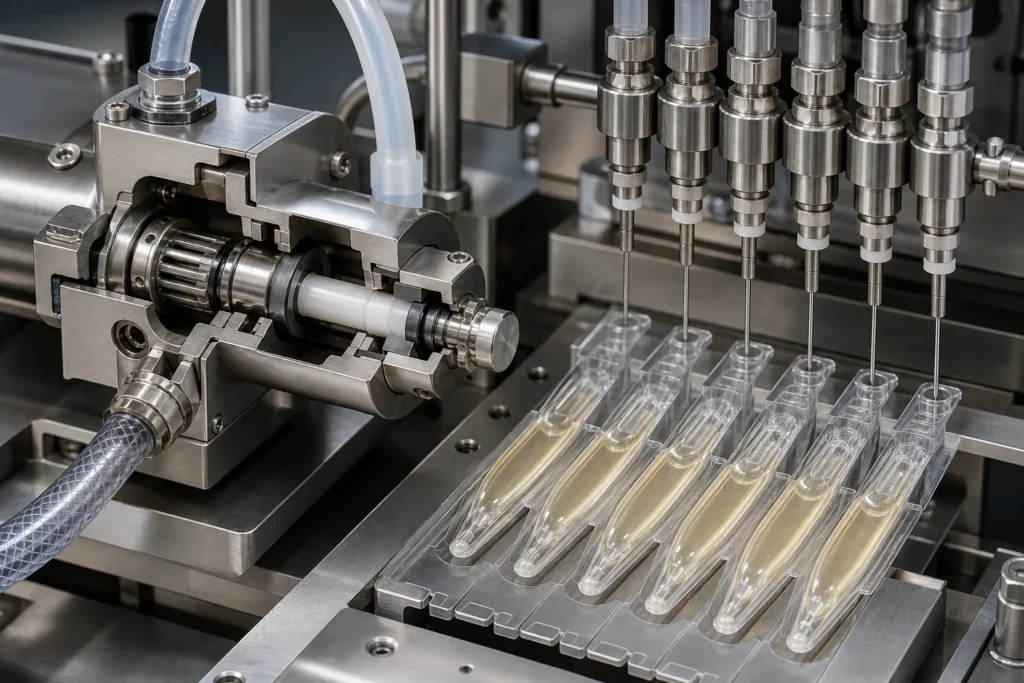
The filling nozzle, pipette support, fill height, shutoff timing and index motion should keep the seal area clean. Drip, splash, stringing or a tilted pipette can contaminate the heat-seal interface. Excessive handling force can also damage a break-tip, thin wall or locating feature before sealing.
Develop the sealing window with production-intent pipettes across the expected material and dimensional variation. Temperature, pressure, dwell, jaw alignment and cooling interact; one setting cannot compensate safely for every defect. Use station-level traceability so a worn holder, misaligned jaw or heater difference can be found.
The KING PACK tube filling and sealing platform provides equipment-family context for filling, indexing and sealing. The final pipette tooling and process window must be confirmed with the actual package, product or justified simulant, and the customer's validated leak-test approach.
Plan Cleaning, Changeover and Product Recovery
Direct answer: Cleaning design should remove formulation and cleaning-agent residues from every wetted surface while protecting operators and preventing incompatible chemicals from being mixed.
21 CFR 211.67 requires written cleaning and maintenance procedures for drug equipment within its human-drug scope. A veterinary project must confirm applicable rules, but the evidence principle remains useful: identify responsibility, method, disassembly, schedule, inspection and records rather than relying on an informal rinse.
Create a product-path map and calculate or measure hold-up at the tank outlet, pump, valves, hose, filter and nozzle. Define recovery boundaries so efforts to reduce expensive product loss do not push unverified residue into good units. For multi-product campaigns, use a risk-based worst case based on solubility, potency, toxicity, cleanability and batch sequence.
Cleaning solvents can introduce a different compatibility or explosion risk from the product. Include cleaning concentration, temperature, contact time, rinsing, drainage, waste collection, drying and safe status before maintenance in the URS. If disposable tubing or parts are proposed, define installation verification, traceability and disposal.
URS and FAT Checklist
Direct answer: A strong URS converts product and safety inputs into observable design requirements, while FAT proves the agreed functions and limitations with representative conditions.
- Define the complete process boundary, line layout, utilities, product path and responsibility matrix.
- Approve the wetted-parts and elastomer matrix against formulation and cleaning exposures.
- Record the site's hazardous-area decision and the responsible authority; do not let the equipment supplier guess it.
- Challenge minimum, nominal and maximum dose with defined sampling, calibration and reaction rules.
- Test priming, low product level, planned stop, restart, sustained run and end-of-batch recovery.
- Inspect pipette positioning, seal-zone cleanliness, sealing station traceability, trim and leak-test evidence.
- Demonstrate recipe access, alarms, interlocks, reject handling, batch records and data export required by the project.
- Review cleaning access, disassembly, drainage, product recovery and changeover using a justified worst case.
- Collect material certificates, drawings, manuals, calibration records, spare-parts list and IQ/OQ support documents.
- Record deviations and open items with owners and closure evidence before shipment.
How to Evaluate a Spot-On Filling-Line Supplier
Direct answer: Choose a supplier that asks for formulation, safety and package evidence, explains the reason for each product-contact choice, and can demonstrate the integrated process with representative samples.
- Compare reference projects by formulation properties, dose range and pipette structure, not by the label 'spot-on' alone.
- Ask what evidence would disqualify the proposed hose, seal, pump or nozzle configuration.
- Review sample-test raw data, station traceability and rejected or unstable conditions, not only the best result.
- Check the supplier's ability to provide layout, P&ID/product-path, electrical drawings, manuals and qualification support.
- Define FAT/SAT boundaries, training, commissioning, critical spares and after-sales response in the commercial scope.
- Verify the exact scope of CE, ISO or hazardous-area documentation; a logo does not prove formulation compatibility or dose performance.
How KING PACK Configures Isoxazoline Spot-On Projects
Direct answer: KING PACK starts with the customer's finished formulation, pipette and site inputs, then configures product preparation, transfer, metering, handling and sealing as one evidence-based line.
KING PACK Machinery is a China-based manufacturer of pharmaceutical, veterinary, cosmetic and liquid filling and packaging equipment, with core solutions covering tube filling and sealing, vacuum emulsifying, liquid filling, pet spot-on filling and prefilled syringe production systems.
For an isoxazoline spot-on project, the proposed scope may include a compatible preparation or buffer vessel, controlled transfer, a metering method proven by sample trial, pipette fixtures, clean-fill control, heat sealing, coding and inspection interfaces. The final configuration depends on the formulation and site risk assessment; KING PACK does not apply a universal solvent or dose specification.
Review the pharmaceutical and veterinary application platform for industry context. To request a technical review, send the SDS, formulation-contact information, viscosity and density, dose range, pipette samples, target output, cleaning method and hazardous-area inputs through the KING PACK contact page.
Frequently Asked Questions
Does every isoxazoline spot-on line require explosion-proof equipment?
No. The requirement depends on the finished formulation, release scenarios, process temperature, ventilation, quantity, jurisdiction and site hazardous-area assessment. Use the SDS and a qualified EHS/electrical review before specifying equipment.
Can the active-ingredient name determine the correct gasket material?
No. Gasket and hose compatibility depends on the complete formulation, cleaning chemicals, temperature, pressure and exposure time. Request a documented material matrix and exposure evidence.
Is water an acceptable FAT liquid?
Water can verify basic motion and controls but may not represent viscosity, density, surface tension, volatility, conductivity or package wetting. Use the product or a justified simulant for performance conclusions.
Which filling method is best for small spot-on doses?
There is no universal winner. Peristaltic, piston, time-pressure and other positive-displacement methods should be compared against dose range, product behavior, air sensitivity, compatibility, cleaning and package geometry.
Why can a correct dose still produce a leaking pipette?
Product can contaminate the seal land, tooling can misalign the package, or sealing and cooling conditions can be outside the proven window. Dosing, handling and sealing must be challenged together.
Should a filter always be installed before the filler?
Only for a defined and justified purpose. Specify what the filter controls, its compatibility, loading behavior, pressure limits and effect on the formulation. Filtration is not a substitute for hygienic processing.
What should be sampled after a line stop?
Keep the first units after restart traceable and check the agreed dose, appearance, seal-zone condition and package integrity. The exact sampling plan and acceptance limits belong in the protocol.
What is the most useful RFQ attachment?
A combined product-package-safety data package: SDS, compatibility inputs, viscosity and density, dose range, pipette drawing and samples, target output, cleaning method, process boundary and site hazard classification.