
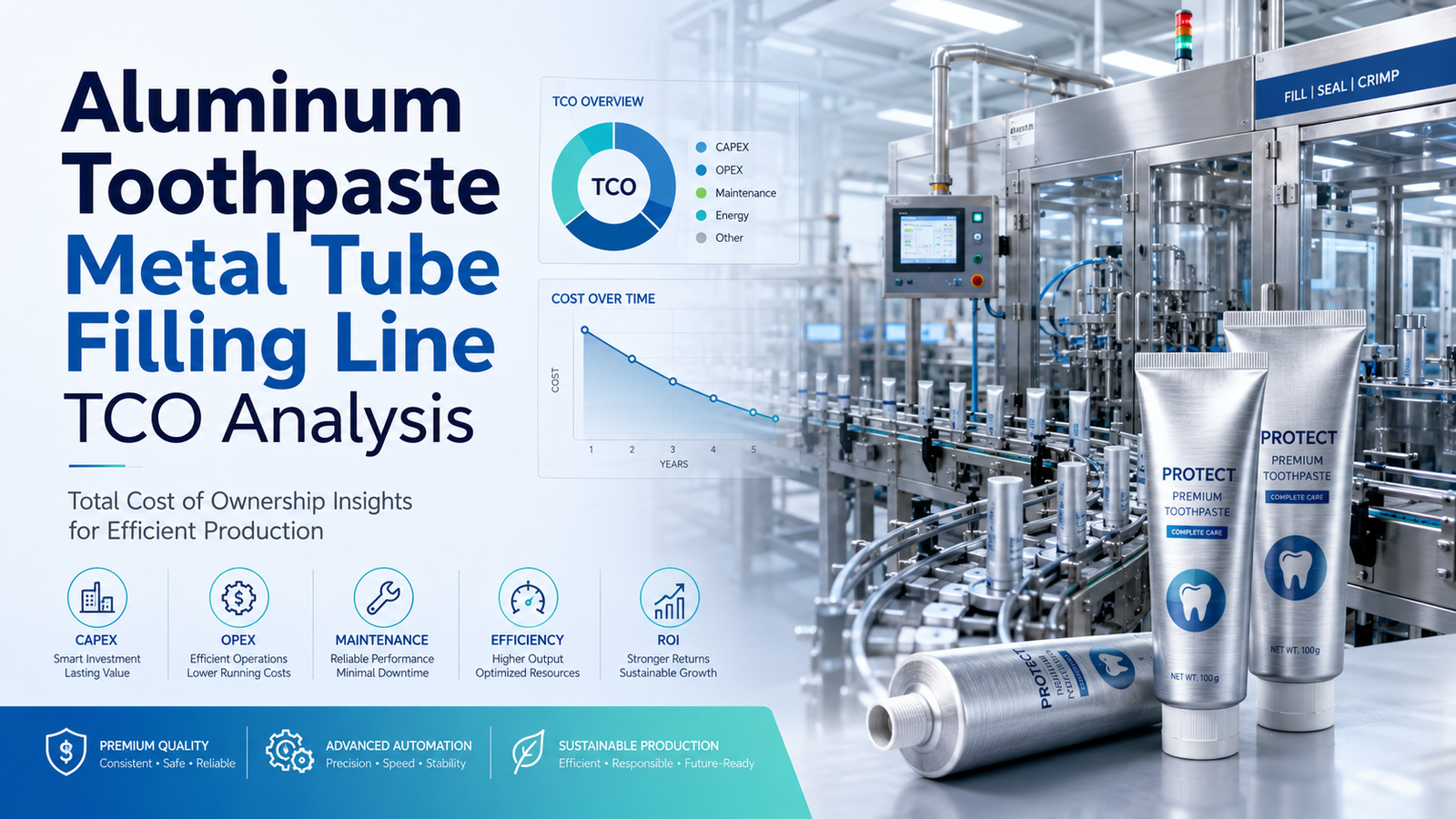
Upgrading from plastic or laminated packaging to aluminum tubes can change the economics of toothpaste production. Aluminum tubes offer strong barrier protection, premium shelf appearance, recyclability potential, and reliable protection for sensitive flavors and active ingredients. But for manufacturers, the decision cannot be based on tube appearance alone. The real investment question is total cost of ownership: how the aluminum toothpaste tube filling line affects material loss, sealing reliability, rejection rate, maintenance, labor, downtime, and long-term ROI.
A metal tube filling machine for toothpaste must handle high-viscosity paste, maintain accurate dosing, avoid tail contamination, fold and crimp the tube end securely, apply batch coding, and discharge finished products without deformation. When these steps are engineered well, the line can reduce waste and support stable output. When they are poorly synchronized, small defects can become expensive over thousands or millions of tubes.
Why Manufacturers Are Upgrading to Aluminum Tubes
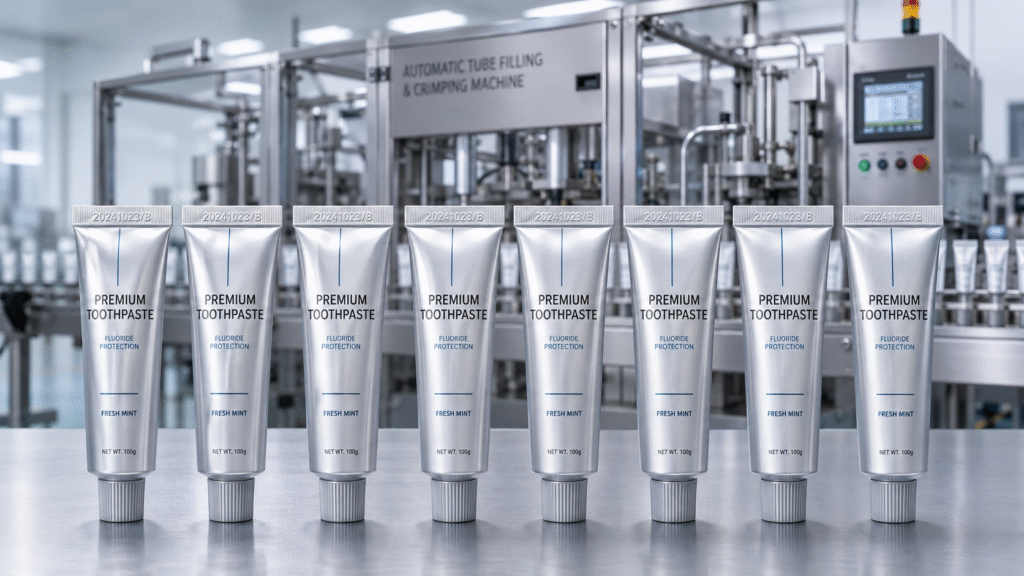
Aluminum tubes remain attractive for premium toothpaste, medicated oral care, herbal toothpaste, sensitive formulations, and products with volatile flavors or active ingredients. The material provides strong protection against oxygen, moisture, and light. It also supports a crisp folding closure that can communicate quality in high-end retail positioning.
For brands targeting sustainable packaging strategies, aluminum may also support recyclability discussions depending on local collection and recycling systems. However, a successful aluminum tube upgrade requires equipment designed for metal tube behavior. Aluminum does not seal like plastic laminate. It must be filled, folded, crimped, and coded with controlled mechanical force.
Packaging Performance and Product Protection
Toothpaste formulations may include flavors, abrasives, fluoride, herbal extracts, whitening agents, enzymes, or sensitivity-care ingredients. Some ingredients are moisture-sensitive or oxygen-sensitive. Aluminum tubes provide barrier protection that helps preserve product quality during storage and distribution.
Tube geometry also affects user experience. A well-formed metal tube should dispense consistently, hold its shape reasonably, and remain leak-resistant after transport. The aluminum tube filling and sealing machine must therefore protect both the product and the package.
Cost Drivers Beyond Machine Purchase Price
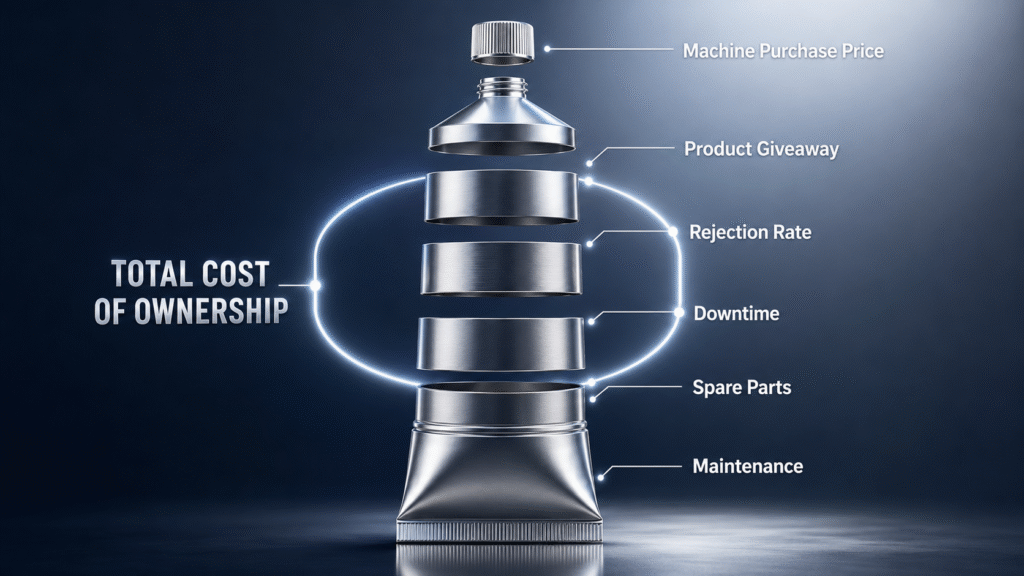
The purchase price of a toothpaste metal tube filler is only one part of cost. Total cost of ownership filling line analysis should include tube cost, paste loss, labor, energy, compressed air, spare parts, downtime, rejected tubes, cleaning time, changeover, and maintenance. For high-value toothpaste formulas, even small filling errors can become a recurring cost.
This is why TCO analysis should be connected to real production data: target capacity, working shifts, tube diameter, filling volume, paste viscosity, rejection rate tolerance, and maintenance strategy. A lower-cost machine may become more expensive if it creates higher scrap or unstable sealing.
Core TCO Factors in Metal Tube Filling Lines
A complete aluminum toothpaste tube filling line includes tube loading, orientation, filling, tail cleaning or control, folding, crimping, coding, discharge, and sometimes cartoning or downstream packaging. Each station affects total cost.
The strongest ROI usually comes from reducing repeated losses: inaccurate filling, leaking tubes, long changeover, unplanned downtime, and excessive manual checking. Buyers should evaluate the line as a cost-control system, not only as toothpaste packaging equipment.
Filling Accuracy and Product Loss Control
Filling accuracy toothpaste control is especially important when formulas include expensive actives, flavors, or specialty additives. Overfilling wastes product and increases cost per tube. Underfilling creates compliance and customer satisfaction risks.
Servo filling systems can improve dosing stability for high-viscosity paste by controlling piston movement, filling speed, and cutoff behavior. A drip-free nozzle and stable paste feeding system help prevent contamination around the tube tail, which is critical before folding.
Sealing Reliability and Rejection Rate
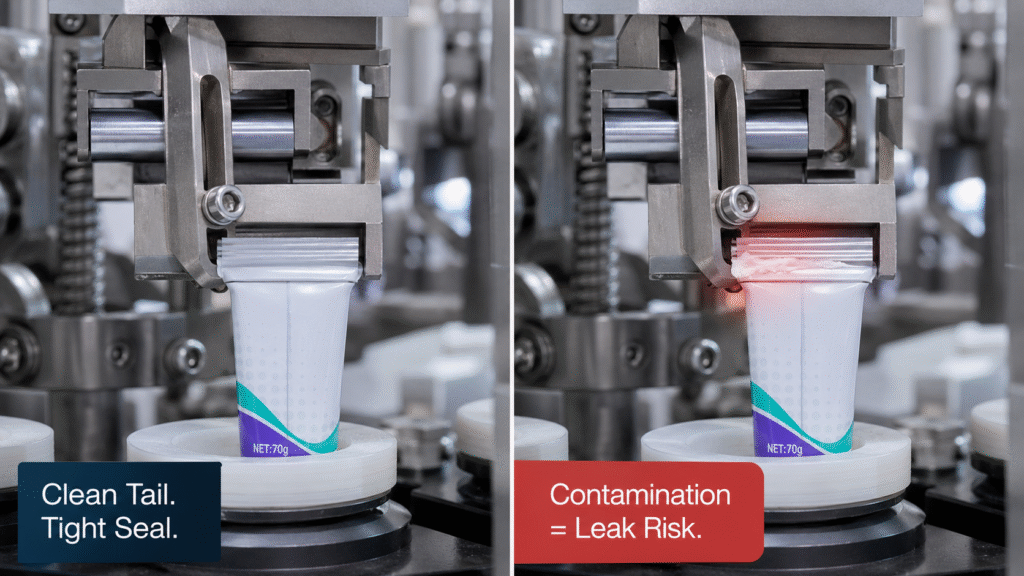
Metal tube sealing is based on mechanical folding and crimping rather than heat sealing. The tail must be shaped through multiple steps so the folded end remains tight, stable, and resistant to leakage. If paste contaminates the folding area, or if pressure is uneven, the tube may leak during transport.
A reliable aluminum tube sealing machine should control folding sequence, crimping pressure, coding position, and final forming. Rejection rate directly affects TCO because every rejected tube wastes packaging material, product, labor, and production time.
Maintenance, Changeover, and Spare Parts Cost
Maintenance cost filling machine analysis should include wear parts, seals, nozzles, folding tools, coding components, sensors, and preventive maintenance labor. Metal tube lines require precise mechanical condition. Worn folding tooling can increase leakage even when the filling system is accurate.
Changeover also affects cost. Factories running multiple tube diameters or volumes need tooling that can be adjusted or replaced predictably. Clear SOPs, accessible components, and spare parts availability reduce downtime.
Technical Advantages of Aluminum Tube Filling Lines
A modern automatic metal tube filling line combines mechanical stability with PLC/HMI control. Automatic tube loading reduces labor, orientation systems align tube marks, servo-driven filling improves dosing control, and integrated folding and coding stations help maintain line efficiency.
For B2B buyers, the value is not only speed. It is the ability to produce saleable tubes with consistent weight, clean tails, readable codes, tight folds, and low rejection rates.
Servo Filling for High-Viscosity Toothpaste
Toothpaste is usually abrasive and viscous. It may contain particles or thickening systems that resist smooth flow. Servo filling allows more controlled movement than simple pneumatic dosing. It can reduce splashing, improve repeatability, and adapt to different filling volumes.
Stable paste feeding is equally important. The hopper, pump, nozzle, and cutoff design should match viscosity and particle profile. A metal tube filling machine that cannot maintain clean filling will create problems at the folding station.
Integrated Coding and End Folding Systems
Integrated coding and metal tube crimping system design improves efficiency by reducing separate handling. The line can fill, fold, code, and discharge in a synchronized sequence. Batch coding on metal tubes must remain readable and correctly positioned after folding.
For ROI toothpaste filling line planning, integrated stations reduce labor and handling risk. They also simplify quality checks because the finished tube exits the line in a consistent state.
Comparing Metal Tube Filling Lines for Toothpaste Production
Metal Tube Filling Lines should be compared by total line behavior, not only by nominal speed. A production line may be rated for a certain output, but its real value depends on how consistently it maintains filling weight, tail cleanliness, folding tightness, code quality, and reject control during long shifts. For toothpaste manufacturers, Metal Tube Filling Lines must also handle abrasive and high-viscosity materials without excessive wear or unstable discharge.
Buyers should review the complete Toothpaste Metal Tube filling sequence: empty tube loading, orientation, paste feeding, servo filling, nozzle cutoff, tail preparation, folding, crimping, coding, inspection, discharge, and downstream cartoning. If any station is poorly synchronized, the line may produce tubes that look acceptable at first but leak during transport or storage. This is especially important for export brands where products may experience long shipping routes, temperature changes, and warehouse handling.
The choice between semi-automatic, intermittent, and high-speed automatic Metal Tube Filling Lines should be based on capacity, labor cost, SKU variety, tube diameter range, and quality requirements. A smaller manufacturer may prioritize flexible changeover and simple maintenance. A larger toothpaste factory may prioritize servo filling, automatic tube feeding, online detection, automatic rejection, and integration with cartoning or case packing equipment.
Practical ROI Model for Aluminum Tube Upgrades
A practical ROI model for Metal Tube Filling Lines should include both visible and hidden costs. Visible costs include the machine, tube materials, utilities, operators, and spare parts. Hidden costs include product giveaway from overfilling, leakage-related rejection, downtime after tooling wear, cleaning after paste contamination, and lost capacity during slow changeover.
For Toothpaste Metal Tube filling, filling accuracy and sealing reliability are the two most important recurring cost points. If a line overfills each tube slightly, the extra toothpaste becomes a permanent cost. If the folding system creates even a small leakage percentage, the factory loses the tube, the product, the packaging labor, and sometimes the carton or shipping case. Over a year of production, these small percentages can matter more than the initial machine price.
Maintenance should also be included in the ROI calculation. Folding tools, nozzles, seals, sensors, and coding parts need planned inspection. A line designed for easy access and stable spare parts supply can reduce unplanned downtime. For multi-SKU production, format changeover time should be measured because every hour spent adjusting a line is an hour not producing saleable toothpaste.
Metal Tube Filling Lines should also be evaluated through line acceptance testing. Before shipment or commissioning, buyers can verify tube orientation accuracy, filling repeatability, tail cleanliness, folding strength, coding readability, reject function, safety interlocks, and HMI recipe control. Testing with the actual toothpaste or a close-viscosity substitute is more useful than testing only with water or low-viscosity material. Toothpaste Metal Tube filling is sensitive to paste flow, so realistic testing helps reveal nozzle, pump, or cutoff issues early.
For manufacturers planning export growth, secondary packaging integration should be considered at the same time. A metal tube filling machine may run well, but if tubes are manually transferred to cartons, labor and handling damage can reduce the benefit. Linking Metal Tube Filling Lines with cartoning, leaflet insertion, checkweighing, and case packing can improve efficiency and reduce contamination or deformation during handling.
The final purchasing decision should connect packaging strategy with production cost. Aluminum tubes can support premium positioning, but the filling line must protect that value through accurate dosing, clean folding, and consistent appearance. A TCO-based approach helps buyers select Metal Tube Filling Lines that serve both brand goals and factory economics.
A supplier discussion should therefore include more than a price quote. Buyers should ask about tube samples, paste testing, filling pump selection, folding tool material, changeover procedure, recommended spare parts, operator training, and overseas service response. Metal Tube Filling Lines are long-term production assets, and their value depends on stable operation after installation.
For toothpaste brands, the line also affects market perception. A cleanly filled and well-folded aluminum tube supports premium positioning, while leakage, poor coding, or tail deformation weakens trust. Toothpaste Metal Tube filling equipment should be chosen to protect the package appearance as carefully as it protects production cost.
A final TCO review should compare expected annual output, product value, tube cost, labor, utility demand, rejection rate, and service requirements. This gives decision-makers a clearer view of which Metal Tube Filling Lines can support both current production and future market growth.
It also helps justify the project internally to finance, production, quality, and brand teams.
The following TCO table helps buyers structure internal discussions without relying on unverifiable market numbers. It focuses on cost categories that can be measured inside the factory before and after installing Metal Tube Filling Lines.
| TCO Factor | What to Measure | How Metal Tube Filling Lines Influence It | Buyer Decision Value |
|---|---|---|---|
| Product giveaway | Average overfill per tube and batch size | Servo filling and stable paste cutoff can reduce unnecessary overfilling | Protects high-value toothpaste formulation cost |
| Rejected tubes | Leakage, tail deformation, unreadable code, underfill | Folding accuracy, coding control, and reject tracking reduce avoidable scrap | Improves yield and reduces rework |
| Changeover time | Time to switch tube diameter, filling volume, or SKU | Tooling design and recipe control may shorten setup depending on configuration | Supports multi-SKU production planning |
| Maintenance cost | Wear parts, tooling, seals, sensors, and downtime | Accessible design and spare parts support reduce unplanned stoppages | Supports long-term production stability |
| Labor and handling | Operators needed for loading, checking, and transfer | Automation and downstream integration reduce manual handling | Improves line efficiency and quality consistency |
This table increases decision value because it gives financial, production, and quality teams a shared TCO framework. It also strengthens SEO around Metal Tube Filling Lines, ROI, filling accuracy, and rejection control.
Buyers can also use the next table to compare line configurations. The output range is not fixed; it may vary depending on tube size, paste viscosity, automation level, and downstream packaging design.
| Line Type | Typical Use Case | Configuration Focus | Best-Fit Buyer Scenario |
|---|---|---|---|
| Semi-automatic metal tube filling | Small batches, new product trials, low SKU volume | Flexible operation, simple tooling, lower automation | Startups, pilot production, or limited regional launches |
| Intermittent automatic line | Medium production with multiple SKUs | Automatic loading, servo filling, folding, coding, and controlled changeover | Growing toothpaste factories needing balance between flexibility and output |
| High-speed automatic line | Large commercial output and stable SKUs | Continuous or high-speed indexing, integrated inspection, cartoning interface | Established manufacturers focused on throughput and low rejection rate |
| Integrated filling and cartoning line | Export or large retail supply | Filling, folding, coding, inspection, cartoning, and case packing | Buyers wanting lower handling risk and better line efficiency |
This selection table makes the article more useful for procurement visitors who are still deciding which Metal Tube Filling Lines fit their capacity stage. It also gives search engines clear semantic relationships among line type, capacity planning, automation, and buyer intent.
Common FAQs About Toothpaste Tube Filling Line TCO
Is an aluminum tube filling line more expensive than a plastic tube line?
The machine and tube cost structure can be different, but the correct comparison is TCO. Aluminum may provide packaging value and product protection, while equipment quality determines waste, downtime, and rejection cost.
What causes leakage in metal toothpaste tubes?
Common causes include tail contamination, uneven folding, insufficient crimping pressure, worn tooling, tube material variation, and poor synchronization between filling and folding.
How does filling accuracy affect ROI?
Accurate filling reduces product giveaway and underfill risk. Over long production runs, small dosing deviations can represent significant material cost.
What information is needed for a TCO proposal?
Capacity, tube diameter, filling volume, paste viscosity, tube material, working shifts, rejection target, labor cost, changeover frequency, and ROI expectations are useful inputs.
Request a TCO-Based Filling Line Proposal
King-Pack, established in 2009, has 17 years of experience in high-end packaging machinery for pharmaceutical, cosmetic, food, chemical, and daily chemical manufacturers. For toothpaste projects, King-Pack can provide engineering customization, servo-driven filling, PLC/HMI control, metal tube folding integration, easy maintenance design, spare parts support, and global service support.
To evaluate an aluminum toothpaste tube filling line, share your capacity target, tube diameter, filling volume, paste viscosity, working shifts, current rejection rate, and ROI goals. King-Pack can recommend toothpaste packaging equipment and GMP toothpaste filling equipment configuration options for long-term production stability. Visit ROI toothpaste filling line at kpfillingmachine.com.
Evaluate Your Toothpaste Tube Filling Project
Compare KING PACK’s tube filling and sealing machines and integrated filling and packaging lines, with project support services for equipment selection and commissioning.