 Skip to content

Upgrading a workshop does not mean tearing out every older conveyor, tank, control panel, and packaging station. For many manufacturers, the smarter path is to integrate a modern filling packing machine into a legacy production system in a controlled, staged way. This approach protects existing investment while improving filling accuracy, packing efficiency, data visibility, and long-term production stability.
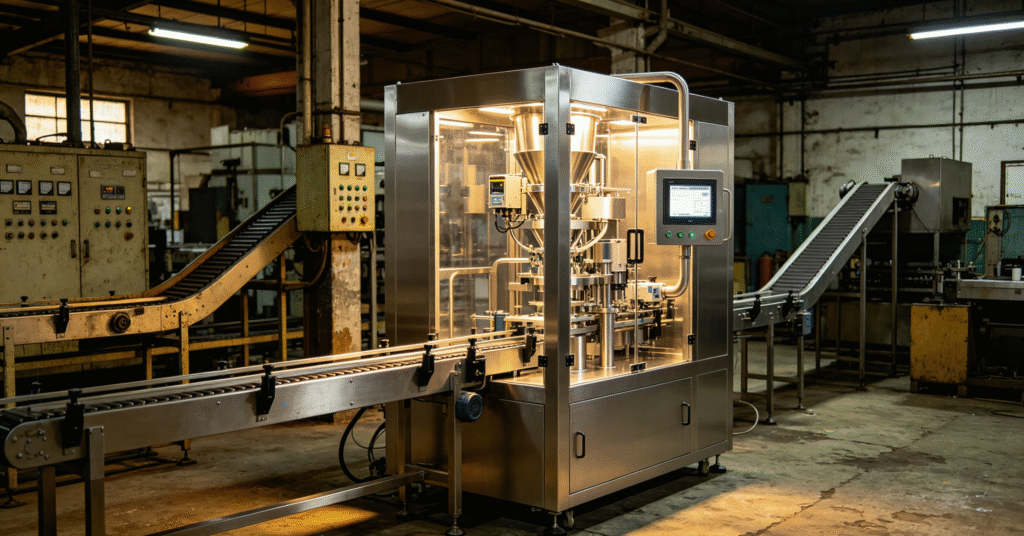
For factories producing liquids, creams, pastes, gels, granules, or semi-viscous products, filling and packing often limit growth. A legacy line may still be mechanically useful, but outdated controls, slow changeover, manual transfer, and poor synchronization can create bottlenecks. A modern filling packing machine can become the new center of the line, connecting upstream preparation equipment, conveyors, sealing units, labeling systems, cartoners, and inspection devices into a more flexible system.
Why Manufacturers Are Upgrading Legacy Production Systems
Manufacturers are upgrading legacy systems because old equipment often costs more to maintain than it appears. The purchase price of a machine is easy to see, but the cost of unplanned downtime, emergency maintenance, rejected products, spare parts, overtime labor, and missed shipments is harder to track. According to the downtime data cited in your original article, unplanned downtime can cost major companies around $1.4 trillion annually, equal to roughly 11% of revenue.
The risk is not limited to large factories. In food processing, your original article notes that downtime can reach approximately $30,000 per hour. Even when the exact number varies by facility, old systems that stop frequently can drain profit quickly.
A new filling packing machine helps address this problem by replacing the weakest production stage with a more stable, data-driven, and automated unit. Instead of running a full “rip and replace” project, manufacturers can modernize the bottleneck first and gain measurable efficiency while keeping useful legacy assets in service.
Why Modernization Does Not Require Replacing the Entire Line
A complete factory rebuild may look clean on paper, but it often creates unnecessary cost and risk. Full-line replacement can require civil work, new utilities, retraining, long shutdown windows, layout redesign, and months of project management. For small and mid-sized manufacturers, that kind of disruption can be difficult to justify.
A modular upgrade is often more practical. The manufacturer identifies the process that limits output, quality, or labor efficiency, then integrates a modern filling packing machine into that area. This makes ROI easier to control because the investment is focused on a specific bottleneck.
A phased strategy also protects operators. Staff can keep using familiar equipment while learning the new HMI, recipes, alarms, and maintenance procedures.
[Suggested image: a modern filling packing machine integrated into an older workshop layout]
What Is a Filling Packing Machine?
A filling packing machine is industrial equipment designed to dose product into containers and prepare those containers for the next packaging stage. Depending on the application, the machine may fill bottles, tubes, jars, pouches, sachets, cans, or custom containers. It may also connect with sealing, capping, labeling, coding, cartoning, weighing, and case packing systems.
In older workshops, filling and packing are often separated by manual handling. A modern filling packing machine reduces these transfer points by combining filling, container handling, sealing, inspection, and packing support into one coordinated workflow.
Different product types require different machine configurations. A liquid filling packing machine may use flow meters, gravity filling, or servo pumps. A paste filling packing machine may require piston filling, heated hoppers, or pressure-assisted feeding. A cream filling packing machine may need gentle product handling to avoid air bubbles, texture damage, or dosing instability. A bottle filling packing machine, tube filling packing machine, and pouch filling packing machine all require different guides, holders, sealing systems, and discharge formats.
How a Modern Filling Packing Machine Works
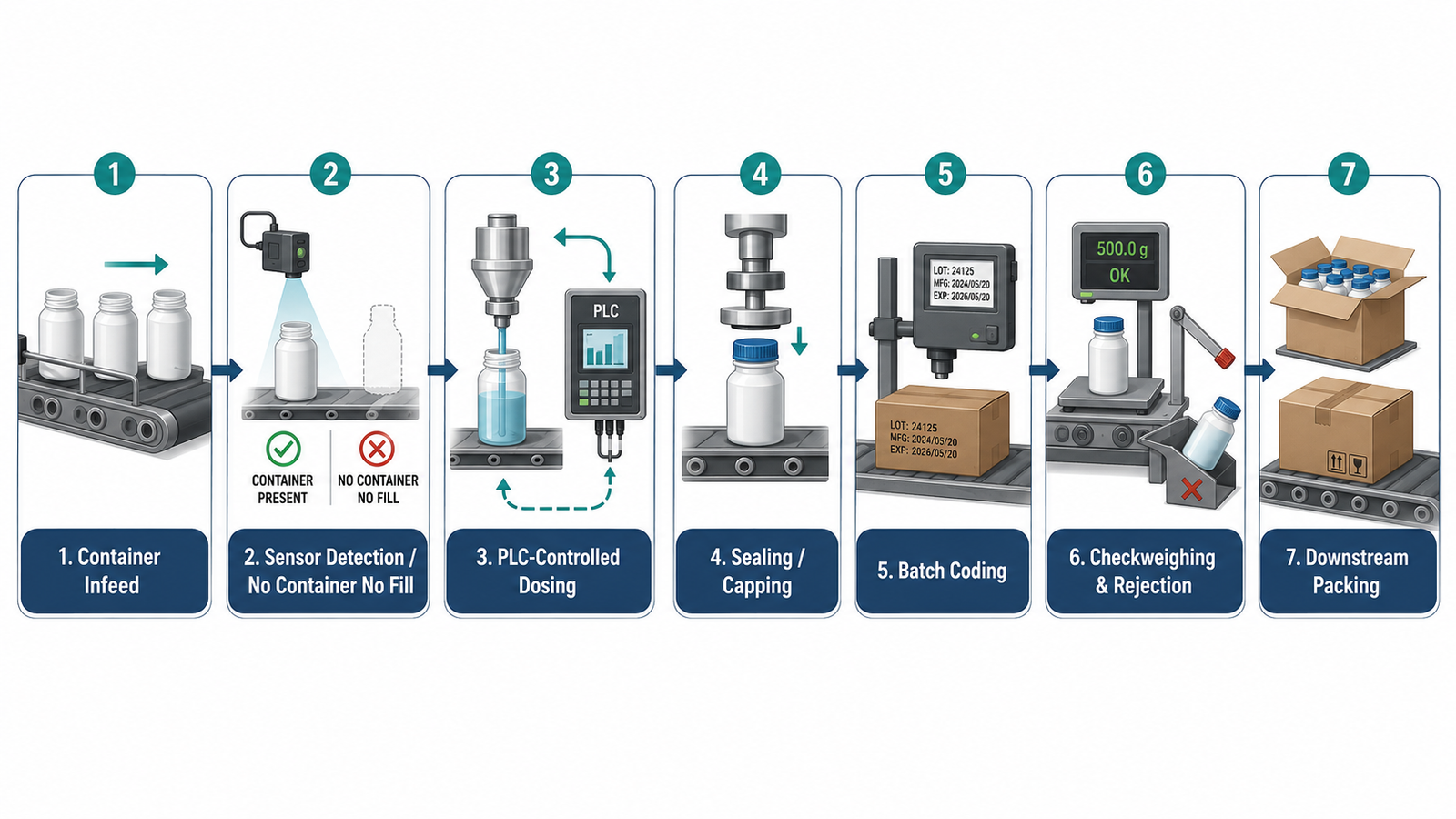
The process starts with container infeed. Bottles, tubes, jars, or pouches are presented to the machine through a conveyor, rotary table, cassette, or feeding system. Sensors confirm container presence before filling begins. This “no container, no fill” logic reduces waste and prevents product discharge into empty stations.
The filling station then doses the product according to the selected recipe. PLC control, servo-driven motion, electronic load cells, or flow-meter feedback can keep the filling volume stable. In modern systems, dosing accuracy may reach very high levels, with your original benchmark noting up to 99.9% dosing accuracy when electronic load cells are used.
After filling, the machine sends the container to sealing, capping, or closing. A bottle line may require a capping machine. A tube line may require hot-air sealing, ultrasonic sealing, or folding. A pouch line may require heat sealing. After closure, the system may apply batch coding, check weight, reject defective units, and transfer accepted products to cartoning or case packing.
The key difference from legacy production is communication. A modern filling packing machine does not simply run mechanically. It uses PLC logic, HMI controls, sensors, and feedback loops to adjust speed, detect errors, store product recipes, and support traceability.
Challenges of Integrating a New Filling Packing Machine into a Legacy System
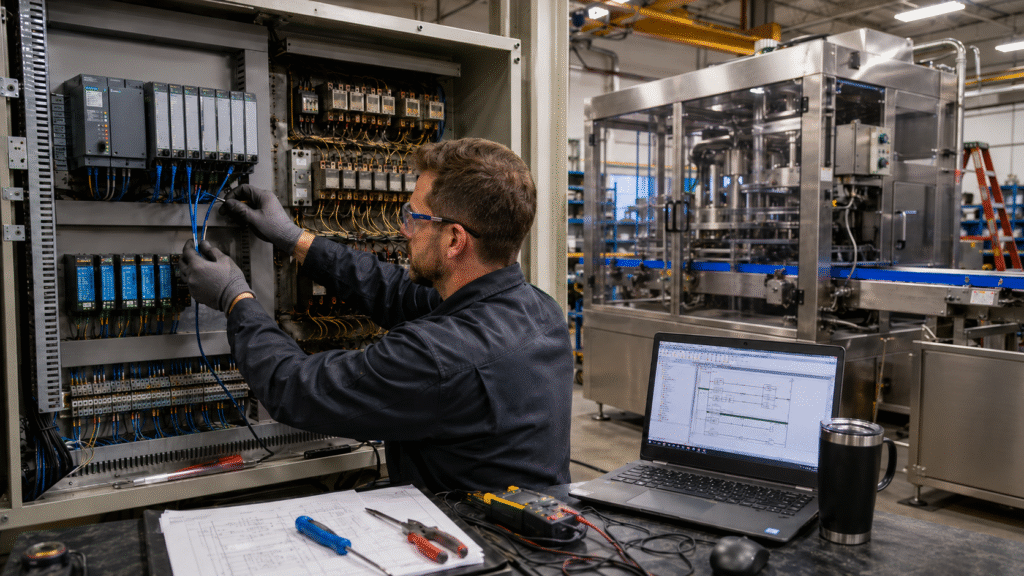
Integration is rarely plug-and-play. Legacy systems may use older relay logic, basic sensors, Modbus RTU, hard-wired signals, or custom control panels. A modern automatic filling packing machine may use Ethernet/IP, PROFINET, advanced PLC communication, cloud data collection, or servo-based motion control. Making old and new equipment communicate requires engineering work.
Speed matching is another challenge. If an upstream mixer, tank, or feeder supplies product faster than the new filling machine can process it, overflow or pressure fluctuation may occur. If the new machine fills faster than the downstream packing area can handle, containers may accumulate and cause jams. Real filling packing line integration requires balancing the entire line, not only installing a faster machine.
Space is also critical. Older workshops were often designed around manual labor and standalone equipment. A high speed filling packing machine may need space for safety doors, product piping, pneumatic connections, maintenance access, conveyors, and operator movement. Floor layout must be checked before purchase, not after delivery.
Key Steps to Integrate a New Filling Packing Machine Successfully
The first step is a production audit. Before choosing a machine, the manufacturer should measure actual throughput, downtime frequency, reject rate, changeover time, labor requirement, cleaning time, and product behavior. The goal is to identify the real constraint, not the assumed constraint.
The second step is compatibility review. Engineers should check container format, fill volume, viscosity, product temperature, required accuracy, existing conveyor height, electrical voltage, compressed-air capacity, cleaning method, safety standards, and available floor space. Control compatibility also matters: the new machine may need signal converters, I/O modules, or a communication gateway to connect with old PLCs or relay panels.
The third step is speed matching. A practical planning formula is: required synchronization rate = upstream output ÷ package volume × safety factor. The safety factor covers surge flow, viscosity variation, and temporary downstream delays.
The fourth step is pre-installation. Mounting platforms, utilities, air lines, product pipelines, drainage, safety zones, and network connections should be prepared while the old line is still running. Physical downtime should be limited to machine placement, connection, testing, and commissioning.
Technical Comparison: Legacy System vs. Modern Filling Packing Machine
| Feature | Legacy System | Modern Integrated Filling Packing Machine |
|---|---|---|
| Dosing Control | Manual weight checks or mechanical cams | Load cells, servo filling, and PLC feedback |
| Changeover Time | 2–4 hours, often tool-required | Less than 15 minutes with digital presets |
| Data Logging | Paper logs with high error risk | Real-time OEE tracking and batch records |
| Maintenance | Reactive break-fix repair | Predictive alerts and planned service |
| Energy Use | Constant motor operation | Servo-driven power-on-demand operation |
| Error Rate | 3%–5% waste | Often below 0.5% waste |
| Integration | Manual transfer between stages | Synchronized filling and packing workflow |
This table shows why modernization is not only about speed. Better control, faster changeover, lower waste, and useful data can be more valuable than the headline output number.
Important Features to Look for in a Modern Filling Packing Machine
A good industrial filling packing machine should be modular. If production grows, the system should support additional filling heads, longer conveyors, upgraded inspection, or downstream packing automation. This prevents the new machine from becoming another bottleneck within two years.
Open communication architecture is also important. A modern filling packing machine should support standard industrial communication protocols or at least offer practical connection options for legacy systems.
Tool-less changeover is another high-value feature. If a workshop handles many SKUs, changeover time can quietly consume production capacity. Digital recipes, adjustable guides, quick-release nozzles, and universal tooling can reduce changeover from hours to minutes.
For regulated or hygiene-sensitive industries, material and cleaning design matter. Product contact parts should be selected according to formula requirements. SS316L is often preferred for contact parts in pharmaceutical, cosmetic, and food applications, while SS304 is commonly used for frames and non-contact structures. Smooth surfaces, accessible parts, and easy cleaning help reduce contamination risk and planned downtime.
Integration with Mixer, Capping Machine, and Existing Packaging Equipment
A filling packing machine is only one part of a production line. Upstream, the mixer or emulsifier determines product texture, temperature, air content, and viscosity. If the mixer output is unstable, filling accuracy can suffer. The connection between the mixer and the filling packing machine should be designed around product flow, pump pressure, pipe length, heating requirements, and cleaning needs.
Downstream, the line may include a capping machine, sealing machine, labeling machine, checkweigher, cartoner, case packer, or palletizing system. The new filling packing machine must communicate with these units to prevent jams and stoppages. If the capping machine slows down, the filling machine should adjust or pause automatically. If the filling station detects a missing container, downstream equipment should receive the correct signal.
This is where a flexible system creates value. A manufacturer can keep useful legacy conveyors or packing units while adding modern control logic around the new machine. The result is a hybrid production line that performs like a newer system without requiring full replacement.
Common Mistakes to Avoid During Integration
The first mistake is assuming “standard” means the same thing across suppliers. Voltage, air pressure, conveyor height, flange size, communication protocol, sensor type, and safety logic must be verified before build.
The second mistake is ignoring future expansion. If demand grows by 10% per year, a machine that only meets current output can become a bottleneck quickly. A 25% to 30% capacity buffer helps protect the investment.
The third mistake is underestimating cleaning, changeover, and training. A fast machine that takes hours to clean may not improve daily output, and operators must understand the HMI, recipes, safety doors, alarms, and basic troubleshooting before full production begins.
Benefits of Integrating a New Filling Packing Machine
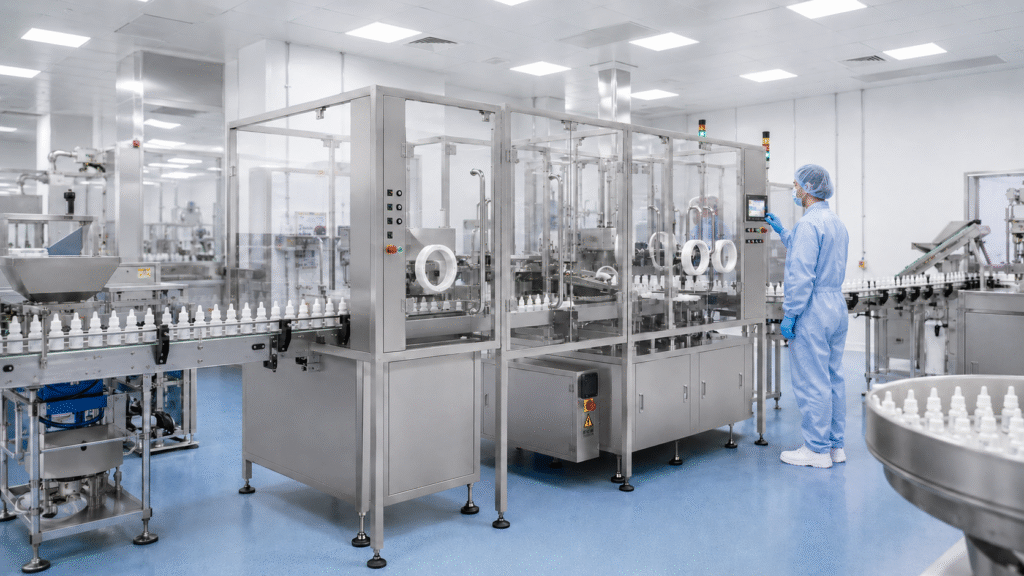
A successful integration can increase throughput, reduce waste, lower labor dependency, and stabilize quality. Your original benchmark notes that modern servo-driven systems can increase throughput by up to 40% while reducing product waste by up to 5%. The exact result depends on the current line condition, product type, and automation level, but the direction is consistent.
Labor efficiency also improves. One automated filling packing machine can often replace several manual transfer or inspection tasks, allowing staff to move into quality control, maintenance, material preparation, or line supervision.
Production stability is another benefit. Automated dosing, controlled sealing or capping, inspection sensors, and digital recipes reduce the “human variable.” Every accepted unit is produced under the same process logic, making batch quality easier to manage.
Why Choose King-Pack’s Filling Packing Machines?
King-Pack helps manufacturers modernize legacy workshops with practical filling packing machine solutions, not one-size-fits-all equipment. Established in 2009, King-Pack has 17 years of experience in high-end packaging machinery for pharmaceutical, cosmetic, food, chemical, and daily chemical manufacturers.
King-Pack machines can be configured for liquid filling, paste filling, cream filling, bottle filling, tube filling, pouch filling, sealing, capping, labeling, and downstream packing integration. Depending on the project, solutions may include SS316L contact parts, SS304 frames, PLC/HMI control, servo-driven filling, electronic weighing, “no container, no fill” protection, tool-less changeover, predictive maintenance options, and open communication interfaces.
For legacy modernization, King-Pack’s engineering team reviews existing machinery, workshop layout, electrical standards, compressed-air supply, product characteristics, container formats, and target output before recommending a system. This reduces installation risk and helps the new machine fit the real production environment.
Custom Integration Solutions for Legacy Workshops
Every legacy workshop has its own limitations. Some lines use aging conveyors. Some rely on old PLCs. Some have unusual container formats, low ceiling height, limited floor space, or temperature-sensitive products. A standardized machine may not solve these issues without adaptation.
King-Pack supports custom integration through adapter kits, product transfer design, PLC programming, signal conversion, layout planning, and commissioning support. For viscous or temperature-sensitive formulas, such as creams and pastes, the filling method can be matched with heated hoppers, piston systems, pressure feeding, or gentle pumping.
This “retrofit first” approach helps manufacturers protect existing assets while improving the most important production stage. The result is not a disconnected new machine, but a modernized line with better synchronization, lower production costs, and more reliable output.
FAQs About Filling Packing Machine Integration
Q: How long does the integration process take?
A: A typical integration project may take 2 to 4 weeks from assessment to commissioning, depending on layout, utilities, control requirements, and machine scope. Physical downtime can often be limited to 48–72 hours with proper pre-installation.
Q: Can a new machine connect with an old PLC?
A: Yes. I/O modules, protocol converters, and custom PLC programming can help connect modern equipment with older Siemens, Allen-Bradley, or relay-based systems.
Q: Can one filling packing machine handle different products?
A: Yes, if the machine is designed with the right filling system, changeover parts, recipes, and cleaning access. Liquids, creams, and pastes may require different pumps or nozzles.
Q: What information should I prepare before requesting a quote?
A: Prepare product viscosity, container type, fill volume, target speed, existing layout, voltage, compressed-air supply, current bottlenecks, and downstream packing requirements.
Q: Does King-Pack provide training?
A: Yes. King-Pack can provide operation guidance, maintenance training, documentation, and after-sales support to help staff run the new system confidently.
Conclusion: Modernize Without Losing the Value of Your Legacy Line
Integrating a modern filling packing machine into an existing legacy system is one of the most practical ways to improve efficiency without rebuilding the entire workshop. The right machine can increase throughput, reduce waste, lower labor dependency, improve data visibility, and extend the useful life of existing production assets.
Modernization succeeds when the new machine is selected around real product behavior, line speed, control compatibility, cleaning needs, and future expansion. With the right engineering partner, old and new equipment can work together as one coordinated production system.
Visit kpfillingmachine.com to request a technical assessment from King-Pack and find the right filling packing machine for your current workshop and future production goals.
Plan Your Filling Line Integration
Review King Pack’s automatic filling and capping line options when planning mechanical, electrical and control-system interfaces. Our after-sales service team can support installation, commissioning and operator training. For a layout-specific proposal, contact King Pack with your existing line drawings, utilities and target output.
