
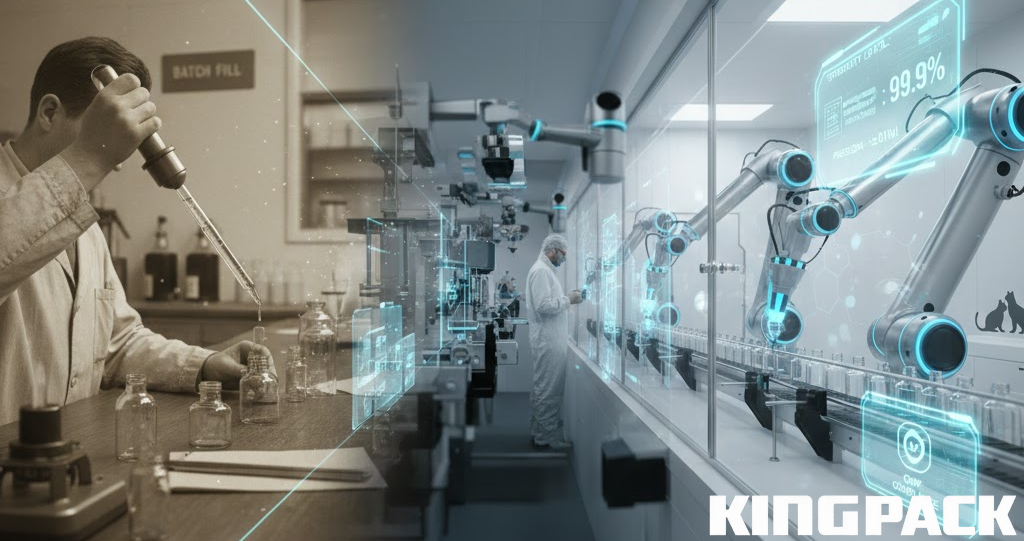
Small and startup pet pharmaceutical manufacturers face constant pressure to control costs while maintaining high product quality. Manual or semi-automatic operations often require multiple operators, cause frequent waste, and complicate GMP compliance.
At King Pack, we design small-scale automatic drop filling machines that help startups reduce labor, improve dosing accuracy, minimize product waste, and maintain compliance. These machines provide a fast return on investment while allowing scalable growth.
In this article, we break down the cost challenges of small-scale production, explain where automation saves money, provide ROI calculation models, and share practical examples for startup pet brands.
Recommended Reading: Pharmaceutical Emulsion Mixer Machine: Vacuum Emulsifying Mixer Machine – King Pack Machinery
Why Cost Control Matters for Small Pet Pharma Factories
For small factories and pilot-scale producers, every dollar counts. Startups often operate with limited budgets and tight timelines. Manual operations increase labor costs, waste, and compliance risk.

Manual filling limitations include:
- High dependency on skilled operators
- Inconsistent dosing accuracy
- Higher likelihood of contamination or quality deviations
Compliance costs, including GMP documentation, cleaning validation, and inspection readiness, add additional financial pressure. Investing in automation reduces these risks while improving efficiency.
Typical Cost Structure in Small-Scale Drop Production
Before automation, small-scale production often incurs high operational costs. Understanding the breakdown helps identify areas where automation delivers ROI.
Labor Cost in Manual or Semi-Automatic Filling
Manual lines require multiple operators per shift, sometimes 3–5 for small batches. Training, turnover, and overtime add to operational expenses.
- Average hourly wage for skilled operators: $15–$20
- Shift duration: 8–12 hours
- Annual labor cost for one manual line can reach $120,000–$150,000
Material Waste and Rework
Small-volume drops are highly sensitive to overfill, leakage, or spillage. Manual handling increases reject rates.
Typical waste contributors:
- Overfilled bottles
- Dripped or leaked product
- Incorrectly capped or labeled bottles
Studies show that manual filling can result in 5–7% product loss, whereas automated micro-filling reduces this to 1–2%, saving thousands annually.
Compliance and Validation Expenses
GMP and cGMP compliance require:
- Detailed batch documentation
- Cleaning and validation downtime
- Audits and inspections
Manual operations often extend downtime for cleaning, increasing costs. Automated lines like our small-scale drop filling machines reduce cleaning time and simplify validation.
Recommended Reading: Multi-Lane Sachet Packing Machines – King Pack High-Speed Liquid & Paste Packaging – King Pack Machinery
What Is a Small-Scale Automatic Drop Filling Machine?

A small-scale automatic drop filling machine is an integrated system designed for startups or small factories producing micro-volume liquids. These machines automate feeding, filling, plugging, capping, and sometimes labeling.
Core Functions
Small-scale automatic drop filling machines provide:
- Bottle feeding: Automatic unscrambling and orientation
- Micro filling: Precise dosing with ±0.5% accuracy
- Plugging and capping: Torque-controlled, secure sealing
- Optional labeling: Batch coding and serialization
Typical Capacity Range
Small-scale machines are ideal for entry-level production:
- 300–1,000 bottles per hour for startups
- Modular expansion to 2,000 bottles/hour as production grows
Suitable Products
These machines handle a wide range of veterinary liquids:
- Pet parasite drops (flea and tick spot-on)
- Ear drops
- Deworming liquids
- Preventive care solutions
Recommended Reading: From Filler to Pallet: The Path to a Fully Automated Packaging Line (Reducing Manual Labor by 40%) – King Pack Machinery
Where Automation Saves Money
Investing in a small-scale automatic drop filling machine saves money in multiple ways.
Labor Reduction
Automation reduces operators from 3–5 to 1–2 per shift. One operator can monitor multiple lines, increasing overall efficiency.
Impact:
- Up to 40% labor cost reduction
- More consistent line monitoring
- Fewer human errors
Filling Accuracy Improvement
High-precision micro-filling ensures stable dosing, minimizing giveaway and product waste. Our servo piston and peristaltic pump systems achieve ±0.3–0.5% accuracy even for volumes as low as 0.5 ml.
Scrap and Rejection Control
Automated capping with torque control reduces leaks and rejects. Anti-drip nozzles prevent spillage, and enclosed filling zones minimize contamination. Various studies show that automated small-scale lines cut rejection rates by 35% compared to manual lines.
Faster Changeover and Cleaning
Startup factories often switch products or bottle sizes frequently. CIP/SIP-ready systems allow faster changeovers and cleaning, reducing downtime and increasing available production hours.
Table: Cost Savings with Automation vs Manual Filling
| Cost Factor | Manual/Semi-Automatic | King Pack Small-Scale Automatic Line |
| Labor Cost per Month | $10,000–$12,500 | $6,000–$7,500 |
| Product Waste | 5–7% | 1–2% |
| Downtime for Cleaning (hrs/shift) | 2–3 | 0.5–1 |
| Compliance Documentation Effort | High | Medium (automated logging) |
| Line Operators | 3–5 | 1–2 |
ROI Calculation Model for Drop Filling Equipment
Investing in automation can be quantified using a simple ROI model.
Investment Cost Components
Initial investment includes:
- Machine price: $45,000–$80,000 for entry-level small-scale lines
- Installation: $5,000–$10,000
- Training and startup support: $2,000–$5,000
Monthly Operating Cost Before Automation
Manual line costs include:
- Labor: $10,000/month
- Waste: $1,500–$2,000/month
- Downtime: 20–30 hours/month
Monthly Operating Cost After Automation
With automation:
- Reduced manpower: $6,000–$7,500/month
- Lower reject rate: $400–$800/month
- Stable throughput: 20–30% higher output
Payback Period Formula
ROI is calculated as:
Payback Period = Initial Investment ÷ Monthly Savings
Example:
- Total investment: $60,000
- Monthly savings: $6,000
- Payback period: 10 months
This demonstrates that even small-scale factories can recover costs quickly with King Pack micro-volume drop filling machines.
Recommended Reading: Knowledge of Pharmaceutical Blister Packaging Machines – King Pack Packaging Solutions – King Pack Machinery
Beyond ROI – Strategic Benefits of Automation for Small Pet Pharma Factories
Return on investment is often the trigger for automation. For small pet pharma factories, the longer-term benefits matter just as much. Automation changes how a factory operates, not only how much it spends.
Quality Stability and Batch Consistency

Manual filling produces variable results. Even experienced operators show drift over time. Fatigue, shift changes, and small setup differences affect output.
Automated drop filling machines deliver repeatable results. Once parameters are set, the system maintains the same dosing and sealing behavior across batches. This stability reduces internal debates about quality and simplifies release decisions.
For startups building brand trust, consistent product performance matters as much as cost control.
Regulatory Confidence and Audit Readiness

Small factories often feel exposed during inspections. Manual records, inconsistent cleaning logs, and operator-dependent steps create uncertainty.
Automation reduces this pressure. Enclosed filling, controlled dosing, and structured cleaning procedures make audits more predictable. Documentation becomes easier to prepare and defend.
At KPFilling, we design machines with clear layouts and accessible product paths. Inspectors can see how the process works. Validation becomes less about explanation and more about confirmation. This confidence saves time and reduces disruption during audits.
Scalability Without Rebuilding the Factory

Growth creates a common problem for startups. Manual lines cannot scale without adding people. Adding people increases variability and cost.
Small-scale automated machines scale differently. Output increases by extending run time or adding modular upgrades. Labor stays stable. This allows startups to grow step by step instead of jumping into large capital projects too early.
Recommended Reading: Pesticide Liquid Filling Machine Guide: Working, Types, and Buying Tips – King Pack Machinery
How to Choose the Right Small-Scale Drop Filling Machine
Not all small-scale machines are suitable for startup Animal Health or pet health production. Price alone should not drive the decision. Mismatch creates cost later.
Volume Range and Micro-Dose Capability
Many veterinary medicines and Veterinary Pharmaceutical Solutions require very small volumes. The machine must handle these accurately and repeatably.
Before selecting equipment, manufacturers should confirm:
- Minimum reliable filling volume
- Accuracy at low volumes
- Stability over long runs
A machine that fills well at 5 ml may struggle at 0.5 ml. This detail affects patient outcomes, waste, and compliance.
Chemical Compatibility
Compounded medications, flavored liquids, and transdermal creams often include alcohols, oils, or solvents. These attack standard seals and mild steel parts.
Equipment should use compatible materials in all product-contact areas. At KPFilling, we use SS316L contact parts and chemical-resistant seals to handle aggressive formulations safely.
Ignoring this leads to premature wear, contamination risk, and unplanned downtime.
Cleaning and Changeover Design
Startups rarely run one product forever. SKU changes are frequent.
Machines should allow:
- Easy access to product paths
- Smooth surfaces that do not trap residue
- Fast disassembly where required
CIP system-friendly design reduces cleaning time and improves validation consistency. This directly affects available production hours for Animal Health, veterinary medicines, and compounded formulations.
Future Expansion Planning
Small factories should not buy equipment that locks them into a fixed setup. Modular design matters.
A machine should allow:
- Speed upgrades
- Additional modules such as labeling for dosage forms, solid treats, or ophthalmic solutions
- Integration with downstream PET bottle blowing machines, blow moulding lines, or packaging lines
This avoids replacement when demand increases and supports scalable growth in veterinary healthcare and pet health production.
Why King Pack for Small Pet Pharma Filling Solutions
At King Pack, we work with many startups at early stages. Our approach focuses on realistic needs, not oversized systems.
Precision Micro-Filling Technology
Our small-scale drop filling machines use servo piston or peristaltic filling systems depending on formulation behavior, suitable for veterinary medicines, compounded formulations, flavored liquids, transdermal creams, and ophthalmic solutions.
Both options deliver stable accuracy at micro volumes. Internal project data from KPFilling shows ±0.3–0.5% dosing accuracy for volumes below 1 ml under continuous operation.
This level of control reduces giveaway, minimizes waste of active ingredients, and supports compliance with USP guidelines for Veterinary Pharmaceutical Solutions.
Modular Systems Designed for Startups
We design our machines as modular platforms. Startups can begin with core filling and capping. Labeling, inspection, and batch coding modules can be added later.
This staged approach reduces upfront investment while keeping future options open, allowing integration with PET bottle blowing machines, blow moulding lines, or packaging lines as production scales.
Turnkey Support From Pilot to Mass Production
Automation should not overwhelm small teams. We provide support through installation, setup, and operator training. Layouts are designed for simple operation and clear documentation.
As production grows, the same platform can support expansion without major disruption, helping startups in Animal Health, pet health, and veterinary healthcare maintain efficiency and consistent patient outcomes.
Recommended Reading: The Realities of Recapping Single-Use Eye Drop Vials – King Pack Machinery
Common Buying Mistakes Small Factories Should Avoid
Many small factories make similar mistakes when investing in equipment. One common issue is choosing based only on price. Low-cost machines often lack accuracy, cleanability, or material compatibility. These gaps create hidden costs later.
Another mistake is overbuying. Large, complex lines strain budgets and underutilize capacity. Small-scale automation works best when it matches current demand with room to grow. Finally, ignoring service and support creates long-term risk. Downtime costs more than the initial machine price.
FAQ – Small-Scale Drop Filling Investment
How small can the filling volume be?
Our small-scale machines reliably handle volumes as low as 0.3–0.5 ml with stable accuracy.
Is automation worth it for startups?
Yes, when labor cost, waste, and compliance risk are considered together. Many startups recover investment within 12–24 months.
What is the typical ROI period?
For most small pet pharma factories, payback falls between 10 and 24 months, depending on volume and shifts.
Can one machine handle multiple products?
Yes. Recipe control and modular design allow multiple SKUs on one platform.
How can factories control cost while meeting GMP?
By choosing compact automated equipment with hygienic design and predictable performance instead of expanding manual operations.
Closing Perspective
For small pet pharmaceutical factories, cost control and quality control are closely linked. Manual filling appears flexible but creates hidden expense and instability over time. A small-scale automatic drop filling machine changes this balance. At King Pack, we design filling solutions that fit the reality of startups and small producers. Smart automation is not about size. It is about control, stability, and long-term viability.
Contact us today to explore how our small-scale drop filling machines can optimize your production and boost efficiency.