
Last reviewed: September 1, 2026.
A veterinary vaccine diluent bottle is not an ordinary secondary bottle. Its recoverable quantity, identity, closure and kit position must agree with the vaccine presentation and the approved manufacturing and labeling strategy. A line can fill within its mechanical target yet still create a commercial risk if the wrong diluent volume is paired with a multidose vial, a stopper is only partly seated, a cap hides a closure defect, or the diluent label cannot be reconciled to the vaccine kit.
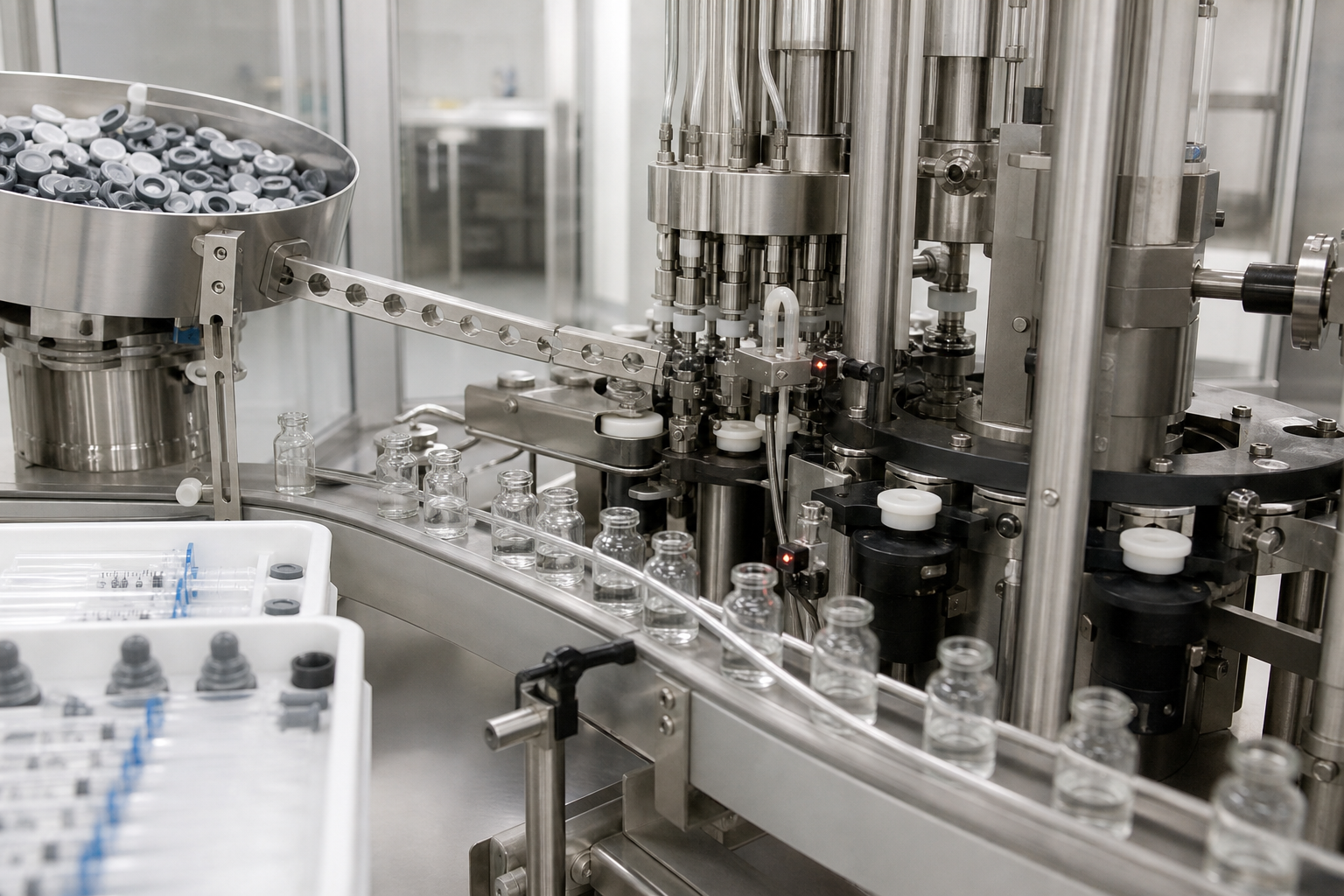
The equipment boundary therefore extends beyond the filling nozzle. It includes container preparation, bulk-feed conditions, dosing, stopper or insert handling, capping, visual and in-process checks, label control, line clearance and the physical or electronic interface to kit assembly. The owner must also decide which operations are performed in a controlled or aseptic area and which acceptance criteria belong to the licensed process. Those decisions cannot be inferred from a catalog output rate.
This article is deliberately a companion to the existing vial filling machine selection guide. That page addresses primary vial-filling selection. Here, the subject is the separate diluent container and its match to the vaccine kit; no aseptic grade, sterilization cycle or regulatory release condition is assumed without the product owner's approved process.
Quick answer: Specify a veterinary vaccine diluent bottle filling line from the complete presentation, not from bottle volume alone. Freeze the vaccine dose and reconstitution ratio, required recoverable diluent quantity, bottle and closure drawings, bulk and environmental controls, label and serial logic, kit-pairing rule, inspection plan and target output. Then test filling, closure insertion, capping, label verification and reconciliation with worst-case approved components at startup, steady run, restart, low bulk level and batch end.
Define the Product and Regulatory Boundary First
Direct answer: Separate the diluent operation from the vaccine primary-container operation, then document where product, quality and equipment responsibility begins and ends.
Start with the approved product concept: vaccine true name, presentation, number of doses, reconstitution instructions, diluent composition, container quantity, administration route and destination markets. Identify whether the diluent is filled in the same establishment and campaign as the vaccine or supplied through a separate approved arrangement. The site quality and regulatory teams should determine the governing requirements and approved Outline of Production or equivalent dossier commitments.
For U.S. veterinary biologics, USDA APHIS Center for Veterinary Biologics material explains that sterile diluent is not itself considered a veterinary biological product, while the licensee must provide the proper amount when it is required for rehydration or dilution. The same APHIS document notes that in most cases the diluent is packaged with the final container of licensed product, with stated exceptions. That is a kit-control input, not a universal equipment recipe.
Create a responsibility matrix for bulk preparation and release, component preparation, filling, closure, inspection, labeling, storage and kit assembly. Mark the approved handoff points and required records. If the diluent path is sterile, the manufacturer must define the validated sterilization and aseptic-processing strategy; the equipment supplier should implement specified interfaces without making unsupported sterility claims.
Match Recoverable Diluent Quantity to the Vaccine Presentation
Direct answer: The nominal bottle size, machine set point and required recoverable quantity are different values and must be connected by an approved calculation and test method.
Begin with the volume needed to reconstitute or dilute the vaccine as directed, including the number of doses and any justified process or administration allowance. Then define the label quantity, allowable fill or mass range, container capacity, closure displacement and the method used to demonstrate recoverable quantity. Do not add an arbitrary overfill or reuse an allowance from another bottle.
USDA's 9 CFR 112.3 requires the U.S. diluent label to include, among other items, the name Sterile Diluent and the recoverable quantity in cubic centimeters or milliliters. It also specifies identification information such as a serial number linked to manufacturing records. Applicability and approved wording must be confirmed with the responsible regulatory team.
Translate the quality requirement into a machine trial. Challenge the lowest and highest approved set points, actual bottle tare variation, bulk temperature and density where relevant, priming, planned stops and low supply level. Record both the meter output and finished-container result using the site's approved method.
| Input | Question to freeze | Line consequence | Evidence to retain |
|---|---|---|---|
| Vaccine presentation | Single or multidose; reconstitution ratio; administration method | Diluent quantity, label and kit rule | Approved presentation and packaging specification |
| Diluent quantity | Recoverable amount and acceptance method | Meter range, check frequency and reject logic | Development data and controlled specification |
| Container capacity | Nominal volume, brimful capacity, headspace and closure displacement | Nozzle depth, fill level and overflow margin | Supplier drawing and component measurements |
| Bulk properties | Density, temperature, viscosity, bubbles and hold limits | Meter selection, feed control and sampling | Approved process range and representative trial |
| Kit architecture | Vaccine-to-diluent ratio and physical grouping | Line balance, code verification and reconciliation | Master packaging record and challenge matrix |
Build a Component Tolerance Stack
Direct answer: Use controlled bottle, stopper, cap and label drawings together; each component can be acceptable alone while the assembled system is difficult to run.
Collect drawings and approved samples for the bottle body, neck finish, flange or crimp geometry, stopper or insert, cap, label and any tray or nest. Record dimensional tolerances, material, surface treatment, supply orientation, allowable cosmetic defects and the component cleanliness or preparation state at the line inlet.
Create a tolerance stack for the operations that touch the package: bottle guiding, nozzle entry, stopper pickup, insertion depth, cap placement, crimp or torque, label wrap and vision inspection. Include maximum and minimum component combinations, not only nominal samples. A cap that runs well on the average bottle may scuff, tilt or fail to seat at a tolerance extreme.
Use incoming inspection and supplier-change control to protect the validated range. If a component mold, elastomer formulation, coating or sterilization method changes, assess its effect on friction, deformation, particles, seal integrity and machine settings before routine use.
Choose a Filling Principle from the Diluent and Dose Range

Direct answer: Select the metering method from dose range, product path, cleanliness, changeover and validation needs—not from a universal pump ranking.
Diluent may be water-like, but the line still has to manage dose range, tubing or seal compatibility, bulk supply, air, dripping, cleaning and any aseptic boundary. Candidate principles can include peristaltic, piston, time-pressure, magnetic-pump or other validated systems. The process owner should state what may contact the product and how the path is prepared between batches.
The pump comparison guide is useful for the first shortlist. Final selection requires representative liquid and containers, the approved dose range and a documented test protocol. A water trial can confirm basic motion but may not represent the actual bulk, temperature, bubble behavior or closure sequence.
Define how the line primes, detects or prevents air, controls the first containers after a stop and recovers residual liquid. Product-contact parts, tubing and filters must be traceable to the supplied specification, and replacement intervals should be based on evidence rather than an unrecorded operator judgement.
Control Nozzle Entry, Drip and Container Cleanliness
Direct answer: The nozzle must dose without touching the container, wetting the closure zone or creating an uncontrolled splash or bubble pattern.
Set nozzle outside diameter, tip geometry, height and motion against the smallest approved bottle opening and worst-case positional tolerance. Use bottle stabilization and neck guidance that do not damage the finish. If bottom-up or staged filling is proposed, verify the trajectory with the final container and line speed.
A positive shutoff, controlled retraction or another anti-drip method may be required, but any suck-back must be checked for air entry and next-dose variation. Observe the neck and stopper-contact area after startup, normal production, planned stop and restart. Define an inspectable limit and a response when the closure zone becomes wet.
Container cleaning or preparation depends on the approved process and incoming component state. The equipment specification should define how containers enter the line, how they are protected, and what happens after a jam or prolonged exposure. Do not add air rinsing or another treatment without assessing contamination and validation implications.
Engineer Stopper, Insert and Cap Handling as One Closure Process
Direct answer: Closure feeding, placement, seating and final securing must be tested as a connected sequence with the full component tolerance range.
Map the intended closure architecture. A vial-style package may use a stopper followed by an aluminum seal; another bottle may use an insert and screw cap. The equipment should not be described as suitable until the approved materials, dimensions, preparation state and application forces are known.
For a stopper, monitor orientation, pickup, insertion path and final seating. For a crimped seal, verify cap presence, skirt formation and visible defects using the owner’s criteria. For screw caps, define pickup, thread start, torque monitoring if used and the relationship between application settings and closure-system performance.
A line sensor can confirm that a component is present, but presence is not the same as acceptable seating or integrity. Combine sensor checks with representative visual, dimensional, force, torque, leak or other package tests selected and validated by the manufacturer.
Design In-Process Inspection and Reject Handling
Direct answer: Every critical inspection needs a defined location, test method, acceptance limit, reject path and response to a failed challenge.
Typical line questions include bottle presence, fill quantity, closure presence and seating, cap condition, label identity, code readability and gross cosmetic defects. Not every attribute can be proven by an online sensor. The quality plan should distinguish automated checks, operator inspections, laboratory or offline tests and final release decisions.
Select check frequency from risk and process capability. Include startup, after adjustment, after stop or jam, during the run and batch end. Trend results rather than treating each check as an isolated pass. If a drift is detected, define the affected interval, product segregation and investigation route.
Rejects must be physically controlled and reconciled. A failed bottle should not be able to fall back into accepted flow. Challenge each detection and reject function during FAT or SAT with approved test pieces, including consecutive rejects and a full reject-bin condition where applicable.
Protect Label, Serial and Kit-Pairing Identity
Direct answer: The line must make it difficult to pair an acceptable diluent bottle with the wrong vaccine, label, serial or kit count.
Use the master packaging record to define the diluent label, vaccine label, serial or lot relationship, expiration information, kit quantity and any country-specific components. Separate label issuance, printer setup, code verification and reconciliation. Vision inspection should compare to the controlled job, not merely confirm that ink exists.
APHIS 9 CFR 112.3 identifies specific information for U.S. diluent labels, including recoverable quantity and a serial number that links to preparation records. The regulation also contains conditional statements for certain multiple-dose or organism-related situations. A packaging line should reproduce only approved artwork and rules supplied by the licensee.
At the kit interface, define whether the diluent and vaccine are grouped mechanically, by a verified code, by a controlled batch relationship or by another approved method. Challenge mixed lots, missing components, unreadable codes and line restart. Reconcile good kits, rejects, samples and remaining components at campaign end.
Balance Filling, Labeling and Kit Assembly Capacity
Direct answer: Base capacity on the slowest validated operation and the real changeover and inspection burden, not the nameplate speed of the filler.
Calculate demand by presentation: bottles per kit, kits per batch, campaign size, shifts, planned efficiency and required changeovers. Then model each operation—container feed, fill, closure, cap, inspection, label and kit assembly—using sustainable rates and buffer limits.
A large buffer can decouple stations but increases work in process and identity-control risk. A small buffer exposes every brief stop. Define maximum accumulation, first-in/first-out behavior, protection from mix-up and the disposition of units left in transfer when a fault occurs.
Use the KING PACK filling and capping line platform as a starting equipment family, then size the project around the approved presentation and kit logic. Request a line-balance table that shows assumptions, format-specific rates and the expected bottleneck.
| Operation | Capacity input | Failure to challenge | Acceptance evidence |
|---|---|---|---|
| Container feed | Bottle stability and approved range | Starvation, scuffing or mixed components | Sustained feed and jam-recovery trial |
| Fill | Dose range and bulk-feed window | Air, drip or restart variation | Traceable in-process results by operating state |
| Closure/cap | Component tolerance and prepared state | Mis-seat, tilt or incomplete securement | Worst-case component challenge |
| Inspection/label | Check cycle and code database | False accept, false reject or wrong job | Challenge set and reconciliation record |
| Kit assembly | Diluent-to-vaccine ratio and grouping rule | Missing or mismatched component | Deliberate mismatch challenge and batch balance |
Plan Changeover, Line Clearance and Cleaning
Direct answer: Changeover must remove the previous product identity and restore the correct mechanical and electronic setup with traceable verification.
List all format parts: guides, starwheels, screws, nozzles, stopper tooling, cap chutes, sensors, label plates, printer files and inspection recipes. Use identification and setup checks that prevent a correct-looking but wrong-size component from being installed.
Line clearance should cover bottles, closures, labels, printed material, rejects, samples and electronic jobs. Define who performs and who verifies the clearance. Include difficult locations such as feeder bowls, conveyor returns, printer cabinets and reject containers.
Cleaning requirements depend on the approved product and area. Map the bulk tank, transfer line, meter, nozzle and any product recovery path. Establish disassembly, cleaning, preparation and storage procedures with the manufacturer; FAT can verify access and sequence but cannot substitute for site validation.
FAT and Qualification Checklist
Direct answer: The acceptance program should challenge the complete presentation and kit interface, not only run empty bottles through separate machines.
FAT demonstrates the agreed machine functions under documented test conditions. It does not establish the finished product’s sterility, container-closure integrity, regulatory approval or process validation. Keep those claims with the manufacturer and the applicable site protocols.
- Approve bottle, closure, label and kit samples with revision-controlled drawings before the trial.
- State actual product or justified simulant, dose range, temperature and bulk-feed conditions.
- Challenge minimum and maximum approved component tolerances where samples are available.
- Record fill results at startup, sustained run, planned stop, restart, low supply and batch end.
- Challenge missing, tilted and mis-seated closures plus cap or seal defects using approved test pieces.
- Verify label job selection, code readability, serial relationship and wrong-component rejection.
- Demonstrate reject segregation, bin-full response and reconciliation of all challenge units.
- Run the format-specific sustainable rate and document the bottleneck and buffer behavior.
- Demonstrate changeover, line clearance, product-path access and controlled restart.
- List open site items for SAT, calibration, environmental verification and qualification.
How to Evaluate a Vaccine Diluent Line Supplier
Direct answer: Choose a supplier that asks how the diluent belongs to the vaccine presentation and can document interfaces, assumptions and acceptance tests.
- Ask for the component and product data request before reviewing a final quotation.
- Review the process flow, product path, layout, controls, alarm matrix and line-balance assumptions.
- Require a tolerance and sample-trial plan for bottle, stopper or insert, cap and label.
- Confirm how label jobs, code verification, rejects and kit reconciliation are controlled.
- Review FAT/SAT scope, manuals, calibration, spare parts, training and qualification support.
- Verify the exact scope of CE, ISO or other documents; do not treat a generic certificate as product approval.
How KING PACK Supports Diluent Bottle and Kit Interfaces
Direct answer: KING PACK can configure a filling and closure line around the customer’s approved diluent quantity, components, inspection plan and kit handoff.
KING PACK Machinery is a China-based manufacturer of pharmaceutical, veterinary, cosmetic and liquid filling and packaging equipment. Its core platforms include tube filling and sealing, vacuum emulsifying, liquid filling and capping, pet spot-on filling and prefilled syringe production systems.
For a veterinary vaccine diluent project, the supplied scope can be developed from the required product path, metering principle, bottle handling, stopper or insert placement, cap or seal application, inspection, labeling and downstream interface. The KING PACK pharmaceutical-industry solutions provide related equipment context; the final arrangement must be based on approved process and package data.
To start an engineering review, send the primary vaccine vial and diluent bottle specifications, recoverable-volume target, closure samples, label and serial logic, kit count, batch size, target output, environmental boundary and acceptance tests through the KING PACK contact page. The response can then focus on the exact interface risks instead of a generic line description.
Frequently Asked Questions
Is a vaccine diluent bottle line the same as a vaccine vial filling line?
No. The diluent has its own bulk, quantity, container, closure, label and kit relationship. It may share equipment principles, but the approved process boundary and acceptance criteria must be defined separately.
How much overfill should be added to a diluent bottle?
There is no universal value. The manufacturer must establish the required recoverable quantity, component capacity, process variation and test method, then justify the machine target within the approved specification.
Does every diluent use a rubber stopper and aluminum seal?
No. Use the approved closure architecture for the product and market. Equipment selection follows the controlled component drawings and required package performance.
Can a vision system prove closure integrity?
Not by itself. Vision can detect defined visible conditions. Integrity or seal-performance claims require the manufacturer’s qualified test strategy and acceptance criteria.
Should diluent and vaccine labels use the same serial number?
The relationship must follow the approved product, labeling and batch-record strategy. The line should verify and record the controlled rule rather than assume one numbering model.
Can the line supplier define the aseptic grade?
The product owner must define the contamination-control and regulatory requirements. The supplier can implement agreed enclosure, cleaning, sterilization and interface features and provide evidence for machine acceptance.
What components should be used at FAT?
Use approved or production-intent bottles, closures, caps, labels and trays, including justified tolerance extremes where possible. Record any difference between FAT samples and commercial components.
What should be included in the RFQ?
Include vaccine and diluent presentation, recoverable quantity, component drawings and samples, bulk conditions, environmental boundary, label and kit logic, inspection plan, format list, target output and qualification documents.