
Last reviewed: August 31, 2026.
A veterinary spot-on line is not only a pipette filler. The quality and repeatability of a small-dose package depend on what reaches the filler: concentration, temperature, dissolved gases, suspended matter, solvent content and feed pressure. If the preparation vessel, filter, holding strategy and transfer loop are specified separately, the filler may receive a product state that changes between the beginning and end of the batch.
The engineering boundary should therefore start at raw-material charging and end at the filler inlet. The process owner must define the formulation, active and excipient sensitivities, solvent hazards, acceptable contact materials, mixing sequence, f

iltration purpose, bulk hold time, transfer conditions, cleaning method and the filler demand profile. Those inputs determine whether the system needs closed charging, inert-gas management, light protection, temperature control, single-pass filtration, controlled recirculation or a simple short feed path.
This article deliberately does not repeat the existing pet spot-on filling application page. It owns the upstream preparation-to-filler interface. Pipettes appear only where the feed condition affects filling, sealing-zone cleanliness or batch reconciliation. Product registration, formulation stability, occupational safety and site classification remain the manufacturer’s responsibility.
Quick answer: Design a veterinary spot-on liquid production line as one controlled path from the preparation vessel to the filler inlet. Freeze the formulation and solvent data, define a mixing endpoint, qualify contact materials and filtration by product recovery and quality, establish maximum bulk and recirculation hold times, size the transfer path for the filler’s real demand pattern, and verify concentration, temperature and pressure at start, restart and batch end. If flammable vapor may be present, a qualified site-specific hazardous-area assessment must precede electrical and ventilation decisions.
Map the Preparation-to-Filler Interface
Direct answer: Use one process map that assigns every vessel, filter, pump, line, valve, instrument and control boundary to an owner and an acceptance test.
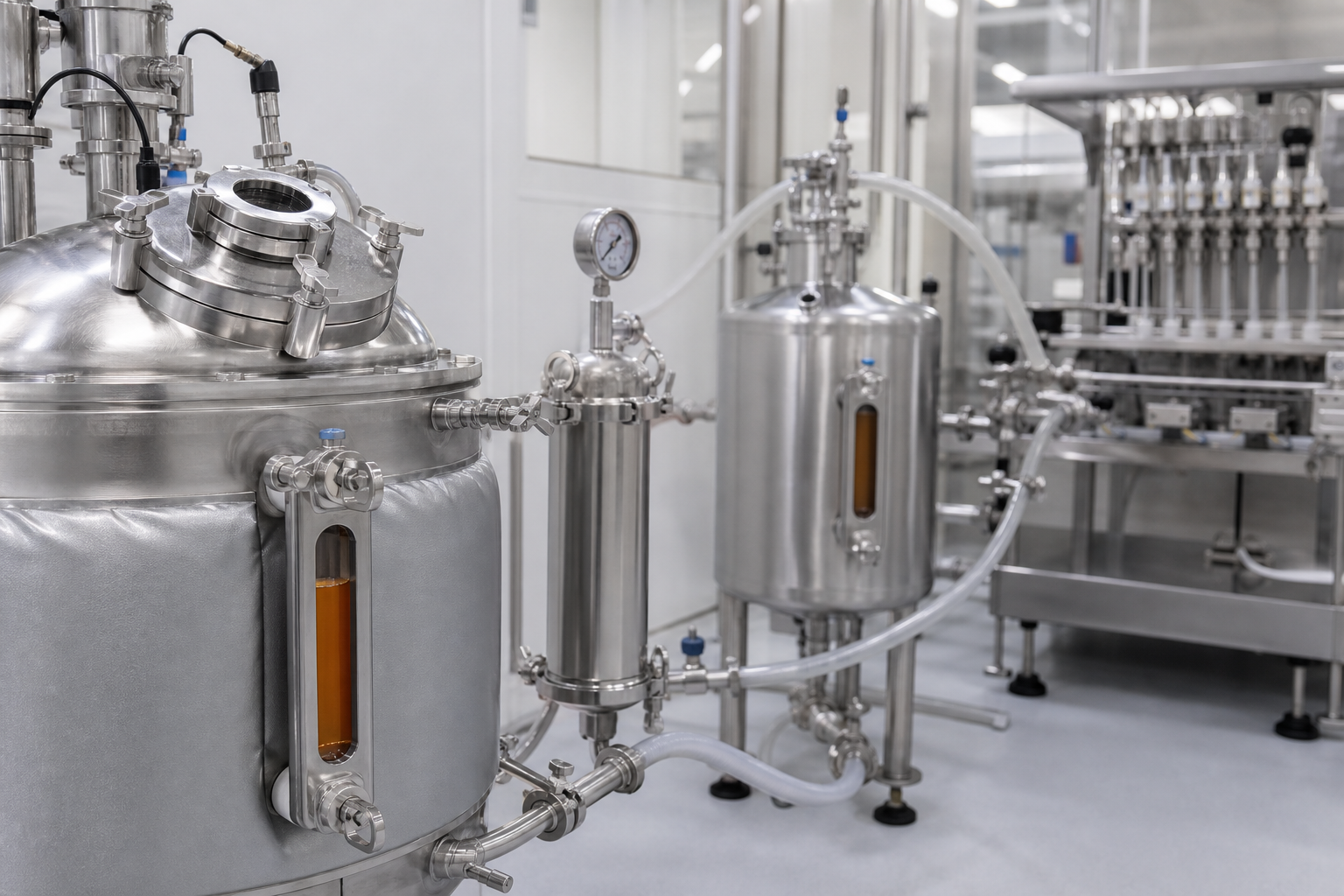
Begin with a process flow diagram that shows charging, mixing, temperature control, sampling, filtration, holding, transfer, return or recirculation, filler feed and recovery. Mark the product-contact boundary, drain points, vents, nitrogen or other inert-gas connections if justified, pressure-relief provisions, sample points and the physical point at which the filler supplier takes responsibility.
Add a material-and-information flow. Raw-material identity, quantities and sequence belong to the formulation record; vessel load cells or other measurement systems need a defined role; filter installation and integrity or condition checks need ownership; and the filler must communicate demand, stop, low-level and fault states back to the upstream system. A line can be mechanically connected yet operationally uncontrolled when those signals are missing.
Keep a separate list of assumptions. Examples include an assumed maximum solvent vapor concentration, assumed batch transfer time, assumed product viscosity at room temperature or an assumed filter life. Convert each assumption into a data request or trial before design approval.
| Interface | Input to freeze | Design consequence | Evidence to request |
|---|---|---|---|
| Formula to vessel | Sequence, solubility, temperature, shear, light and oxygen sensitivity | Agitation, charging, jacket, enclosure and controls | Development data and representative batch procedure |
| Vessel to filter | Solids or clarity target, product loss, compatibility, pressure limit | Filter type, area, housing, bypass prevention and sampling | Filter study with recovery and quality results |
| Filter to hold | Maximum hold time, temperature, headspace and mixing need | Day tank, gentle agitation, blanketing and alarms | Hold-time and concentration data |
| Hold to filler | Demand profile, allowable pressure, flow, pulsation and stop duration | Pump, line size, control valve, buffer and return logic | Interface trial over start, run, stop and restart |
| Product path to cleaning | Residue, solubility, toxicity, carryover and solvent handling | Drainability, disassembly, CIP/COP and waste route | Cleaning development and inspection plan |
Define the Formula and Solvent before Choosing Equipment
Direct answer: A machine supplier needs measured formulation behavior and safety data, not only the active name or nominal batch volume.
Record the active and excipient functions, solvent composition, density, viscosity with test method and temperature, surface tension where it affects wetting, volatility, flash point from the applicable safety data, water sensitivity, light and oxygen sensitivity, corrosivity, elastomer compatibility, expected particles and cleaning solubility. The formulation owner should also provide concentration limits, assay or other critical quality attributes and any justified temperature and exposure limits.
Do not infer stability from a single active ingredient. The commercial formulation, impurities, antioxidants, chelators, solvent grade, headspace, packaging and process history can change the result. The existing fipronil active-protection article can frame degradation questions, while the project must use formulation-specific development and stability data.
For a new or changed product, ICH Q1A(R2) describes stability testing as evidence that supports a product’s shelf life under defined conditions. It does not prescribe a mixer or filter for spot-on liquids. Use stability knowledge to set process boundaries, then confirm those boundaries through development and validation appropriate to the veterinary product and destination market.
Control Mixing without Creating a New Product Risk
Direct answer: Mix only as strongly and as long as needed to achieve the defined endpoint, while controlling heat, air entrainment, evaporation and wall or shaft hold-up.
Select impeller type, diameter, speed range and vessel geometry from the required duty: dissolution, blending, wetting or suspension control. A clear solution may need efficient turnover with limited vortexing; a formula containing difficult powders may need a defined wetting method; and a shear-sensitive component may require a lower-energy step after dispersion. A universal revolutions-per-minute value is not transferable between vessel sizes.
Define the endpoint using evidence such as mixing time, concentration uniformity, clarity, particle condition or another justified attribute. Sample location matters. A top sample can appear acceptable while a poorly swept bottom zone retains concentrated material. Development should establish where to sample and whether a recirculation sample represents the vessel.
Closed charging and headspace control can reduce vapor release or moisture exchange, but they introduce their own design requirements. Any use of inert gas needs an oxygen-deficiency and pressure-safety review. Temperature probes should represent the bulk state, and control logic should prevent heating or cooling beyond the formulation’s proven operating window.
Select Materials, Seals and Surface Finish by Compatibility
Direct answer: Product-contact materials must be suitable for the actual formula, cleaning agents, temperature and exposure time, with documentation tied to the supplied components.
The stainless-steel grade alone does not complete a compatibility review. Gaskets, pump stators, valve seats, hoses, sight-glass seals, filter media, adhesives and lubricants can contact product or cleaning fluids. Ask for a product-contact list, material declarations or certificates where applicable, surface-finish information for hard product-contact parts and the planned replacement intervals for wear components.
Run compatibility screening with representative exposure conditions. Look for swelling, softening, embrittlement, discoloration, mass change, extractable or leachable concerns where relevant, and changes to the product. A supplier statement that a material is ‘pharmaceutical grade’ does not prove compatibility with a particular solvent mixture.
If U.S. finished-drug CGMP applies, 21 CFR 211.65 requires product-contact surfaces not to be reactive, additive or absorptive to an extent that alters product safety, identity, strength, quality or purity. The product owner should confirm jurisdiction and acceptance criteria rather than treating the citation as a universal global specification.
Engineer Filtration around Purpose, Recovery and Control
Direct answer: Specify what the filter must remove or protect against, then qualify media, area and operating limits with the real formulation.
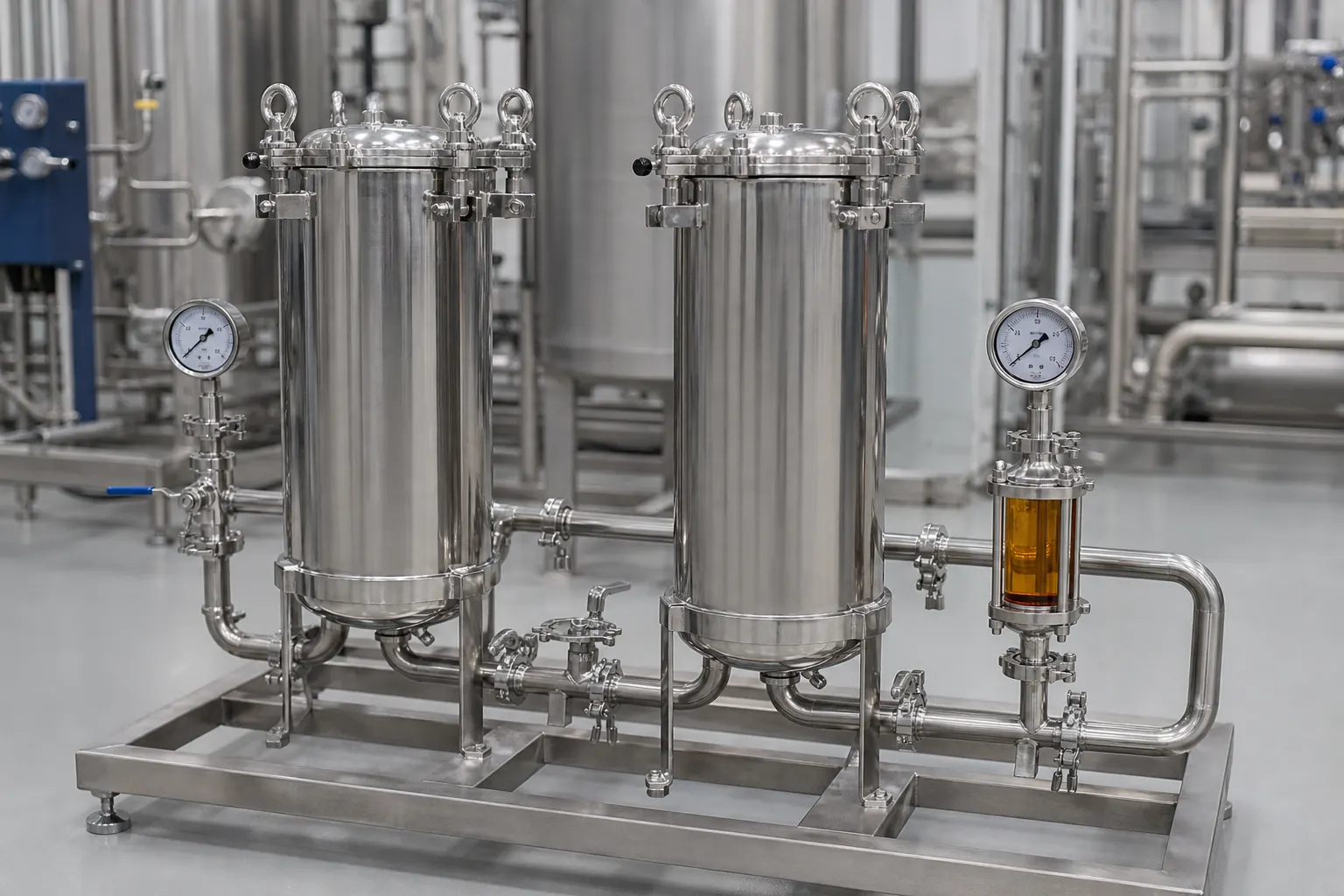
First decide the purpose: removal of incidental particles, polishing for appearance, protection of a small filling nozzle or another product-specific objective. Do not describe filtration as sterilization unless a validated sterile process and appropriate product and filter requirements apply. Most nonsterile spot-on operations need a controlled particle or clarity step, not an unsupported sterile claim.
Filter grade is only one input. Media chemistry, effective area, housing hold-up, initial and terminal differential pressure, flow rate, temperature, pre-wetting, adsorption, extractables, bypass prevention and disposal affect the result. A fine filter may reduce throughput or retain active or excipient; an oversized housing may increase residual product and solvent exposure.
Conduct a scale-representative study that measures product quality before and after filtration, filtrate clarity or particle result, active recovery, volume loss, pressure trend and filter capacity. Define when the filter is changed and how the batch record captures filter identity, installation, condition and reconciliation. A pressure alarm protects equipment only if the response and product disposition are defined.
Set Holding, Recirculation and Batch-Time Limits
Direct answer: A day tank or recirculation loop should maintain a proven product state for a defined time; it should not become an indefinite buffer for line delays.
Define the maximum time from completion of mixing to final fill, plus limits for filtered-bulk holding, filler stoppage and any restart. Consider concentration drift from evaporation, chemical degradation, temperature change, particle settling, air exposure and microbial risk appropriate to the formulation. Sample at meaningful times and locations during development.
Recirculation can maintain temperature or concentration and stabilize feed, but it can also increase shear, pump heat, aeration, solvent loss and cumulative exposure to seals or filters. If recirculation is used, specify path, flow or pressure window, return position, minimum level, maximum duration and the response to an out-of-limit condition.
A buffer vessel is useful when a batch tank cannot follow the intermittent demand of a multi-nozzle filler. Size it from the real demand and stop pattern, not only the average liters per hour. Too little working volume can starve the filler; too much can extend hold time and increase residual loss.
Choose the Transfer Pump and Product Path
Direct answer: Select the pump and line from product compatibility, required flow and pressure, shear and vapor behavior, cleaning, drainability and the filler’s operating pattern.
Possible pump families include diaphragm, peristaltic, gear, lobe or other positive-displacement and centrifugal designs, but there is no universal choice. Evaluate wetted materials, dry-running or dead-head behavior, pulsation, leak containment, seal arrangement, minimum controllable flow, cleanability and maintenance. A solvent-rich formula may change motor, enclosure, earthing and ventilation decisions after the EHS assessment.
Keep the product path as short and simple as practical. Avoid uncontrolled low points, long flexible hoses, dead legs and high points that trap air. Identify line slope, drain or recovery method, sample point, pressure instrumentation, flexible connection rating and how the path is protected during disconnection or cleaning.
Develop the pressure-control strategy with the filler. A constantly running pump against a closed demand valve can heat the product or stress the system. A simple gravity feed may be stable for one layout but sensitive to changing head height. Pressure-controlled feed, level-controlled buffer supply or on-demand transfer each needs a verified stop and restart response.
Deliver a Stable Feed to the Pipette Filler
Direct answer: The filler should receive product within an agreed temperature, pressure, concentration and air-content window across the entire batch.
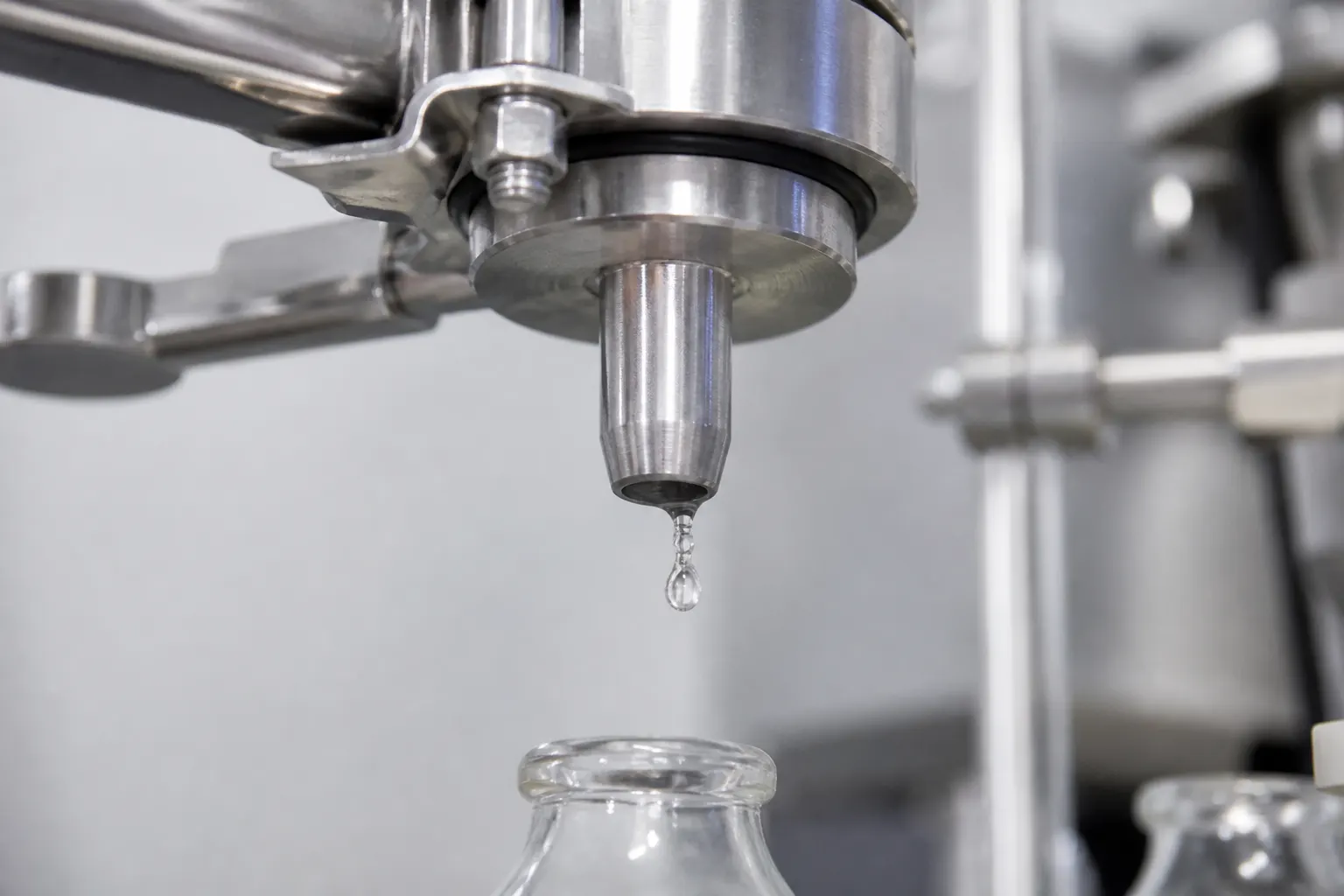
Translate the filler specification into upstream inputs: allowable inlet pressure and variation, minimum and maximum flow, feed temperature, acceptable gas or bubble condition, minimum tank level, product-return arrangement, maximum pause and alarm interfaces. Define which instrument is authoritative and how it is calibrated or checked.
Test the interface at startup, nominal running, low bulk level, planned stop, fault stop and restart. Observe fill-mass trend, cutoff behavior, bubbles, dripping, nozzle wetting and seal-zone contamination. The test should distinguish a metering problem from a changing inlet condition.
Reconcile prepared, filtered, transferred, filled, sampled and recovered quantities using the site’s approved method. A high unexplained loss can indicate filter hold-up, hose retention, evaporation, leakage or unrecorded recovery. Reconciliation is a process-control input, not only an accounting exercise.
Manage Flammable-Solvent and EHS Decisions
Direct answer: Do not label the whole line ‘explosion proof’ from a solvent name; classify each area and select protection from the verified vapor hazard and operating scenario.
Obtain current safety data and define quantities, charging method, open and closed operations, normal and abnormal releases, ventilation, cleaning, waste handling and nearby ignition sources. A qualified EHS and electrical team should determine whether a hazardous location exists and document the classification under the rules that apply at the site.
OSHA 29 CFR 1910.307 states that hazardous locations are classified from the flammable materials and likelihood of a hazardous concentration, and that electrical equipment must be suitable for the classified location. It does not mean every alcohol-containing formula automatically requires the same zone, division or equipment package.
Use the solvent-based pet medicine safety article as a project-question checklist. Then document the site-specific classification, equipment markings, bonding and grounding, ventilation, static control, gas detection if required, operating procedures, maintenance and emergency response. Never use an equipment quotation as the sole EHS study.
Design Cleaning, Recovery and Changeover
Direct answer: The cleaning strategy must remove formulation residue from every product-contact surface while controlling solvent exposure, waste, disassembly and reassembly risk.
Map the vessel, agitator, baffles, outlet, filter housing, pump, valves, hoses, filler reservoir and nozzles. Decide which items are cleaned in place, cleaned out of place, dedicated or replaced. Confirm access for inspection, drainability and the sequence for recovering valuable product before cleaning.
If 21 CFR Part 211 applies, section 211.67 requires written cleaning and maintenance procedures and records. The regulation does not define one cycle for every formula. The manufacturer must develop the agents, concentrations, contact times, temperatures, flow or mechanical action, rinse endpoints, inspection and residue limits appropriate to the product and equipment.
Changeover should address formula, active, solvent and packaging changes. Label change parts and hoses, define line clearance, verify filter and gasket identity, challenge the correct recipe and document the first acceptable filled units. Waste and vapor-control routes must be included in the procedure.
Write the URS and Test the Complete Interface
Direct answer: A useful URS turns formulation and safety knowledge into measurable process ranges, alarms, documents and acceptance tests.
FAT can verify mechanics, controls and agreed product-path behavior, but it does not replace formulation stability, cleaning validation, site EHS validation or performance qualification. Split those responsibilities clearly between supplier and manufacturer, and carry open items into SAT and qualification protocols.
- Attach the process flow diagram, batch size, formulation-property ranges and safety data.
- Define the mixing duty, endpoint, temperature range, sample method and maximum process time.
- State filter purpose, media constraints, recovery requirement and differential-pressure response.
- Define hold, recirculation, agitation and restart limits with product disposition rules.
- State filler inlet pressure, temperature, flow and signal interfaces, including fault behavior.
- List all product-contact materials, certificates, surface requirements and replaceable parts.
- Document hazardous-area classification inputs and the party responsible for the final site decision.
- Define cleaning, product recovery, disassembly, inspection and changeover evidence.
- Run representative product or justified simulant trials; record what a simulant cannot prove.
- Challenge start, sustained run, stop, restart, low level, alarm, drain and batch-end conditions.
How to Evaluate a Spot-On Process-Equipment Supplier
Direct answer: Choose a supplier that can explain the preparation-to-filler interface, request real product data and turn uncertainties into sample tests and documented design decisions.
- Ask for comparable process experience while protecting customer confidentiality; compare formulation and hazard differences.
- Review the PFD, P&ID, product-contact list, line layout, utilities, control narrative and alarm matrix.
- Require a reasoned mixer, filter, pump and feed concept rather than a catalog-only selection.
- Confirm sample-trial material, volume, test method, acceptance criteria and responsibility for disposal.
- Review FAT/SAT scope, calibration, manuals, spare-parts list, commissioning, training and IQ/OQ support.
- Verify the exact scope of CE, ISO or other documents; do not accept a generic certificate as proof of product stability or site compliance.
How KING PACK Connects Preparation and Spot-On Filling
Direct answer: KING PACK can configure the upstream vessel, transfer path and spot-on filling interface around the customer’s verified formulation, package and production inputs.
KING PACK Machinery is a China-based manufacturer of pharmaceutical, veterinary, cosmetic and liquid filling and packaging equipment, with core solutions covering tube filling and sealing, vacuum emulsifying, liquid filling, pet spot-on filling and prefilled syringe production systems.
Depending on the project, the upstream concept may use a controlled mixing or holding vessel, suitable filtration, a short compatible transfer path and an agreed filler-feed strategy. The KING PACK emulsifying and mixing equipment page shows the broader vessel platform; the final design must be narrowed by solvent, shear, filtration, hold-time and EHS evidence.
To request an interface review, send the formula-property envelope, safety data, batch and working volumes, process sequence, filtration goal, hold-time limits, cleaning method, filler format and demand profile through the KING PACK contact page. KING PACK can then propose the sample-test, PFD/P&ID and FAT questions that should be resolved before the line is released for manufacture.
Frequently Asked Questions
Should every spot-on liquid use a homogenizer?
No. A clear solution may need controlled blending or dissolution rather than high shear. Select the mixing duty from formulation development data, and use only the energy needed to reach the defined endpoint.
Can filtration remove active-degradation products?
Not as a general rule. A particulate filter does not correct chemical degradation or concentration change. Prevent degradation through justified formulation, exposure and hold-time controls, then test the relevant quality attributes.
Where should the filter be installed?
The position depends on its purpose and the system layout. Common questions include whether it protects the holding vessel or only the filler, how the housing is sampled and drained, and whether recirculation would repeatedly pass product through the media.
Is recirculation always needed to keep feed pressure stable?
No. It can help some systems but can also add shear, heat, aeration and solvent loss. Compare gravity, controlled on-demand transfer, buffer-vessel and recirculation concepts using the real demand profile.
How is filter size selected for a veterinary spot-on liquid?
Use representative product studies that consider media compatibility, required result, area, flow, pressure trend, active recovery, hold-up and batch duration. Do not select from nominal pore rating alone.
Does an alcohol-based formula automatically require an explosion-proof line?
No universal conclusion is safe. A qualified team must assess material properties, quantities, release scenarios and ventilation, classify each location under applicable rules and select suitable equipment for that documented classification.
What should be sampled during an interface trial?
At minimum, define samples at prepared bulk, post-filtration, filler feed, startup, after a planned stop and near batch end. Test only attributes justified by the product and process risk assessment.
What should be sent with an RFQ?
Send the process flow, batch size, solvent and formulation-property envelope, safety data, mixing and filtration goals, maximum hold time, contact-material restrictions, cleaning method, filler inlet requirements and target output.