
Last reviewed: August 27, 2026.
Pet nutritional pastes are often described with words such as sanitary, sterile or aseptic even when the process and package do not support those claims. That language can hide the real engineering decisions: what hazards are reasonably foreseeable, how the formulation controls growth, where the product is exposed, how long it is held, whether the equipment is fully cleanable and what evidence releases the batch.
A hygienic filling line reduces contamination opportunities and makes cleaning repeatable. It does not automatically create an aseptic process, sterilize the formulation or guarantee shelf life. The product owner must define the regulatory category, formulation controls, environmental requirements, validated cleaning and release specification for each market.
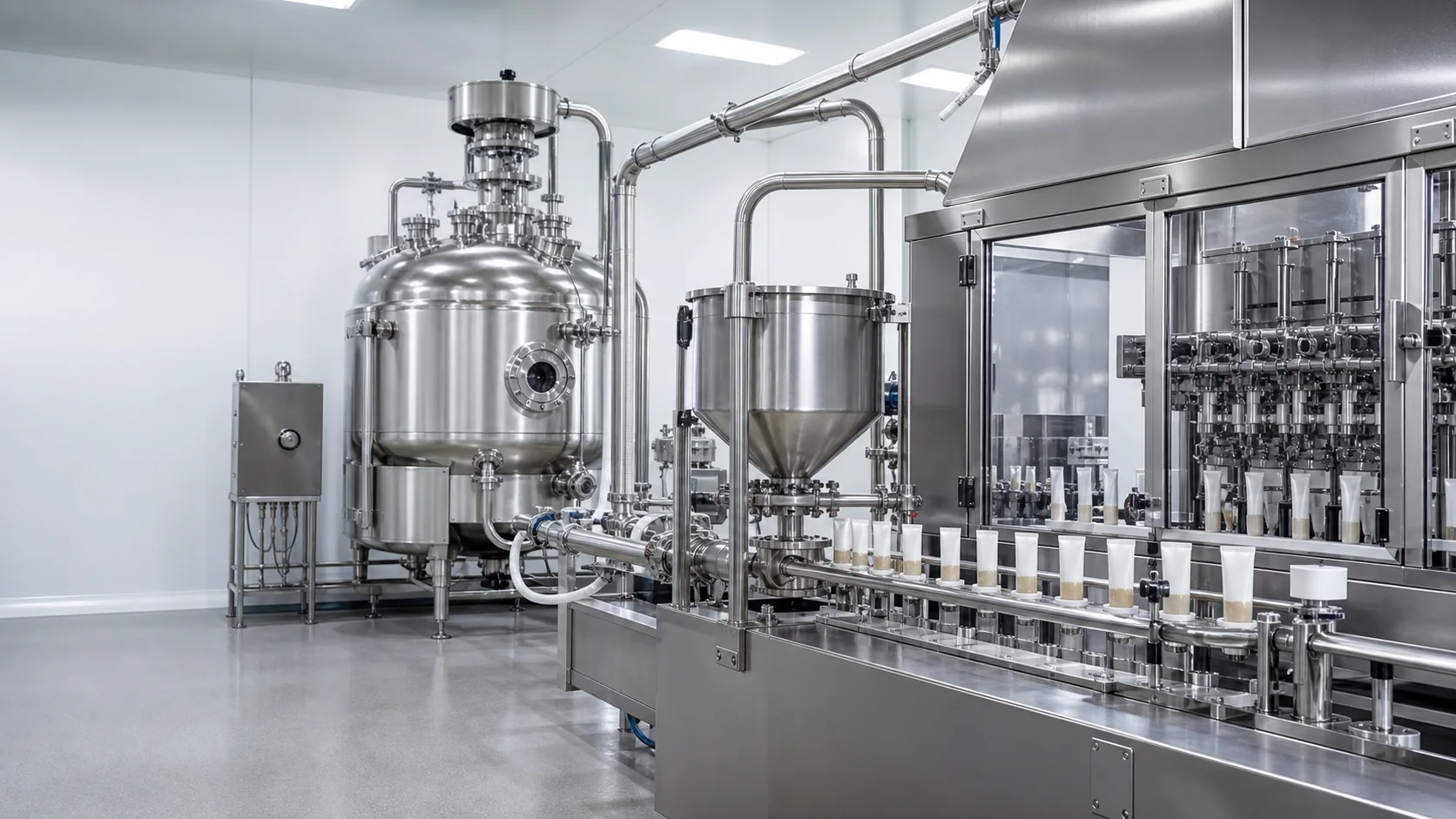
The practical design boundary starts with a controlled vacuum emulsifying and mixing system, continues through closed transfer and a suitable buffer or hopper, and ends with clean filling and immediate package closure. This guide shows how to translate microbial-risk inputs into equipment, URS and FAT decisions without inventing a universal water-activity limit, preservative system or sterile classification.
Quick answer: Control microbial risk during pet nutritional paste filling by first classifying the product and completing a formulation-specific hazard analysis. Then combine controlled mixing, closed and drainable transfer, justified temperature and maximum hold time, a cleanable low-hold-up filler, protected package handling, validated cleaning, environmental and operator controls, and traceable start/middle/end plus stop/restart checks. Call the process aseptic only when the full sterilization, environment, packaging and validation system supports that claim.
Hygienic Is Not Automatically Aseptic
Direct answer: Hygienic design reduces contamination and supports effective cleaning; aseptic processing requires a much broader, validated system that protects a sterile product and package from contamination.
A polished stainless-steel filler, enclosed guarding or a clean-looking room does not establish aseptic status. An aseptic claim depends on the product condition, sterilization strategy, container-closure system, environmental controls, personnel practices, interventions, monitoring and validation. If those elements are not designed and controlled as an aseptic process, use accurate language such as hygienic, closed-transfer or cleanable filling.
Pet nutritional pastes can also fall under different regulatory categories. A product may be animal food, a supplement-type product or a veterinary medicinal product depending on composition, claims and jurisdiction. The applicable requirements and release evidence must be confirmed by the product owner. An equipment supplier should support the required design and documentation without deciding the legal category.
The design target is therefore risk reduction with measurable controls: minimize open exposure, avoid stagnant product zones, maintain the justified process window, prevent operator and packaging contamination, clean every product-contact surface and verify that deviations trigger a defined response.
Start with Product-Risk Inputs
Direct answer: The hygienic level and control strategy should be based on the finished formulation, intended shelf life, manufacturing process and package, not on viscosity or the word nutritional alone.
FDA CVM Guidance for Industry 245 explains a hazard-analysis and risk-based preventive-control approach for food for animals. It also makes clear that not every example hazard applies to every animal food or facility. For a pet paste, the manufacturer should evaluate known or reasonably foreseeable biological, chemical and physical hazards based on the actual ingredients, process, equipment, environment and use.
- Regulatory category and target markets, including whether animal-food or veterinary-drug requirements apply.
- Water activity, pH, preservative system and other formulation hurdles, with methods and specification limits defined by the product owner.
- Raw-material hazards, heat treatment or other kill/reduction step, and the risk of recontamination after that step.
- Maximum product temperature, cooling profile, filling window, maximum bulk and hopper hold time, and stop/restart limits.
- Viscosity across temperature and shear, air-release behavior, particles or inclusions, and settling or separation risk.
- Package format, opening size, closure or seal process, barrier needs, package cleanliness and post-fill handling.
- Cleaning chemistry, acceptable residue, microbiological verification, allergen or cross-contact considerations and campaign strategy.
- Batch size, target output, SKU count, operator interventions, environment, utilities and required release tests.
Control Temperature, Hold Time and Formulation Condition
Direct answer: Temperature and residence time are process parameters when they affect viscosity, microbial growth potential, preservative performance, separation or filling consistency.
Do not assign a universal safe hold time or filling temperature. Development and shelf-life work should define the acceptable window, and production records should show the actual time and temperature history. If the product is cooled after mixing or heat treatment, identify where slow cooling or warm hold can create risk.
A jacketed vessel or hopper can help maintain flow, but heating is not automatically a microbial control and can accelerate degradation or create condensation elsewhere. Cooling may increase viscosity and pressure. The equipment design should define measurement points, alarm limits, circulation or agitation status and the action after an excursion.
Planned breaks and unplanned stops need separate rules. The response may include continued low-speed agitation, covered hold, reconditioning, additional testing or disposal. The maximum stop time and restart method must come from product evidence, not a default machine timer.
Use Hygienic Mixing and Closed Transfer
Direct answer: Mixing and transfer should achieve the required product condition while limiting exposure, air entrainment, residue and uncleanable connections between the vessel and filler.
Vacuum mixing can reduce entrained air in suitable formulations and support controlled addition, homogenization and discharge. It does not sterilize the product. The mixer should be selected by batch size, rheology, shear requirement, heat-transfer duty, addition sequence, deaeration need and cleaning method.
After the final risk-reduction or preparation step, each open transfer, manual scoop, temporary hose and uncovered hopper can reintroduce contamination. Prefer closed, identifiable connections where practical. Use capped ports, controlled vents, suitable seals and a transfer procedure that prevents the hose end or connector from contacting uncontrolled surfaces.
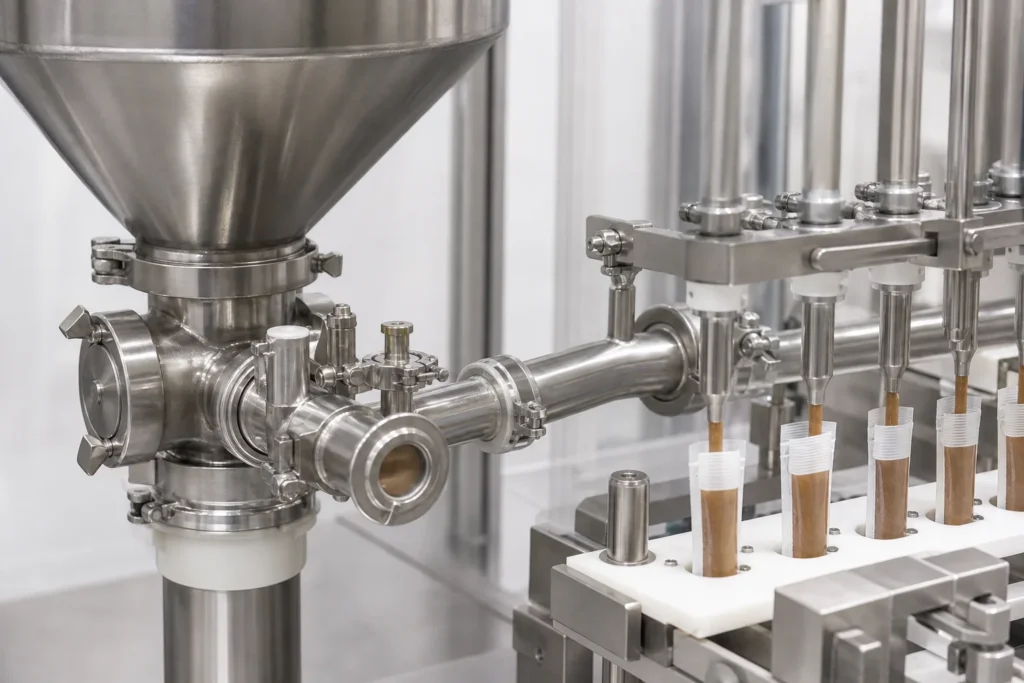
Map the product path from vessel outlet through pump, hose, valves, buffer hopper and nozzle. Remove unnecessary branches, dead legs and low points. If a flexible hose is required, support it to prevent loops and define its cleaning, drying, storage, inspection and replacement. A short path also reduces product loss and the time residue remains warm.
| Process zone | Primary hygienic risk | Design/control input | Evidence |
|---|---|---|---|
| Mixer | Incomplete mixing, residue under agitator or uncontrolled addition | Agitator/homogenizer duty, covered additions, cleanable internals | Mixing study, inspection and cleaning verification |
| Vessel outlet | Retained product, inaccessible valve or warm heel | Flush-mounted outlet, drainability and valve access | Drain test and teardown review |
| Transfer path | Open connection, hose loop, air intake or long residence | Closed connection, short route, supported hose and defined vent | P&ID walkdown and stop challenge |
| Buffer/hopper | Stagnant product, uncovered exposure or minimum-level heel | Cover, controlled working range, agitation if justified, low-point design | Low-level run and cleanability review |
| Nozzle/package | Drip, contact, dirty neck or delayed closure | Positive shutoff, controlled motion, package protection and line balance | Start/stop observations and package checks |
Specify a Cleanable Low-Hold-Up Filler
Direct answer: A hygienic paste filler needs product-contact surfaces that can be accessed or cleaned by a defined method, plus geometry that avoids stagnant residue and uncontrolled air entry.
For animal food under U.S. jurisdiction, 21 CFR Part 507 Subpart B requires equipment and utensils to be adequately cleanable and installed to facilitate cleaning and maintenance. It also requires food-contact materials to withstand the product, cleaning procedures and sanitizing agents. Applicability depends on product and facility status, but these are useful design-review questions for any pet paste project.
Review the hopper bottom, agitator shaft, pump chamber, valve seats, hose connections, elbows and nozzle shutoff. Ask how each area drains, whether it is cleaned in place or out of place, what must be disassembled, how clean parts are protected and how correct reassembly is verified. A smooth external surface cannot compensate for an inaccessible product pocket.
Choose the metering method by viscosity, particles, shear sensitivity, air content, dose range, cleaning and package format. A piston system may be a strong candidate for thick pastes, but valve geometry and seals must fit the product. Progressive-cavity or other positive-displacement methods may offer steady flow for some products, yet elastomer compatibility, wear, heat and cleanability must be tested.
For tube formats, review the tube filling and sealing machine platform. For oral dosing syringes, the syringe filling machine family provides a separate packaging route. The product and administration format should determine the line, not a preference for one machine type.
Control the Environment, Operators and Packaging

Direct answer: Hygienic equipment works only when the surrounding environment, operator practices and incoming packaging prevent the product-contact zone from being recontaminated.
21 CFR 507.14 addresses hygienic practices for personnel who contact animal food, food-contact surfaces and packaging materials. The same risk logic applies more broadly: define gowning, hand hygiene, glove changes, tool control and intervention rules appropriate to the product. Reduce routine operator reach over open product and make necessary interventions observable and documented.
Air classification is not a substitute for hazard analysis. The required environment depends on product risk, exposure time, package and regulatory category. Control condensation, dust, pests, traffic and cleaning-tool movement. If local extraction or positive pressure is used, confirm that airflow does not direct contamination toward open product.
Packaging materials need a controlled receipt, storage and feeding method. Tubes, syringe barrels, caps and tips should be protected from dust and handling. Define whether cleaning, air rinsing, disinfection or another preparation is justified. Do not add a packaging-treatment step without showing that it is compatible and effective for the identified risk.
Define Cleaning, Sanitizing and Verification
Direct answer: Cleaning should have a written method, measurable endpoint and verification plan that covers both visible paste residue and the microbiological or cross-contact risks identified for the product.
Part 507 requires animal-food-contact surfaces to be cleaned and maintained as necessary to protect against contamination, and where wet cleaning and sanitizing are necessary in wet processing, it addresses cleaning and sanitizing before use and after interruptions that may contaminate surfaces. The exact method and frequency must be justified for the product and operation.
A cleaning sequence may include product recovery, pre-rinse, detergent wash, intermediate rinse, sanitizing where justified, final rinse, drainage and drying. Define concentration, temperature, flow or mechanical action, contact time, water quality, disassembly and hold time after cleaning. Avoid leaving wet, closed equipment in a condition that creates a new microbial risk.
Visual inspection is necessary but may not be sufficient. The manufacturer should define chemical-residue, allergen/cross-contact and microbiological verification based on the hazard analysis. Select sampling sites at the hardest-to-clean locations, not only easy surfaces. Record failures, corrective cleaning, reinspection and the status of potentially affected product.
| Cleaning stage | Controlled input | Verification question | Record |
|---|---|---|---|
| Product recovery | Defined endpoint and recovery destination | Was unverified heel prevented from entering good product? | Recovery/reconciliation log |
| Wash | Chemistry, concentration, temperature, time and action | Did the method reach the worst-case location? | Cycle or manual cleaning record |
| Rinse | Water quality, volume/endpoint and drainage | Are detergent and product residues within limits? | Endpoint result and exception |
| Sanitize, if justified | Agent, concentration, contact time and compatible surface | Does the step control the identified risk? | Preparation and contact-time record |
| Dry/store | Drainage, drying method, protection and clean hold time | Can moisture or exposure recontaminate the path? | Release-to-use inspection |
Link Filling Checks to Batch Release and Deviations
Direct answer: A stable fill weight and a clean-looking package do not by themselves prove microbiological control, so production checks must connect to the product specification and hazard-based release plan.
Keep beginning, middle and end samples traceable to time, hopper level, temperature and operating condition. Add checks after a planned stop, nozzle intervention, package jam or cleaning-related restart. Depending on the product, the control plan may include fill mass, appearance, seal integrity, temperature, bulk or finished-product microbiological tests and preservative or formulation attributes.
Define deviation triggers before production. Examples include exceeded hold time, temperature excursion, uncovered product, failed cleaning verification, environmental event, damaged package feed, repeated nozzle contact or an unexplained fill trend. The response should protect product, preserve evidence and require documented disposition by authorized quality personnel.
Do not composite samples when the objective is to detect a trend across the batch or after an event. The protocol should state sample identity, test method, acceptance limit, who reviews the result and whether product may proceed while a result is pending.
URS and FAT Checklist for Hygienic Paste Filling
Direct answer: The URS should translate the hazard analysis and formulation limits into cleanability, exposure, time, temperature, filling and package requirements that can be demonstrated during FAT and SAT.
- State product category, formulation-risk inputs, batch size, package formats, dose range and target output.
- Draw the process boundary from post-mix hold through transfer, filling, closure, inspection and product exit.
- Define product-contact materials, surface condition, elastomers, hose construction and compatibility evidence.
- Specify maximum hold and stop times, temperature measurement points, alarms and restart disposition.
- Review drainability, dead legs, disassembly, clean-out-of-place parts, cleaning chemistry and drying.
- Limit operator interventions and define protected packaging presentation and contamination controls.
- Challenge minimum and maximum dose, low hopper level, sustained run, stop/restart and nozzle intervention.
- Demonstrate cleaning access with a representative paste or justified soil, including the hardest-to-clean points.
- Verify recipes, alarms, batch records, calibration, reject handling and audit trail required by the project.
- Collect drawings, manuals, certificates, spare-parts list, training, commissioning and IQ/OQ support scope.
How to Evaluate a Hygienic Paste-Line Supplier
Direct answer: Select a supplier that asks for product-risk and cleaning evidence, shows the complete product path, and demonstrates hygienic claims through design details and representative trials.
- Ask the supplier to distinguish hygienic, sanitary and aseptic claims and state exactly what the offered line does and does not provide.
- Review comparable projects by product properties, process and package, not by the generic label pet paste.
- Inspect product-contact drawings, low points, seals, valve cavities, disassembly and cleaning access.
- Require sample trials covering temperature, hold, low level, stop/restart, nozzle cutoff and package cleanliness.
- Agree FAT/SAT acceptance, deviation handling, cleaning demonstration and document-delivery milestones.
- Verify CE/ISO or other documents by scope; certification does not replace product-specific hazard analysis or cleaning validation.
How KING PACK Configures Pet Nutritional Paste Lines
Direct answer: KING PACK connects mixing, closed transfer, hygienic paste metering and the selected tube or syringe package around the customer's product-risk, cleaning and output requirements.
KING PACK Machinery is a China-based manufacturer of pharmaceutical, veterinary, cosmetic and liquid filling and packaging equipment, with core solutions covering tube filling and sealing, vacuum emulsifying, liquid filling, pet spot-on filling and prefilled syringe production systems.
A pet nutritional paste project may combine vacuum mixing, a covered or closed buffer system, a short drainable transfer path, a product-tested metering system, positive nozzle shutoff, tube sealing or syringe closure, coding and inspection interfaces. The final configuration depends on the formulation, regulatory category, package and hazard analysis; it should not be sold as aseptic without the full supporting system.
Review the KING PACK pharmaceutical and veterinary solution hub for application context. For a design review, submit the product category, water-activity and preservative information, process temperature and hold limits, viscosity, package samples, cleaning method and output target through the KING PACK contact page.
Frequently Asked Questions
Is hygienic filling the same as aseptic filling?
No. Hygienic filling reduces contamination and supports cleaning. Aseptic processing requires a validated sterile-product, environment, packaging and intervention system. Use the term aseptic only when the complete process supports it.
Does low water activity eliminate the need for hygienic equipment?
No. Water activity is one product-risk input. Raw materials, spores, molds, formulation variation, cross-contact, packaging and post-process contamination may still require controls. Use the complete hazard analysis.
Can vacuum mixing sterilize a pet nutritional paste?
No. Vacuum can support deaeration and controlled mixing, but it is not a sterilization claim. Any microbial reduction step must be separately designed, validated and monitored.
Should the hopper always be continuously agitated?
Not automatically. Agitation depends on separation, temperature, shear and air sensitivity. Define the mode and speed from development data and confirm it does not create aeration or excessive heat.
Which filler is best for a thick pet paste?
The choice depends on viscosity, particles, shear sensitivity, air, dose range, package and cleaning. Piston, progressive-cavity and other positive-displacement systems should be tested with representative product.
Is visual inspection enough after cleaning?
Visual inspection is important but may not address chemical residue, allergen/cross-contact or microbiological risks. Add verification methods and worst-case locations based on the hazard analysis and cleaning-validation plan.
What should happen after the line stops with product inside?
Follow a product-specific maximum hold and restart procedure. It may require temperature checks, reconditioning, disposal of first units, additional sampling or product disposition by quality personnel.
What should be demonstrated during FAT?
Challenge product flow, dose, low level, sustained run, stop/restart, nozzle interventions, package handling and cleaning access with the product or a justified simulant. Record limitations and open items.