
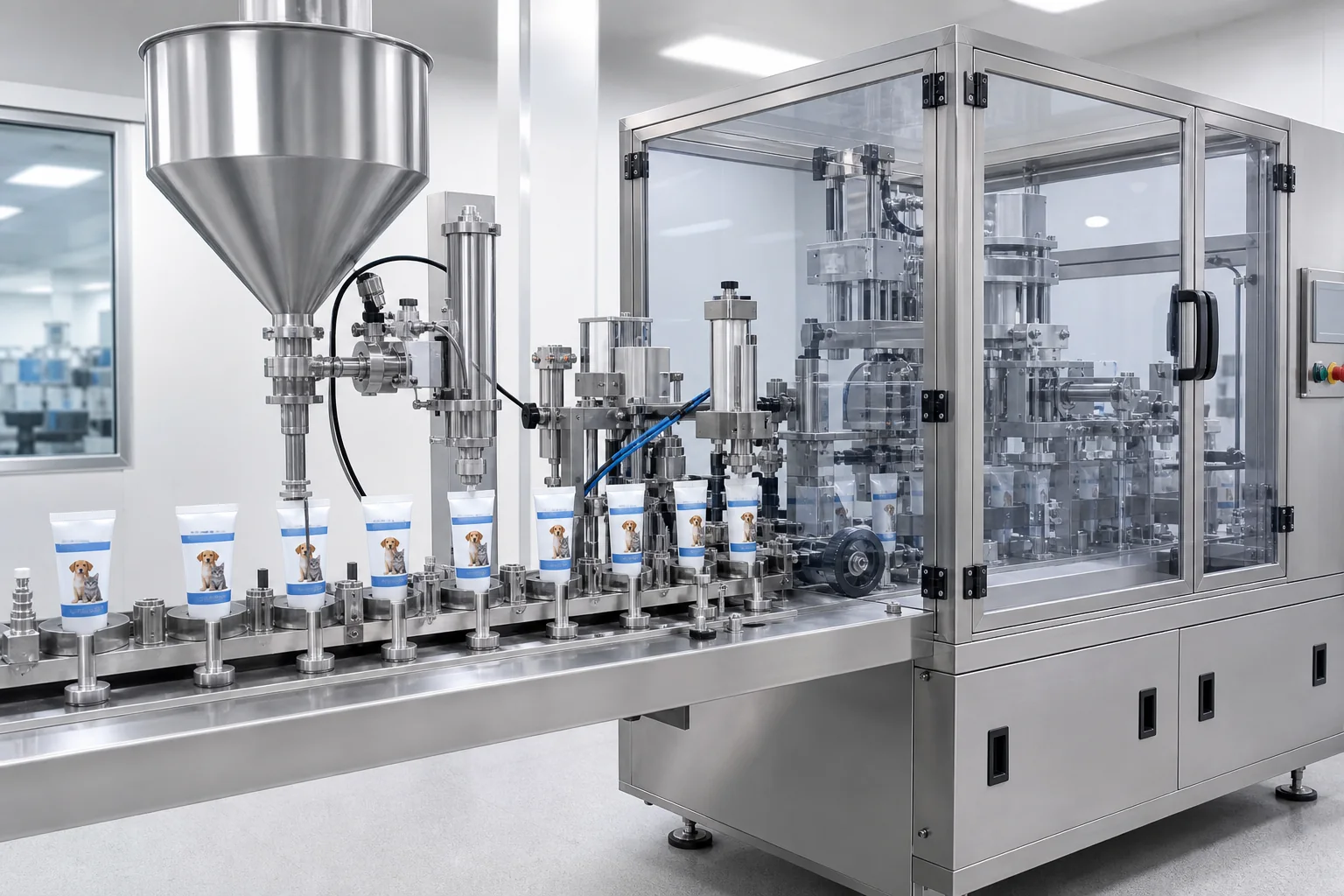
Veterinary Ointment Tube Filling and Sealing Machine: A Buyer’s Guide
Selection by rheology, dose, tube material, cutoff, seal control, cleaning, changeover and FAT evidence
Quick answer
Choose a veterinary ointment tube filling machine from the complete product-package test, not from nominal speed alone. The critical inputs are ointment rheology and temperature, fill range, tube material and tolerances, nozzle cutoff, acceptable air content, tail-cleanliness criteria, sealing or folding method, cleaning boundary, format-change strategy and FAT evidence. A supplier should prove these requirements with representative ointment and tubes across the intended operating range.
This guide is deliberately different from King Pack’s existing article about modular pet pharmaceutical filling systems. The focus here is the buyer’s specification and acceptance decision for veterinary ointment and gel tubes: what to send, what to test, what defects to define and what evidence should control release.
Related KING PACK resources: veterinary filling solutions; pet-care tube packaging overview; high-viscosity tube-filling engineering; existing modular veterinary ointment equipment article; contact King Pack for a product trial.
1. Selection table: translate the product into machine decisions
| Buyer input | Machine decision | Proof required |
|---|---|---|
| Rheology and temperature | Hopper conditioning, pump and nozzle | Trial at defined temperature and product state |
| Dose range | Dosing size, control resolution and sampling plan | All heads at minimum, nominal and maximum fills |
| Plastic/laminate tube | Orientation, hot-air or ultrasonic sealing, cooling and trim | Seal challenges using production samples |
| Aluminum tube | Folding tooling, crimp sequence and code position | Leak, fold geometry and cosmetic inspection |
| Stringing/air tendency | Bottom-up profile, cutoff and suck-back | First-off, steady-state and restart samples |
| Cleaning/changeover | Contact-part access, change parts and recipes | Timed changeover and cleaning demonstration |
| Quality controls | Inspection, reject tracking and reconciliation | Known-defect challenge and reject verification |
2. Rheology and dose define the filling system
Veterinary ointments may behave as structured, thixotropic or temperature-sensitive products. Provide viscosity or a rheology curve with the measurement method and temperature, plus yield behavior, density, particles, shear sensitivity, foaming and maximum processing temperature. “Thick paste” is not an engineering specification.
Dose range affects pump displacement, resolution, nozzle size and cycle time. Define whether acceptance is by mass or volume and how density is used. The FAT should report individual results by filling head at minimum, nominal and maximum doses. Include start-up, restart after a defined dwell and low hopper level. Do not approve a line from an average that can hide one biased station.
3. Tube material controls the closing technology
| Tube type | Typical closing principle | Critical project inputs |
|---|---|---|
| Plastic | Hot air or another compatible heat-seal process | Layer structure, seal window, cooling, trim and distortion limit |
| Laminate | Material-specific heat or ultrasonic process | Barrier structure, overlap, printed artwork and seal validation method |
| Aluminum | Mechanical folding/crimping | Wall behavior, fold count, tooling, code and leak criteria |
The table is a starting framework, not a universal rule. The tube supplier’s specification and actual samples control the choice. Provide minimum, nominal and maximum dimensions, print-mark position and multiple lots when possible. Tube stiffness, ovality and wall variation can change indexing, filling position and closure consistency.
4. Hopper, pump and nozzle must operate as one system
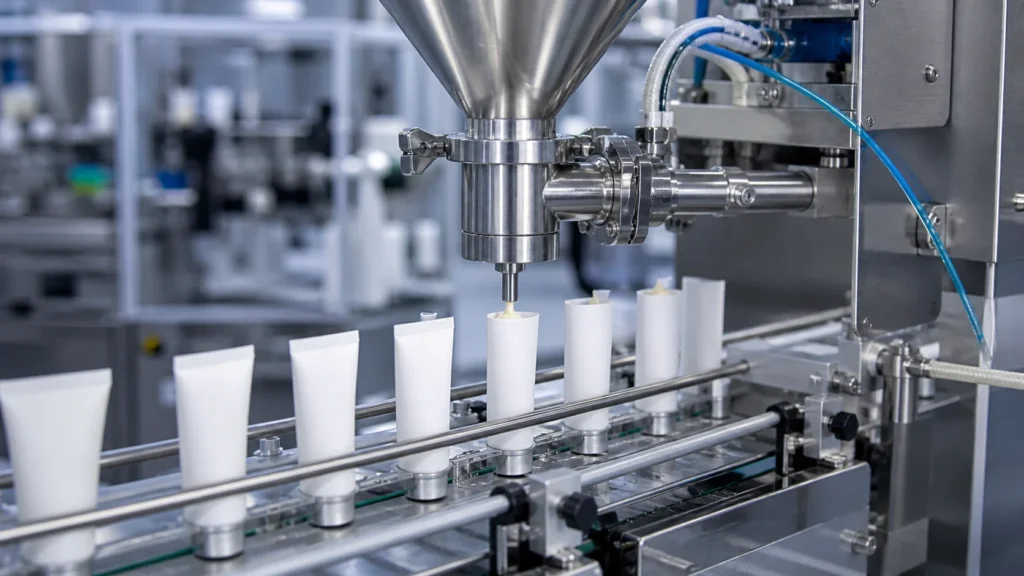
The hopper must maintain a consistent feed without unnecessary air addition. Decide whether it needs a jacket, level control, slow agitation or a pressurized/controlled supply. Pump selection should consider suction conditions, shear, particles, cleaning, refill time and pulsation. A pump that meters accurately in a bench test can still become unstable if the inlet starves or product temperature drifts.
Nozzle diameter, tip geometry, bottom-up motion and dosing profile determine cutoff and tube-tail cleanliness. Use a trial to adjust the system; avoid treating suck-back as the only remedy because excessive retraction may draw air into the product path.
5. Control air pockets and stringing
Air may enter during upstream mixing, transfer, hopper replenishment or nozzle retraction. Map all four sources. A stable vacuum-deaerated bulk can still pick up air through a leaking suction connection or an uncontrolled hopper refill. Define acceptable bubbles by the product and dose risk, and inspect cross-sections or dispense performance when appearance alone is insufficient.
Stringing is governed by rheology, temperature, nozzle geometry, closing speed, fill profile and suck-back. FAT should observe drip, thread and smear at the specified output after normal stops. The acceptance criterion should describe the downstream consequence: no product in the closure zone, no cosmetic contamination and no unacceptable dose loss.
6. Tail cleanliness and sealing are linked
A closure station cannot compensate for ointment in the tube tail. Establish the clean-tail requirement first, then challenge sealing. For heat-sealed tubes, monitor controllable temperature, pressure, time, cooling and trim conditions appropriate to the material. For aluminum tubes, challenge folding geometry, crimp pressure, code position and leakage. Final methods and limits belong to the manufacturer’s approved package-validation strategy.
| Defect | Possible upstream cause | Acceptance evidence |
|---|---|---|
| Channel or incomplete seal | Contamination, energy/pressure/time or tube variation | Visual criteria plus validated leak/strength method |
| Wrinkled/distorted tail | Tube alignment, heat or tooling | Dimensional/cosmetic standard with challenge samples |
| Product smear | Nozzle cutoff, fill height or splash | Clean-tail inspection at start, run and restart |
| Poor aluminum fold | Tool wear, position or material variation | Fold geometry and leak evaluation |
| Unclear code | Timing, pressure or artwork conflict | Legibility and location check |
| False accept/reject | Sensor/vision threshold or tracking fault | Known-defect challenge through physical reject |
7. Coding, inspection and rejection
Specify batch/expiry coding method, character set, location, readability and recipe link. Build a defect library for missing tube, orientation error, under/overfill where inspected, closure defect, bad code and cosmetic damage. The inspection system should be tested as a chain: detect the defect, track the exact unit, actuate rejection and prove secure segregation.
Record reject counts and reconcile challenged units. Challenge a full or missing reject container and define access control. A camera specification without realistic defect samples is not sufficient evidence of detection capability.
8. Change parts and format control
List every tube diameter, length, fill range and closure type. The supplier should identify the required holders, starwheels, guides, nozzles, sealing or folding tools and recipe changes. Use positive identification and storage for change parts. Time a representative change from last good unit to first approved unit, including line clearance, cleaning, mechanical setup, recipe selection and first-piece checks.
If one machine will handle veterinary ointment, gel and cream, confirm that the common product-contact path and change process fit the manufacturer’s carryover and cleaning strategy. Flexibility is valuable only when each configured state is controlled and repeatable.
9. GMP and FAT evidence
FDA’s process-validation guidance covers human and animal drugs and supports a lifecycle approach. For machine procurement, convert that principle into traceability: every critical URS requirement should map to design evidence, FAT, SAT or qualification. The FAT should identify equipment and software versions, calibrated instruments, samples, raw data, deviations, retests and punch-list disposition.
- Verify contact materials, elastomers, drainage, accessible cleaning and lubrication separation.
- Run representative product or a justified simulant at the specified operating envelope.
- Challenge all dosing heads and package formats, including stops and restarts.
- Test alarms, no-tube/no-fill logic, guards, utilities loss, jam recovery and reject tracking.
- Demonstrate recipe access, protected critical parameters, backup and version identification when in scope.
- Classify punch-list items and define which defects block shipment.
10. How to evaluate a supplier
Request comparable veterinary or high-viscosity tube applications, but evaluate evidence rather than logos. Ask for a sample-test protocol, fill and closure raw data, defect challenges, layout and electrical drawings, contact-material documentation, spare-parts list, FAT/SAT responsibilities, IQ/OQ support, commissioning plan and after-sales capability. Any CE or ISO evidence should be current, applicable to the offered scope and available for review; it should not be assumed from marketing text.
KING PACK Machinery is a China-based manufacturer of pharmaceutical, veterinary, cosmetic and liquid filling and packaging equipment, with core solutions covering tube filling and sealing, vacuum emulsifying, liquid filling, pet spot-on filling and prefilled syringe production systems. Send the ointment, tube drawings and samples, fill range, output, defect criteria and cleaning expectations to build a relevant trial plan.
Buyer checklist
- Product rheology and temperature data include test conditions.
- Tube drawings, material structure, tolerances and representative samples are approved.
- Fill range, accuracy calculation and sampling plan are defined.
- Cutoff, bubble and clean-tail defects have visible acceptance examples.
- Closure test methods and limits are owned by the package-validation strategy.
- Change parts, recipes, line clearance and cleaning boundaries are listed.
- FAT includes raw data, failed runs, deviations, retest rules and shipment release.
FAQ
Which filler is best for veterinary ointment tubes?
There is no universal best system. Select the dosing technology after testing rheology, dose range, temperature, particles, cleaning and cutoff with the actual package.
Can one machine fill ointment and gel?
Often yes, if the pump, nozzle, hopper and cleaning strategy cover both product envelopes. Prove each product state and format through trials and controlled recipes.
How do you prevent ointment stringing?
Control product state, nozzle geometry, dosing profile, cutoff speed and suck-back, then test at real output including stops and restarts.
Can plastic and aluminum tubes run on one machine?
A platform may support both, but they require different closing stations and change parts. Confirm the offered configuration and qualification scope.
What should a veterinary ointment FAT include?
Include product trials, all heads and fills, tube/closure challenges, clean-tail defects, inspection/reject tests, alarms, recipes, changeover, cleaning demonstration and traceable raw data.
What should a buyer send before requesting a quotation?
Send product rheology, tube drawings and samples, fill range, output, utilities, layout, defect criteria, cleaning plan and required documentation.