
Last reviewed: August 28, 2026.
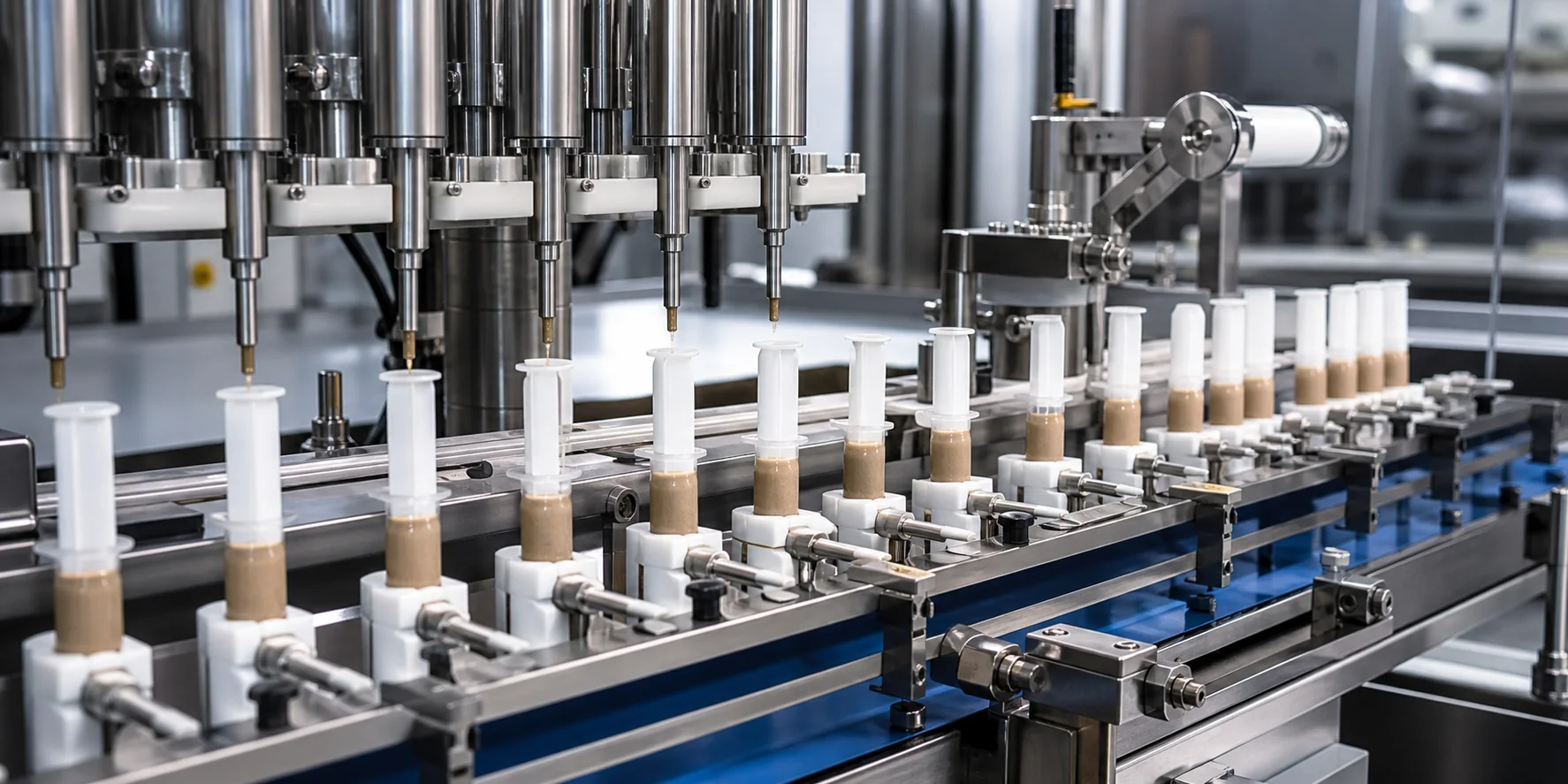
A veterinary oral-paste syringe is a dosing package, not automatically a sterile injectable prefilled syringe. The barrel may be filled from the rear or through another package-specific route, then assembled with a plunger, rear closure, tip cap or protective component. Paste rheology, trapped air, plunger friction, cutoff and component handling determine whether the line produces a consistent, clean and usable pack.
Buyers often start with a requested speed and fill volume, but those two numbers do not define the machine. A useful equipment specification also includes the syringe drawing and tolerances, component presentation, paste viscosity and temperature range, density, dose or mass acceptance, headspace, air limit, cap and plunger assembly forces, cleaning strategy, format range and the inspection method.
This guide owns the complete selection decision for a non-sterile veterinary oral-paste line. It uses the existing veterinary gel syringe accuracy article as an accuracy-specific child page and the existing high-speed page as a broad automation reference. It does not copy sterile PFS requirements or promise a universal percentage, output or package design.
Quick answer: Select a veterinary oral-paste syringe filling and capping machine by freezing the non-sterile package architecture first, then proving paste feed, deaeration, metering, nozzle cutoff, barrel support, plunger and tip-cap handling, inspection, cleaning and changeover with production-intent samples. The supplier should demonstrate low, nominal and high fills, startup, low hopper level, stop-restart and sustained running against customer-approved specifications; a water test or an unsupported universal accuracy claim is not enough.
Separate Oral Dosing Syringes from Sterile Prefilled Syringes
Direct answer: Define the product route and package use before selecting equipment because a non-sterile oral dosing syringe has a different risk, filling and assembly architecture from a sterile injectable PFS.
An oral paste syringe may be intended for direct dosing into an animal's mouth, including equine and companion-animal products. Its barrel, tip, plunger and closure arrangement can look syringe-like, but that does not make it an injectable system. Avoid terms such as aseptic, sterile, nest, stopper or container-closure integrity unless they accurately describe the approved product and package.
The product owner must determine whether the paste is a veterinary drug, animal food or another regulated product in each destination market. That decision controls facility, quality, labeling and release requirements. The equipment URS should state the required cleanliness or hygiene boundary, but the machine supplier should not infer the legal category from the package shape.
For applicable drug products, 21 CFR 211.65 addresses product-contact construction, 21 CFR 211.67 addresses written equipment cleaning and maintenance, and 21 CFR 211.110 addresses in-process controls for processes that can create variability. These official US references do not replace the customer's market assessment, approved dossier, product specification or quality system.
Build the Paste-and-Syringe Input Package
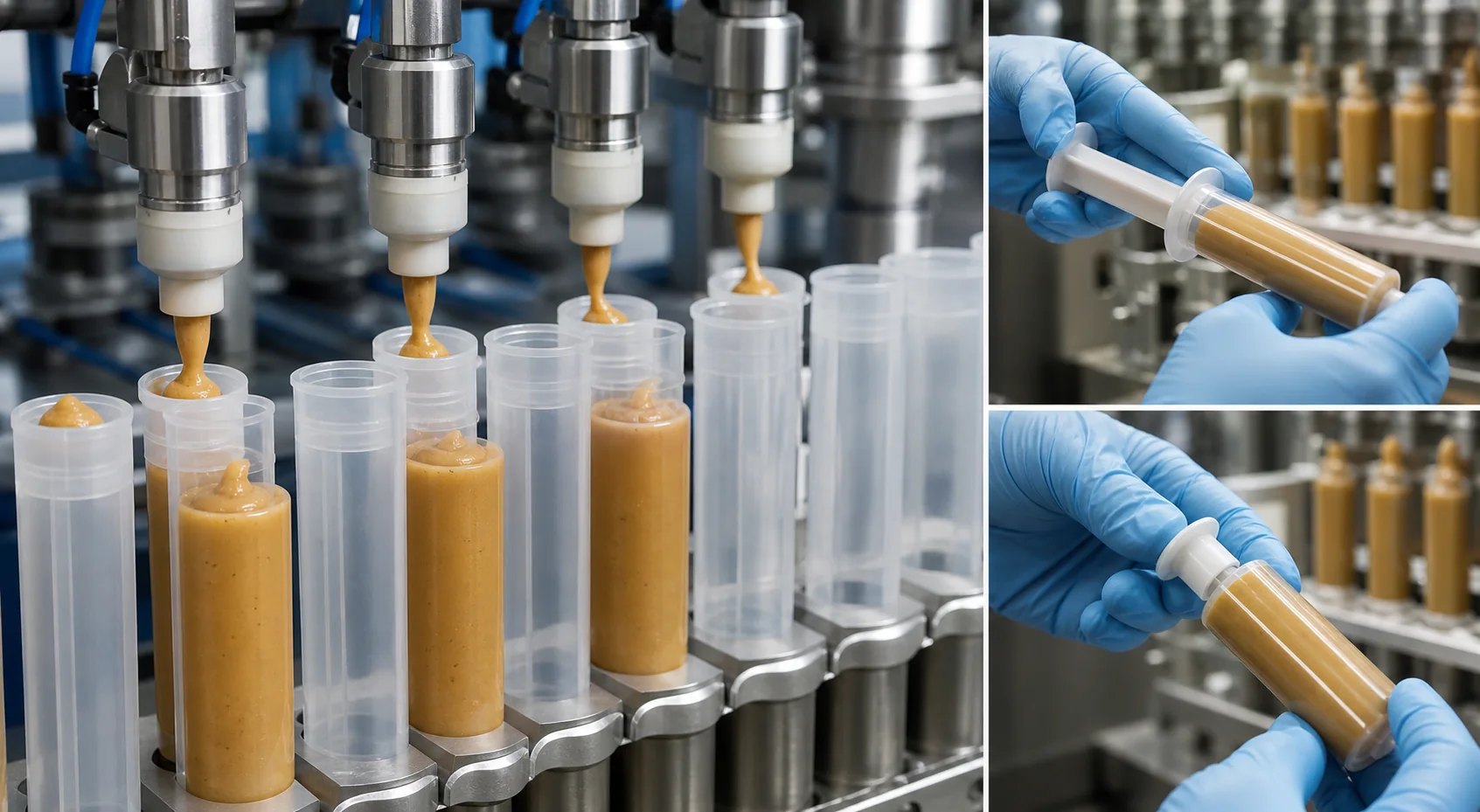
Direct answer: A serious RFQ combines formulation, package, process, quality, cleaning and production inputs so the supplier can select the product path and handling method on evidence.
Send marked drawings that identify every datum used for orientation, clamping, filling and assembly. A nominal barrel volume is not enough. Small variation in flange thickness, barrel straightness, internal diameter, tip-cap engagement or plunger friction can change transport stability and insertion force.
- Product category, intended use, approved or development-stage specification and destination markets.
- Viscosity versus temperature with test method, density, tack, elasticity, particle information where relevant, shear and temperature limits, and hold-time behavior.
- Minimum, nominal and maximum fill; whether acceptance is mass, volume or another measure; sampling and reaction rules.
- Complete syringe drawing, barrel material, internal diameter and tolerance, tip geometry, flange, graduations, plunger and closure parts, and production-intent samples.
- Required headspace, bubble or void criteria, visible cleanliness, coding, label and tamper-evidence interfaces.
- Component supply format: bulk, tray, bag, oriented magazine or another presentation; acceptable operator loading and replenishment model.
- Batch size, product preparation, deaeration, transfer distance, hopper working range, campaign length and end-of-batch recovery boundary.
- Cleaning chemicals and method, disassembly, product-contact material requirements, format change frequency, utilities, layout and target output.
- FAT/SAT, drawings, material records, calibration, software records, spare parts, training and qualification-support expectations.
Use a Selection Matrix before Comparing Quotations
Direct answer: Compare proposals against the same product, package and acceptance conditions so a lower-price or higher-speed claim does not hide a mismatched product path.
| Decision area | Questions for the supplier | Evidence at trial/FAT | Buyer risk if omitted |
|---|---|---|---|
| Paste feed | How are deaeration, hopper level, pressure and low-level behavior controlled? | Product-path drawing and low-level challenge | Air, incomplete pump charge or dose drift |
| Metering/cutoff | Which pump, valve and nozzle suit the approved rheology and fill range? | Low/high fill plus start/stop/restart data | Variable fill, stringing or residue |
| Syringe handling | Which features orient, support and protect the actual barrel? | Production-intent dimensional sample run | Jams, scuffs, tilted fill or damage |
| Plunger/cap | How are parts presented, detected, inserted and checked? | Force/position or presence evidence as specified | Loose, missing or damaged components |
| Cleaning/changeover | What is removed, drained, inspected and recipe-controlled? | Teardown and format-change demonstration | Residue, mix-up or excessive downtime |
| Inspection/reject | Which defects are detected and how is rejection verified? | Challenge set with traceable reject results | Undetected nonconforming packs |
Prepare, Deaerate and Feed High-Viscosity Oral Paste
Direct answer: Stable filling begins upstream: the line needs paste at a controlled temperature and condition, with trapped air minimized and a continuous feed to the metering chamber.
Define the mixing and deaeration endpoint from the formulation process. Excessive late-stage shear can introduce heat or air; an incomplete vacuum step can leave voids that compress during dosing. Verify condition at the mixer outlet, after transfer and in the hopper because air can be reintroduced by a vortex, loose connection, restricted inlet or dry-running pump.
Choose hopper geometry, outlet size and assistance method from actual paste flow. Gentle agitation, a follower system, controlled jacket temperature or a short transfer pump may be considered, but each can affect product condition or feed pressure. Establish an operating range and challenge the minimum permitted level.
Map the line from preparation vessel through valves, hose, pump and hopper to the nozzle. Minimize unnecessary hold-up, unsupported flexible line and high points that collect air. Define the priming sequence, first-unit segregation, planned-stop limit and restart checks before production begins.
Choose the Pump and Nozzle as One Metering System
Direct answer: Pump displacement, valve passages, feed condition, nozzle bore, shutoff and motion must be matched to the paste and syringe geometry, then proven together.
A servo piston or another positive-displacement method can be a candidate for high-viscosity oral paste, but the chamber must fill completely and consistently. Review inlet restriction, valve timing, seal material, shear, allowable pressure, air-trap locations and cleaning access. Servo position alone does not prove that the chamber contains a full product charge.
Nozzle outside diameter, bore, insertion depth and withdrawal should fit the barrel without scraping graduations, trapping air or contaminating the closure area. Bottom-up or synchronized withdrawal may help some packages, but it must be tuned to the product. Positive shutoff and controlled suck-back can improve cutoff; excessive retraction can pull air into the next dose.
Observe the final part of the dose at the approved temperature boundaries. Check external stringing, paste on the barrel or flange, internal void position and the first dose after a stop. The selected configuration should be a product-and-package result, not a copied recipe from another gel.
Verify Fill Quantity and Trapped Air without a Universal Accuracy Claim

Direct answer: Use the customer's approved specification, a traceable measurement method and condition-specific sampling; do not assume that every veterinary paste line must meet the same percentage.
Define whether the finished requirement is net mass, delivered volume, marked dose, number of plunger graduations or another attribute. Gravimetric checks can be useful, but tare variation and density must be understood if the product claim is volumetric. Any bubble or void criterion should specify location, size or effect using a validated or otherwise approved inspection method.
Sample by filling head and time point at startup, steady running, low hopper level, after a planned stop, after restart and near the end of the batch. Use suitable statistical methods when establishing process capability and reaction limits. 21 CFR 211.110 states, for applicable drug products, that in-process procedures should monitor output and validate processes that can cause variability; the exact controls must fit the approved product and quality system.
The published high-viscosity veterinary gel accuracy page goes deeper into accuracy drivers. Use it as a child reference; the buying decision here also includes component handling, closure assembly, cleaning, inspection and FAT.
Control Syringe Transport, Plunger and Tip-Cap Assembly
Direct answer: Package handling must locate the actual barrel without distortion, preserve a clean closure area and confirm every required plunger and cap component before release.
Define how empty syringes arrive and how they are oriented. Bulk feeding may require careful singulation and accumulation; trays or magazines can reduce orientation work but add manual replenishment and format constraints. Evaluate scuffing, static, dust, flange or tip damage and the ability to detect a misoriented barrel.
Support the syringe during filling so nozzle alignment and fill height remain stable. After filling, component insertion should not compress an uncontrolled air pocket or force paste into the tip or closure. Specify plunger orientation, insertion position or force limits where applicable, tip-cap engagement, rear closure, presence detection and the response to a missed component.
The broad high-speed veterinary syringe automation guide provides neighboring context. The oral-paste project must still be based on its non-sterile dosing package and actual closure architecture rather than sterile PFS handling assumptions.
Define Inspection, Rejection and Traceability
Direct answer: Inspection should target the defects that matter for the approved oral-paste package and must be paired with a verified reject path and traceable challenge set.
Potential checks include syringe presence and orientation, component presence, fill quantity through weighing or another approved method, visible residue, plunger or cap position, coding and label information. Vision cannot see every internal air pocket through an opaque or printed barrel, so the inspection concept must state its limits.
Challenge each sensor with good and known-defect samples at the intended line condition. Confirm that a detected defect is physically rejected, that reject verification works and that rejected units are controlled. Where required, preserve the relationship among filling head, component station, inspection result and batch record.
Do not add an inspection claim simply because a camera is present. Define the defect set, lighting, product and package variation, false reject tolerance, access control and periodic challenge procedure in the URS and FAT protocol.
Cleaning, Changeover and FAT Checklist
Direct answer: The buyer should see the complete product path cleaned and changed over, then run the difficult operating conditions with production-intent paste and components before shipment.
- Approve the product-contact material matrix against paste, cleaning chemicals, temperature, pressure and exposure time.
- Map and inspect vessel, hose, pump, valves, hopper, metering chamber and nozzle for hold-up and cleaning access.
- Demonstrate safe drainage, disassembly, cleaning sequence, reassembly, inspection and protection of clean parts according to the agreed scope.
- Run minimum, nominal and maximum fills at justified paste temperatures and hopper levels with traceable head-level samples.
- Challenge startup, sustained running, planned stop, restart, low-level feed, end-of-batch recovery and a representative component replenishment event.
- Verify syringe orientation and support, nozzle alignment, cutoff, internal air criterion, plunger/cap assembly and package cleanliness.
- Challenge inspection and reject functions using a controlled good/defect set; confirm the physical reject path and records.
- Demonstrate recipe permissions, alarms, interlocks, line clearance, format change and restoration to an approved setup.
- Review layout, product-path drawing, electrical drawings, manuals, calibration evidence, spare parts, training and qualification-support documents.
- Record deviations and open items with owners, acceptance rationale and closure evidence before shipment.
How to Evaluate a Veterinary Oral-Paste Line Supplier
Direct answer: Select a supplier that understands the non-sterile oral dosing package, requests complete product and component evidence, and can demonstrate the integrated line rather than only the filler stroke.
- Ask for comparable references by paste rheology, syringe architecture, fill range and closure parts, not just by the word 'syringe'.
- Review actual product-path and component-handling drawings with clear responsibility at every interface.
- Require sample trials with production-intent paste and parts; inspect raw results, difficult conditions and rejected settings.
- Verify material declarations, calibration, manuals, software records, spare parts, training, commissioning and after-sales scope.
- Confirm how the supplier will support cleaning studies, format change, FAT/SAT and qualification documentation required by the buyer.
- Tie performance commitments to defined product, package, environment, sampling and acceptance conditions; avoid unsupported sterile, speed or accuracy claims.
How KING PACK Configures Veterinary Oral-Paste Syringe Lines
Direct answer: KING PACK begins with the paste and syringe package, then develops feed, metering, cutoff, transport, assembly and inspection around a representative trial.
KING PACK Machinery is a China-based manufacturer of pharmaceutical, veterinary, cosmetic and liquid filling and packaging equipment, with core solutions covering tube filling and sealing, vacuum emulsifying, liquid filling, pet spot-on filling and prefilled syringe production systems.
For a non-sterile veterinary oral-paste project, the configured scope may include paste preparation or deaeration, controlled transfer, hopper feed, positive-displacement dosing, tailored nozzle motion, barrel orientation and support, plunger or tip-cap assembly, coding, inspection and rejection. The final design depends on the approved product category, rheology, syringe and cleaning strategy.
Review the KING PACK syringe filling machine platform with the oral-paste scope clearly stated, plus the broader veterinary filling application page. To request a trial and line concept, send viscosity and density data, syringe drawings and samples, fill range, closure parts, cleaning method, required output and acceptance criteria through the KING PACK contact page.
Frequently Asked Questions
Is a veterinary oral-paste syringe the same as a sterile prefilled syringe?
No. An oral dosing syringe is not automatically sterile or injectable. Define the intended route, product category, barrel and closure architecture, hygiene boundary and market requirements before selecting equipment.
Which pump is best for horse or companion-animal paste?
There is no universal choice. Compare positive-displacement candidates against rheology, air sensitivity, fill range, pressure, valve passages, seal compatibility, cleanability and the actual syringe geometry, then prove the choice by trial.
How can trapped air be reduced?
Control mixing and deaeration, prevent air entry during transfer, maintain a stable hopper feed, avoid incomplete chamber filling and tune nozzle cutoff without excessive suck-back. Locate where the first void appears before changing settings.
Can the line be accepted with a water test?
Water can confirm motion and basic controls but usually does not represent paste feed, pressure, air retention, cutoff, plunger interaction or cleaning. Use product or a justified representative material for performance conclusions.
What accuracy should the machine guarantee?
Use the approved product specification and a defined sampling and measurement method. Do not assume a universal percentage; the guaranteed condition must state product, fill range, package, temperature, operating state and acceptance method.
Should the plunger be inserted before or after filling?
That depends on the syringe design and intended process. The package owner and supplier must define the filling route, venting, headspace, plunger position, closure sequence and the risk of compressing air or displacing paste.
Which inspection functions are essential?
Start from the defect risk analysis. Typical candidates include syringe orientation, component presence, fill verification, visible cleanliness, plunger or cap position and coding, but each function must have a defined defect set and verified reject path.
What should I send to obtain a reliable quotation?
Send product classification, rheology and temperature data, density, fill range and limits, syringe and component drawings and samples, supply format, cleaning method, required output, inspection needs, utilities, layout and FAT documentation requirements.