
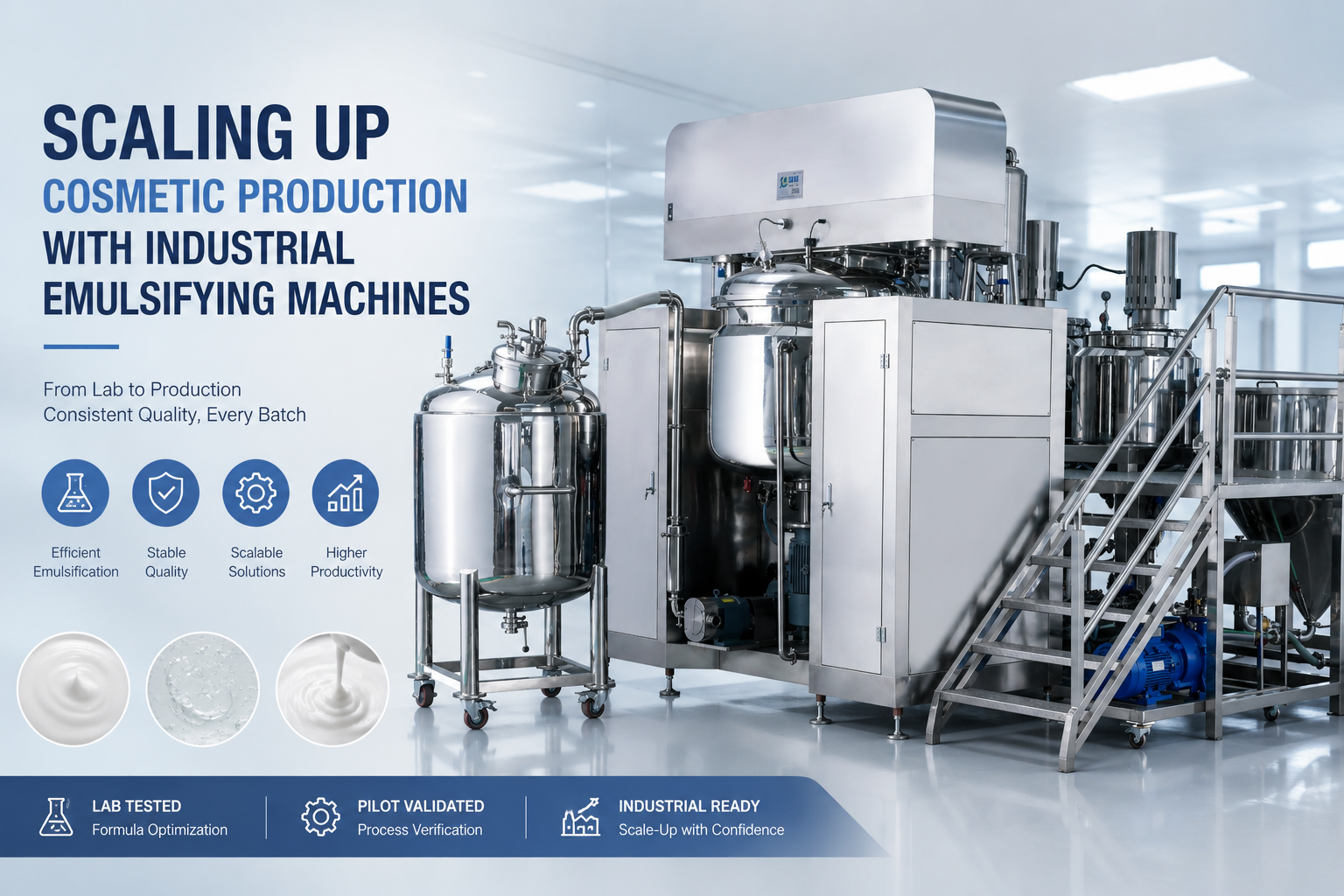
A cosmetic formula that performs beautifully in the lab can behave very differently when transferred to an industrial emulsifying machine. The texture may become thinner or thicker than expected. The lotion may separate after storage. A cream may show graininess, air bubbles, unstable viscosity, or a different skin feel. These problems are common during cosmetic production scale up because lab tools and industrial equipment do not deliver shear, heat transfer, vacuum, feeding, and mixing geometry in the same way.
For manufacturers expanding from R&D batches to commercial production, the right industrial emulsifying machine is not only a larger tank. It is a controlled process platform that turns a lab formula into a repeatable production method. Successful scale-up requires defined process parameters, pilot testing, equipment configuration, automated recipe control, hygienic design, and consistent documentation.
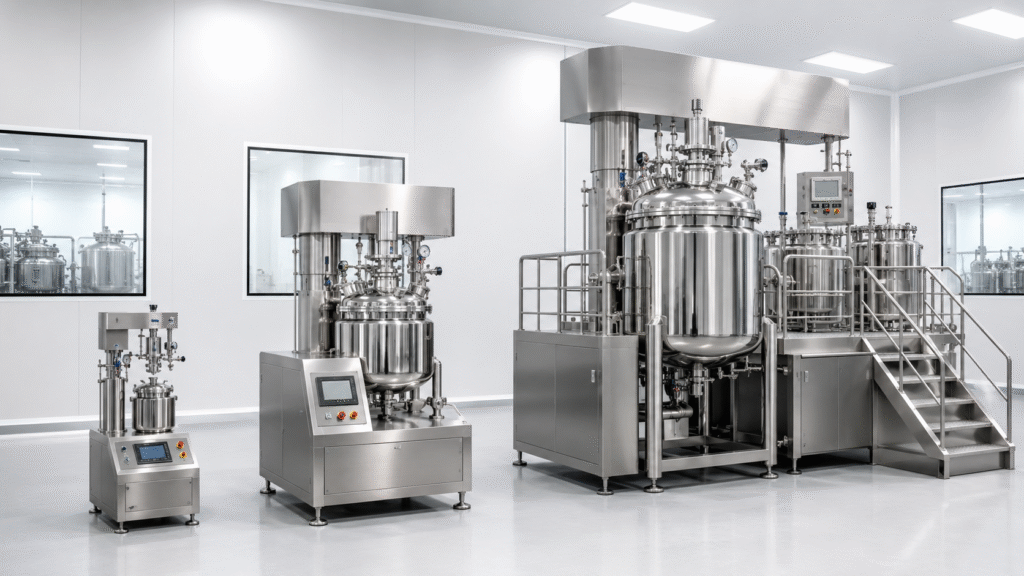
Why Lab Formulas Often Fail During Industrial Scale-Up
Lab formulas are usually developed in small vessels with flexible manual control. An R&D technician can add ingredients slowly, adjust speed by observation, change temperature quickly, and correct texture during the process. In production, the batch is larger, the thermal mass is higher, the mixing path is longer, and every adjustment affects more material.
This is why cosmetic batch consistency can fail even when the ingredient list is unchanged. The formula is the same on paper, but the process environment is different. Equipment geometry, agitator design, homogenizer position, vacuum level, heating and cooling capacity, and discharge method all influence the final product.
Viscosity Drift and Texture Inconsistency
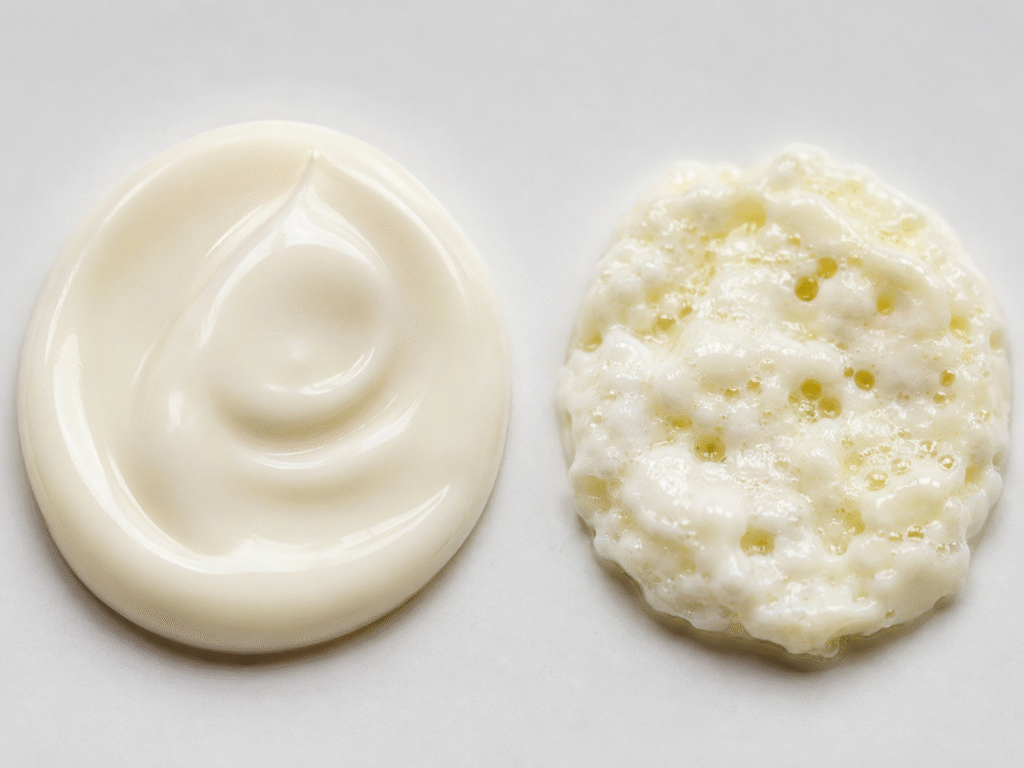
Viscosity control cosmetics work is one of the most frequent scale-up challenges. A cream may become too thick because the cooling curve is slower, the polymer hydrates differently, or the shear history changes. A lotion may become too thin if emulsification energy is insufficient or if the oil phase is not dispersed properly.
Texture inconsistency can also appear as graininess, phase separation, trapped air, poor gloss, or unstable spreadability. These issues are not always caused by the formula. They often come from scale-up mixing parameters that were not translated correctly from lab to production.
Heat Transfer and Mixing Geometry Differences
Heat transfer changes dramatically as batch size increases. A small lab beaker heats and cools quickly, while an industrial vessel depends on jacket area, scraper contact, product viscosity, and circulation inside the tank. If the product near the wall cools faster than the product in the center, viscosity and crystal formation may become uneven.
Mixing geometry also matters. Vessel diameter, bottom shape, agitator blade design, scraper clearance, baffle arrangement, and high shear homogenizer location all affect material movement. A well-selected vacuum emulsifying mixer should be configured around the product, not chosen only by nominal volume.
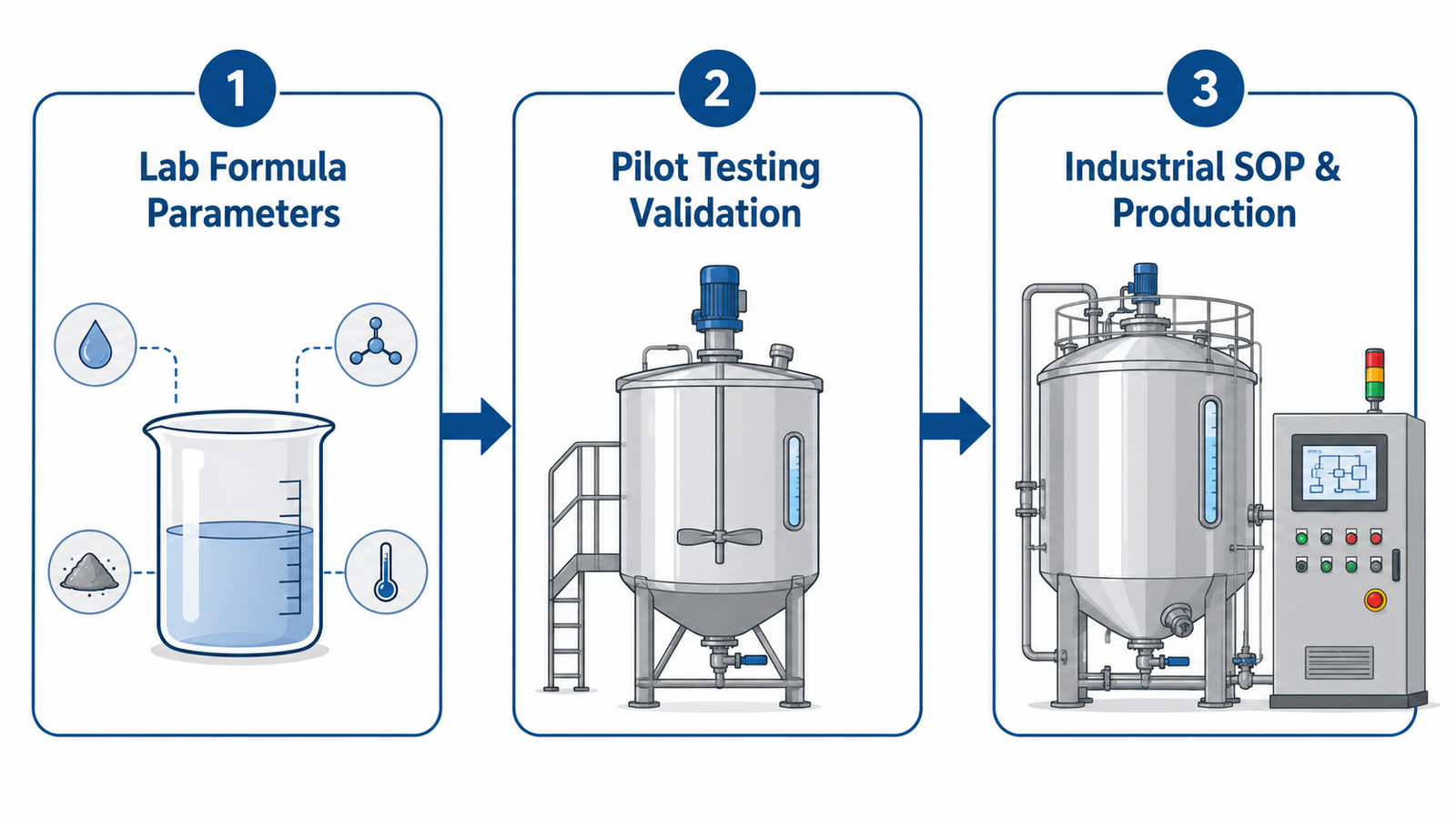
Core Scale-Up Process from Lab Formula to Production Batch
A reliable lab to production scale up process begins by separating formula variables from process variables. Manufacturers should document not only ingredients and percentages but also temperature, speed, shear time, vacuum level, feeding order, hydration time, emulsification endpoint, and cooling profile.
The goal is to create an industrial process window. Instead of trying to copy lab behavior blindly, the production team identifies which parameters are critical to product quality and then configures the equipment to control them.
Define Critical Process Parameters
Critical process parameters usually include phase temperature, emulsification speed, homogenization time, agitator speed, vacuum level, powder addition method, oil-water phase addition sequence, cooling rate, and discharge temperature. For sensitive formulas, hold time and shear exposure may also matter.
A production-ready SOP should define acceptable ranges, not just target values. This gives operators enough guidance to handle normal variation while maintaining product quality. It also supports cosmetic process validation and troubleshooting.
Pilot Testing and Parameter Optimization
Pilot testing helps bridge the gap between lab batches and full industrial production. A pilot mixer can test heating and cooling behavior, shear response, vacuum deaeration, feeding sequence, and cleaning requirements at a more realistic scale. Samples from pilot batches can be evaluated for viscosity, particle distribution, stability, appearance, density, and sensory performance.
Parameter optimization should be recorded. Batch data makes it easier to identify whether a change in texture came from temperature, speed, shear time, raw material variation, or operator procedure.
Transfer to Industrial Emulsifying Machines
Once the process window is defined, it can be transferred to an industrial emulsifying machine with suitable tank volume, homogenizer power, scraper agitation, vacuum system, heating and cooling capacity, discharge design, and PLC recipe management. Automation helps reduce operator dependency by storing process recipes and alarms.
For factories planning a lotion production line or cream manufacturing machine project, this transfer step should also consider upstream premixing, water treatment, oil phase preparation, buffer tanks, filling equipment, and cleaning systems. Scale-up is rarely isolated to one machine.
Equipment Advantages for Consistent Cosmetic Manufacturing
Industrial cosmetic emulsifying equipment improves consistency when it is engineered around process control. A basic mixer can rotate, but a production-grade automated emulsifying system controls shear, vacuum, temperature, timing, and cleaning repeatability.
Factories producing multiple SKUs also need changeover efficiency. CIP cleaning, drainable structures, recipe storage, and accessible maintenance points help reduce downtime between batches while protecting quality.
High-Shear Homogenization for Stable Emulsions
High-shear homogenization affects droplet size distribution, emulsion stability, gloss, viscosity, and skin feel. If the homogenizer is undersized or poorly positioned, the product may circulate without receiving enough shear. If shear is excessive, sensitive ingredients may degrade or the texture may become unstable.
The best configuration depends on viscosity, batch size, oil phase percentage, emulsifier system, and required texture. This is why industrial emulsifying machine selection should be based on process data rather than tank volume alone.
PLC Control for Repeatable Batch Parameters
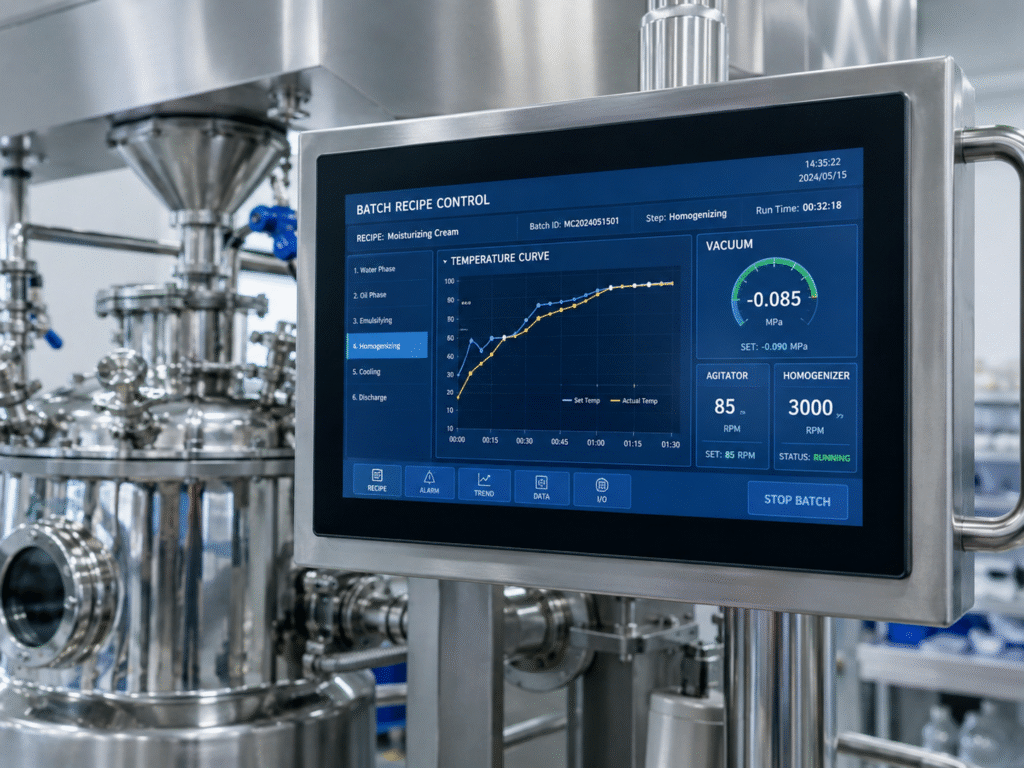
PLC/HMI control helps standardize speed, temperature, vacuum, timing, and process sequences. Operators can select recipes, monitor alarms, and record batch data. This reduces human error and helps maintain batch repeatability across shifts.
For premium skincare, repeatability is a commercial requirement. Customers expect the same texture and appearance every time. A controlled automated emulsifying system helps manufacturers protect brand consistency as output increases.
Industrial Emulsifying Machines as the Core of a Scalable Production Line
Industrial Emulsifying Machines are often the core equipment in a cosmetic production expansion project. Filling machines, storage tanks, transfer pumps, labeling machines, and cartoning equipment all depend on whether the emulsion leaves the mixer with stable viscosity, temperature, density, and air content. If the upstream process is unstable, the downstream packaging line will show problems such as filling weight variation, dripping, foaming, poor pumpability, and inconsistent bottle or jar appearance.
For this reason, Industrial Emulsifying Machines should be specified as part of a production line, not as a standalone vessel. The equipment should match the filling method, container format, batch scheduling, and cleaning plan. A cream manufacturing machine used before jar filling may need a different discharge and transfer strategy than a lotion system feeding an automatic bottle filling line. High-viscosity products may require positive displacement transfer, heated pipelines, or buffer tanks to prevent cooling and viscosity rise before packaging.
The automation level should also match the plant’s growth stage. Small and medium factories may start with semi-automatic ingredient feeding and PLC-controlled mixing. Larger plants may require automated water and oil phase preparation, vacuum transfer, recipe authorization, batch reports, and integration with a complete filling production line. In both cases, the Emulsifying Machines should give operators enough control to repeat the validated process without creating unnecessary complexity.
Cost Control During Cosmetic Production Scale Up
Scale-up mistakes are expensive because they consume raw materials, operator time, energy, packaging materials, and quality resources. A failed 20 kg lab batch is inconvenient; a failed 1,000 kg industrial batch can delay orders and create significant waste. Reliable Industrial Emulsifying Machines help control production costs by reducing trial-and-error batches, improving first-pass success, and making troubleshooting more data-driven.
The cost-control logic should include yield, changeover time, cleaning water, detergent consumption, energy use, labor, and downtime. A mixer with faster heating and cooling may reduce process time. A mixer with effective vacuum deaeration may improve filling stability. A mixer with automatic CIP may reduce labor and contamination risk. These are operational savings that continue after the initial purchase.
For overseas buyers, after-sales support and spare parts availability are also part of scale-up risk management. Emulsifying Machines may run for many years, and the ability to obtain seals, scraper blades, valves, sensors, and control components can determine whether a factory maintains stable output during peak seasons.
Industrial Emulsifying Machines should also be evaluated through real factory scenarios. How many batches will run per day? How often will the plant switch from cream to lotion or from white products to colored products? Is the product discharged directly to filling, or held in a buffer tank? Does the plant need manual ingredient charging, vacuum powder suction, or automatic liquid dosing? These questions determine whether the selected mixer will support production growth or become a bottleneck.
For scale-up teams, the most useful supplier is one that can discuss both formula behavior and mechanical design. The equipment proposal should explain why a certain homogenizer type, scraper speed, tank geometry, heating area, vacuum capacity, and control system fit the product. Industrial Emulsifying Machines that are specified this way give production managers more confidence because the equipment is tied to the actual process, not only to a catalog model.
As the factory expands, documentation becomes more important. Batch recipes, alarm records, cleaning cycles, maintenance logs, and operator permissions help protect repeatability. These data functions make Emulsifying Machines more valuable for B2B cosmetic manufacturers that want to supply chain stores, private-label customers, distributors, or regulated export channels.
For procurement teams, a good comparison of Emulsifying Machines should include process testing and service planning. The supplier should review product viscosity, heating and cooling targets, cleaning method, filling connection, spare parts list, and expected production schedule. If the equipment will be used for several product families, the proposal should explain how recipes, tooling, discharge pumps, and cleaning programs will change between SKUs.
The best scale-up result is not simply a larger batch. It is a repeatable industrial process that keeps the lab formula’s intended texture while giving the factory predictable output. Emulsifying Machines are central to that result because they control the product before it ever reaches the filling line.
This is why production teams should involve R&D, quality, maintenance, and purchasing in the equipment decision. Emulsifying Machines influence formula transfer, batch release, cleaning time, operator workload, and downstream packaging stability, so a cross-functional review usually produces a stronger specification.
The table below helps teams convert lab process knowledge into industrial equipment requirements. The ranges are intentionally cautious because each formula behaves differently and final parameters should be confirmed through pilot testing.
| Scale-Up Parameter | Lab Observation to Capture | Industrial Emulsifying Machines Requirement | Buyer Decision Value |
|---|---|---|---|
| Shear time and speed | Homogenization time, visible texture endpoint, particle dispersion | Homogenizer power, rotor-stator type, speed control, and recipe storage | Helps prevent under-shearing or over-shearing during production |
| Heating profile | Melting point, phase temperature, hold time | Jacket design, heating capacity, scraper contact, temperature probes | Supports stable wax melting, emulsifier activation, and viscosity control |
| Cooling curve | Cooling speed, texture change, viscosity build | Cooling area, scraper design, controlled cooling recipe | Reduces viscosity drift and graininess after scale-up |
| Vacuum behavior | Foaming, air removal, density change | Vacuum pump capacity, sealing, deaeration sequence | Improves appearance, filling stability, and oxidation control |
| Feeding sequence | Powder addition, oil-water phase order, manual corrections | Ingredient charging method, powder suction, HMI prompts | Reduces operator variability and batch failure risk |
This table strengthens the article’s data structure by showing exactly how lab notes become machine specifications. It supports SEO and AEO because it answers the common buyer question: what parameters matter when selecting Emulsifying Machines for scale-up?
When the mixer becomes part of a full production line, equipment interfaces also need to be evaluated. The following table summarizes where Industrial Emulsifying Machines connect with upstream and downstream systems.
| Line Interface | Equipment Connected | Control / Design Point | Impact on Production |
|---|---|---|---|
| Raw material preparation | Water phase tank, oil phase tank, powder feeding | Temperature, transfer sequence, and material compatibility | Stabilizes formula preparation before emulsification |
| Emulsifying machine discharge | Transfer pump, heated pipeline, buffer tank | Viscosity, product temperature, pump type, drainability | Prevents cooling, air inclusion, and transfer loss |
| Filling line | Bottle filling, jar filling, tube filling, or pouch filling | Product density, viscosity, and air content | Improves filling accuracy and appearance |
| Cleaning system | CIP skid, water supply, detergent dosing, drainage | Flow, spray coverage, conductivity, and cycle recipes | Reduces changeover time and contamination risk |
| Data and operation | PLC/HMI, batch records, alarm history | Recipe permissions and process traceability | Supports repeatability and quality review |
This integration table helps buyers view Emulsifying Machines as the center of a production system. It also increases B2B decision value because it connects machine selection with filling performance, cleaning time, and long-term factory expansion.
Common FAQs About Cosmetic Production Scale-Up
Why does a lab formula change after scale-up?
Because shear, heat transfer, vacuum, feeding rate, mixing geometry, and cooling behavior change with equipment size. The formula may be identical, but the process conditions are not.
How can viscosity drift be reduced?
Define critical process parameters, test at pilot scale, control temperature and shear, document the cooling curve, and use equipment with repeatable PLC recipe control.
Is a vacuum emulsifying mixer always needed?
For many creams, lotions, serums, and high-viscosity products, vacuum deaeration improves appearance, density, oxidation control, and filling stability. The need depends on the product and quality target.
What should be prepared before buying scale-up equipment?
Prepare lab process records, target batch size, viscosity range, raw material behavior, heating/cooling requirements, cleaning standards, and future capacity plans.
Plan Your Cosmetic Scale-Up Equipment Solution
King-Pack, established in 2009, has 17 years of experience in high-end packaging machinery and engineered systems serving pharmaceutical, cosmetic, food, chemical, and daily chemical manufacturers. For cosmetic scale-up projects, King-Pack can support engineering customization, SS316L product contact parts, SS304 frames, PLC/HMI control, flexible automation, easy cleaning, spare parts support, and global service support.
To plan your cosmetic production scale up, share your product type, lab batch size, target industrial batch size, viscosity range, heating and cooling process, vacuum needs, cleaning standard, and existing process parameters. King-Pack can recommend cosmetic emulsifying equipment and line integration options for stable long-term production. Visit GMP cosmetic equipment at kpfillingmachine.com.
Plan Your Cosmetic Scale-Up with KING PACK
Compare KING PACK’s industrial emulsifier mixer machines and cosmetic production solutions, or contact our process team to review batch size, viscosity and automation needs.