
Introduction
The purchase price of a filling machine is the number that appears on the quotation. It is also the least important number in the total cost calculation. For veterinary and pharmaceutical manufacturers, the real financial consequences of a low-cost filling machine show up later, in downtime reports, maintenance budgets, batch rejection logs, and compliance audit findings.
In this article, we walk through the six hidden cost categories that make a cheap servo driven filling system significantly more expensive than it first appears. We will explain how to evaluate a filling machine ROI correctly from the start, which leads to better capital decisions. Throughout, we will also explain how our King Pack filling systems are engineered to avoid each of these cost categories.
Why “Low Price” Does Not Mean “Low Cost” in
The Common Filling Machines Purchasing Mistake
Most equipment buyers compare filling machine options on three variables: price, lead time, and basic specifications. This is an understandable approach, particularly when procurement decisions are driven by CapEx approval processes that treat all equipment purchases as line items to be minimized.
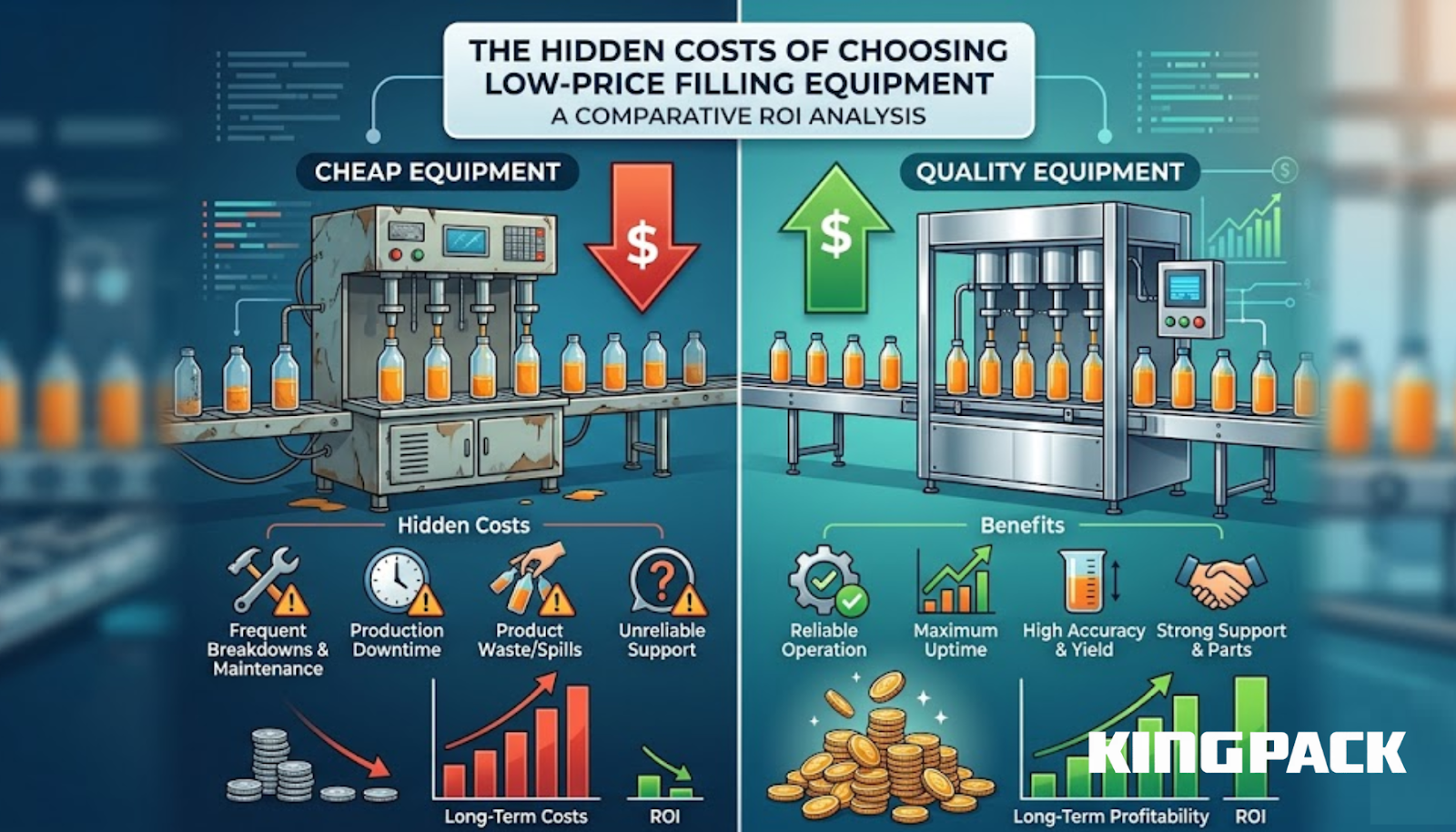
The problem is that filling machine cost analysis based purely on purchase price ignores the largest cost categories entirely. A machine that costs 40% less at purchase but breaks down twice as often, fills at ±3% accuracy instead of ±1%, and cannot pass a GMP audit does not save money. It costs significantly more over its operating life.
Short-Term Savings vs Long-Term Cost
The total cost of ownership (TCO) for a filling machine covers initial purchase price, installation and commissioning, spare parts, maintenance labor, production losses from downtime, product waste from filling inaccuracy, compliance remediation, and eventual replacement cost. A low purchase price reduces only the first of these categories, often at the expense of all the others.
According to Limble CMMS’s maintenance cost analysis, unplanned repairs cost three to ten times more than the same maintenance work done on a planned schedule, meaning that equipment chosen for low purchase price typically generates disproportionately higher maintenance costs over its operating life.
Understanding Total Cost of Ownership of a Servo System
TCO analysis converts the low price vs high quality filling machine comparison into a time-based financial model. It asks not what a machine costs to buy, but what it costs to own and operate over three, five, or ten years of production. When that calculation is done correctly, the higher-quality filling machine almost always delivers better value, often recovering the price premium within the first year through reduced downtime and product waste alone.
Recommended Reading: How Small Pet Pharma Factories Can Cut Costs: ROI Analysis of Drop Filling Machine Investment – King Pack Machinery
The Real Cost Breakdown of Filling Equipment
Before examining individual hidden costs, it helps to see where costs actually fall across the lifetime of a filling machine:
| Cost Category | Low-Cost Machine | High-Quality Machine |
| Purchase price | Low | Higher |
| Annual maintenance cost | High | Low to moderate |
| Downtime losses per year | High | Low |
| Product waste from inaccuracy | High | Minimal |
| Compliance remediation cost | Variable to high | Minimal |
| Equipment lifespan | 3 to 5 years | 8 to 15 years |
| Total 5-year cost of ownership | Very high | Moderate |
The purchase price advantage of a low-cost machine is typically recovered by the manufacturer within the first 12 to 18 months of operation, after which the higher ongoing costs begin to compound year on year.
Hidden Cost 1: Downtime and Production Loss
Unstable Machine Performance
Low-quality liquid filling machine designs rely on basic components, loose tolerances, and simple control logic. This lowers upfront cost but increases failure frequency in the filling process. Bearings wear faster, seals in the product cylinder fail earlier, and the pump system loses stability under load.
A servo pump filling machine with industrial-grade servo piston control and high accuracy maintains stable vertical movement and consistent output. In contrast, a low-grade filler struggles to precisely control liquid flow across different products, especially viscous products or thin formulations.
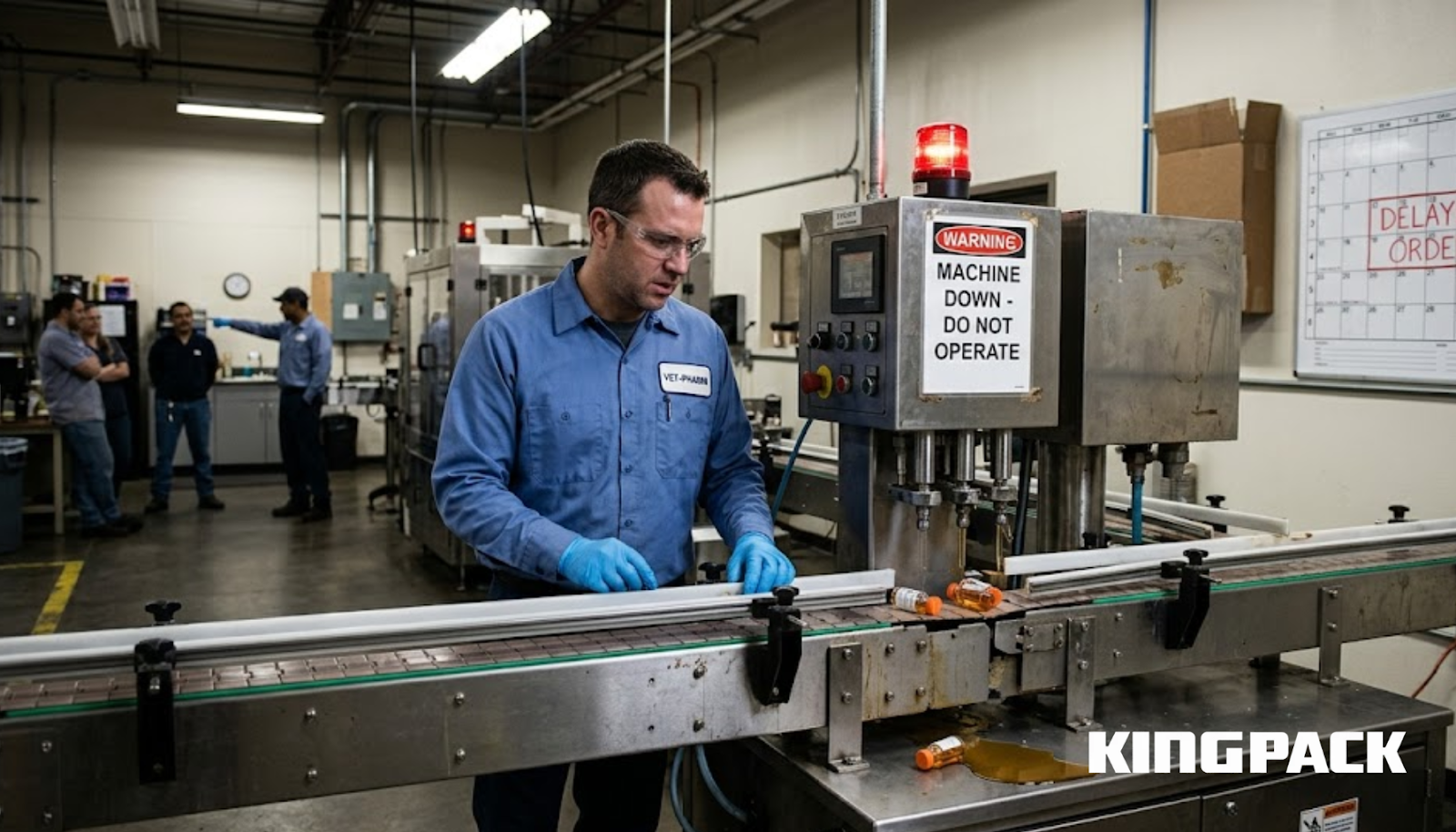
Industry data shows that equipment failure drives a large share of downtime. For a line running automatic filling at high speed, even short stops reduce efficiency. A line producing 5,000 bottle units per hour at $2 per unit loses $10,000 per hour when idle.
Impact on Delivery and Orders
Downtime disrupts more than one batch. It affects the full schedule. Delays in one liquid filling stage push other liquid products back. Orders slip. Extra shipping costs rise to recover timelines.
Production monitoring becomes harder on unstable systems. A machine with poor load rate control cannot maintain steady output across industries such as cosmetics, chemicals, or veterinary production.
Cost of Lost Production Time
Each downtime event adds multiple costs. Idle operators, emergency spare parts, and overtime to recover lost production all increase total spend.
A high-quality servo pump system reduces these risks. Stable operation and efficient performance keep the filler running longer without interruption, protecting both output and schedule.
Hidden Cost 2: Filling Accuracy and Product Waste
Overfilling Equals Material Waste
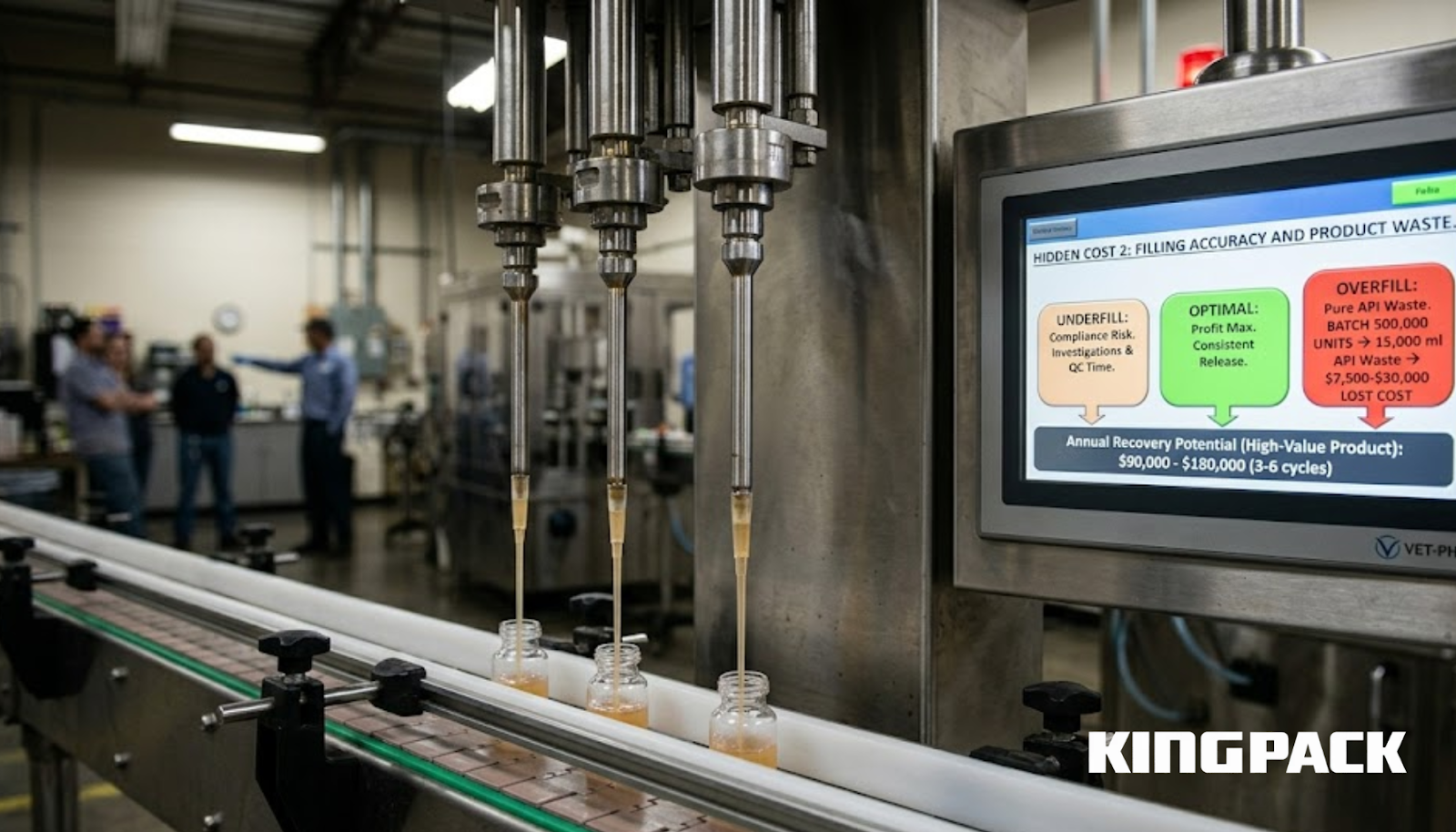
A filler operating at ±3% cannot maintain high accuracy across the full filling process. On a 1 ml bottle, the system may deliver up to 1.03 ml. Across 500,000 units, this creates 15,000 ml of excess liquid.
A servo pump filling machine with filling pistons can precisely control volume through calibrated stroke. This improves consistency and reduces waste in liquid filling.
At $500 per liter, that excess equals $7,500 lost per batch. This loss increases with higher-value liquid products or specialty chemicals.
Underfilling Equals Compliance Risk
Underfilled units fall below label claims. In regulated industries, this creates compliance issues. Batches may be rejected, reworked, or destroyed.
Low-quality machines often lack accurate calibration tools. According to Eurofins’ GMP audit non-conformity analysis, poor maintenance of pump components and filling pistons increases variation.
High accuracy systems with servo piston control maintain stable output, even with viscous products or corrosive products, reducing compliance risk.
Impact on High-Value Products
At higher API cost levels, the impact grows fast. A $2,000 per liter formulation turns the same overfill into $30,000 loss per cycle.
A high-quality liquid filling machine with advanced technology and precise control recovers this cost through better efficiency and reduced waste.
Recommended Reading: Emulsifying Mixer Machine: Factors Affecting The Emulsification Result – King Pack Machinery
Hidden Cost 3: Maintenance and Spare Parts
Low-Quality Components Wear Faster
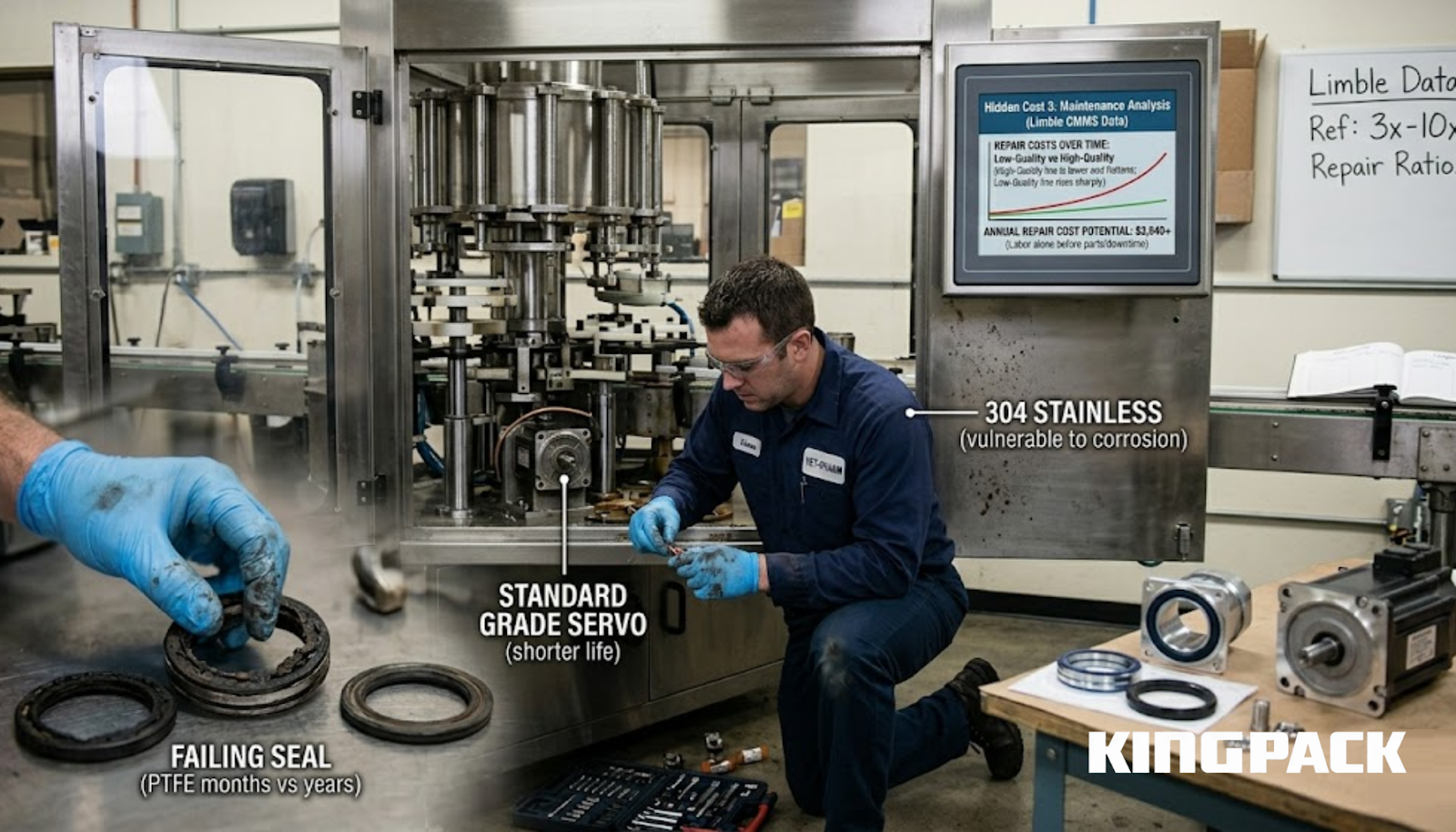
Internal parts such as pumps, seals, and filling pistons define machine life. Low-grade materials degrade quickly under continuous liquid filling conditions.
A servo pump system built with industrial materials maintains performance for years. A low-cost machine loses consistency within months, especially when handling different products like lubricants, thin liquids, or viscous formulations.
Frequent Repairs
Internal parts such as pumps, seals, and filling pistons define machine life. Low-grade materials degrade quickly under continuous liquid filling conditions.
A servo pump system built with industrial materials maintains performance for years. A low-cost machine loses consistency within months, especially when handling different products like lubricants, thin liquids, or viscous formulations.
Maintenance Labor Cost
The labor cost of maintenance on a low-quality filling machine is often underestimated at the time of purchase. Maintenance technicians spend time diagnosing faults, sourcing spare parts, disassembling and reassembling the machine, and verifying performance after repair. On a high-breakdown-frequency machine, that time accumulates quickly.
If a low-cost machine requires an average of four unplanned maintenance interventions per month, each taking two hours of technician time at a fully loaded labor rate of $40 per hour, the monthly hidden maintenance labor cost alone is $320, adding up to $3,840 per year before the cost of parts and downtime is included.
Hidden Cost 4: Compliance and Certification Risks
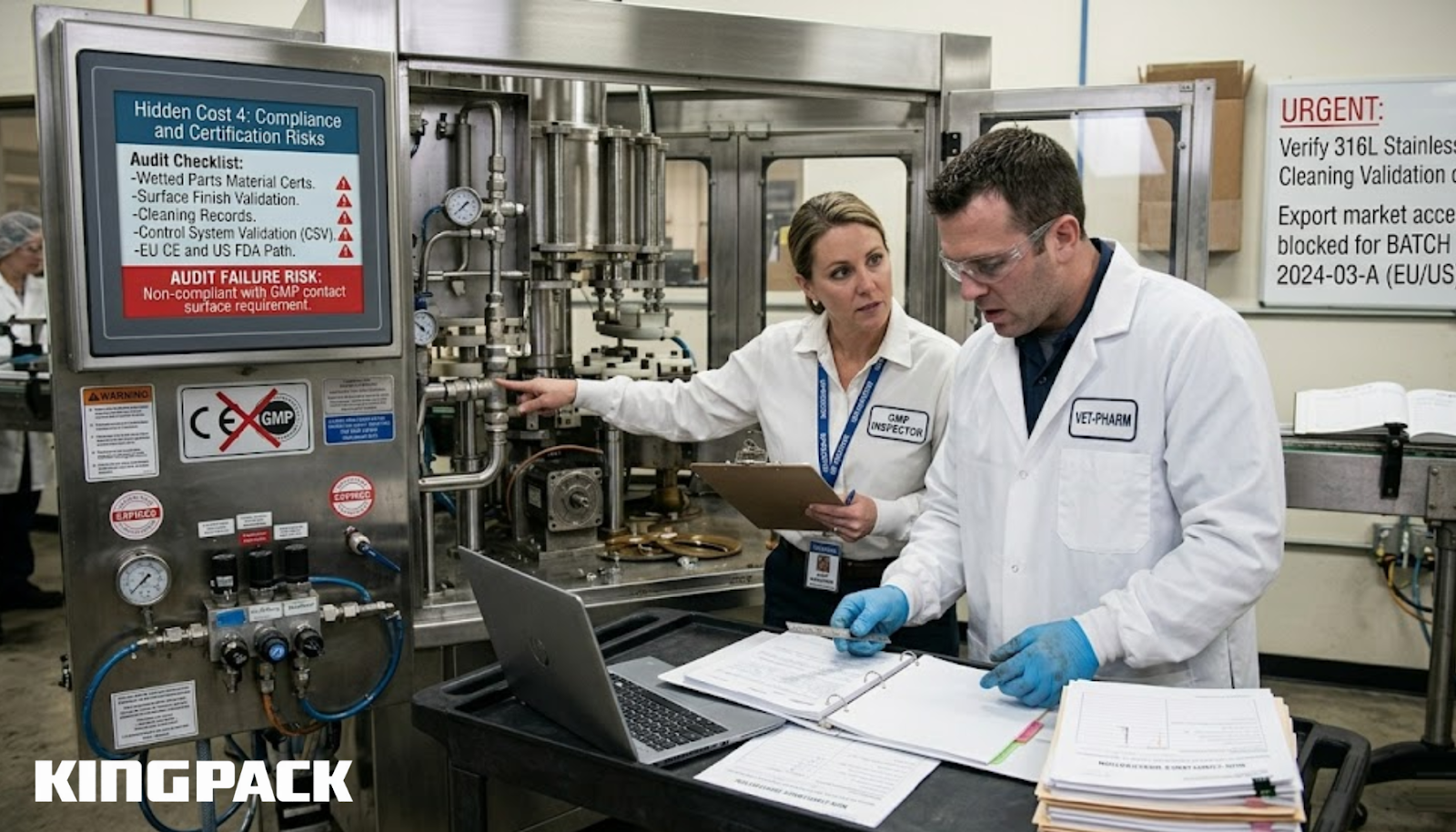
A liquid filling machine used in regulated industries must meet strict standards. This includes material quality, cleanability, and calibration records.
Low-cost machines often fail in these areas. Contact parts may not support safe handling of chemicals or sensitive liquid products. Control systems may lack traceability features.
A servo pump filling machine designed for compliance includes validated features, accurate control, and documented performance. This supports safe and efficient operation across industries.
Audit Failure Risks Related to Servo Pump
During a regulatory audit, the filling machine is one of the first pieces of equipment an inspector examines. Maintenance logs, calibration records, cleaning validation data, and material certifications are all reviewed.
A machine with incomplete documentation, non-certified components, or a history of unresolved maintenance deficiencies generates audit observations that delay batch release and trigger corrective action requirements.
According to ISPE’s Pharmaceutical Engineering analysis on equipment qualification, equipment that has not been properly qualified and maintained is one of the leading sources of GMP non-compliance findings during regulatory inspections, with consequences ranging from warning letters to production suspension for serious or repeated violations.
Market Access Limitations
Export markets require certified equipment. A non-compliant liquid filling machine blocks access to regulated regions.
A high-quality system with certified technology, stable operation, and documented performance supports entry into global markets. The long-term revenue impact often exceeds the initial savings from a low-cost purchase.
Recommended Reading: From Filler to Pallet: The Path to a Fully Automated Packaging Line (Reducing Manual Labor by 40%) – King Pack Machinery
Hidden Cost 5: Labor Dependency
Manual Operation Costs
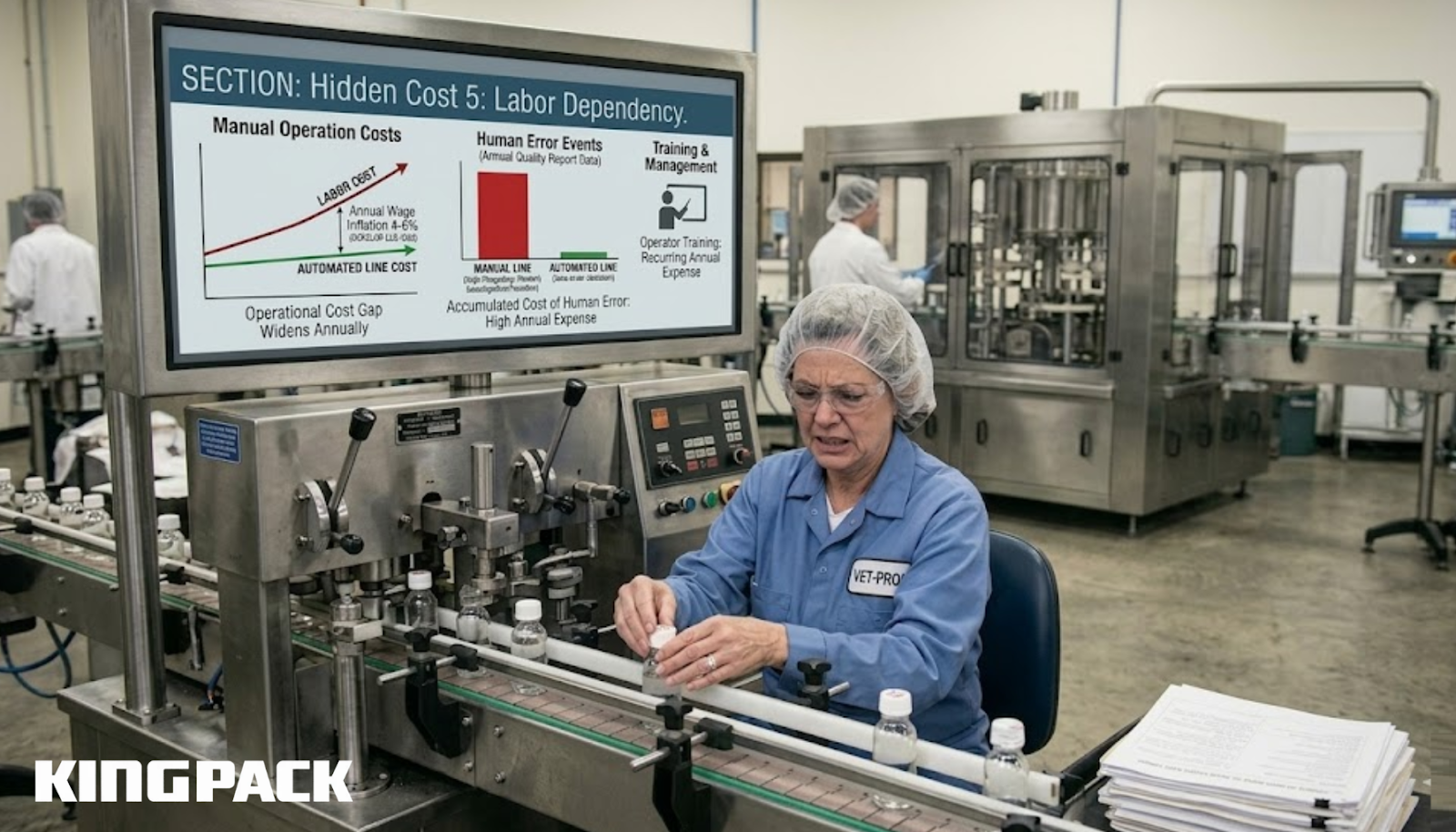
Low-cost filling machines typically require more manual operator input than high-quality automated equivalents. Container loading, cap placement, and in-process checking all require operator time that an automated filling line eliminates. As labor costs rise, the operational cost gap between a low-cost manual machine and a high-quality automated one widens every year.
According to DEVELOP LLC’s automation ROI analysis, manufacturers who delay automation investment face compounding labor cost increases, with wage inflation in production roles averaging 4% to 6% annually in most developed manufacturing markets, meaning the labor cost of manual operations grows every year the automation investment is deferred.
Human Error
Manual operations introduce variability that automated systems eliminate. An operator who mis-seats a cap, positions a container incorrectly under the nozzle, or fails to catch a fill volume deviation during in-process checking generates quality events that an automated line would have prevented or detected automatically.
Over a full production year, the accumulated cost of human error events, including rework, investigation time, and failed batch segments, is a hidden cost that rarely appears in the original equipment cost analysis but shows up very clearly in the annual quality report.
Training and Management Cost
Every new operator on a manually intensive filling line requires training time before they can work independently. On a low-cost machine with less intuitive controls and more manual adjustment points, that training takes longer. When operator turnover is high, as it is in many production environments, the training cost becomes a recurring annual expense.
Hidden Cost 6: Scalability Limitations
Cannot Meet Future Capacity
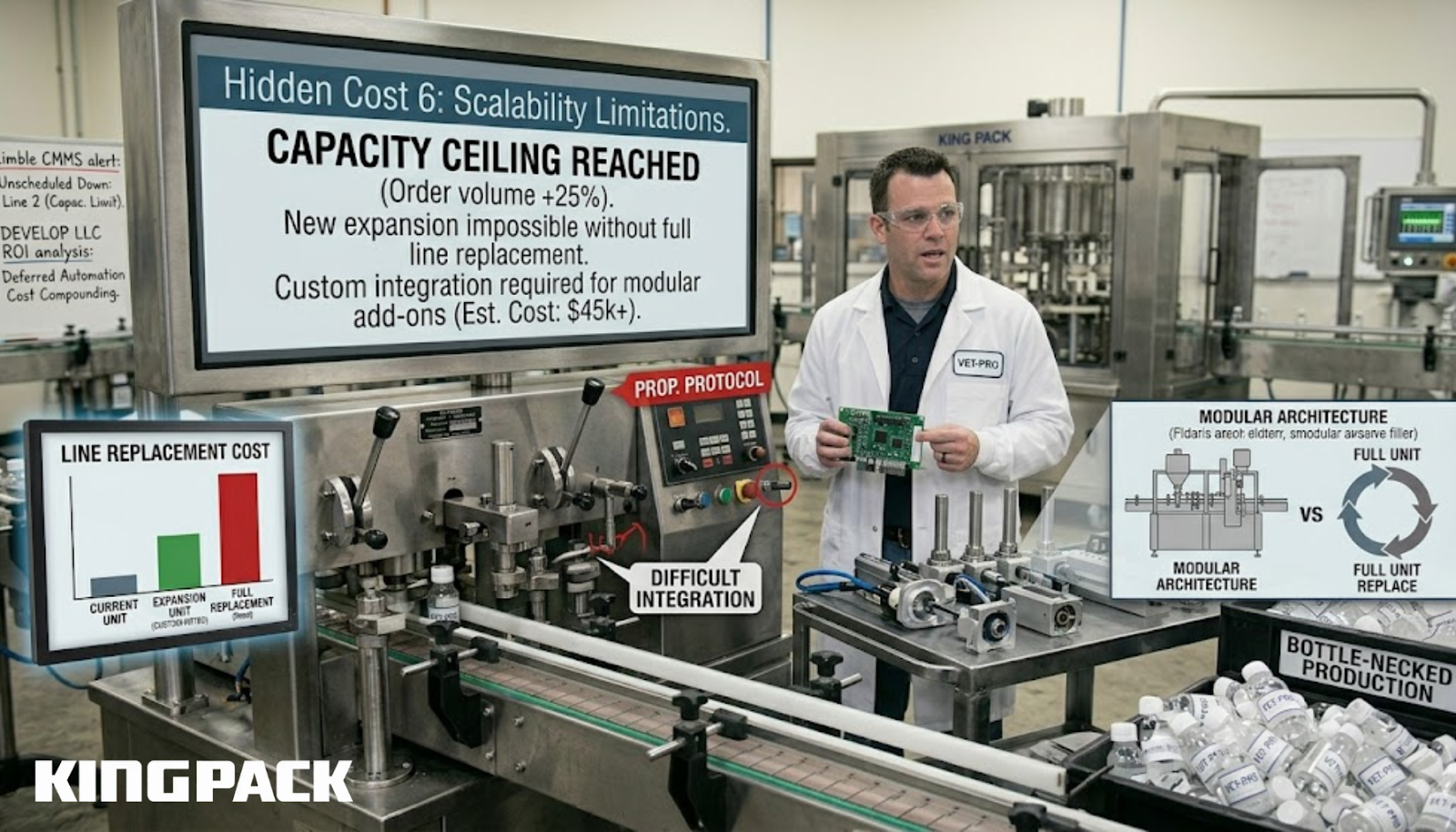
A low-cost filling machine sized for current production volume provides no headroom for growth. When order volume increases, the machine cannot keep pace. The manufacturer faces a choice between running additional shifts at higher labor cost, or purchasing a second machine, incurring the full purchase price again along with all the hidden costs that come with it.
A high-quality filling machine with modular architecture can be expanded by adding filling heads, increasing line speed, or integrating additional downstream modules, without replacing the core equipment.
Difficult System Integration
Low-cost filling machines are rarely designed with integration in mind. Their control systems use proprietary or non-standard communication protocols that cannot easily connect to labeling, cartoning, MES, or ERP systems. Building those integrations requires custom engineering work that adds cost and complexity to every subsequent automation upgrade.
Our modular filling line designs at King Pack use standard industrial communication protocols from the base configuration, making downstream integration straightforward at any stage of production growth.
Full Line Replacement Cost
The ultimate scalability failure of a low-cost filling machine is that it often cannot be upgraded at all. When production requirements outgrow the machine’s capability, the entire unit must be replaced rather than expanded. That replacement resets the purchase cost clock and repeats every associated hidden cost, installation, commissioning, validation, operator training, and compliance documentation, from the beginning.
ROI Comparison: Low-Cost vs High-Quality Equipment
| Parameter | Low-Cost Machine | High-Quality Machine |
| Purchase price | $30,000 to $80,000 | $80,000 to $200,000 |
| Annual maintenance cost | $15,000 to $40,000 | $3,000 to $8,000 |
| Annual downtime cost | $50,000 to $150,000 | $5,000 to $20,000 |
| Annual product waste cost | $10,000 to $50,000 | $1,000 to $5,000 |
| Total 5-year cost of ownership | $425,000 to $1,240,000 | $114,000 to $365,000 |
The total cost of ownership comparison consistently shows the same result: the higher purchase price of a quality filling machine is recovered within 12 to 24 months through reduced downtime, lower maintenance costs, and eliminated product waste. After that payback point, the quality machine generates net financial advantage every year it runs.
How to Evaluate Filling Equipment from an ROI Perspective
Before investing in a liquid filling machine, assess the equipment to understand its full cost and long-term value:
- What is the mean time between failures (MTBF) for the machine, verified by reference customers with similar applications?
- How accurate is the main filling structure at full production speed with the actual formulation, not just water?
- Does the machine use a servo motor system with a personalized control panel system to precisely manage the filling process and reduce foam?
- Are spare parts readily available, and what is the typical lead time for commonly replaced components?
- Does the equipment carry GMP, CE, and relevant export certifications, with documentation ready for regulatory submission?
- Can the machine be integrated with downstream automation, and does it offer easy operation for operators during format changeovers?
- What after-sales support does the manufacturer provide, and is technical assistance available in the production region?
Recommended Reading: The Differences Between Homogenization and Emulsification – King Pack Machinery
Why High-Quality Filling Systems Deliver Better ROI
A high-quality filling machine delivers better ROI across every cost category, not just purchase price. Stable performance means fewer unplanned downtime events and predictable production output.
Higher precision means lower material waste and fewer compliance events. Longer service life means the capital investment is spread across more production years. Compliance-ready design means no retrofit costs and no blocked export markets.
These are not theoretical advantages. They are measurable financial outcomes that appear in the production cost accounts of every manufacturer who has made the transition from a low-cost to a high-quality filling machine.
Why King Pack Filling Systems
At King Pack, we design filling systems that are built to minimize total cost of ownership rather than minimize purchase price. Our servo-driven filling technology delivers ±1% accuracy across the full production shift, reducing product waste to the minimum physically achievable level.
Our industrial-grade components carry service lives measured in years, not months, and our maintenance requirements are predictable and manageable on a planned schedule.
Our global after-sales support network provides spare parts availability and technical support in the regions where our customers operate. When a component requires replacement, our customers receive the correct part quickly, through a documented supply chain, with installation guidance from our technical team.
Contact King Pack to discuss your production requirements and receive a total cost of ownership analysis comparing your current or planned filling equipment against our high-quality filling line configurations.