 Skip to content

Premium cosmetic manufacturing depends on much more than a strong formula. Creams, lotions, serums, balms, and high-viscosity skincare products must be mixed, emulsified, heated, cooled, deaerated, discharged, cleaned, and repeated across batches without residue, contamination, or texture drift. For this reason, a mirror polished CIP/SIP cosmetic emulsifying mixer has become an important investment for factories producing higher-value formulations under stricter hygienic and quality expectations.
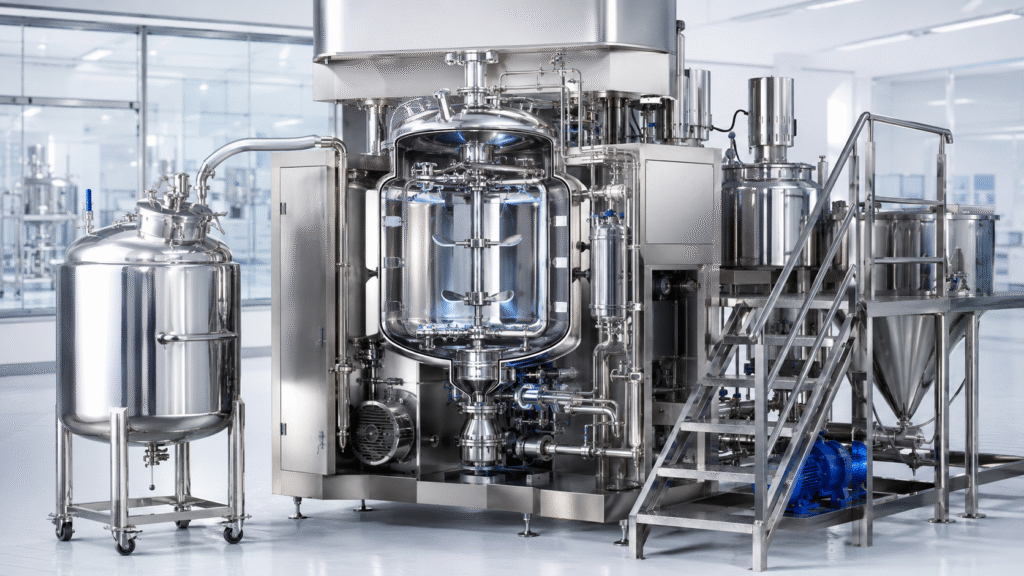
Why Surface Finish Determines Cosmetic Product Quality
Cosmetic products often contain oils, waxes, surfactants, polymers, powders, botanical extracts, active ingredients, fragrances, and preservatives. Many formulas are sticky, viscous, or temperature-sensitive. If the inner tank surface is rough, residues can remain after discharge and cleaning. These residues may affect the next batch, create microbial risk, or cause visible defects such as dark specks, odor transfer, or unstable texture.
A mirror polished emulsifying mixer reduces the chance of material retention on the vessel wall, pipelines, discharge port, and contact surfaces. For manufacturers serving premium skincare or pharmaceutical-adjacent cosmetic markets, this helps support a more reliable quality system and a stronger cleaning validation process.
Ra <= 0.4 um Mirror Polishing for Residue Control
Surface roughness is commonly measured as Ra. A lower Ra value indicates a smoother surface profile. In cosmetic production, Ra <= 0.4 um surface finish helps reduce microscopic valleys where cream, lotion, pigment, or microbial contamination may remain after cleaning. This is especially important for whitening creams, sunscreen emulsions, eye creams, and products with high oil or wax content.
Mirror polishing also supports easier inspection. Operators can visually check surfaces more effectively, and the cleaning cycle has a better chance of removing residue without excessive manual scrubbing. For high-viscosity products, this can reduce labor and shorten the time between batches.
Dead-Corner-Free Design for Hygienic Manufacturing
Surface finish alone is not enough. A hygienic emulsification equipment design must avoid dead corners around the lid, agitator shaft, vacuum port, manway, sampling valve, discharge valve, pipelines, and seals. Dead zones can trap product and cleaning liquid, making validation difficult.
A sanitary mixing tank should use smooth transitions, appropriate welding, drainable piping, cleanable valve structures, and contact parts suitable for the formula. SS316L is commonly preferred for product-contact parts in demanding applications, while SS304 may be used for machine frames and non-contact structures. The design should make cleaning predictable rather than dependent on operator effort.
Core CIP/SIP Process for Cosmetic Emulsifying Mixers
CIP and SIP are often discussed together, but they solve different problems. CIP, or cleaning in place, removes product residue and cleaning chemicals without full disassembly. SIP, or sterilization in place, uses steam or validated heat treatment to reduce microbial risk where required by the product and factory standard.
For a CIP SIP cosmetic mixer, the cleaning and sterilization design should match formula viscosity, batch size, product risk level, facility utilities, and validation expectations. A factory making basic body lotion may not need the same SIP program as a manufacturer producing high-end eye cream or sensitive skincare products for tightly controlled markets.
Pre-Rinse, Detergent Wash, and Final Rinse
A typical automatic CIP cleaning system begins with pre-rinse to remove bulk residue. Detergent wash follows, using controlled concentration, temperature, contact time, and flow. Final rinse removes detergent and prepares the mixer for inspection or sterilization. Spray balls or rotary spray devices must cover the vessel wall, lid, agitator surfaces, and other product-contact areas.
Cleaning validation depends on repeatable parameters. Flow rate, temperature, detergent concentration, rinse conductivity, cycle time, and drainability should be documented. A PLC/HMI system can store cleaning recipes and reduce operator-dependent variation.
Steam Sterilization and Condensate Drainage
SIP sterilization system design requires more than injecting steam into a tank. Temperature distribution, condensate drainage, sanitary sealing, pressure control, and instrument placement all matter. Poor drainage can leave water in low points, increasing microbial risk after the cycle.
For cosmetic factories adopting higher hygiene standards, SIP can support product safety and brand confidence. However, it must be engineered according to real production needs. Over-specifying SIP without suitable utilities, seals, or validation support may increase cost without improving quality.
[Suggested diagram: CIP/SIP cycle sequence for cosmetic emulsifying equipment]
Technical Advantages for Premium Cosmetic Manufacturers
A high-quality cosmetic emulsifying mixer contributes to product texture, stability, and repeatability. Buyers should evaluate not only tank volume and motor power but also homogenizer performance, vacuum deaeration, heating and cooling control, scraper efficiency, discharge design, automation, and cleaning access.
For premium cosmetics production, the commercial value of the mixer lies in batch reliability. Fewer failed batches, faster changeover, less manual cleaning, and stable product feel can matter more than the initial machine price.
Stable Emulsification for Creams, Lotions, and Serums
A vacuum emulsifying mixer uses high-shear homogenization to disperse oil and water phases, reduce particle size, and build a stable emulsion. Vacuum deaeration helps remove trapped air that can affect appearance, density, oxidation, and filling accuracy. A wall scraper improves heat transfer and prevents material from sticking to the vessel wall during heating and cooling.
Temperature control is especially important for wax melting, emulsifier activation, polymer hydration, and cooling curve management. If the cooling phase is unstable, viscosity and skin feel may change from batch to batch. A well-designed high shear emulsifying mixer helps maintain predictable texture and stability.
Automated Cleaning to Reduce Downtime
Manual cleaning requires disassembly, operator access, water, detergent, and inspection time. It also introduces variability. Automated CIP reduces the need for repeated manual scrubbing, helps protect workers, and improves equipment utilization.
For factories running multiple formulas, shorter and more reliable changeover can increase available production time. The business case includes labor reduction, lower contamination risk, less rework, and better scheduling. This is why automatic CIP cleaning system design is often central to premium mixer selection.
How to Select Emulsifying Mixers for Premium Cosmetic Production
When procurement teams compare Emulsifying Mixers, tank volume is only the starting point. A 500 L mixer and a 500 L premium cosmetic emulsifying mixer may perform very differently if the homogenizer, scraper, vacuum system, jacket design, discharge valve, and CIP/SIP layout are not engineered for the formula. Premium creams and lotions need Emulsifying Mixers that can maintain stable shear, controlled temperature, clean discharge, and repeatable cleaning across many batches.
The selection process should begin with product data. Buyers should provide viscosity range, oil phase percentage, powder content, heating temperature, cooling curve, target texture, deaeration needs, batch frequency, and cleaning standard. For high-viscosity creams, the Emulsifying Mixers should include a robust wall scraper and bottom or inline homogenizer arrangement that avoids unmixed zones. For low-viscosity lotions and serums, the priority may shift toward efficient circulation, fast deaeration, and gentle post-emulsification mixing.
Automation is another major difference between basic mixers and production-grade Emulsifying Mixers. PLC/HMI recipe control allows manufacturers to standardize speed, time, temperature, vacuum, and cleaning cycles. This supports batch repeatability, operator training, and troubleshooting. When a product fails stability testing, recorded process data helps determine whether the root cause came from raw materials, shear time, temperature control, or cleaning residue.
ROI, Cleaning Validation, and Line Integration
The ROI of Emulsifying Mixers is not limited to faster mixing. A well-designed system reduces manual cleaning, lowers cross-contamination risk, improves batch consistency, and shortens changeover. For factories producing multiple skincare SKUs, CIP and SIP can recover many hours of production time each week compared with full manual disassembly. The benefit becomes even stronger when the mixer is connected to buffer tanks, transfer pumps, filling machines, and a downstream packaging line.
Cleaning validation should be considered before purchase. The mixer should allow repeatable spray coverage, full drainage, cleanable seals, controlled detergent concentration, and accessible sampling points where required. If the cleaning process is difficult to prove, the equipment may become a bottleneck during audits or product changeover.
Maintenance planning also affects long-term performance. Scraper blades, mechanical seals, homogenizer bearings, valves, spray devices, temperature probes, and vacuum components should be easy to inspect and replace. For premium cosmetic production, consistent texture depends on keeping the Emulsifying Mixers in stable mechanical condition, not only on choosing the correct model at the beginning.
For buyers comparing several Emulsifying Mixers, factory acceptance testing should include more than empty-machine operation. A useful FAT may check vacuum holding, heating and cooling response, agitator direction, scraper clearance, homogenizer operation, CIP spray coverage, alarm logic, HMI recipes, valve operation, and discharge performance. If product testing is possible, the buyer can also evaluate texture, air removal, cleaning time, and residue behavior before shipment.
Emulsifying Mixers should also be reviewed against future product plans. A factory that currently produces basic lotion may later add sunscreen, hair mask, body butter, gel cream, or pharmaceutical-grade skincare. Choosing a mixer with appropriate motor margin, hygienic piping, automation capacity, and flexible cleaning recipes can reduce the need for early replacement. This future-oriented selection is especially important for brands expanding from local sales to export markets, where batch consistency and documentation expectations are higher.
The commercial goal is simple: the mixer should help the factory make more acceptable product with less rework. Smooth internal surfaces, effective CIP/SIP, stable vacuum emulsification, and easy maintenance all contribute to that outcome. In this sense, premium Emulsifying Mixers are not just process machines; they are quality-control assets inside the cosmetic production line.
For purchasing managers, the final comparison should include technical scope and service scope together. Emulsifying Mixers may require installation guidance, utility confirmation, operator training, cleaning recipe adjustment, and spare parts support after delivery. A supplier that can discuss formula viscosity, sanitary design, automation, and downstream filling integration will usually provide a more usable system than one that only quotes tank capacity and motor power.
This is also where brand positioning connects with engineering. Premium cosmetics need stable appearance, fragrance retention, texture, and microbial control. Emulsifying Mixers with mirror polished surfaces and validated cleaning logic help manufacturers protect those quality signals batch after batch.
In practical purchasing terms, Emulsifying Mixers should be treated as long-life production infrastructure. A slightly better hygienic design, clearer automation, or easier maintenance structure can reduce daily operating friction for years. That long-term view is usually more useful than choosing only by the lowest initial quotation.
The table below gives buyers a practical way to evaluate hygienic design features in Emulsifying Mixers. The values are not a substitute for project-specific engineering, but they reflect common decision points in premium cosmetic production.
| Feature | Recommended Buyer Focus | Typical / Cautious Technical Reference | Why It Matters |
|---|---|---|---|
| Internal surface finish | Product-contact tank, lid, pipelines, and discharge areas | Ra <= 0.4 um where premium hygiene and residue control are required | Reduces residue retention and supports cleaning validation |
| Product contact material | Contact parts exposed to cream, lotion, or serum | SS316L is commonly preferred for demanding formulas; SS304 may suit non-contact structures | Supports corrosion resistance and hygienic operation |
| Dead-corner-free layout | Shafts, valves, manway, bottom outlet, and seals | Smooth transitions and drainable geometry depending on configuration | Reduces residue, microbial risk, and manual cleaning burden |
| CIP coverage | Spray balls, rotary spray devices, and pipeline cleaning | Coverage must be verified during FAT or validation testing | Helps make cleaning repeatable rather than operator-dependent |
| SIP readiness | Steam path, condensate drainage, sanitary sealing | Required only when product and factory standard justify sterilization | Supports higher hygiene requirements without over-specification |
This table improves buyer decision value because it links visible machine features to hygiene, cleaning, and batch quality outcomes. It also helps search engines understand the article’s technical depth around Emulsifying Mixers, CIP/SIP, Ra <= 0.4 um, SS316L, and sanitary design.
Maintenance planning should be discussed before the machine is ordered. The table below summarizes common maintenance areas without pretending that every factory follows the same interval; actual timing depends on formula abrasiveness, batch frequency, cleaning method, and operating hours.
| Maintenance Area | What to Check | Typical Frequency Guidance | Risk if Ignored |
|---|---|---|---|
| Scraper blades | Wear, clearance, deformation, and wall contact | Typically checked during routine cleaning or scheduled maintenance | Poor heat transfer, wall residue, and texture variation |
| Mechanical seals | Leakage, noise, overheating, and cleaning compatibility | Depending on operating hours and seal design | Contamination risk and unplanned downtime |
| Homogenizer | Bearing condition, vibration, rotor-stator wear | Typically inspected during preventive maintenance | Unstable particle size and poor emulsification |
| CIP spray devices | Blockage, rotation, spray pattern, and drainage | Checked after cleaning issues or during validation review | Incomplete cleaning and residue carryover |
| Sensors and probes | Temperature accuracy, vacuum reading, and alarm response | Calibrated according to factory quality procedures | Batch inconsistency and weak process traceability |
By including maintenance data in the article, the content becomes more useful for engineering buyers and plant managers. It also supports AEO-style answers for questions such as how to maintain a cosmetic emulsifying mixer and what parts affect batch consistency.
Common FAQs About Mirror Polishing and CIP/SIP Mixers
Is Ra <= 0.4 um necessary for every cosmetic emulsifying mixer?
Not every product requires the same surface finish. However, Ra <= 0.4 um is valuable for premium, high-viscosity, sensitive, or hygiene-focused formulas where residue control and cleanability are critical.
What is the difference between CIP and SIP?
CIP removes residues through automated cleaning cycles. SIP uses steam or heat to sterilize contact surfaces. CIP is about cleaning; SIP is about microbial reduction after cleaning.
Can CIP completely replace manual inspection?
No. CIP can reduce manual cleaning work, but visual inspection, validation, and periodic maintenance remain important. The goal is repeatability and reduced intervention, not blind operation.
What information is needed before selecting a mixer?
Key data includes batch size, viscosity, formula type, cleaning standard, heating/cooling needs, vacuum requirement, homogenizer speed, automation level, and available utilities.
Request a Hygienic Emulsifying Mixer Configuration
King-Pack, established in 2009, has 17 years of experience in high-end packaging machinery and process-related equipment for pharmaceutical, cosmetic, food, chemical, and daily chemical manufacturers. For cosmetic emulsifying projects, King-Pack can provide engineering customization, SS316L product contact parts, SS304 machine frames, PLC/HMI control, easy cleaning design, spare parts support, and global service support.
To configure a cosmetic emulsifying mixer for your production, share your formula type, viscosity range, batch size, cleaning requirements, SIP expectations, heating and cooling process, and target automation level. King-Pack can help evaluate a CIP SIP cosmetic mixer solution for long-term production stability. Visit GMP cosmetic manufacturing equipment at kpfillingmachine.com.
Related resources: For related guidance, explore Encyclopedia resources, Emulsifying Mixer Machine for Cosmetics Production, and Scaling Up Cosmetic Production with Industrial Emulsifying Machines.
