
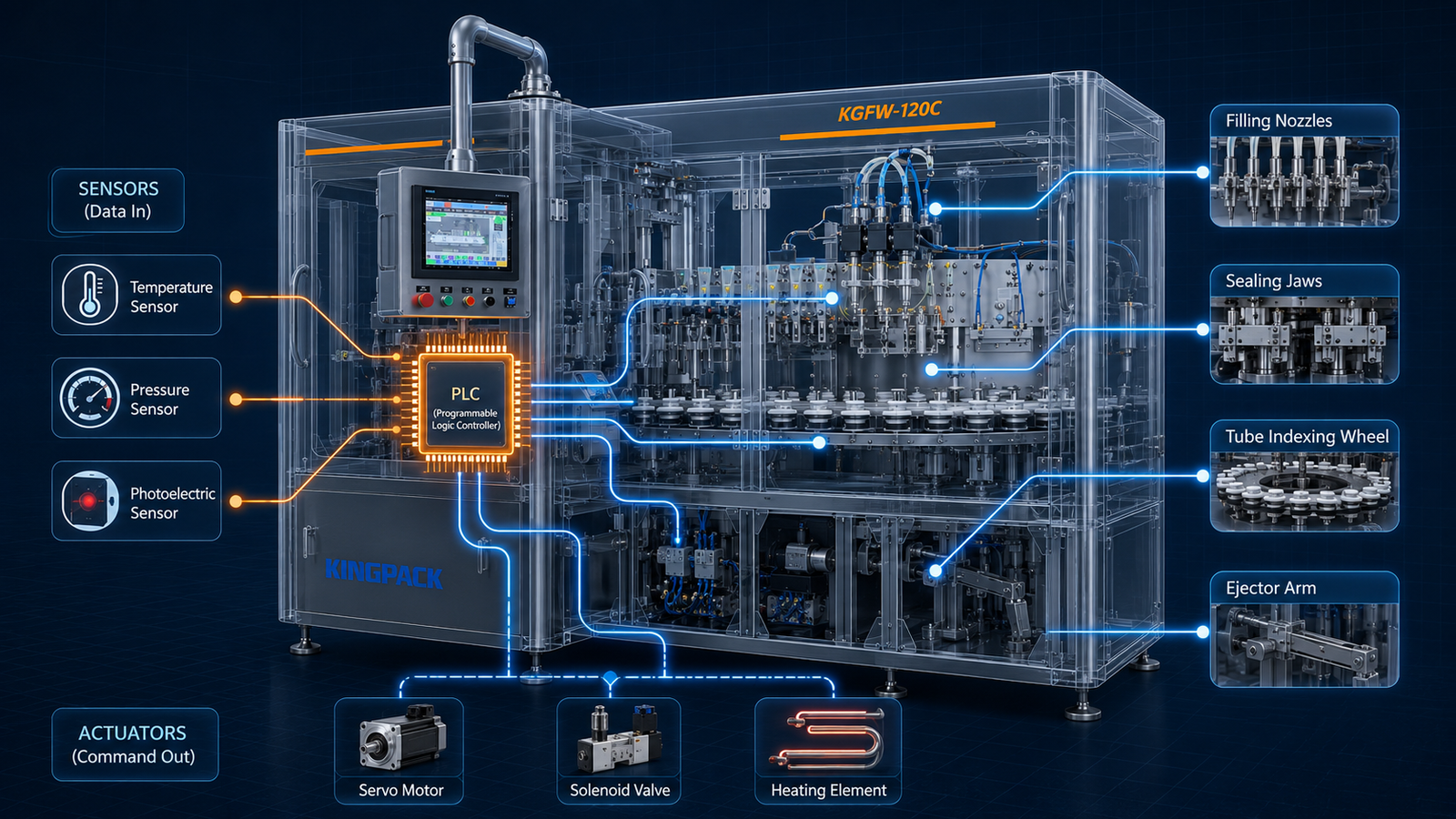
There’s one moment that happens on almost every production floor. An operator stares at a machine that’s just thrown a fault, the line is stopped, and nobody can quite agree on what went wrong or why. It’s frustrating. It’s expensive. And more often than not, it traces back not to a mechanical failure but to a gap in how the machine communicates what it’s doing.
Modern packaging equipment (whether handling tubes, bottles, or specialty containers), and specifically the automatic tube filling machine, has become remarkably capable. Speeds that would have seemed implausible fifteen years ago are now routine. Fills are measured in fractions of a gram. Seals are timed to the millisecond. But none of that capability matters much if the people operating the machine can’t see what’s happening inside it and if the machine itself can’t respond intelligently to changing conditions.
That’s what the PLC and HMI are really about. The PLC (Programmable Logic Controller) is the machine’s decision-making engine. It runs the machine control logic that tells every motor, valve, and actuator what to do and when. The HMI i.e., Human-Machine Interface is how that logic gets communicated to the people running the line. Together, they turn a mechanical tube filler into a system that can be monitored, adjusted, and diagnosed in real time.
What is a PLC (Programmable Logic Controller) in Tube Filling?
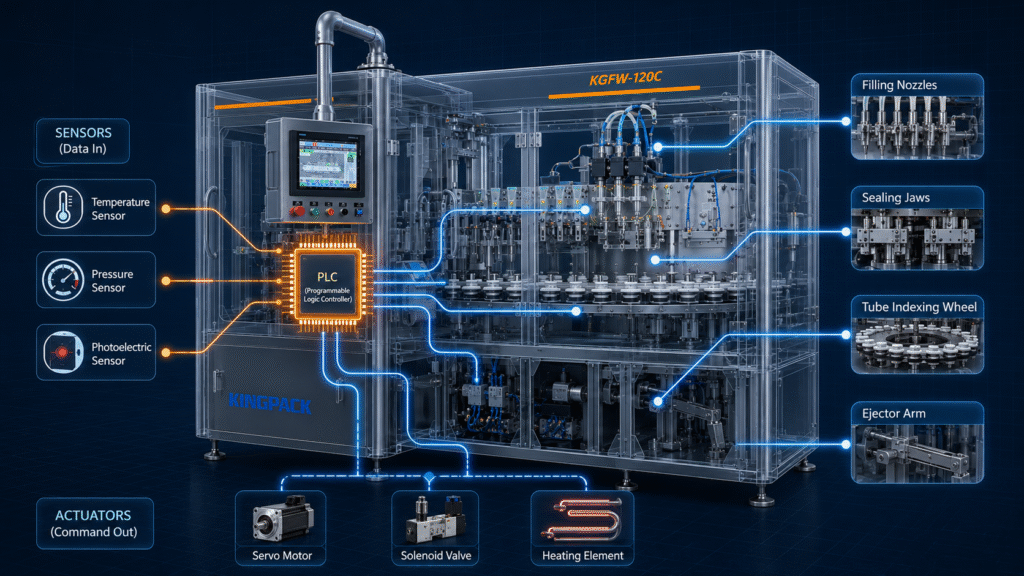
A PLC is, at its core, an industrial computer. But calling it that undersells what makes it different from the kind of computer sitting on your desk. It’s built specifically to survive factory environments i.e., electrical noise, temperature swings, vibration, and the kind of continuous operation that would kill a standard computer in days. It runs one program, it runs it reliably, and it runs it fast.
In facilities processing plastic, laminate, or aluminum tubes, the PLC ensures that every stage of production follows the same programmed sequence regardless of product specifications.
In a PLC tube filling machine, that program is the machine control logic: the set of rules that governs every step of the filling and sealing process. The PLC reads inputs from sensors across the machine dozens of times per second, evaluates what those inputs mean, and issues commands to actuators and drives accordingly. It doesn’t pause, it doesn’t drift, and it doesn’t forget steps.
What this delivers in practice is consistency. Every cycle runs to the same specification. Fill volumes don’t drift because an operator got distracted. Seal times don’t vary because someone manually adjusted a timer. The process runs to its programmed parameters, and deviations get flagged.
How the PLC Controls Timing, Speed, and Motion
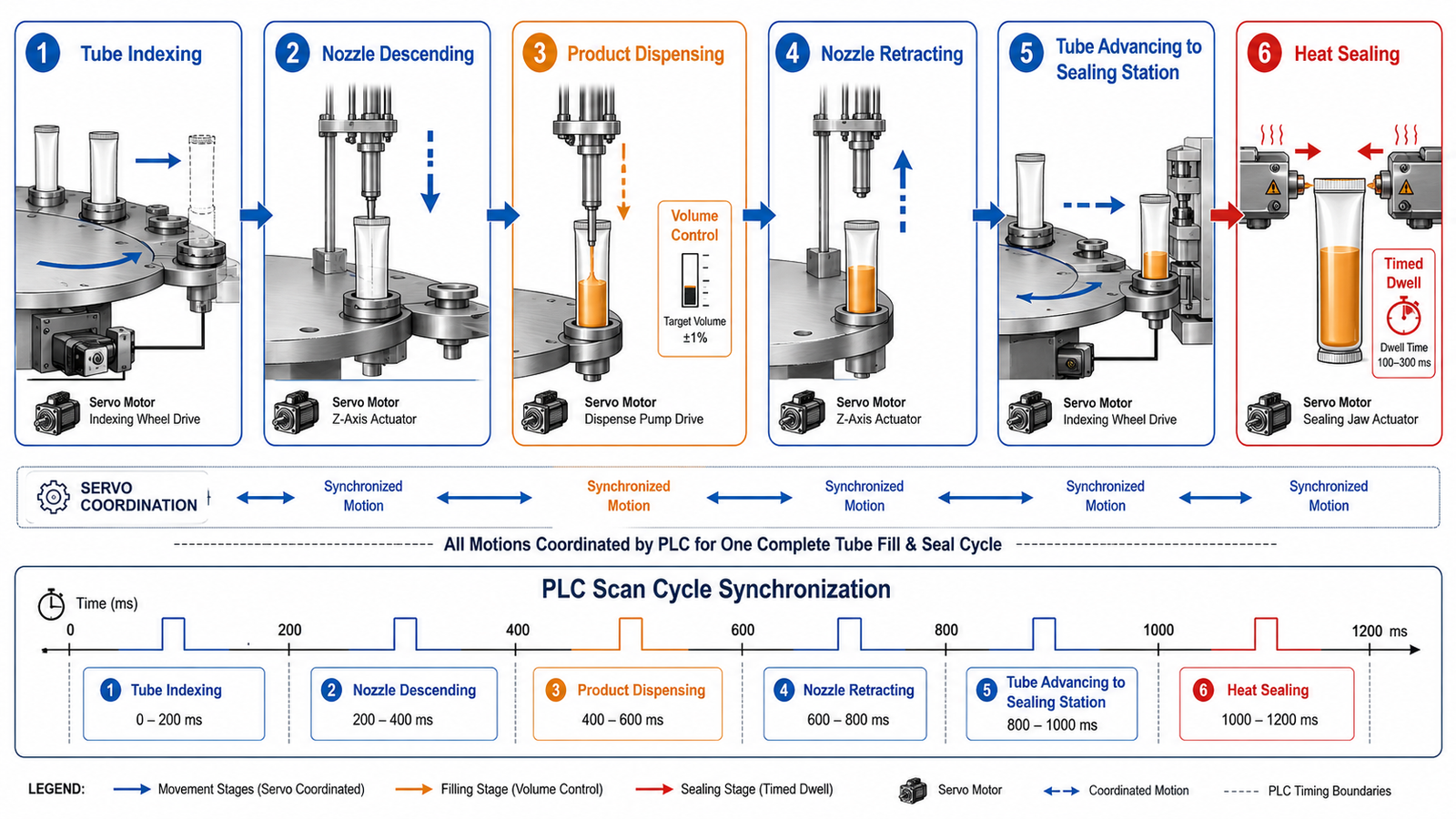
Walk through a single cycle on a tube filler machine for aluminum tubes and you quickly realise how much needs to happen in precise sequence. A tube is indexed into the filling station. A nozzle descends to the correct depth. Product is dispensed at a programmed volume. The nozzle retracts. The tube advances to the sealing station. Heat is applied (or ultrasonic energy, depending on the machine type) for a specific dwell time. The sealed tube gets ejected, and the next one moves in.
Each of those steps has timing requirements, and they’re not forgiving. A nozzle that descends a fraction of a second early creates contamination risk. A seal that gets an extra half-second of heat can degrade the tube material. The PLC manages this timing through its scan cycle: it reads the current machine state, executes the next logical step, and checks the result, all within milliseconds.
On a well-designed plastic tube sealing machine, the PLC also coordinates servo motors: which increasingly replace the mechanical cams that older machines relied on. This is significant for one practical reason: changeovers. When tube size or product formulation changes, the adjustments get made through software parameters rather than physical hardware. Faster changeovers, less risk of setup errors.
Managing Complex Sensor Inputs and Actuators
The sensor array on a modern tube sealing machine is more extensive than most people realise. Photoelectric sensors confirm tube presence at each station. Pressure transducers monitor the filling system. Encoders track motor position. Temperature sensors sit at the seal jaws. Proximity switches confirm that mechanical actions are completed correctly.
All of this feeds into the PLC simultaneously. The controller’s job is to make sense of all those inputs at once, compare them to programmed setpoints, and decide what to do whether that’s continuing normally, making a small correction, or triggering an alarm and stopping the line. On machines with fifty or more I/O points, this is genuinely complex work. The quality of how that logic is structured determines how reliably the machine handles edge cases and unexpected conditions.
On the output side, the PLC is commanding pneumatic cylinders, solenoid valves, variable-frequency drives, and heating elements — often simultaneously. Getting the sequencing right under all operating conditions, including during accelerations and decelerations at the start and end of a run, is where the quality of the control program really shows.
The same principles apply when the production environment includes interconnected systems such as a capping machine or secondary packaging stations that rely on synchronized machine communication.
Understanding the HMI (Human-Machine Interface)
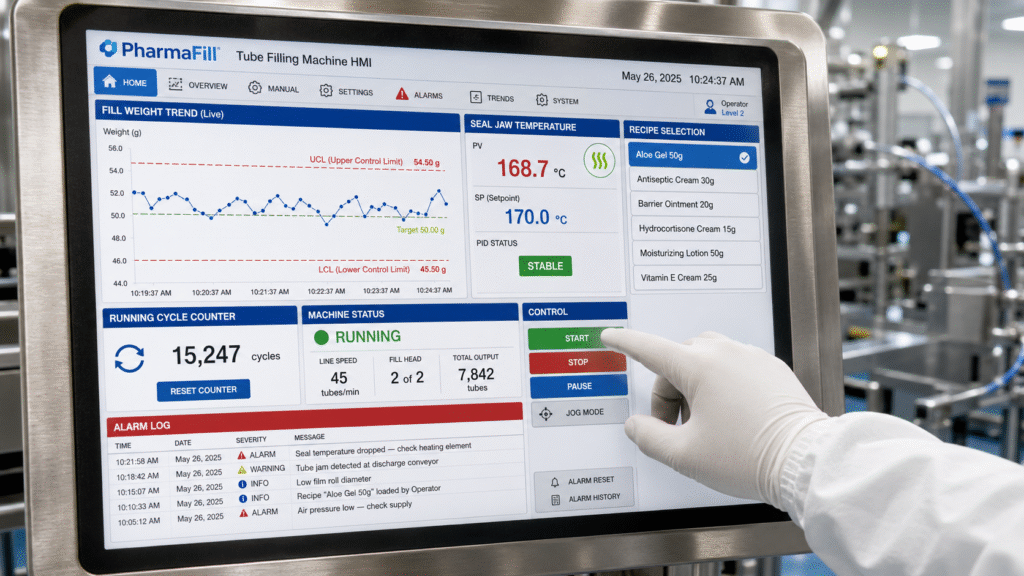
HMI packaging equipment has come a long way from the push-button panels that used to pass for machine interfaces. Today’s HMIs are typically full-colour touchscreens running graphical interfaces that display the machine’s actual state in real time. But the hardware is almost beside the point. What matters is what the interface actually does for the people using it.
An HMI connects to the PLC and translates raw machine data into something actionable. Instead of reading register values from a controller, an operator sees fill volumes, seal temperatures, cycle counts, and alarm states: all updated live, all presented in context. The interface doesn’t just show information; it helps people make decisions.
For operators managing multiple product formats, the interface provides a suitable way to access critical production data without navigating complex control structures.
Simplifying Complex Operations for Operators
A high-spec automatic tube filling machine might have several hundred configurable parameters. Without a well-designed HMI, navigating those parameters is a specialist task that most operators simply can’t do reliably. With one, the same machine can be operated confidently by someone who learned the job last month.
Recipe management is the clearest example of this. In a facility running ten or twenty different SKUs (each with its own tube dimensions, fill weight, seal temperature, and cycle speed) switching products used to mean working through a checklist of individual parameter adjustments. Miss one, and you find out at the first quality check. With a proper HMI, switching products means selecting a recipe name from a list. The machine handles the rest.
Smart packaging machinery built around thoughtful HMI design also protects against one of the quieter risks in manufacturing: staff turnover. When a skilled operator leaves, their knowledge of machine settings doesn’t have to leave with them. It’s stored in the system, accessible to whoever takes their place.
Real-Time Monitoring and Error Diagnostics
When something goes wrong (which eventually, something always does) the quality of the HMI’s diagnostic interface determines how quickly the line recovers. There’s a meaningful difference between an alarm that says ‘Fault 47’ and one that says ‘Seal jaw temperature dropped below setpoint: check heating element at Station 3.’ The first sends your maintenance tech to the manual. The second sends them directly to the problem.
Good HMI packaging equipment also maintains a timestamped alarm log, so when a fault clears and the line restarts, there’s a record of what happened and when. Some HMIs also support coding checks as part of monitored production, including printing batch numbers and expiration dates. This is useful not just for immediate troubleshooting, but for spotting patterns. If the same alarm is appearing every few hours, that’s data worth acting on before it becomes an unplanned shutdown.
Trend displays are another underappreciated feature. Watching fill weight or seal temperature drift slowly over a shift (and being able to see that drift on a graph rather than just noticing the occasional reject) is the kind of visibility that separates reactive production management from proactive.
The Synergy Between PLC and HMI in Tube Filling and Sealing
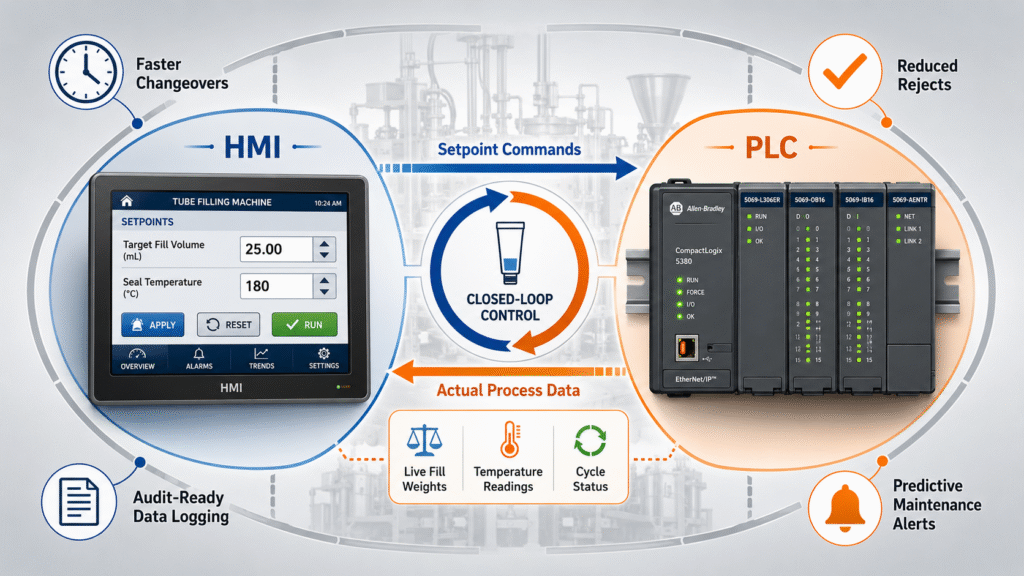
Technically, the PLC and HMI are separate systems. In practice, the distinction should be invisible to the people running the machine. When integration is done well, the operator sets a parameter through the HMI and the machine responds immediately. They see a fault and the screen tells them exactly what caused it. They load a recipe and the machine transitions seamlessly. The two systems feel like one.
The same integrated architecture can also coordinate upstream and downstream equipment, including a capping machine, ensuring smooth material flow throughout the production line.
Seamless Data Exchange for Precision Filling
In an automatic tube filling machine, fill volume is ultimately a PLC function. It controls the pump timing or the servo-driven piston that determines how much product goes into each tube. But the target volume lives in a recipe, entered through the HMI, and written to PLC memory when the run starts.
That data exchange needs to be immediate. If an operator adjusts fill volume mid-run, the change needs to take effect on the next cycle: not after some lag that results in a batch of under-filled tubes. This sounds obvious, but on systems where PLC-HMI communication is poorly implemented, lags and synchronisation issues are a real operational problem.
Closed-loop corrections during a run are where this integration pays off most clearly. If production statistics in the HMI show fill weight trending toward the lower specification limit, an operator can nudge the target upward and watch the trend correct in real time. That kind of interactive control is only possible when the data flow between HMI and PLC is genuinely bidirectional and immediate.
Temperature and Pressure Control in Tube Sealing Machines
Sealing is where getting the parameters wrong has the most visible consequences. A weak seal fails to create the hermetic seals needed to prevent leakage and contamination. An overheated seal and the tube looks damaged or worse, the heat has degraded something in the product itself. In either case, you’ve got a quality problem that traces directly back to the control system.
A well-engineered tube sealing machine runs a PID control loop on seal jaw temperature, helping the sealer maintain stable sealing conditions by continuously adjusting heating element power to hold the setpoint within a tight band. The target and the tolerance window are set through the HMI. The actual temperature, updated in real time, is displayed there too. So if the jaw starts running cold because an element is wearing out, the operator sees it before it creates rejects: not after.
This matters especially for plastic tube sealing machine applications, where hot air sealing is a reliable method for plastic and laminate tubes, and ultrasonic sealing is another option depending on the pack and process. The ability to store those combinations per product, recall them reliably, and have the PLC enforce them precisely is what makes high-variety production on a single machine actually work. Heated tool sealing and metal tube folding are also used depending on tube material.
For manufacturers working with aluminum tubes, maintaining accurate temperature and pressure settings is essential for achieving reliable closure quality.
Advantages of Advanced PLC & HMI Integration
The business case for quality control architecture isn’t really about technology. It’s about what inferior systems cost you. Unplanned downtime, slow changeovers, batch rejects, compliance gaps, and machines that your team can’t diagnose without calling the manufacturer. These costs are real and they compound over the life of the equipment.
The resulting control environment is highly suitable for manufacturers operating in regulated industries where consistency and traceability are non-negotiable.
Reducing Downtime with Smart Troubleshooting
Smart packaging machinery with sophisticated machine control logic can do more than react to problems: it can anticipate them. Monitoring parameters like motor current draw and cycle completion times lets the PLC flag anomalies that suggest something mechanical is developing before it causes a breakdown. That early warning is valuable in a way that’s hard to put a number on until you’ve experienced an unplanned stop on a high-speed line.
When stops do happen, recovery time depends almost entirely on how quickly the fault can be identified and corrected. On machines with detailed HMI diagnostics (timestamped alarm logs, machine state snapshots at the moment of fault, guided troubleshooting steps) maintenance technicians find the problem faster. That’s not a minor efficiency gain. On a line producing tens of thousands of tubes per shift, every minute of downtime has a calculable cost.
Changeover time is the other major downtime driver, and it’s one that often gets underestimated when evaluating equipment. Software-driven changeovers, where the HMI handles all parameter transitions automatically when a recipe is loaded, can cut format change time from an hour to ten minutes. Across a year of production, that’s significant recovered capacity.
Data Logging and Traceability for Pharma and Cosmetics
Regulated industries don’t get to treat data logging and batch coding as optional. A pharmaceutical tube filler operating under GMP requirements needs documented evidence that each batch ran within validated parameters: not just an operator’s word that everything looked fine.
Integrated PLC/HMI data logging handles this automatically. Fill volumes, seal temperatures, cycle counts, alarm events, and operator interventions all get recorded with timestamps and written to a log that can be exported or accessed remotely. For pharmaceutical and cosmetic tube filling operations, these machines are widely used in the cosmetic industry and also apply in chemical industries, so this documentation simplifies audit preparation considerably and means that when a deviation investigation is needed, the data actually exists.
There’s also a straightforward quality argument here beyond compliance. Electronic records generated automatically from machine data are more reliable than paper-based systems. The data can’t be filled in retrospectively, can’t be misread, and doesn’t have gaps from when the line was running fast and the operator was busy.
Many modern facilities integrate data from filling systems, inspection units, and a packaging machine into a centralized production record for improved traceability.
Why King Pack Machinery Integrates Top-Tier Control Systems
Equipment decisions tend to focus heavily on mechanical specifications: tube size range, fill volume capacity, output speed. These matter. But on a well-built machine, the mechanical capabilities are only realised if the control system can actually deliver them consistently over years of production. That’s the part of the specification that’s harder to evaluate from a datasheet.
The control architecture is designed to remain suitable for both smaller production environments and large-scale manufacturing operations with complex automation requirements.
At King Pack, the choice to use industrial-grade PLC and HMI hardware across their range is a deliberate one. It reflects a view that the control architecture isn’t a component to value-engineer: it’s what determines whether the machine lives up to its mechanical potential in actual production.
Industrial-Grade Stability and User-Friendly Design
King Pack’s tube filling and sealing machine lineup uses control hardware from established industrial suppliers — brands with global service networks, long-term parts availability, and track records in demanding production environments. For a manufacturer running equipment for ten or fifteen years, that supply chain stability matters more than it might seem when the machine is new.
The HMI interface is designed for real production conditions. Touch targets sized for gloved hands. Alarm messages in plain language. Navigation that a new operator can learn in a shift, not a week. These might seem like details, but they’re the difference between an interface that operators actually use and one they work around.
The underlying machine control logic is also structured for transparency meaning that when a customer’s technical team needs to understand or modify the program, they’re not facing an opaque system. King Pack provides documentation and support that help customers maintain or modify the program with confidence, which matters particularly for manufacturers who prefer to keep some in-house capability for machine adjustments.
Whether the requirement is a cosmetic tube filling line for a mid-size beauty operation or a fully validated pharmaceutical tube filler for a regulated facility, the control system gets specified to the actual operational requirements — not a generic configuration dressed up for a sales brochure. The range covers semi-automatic through high-speed fully automatic configurations, with servo-driven filling and integrated inspection available where the application calls for it.
FAQs About Machine Control Systems in Tube Packaging and Filling Machines
What’s the practical difference between a PLC and a basic microcontroller on a tube filler?
A microcontroller handles a specific, limited task within a component. A PLC manages the entire machine (all stations, all sensors, all actuators) through one unified program; by contrast, semi-automatic machines still require manual placement of empty tubes into the tube holder, while PLC-controlled systems coordinate the full sequence after that point. On a PLC tube filling machine, everything from tube indexing to fill dosing to seal control to rejection is coordinated by the PLC. It’s also built to handle industrial electrical environments and run continuously for years, which basic microcontrollers aren’t designed to do.
Can the HMI be set up for our specific products and SKUs?
Yes. Recipe storage is a standard feature on properly specified HMI packaging equipment. During commissioning, your product parameters get stored as named recipes that operators can select at the start of each run. Language options, screen layouts, and access levels can also be configured to suit your team.
How much does PLC control actually affect fill accuracy?
It’s the primary factor. Piston pumps are typically used for higher viscosity products, while ceramic pumps are better suited to small volume filling. Pressurized hoppers are recommended for thick pastes, and especially heavy products may need heated hoppers and heavy-duty pumps. The PLC controls the timing, speed, and actuation of the filling system with millisecond precision. On a well-calibrated automatic tube filling machine, this typically delivers fill weight repeatability within ±0.5% or better — tighter than what mechanical or manual methods can achieve, and consistent across an entire shift rather than just at the start of one, making the device essential for packaging high-viscosity liquid, creams, gels, and pastes.
If the HMI fails, does the machine stop completely?
Not on a well-designed system. The PLC runs independently of the HMI. The screen is an interface to the controller, not the controller itself. If the HMI fails, the machine can typically continue running the current recipe while a replacement is sourced. The separation between interface layer and control layer is an important reliability feature.
Upgrade Your Production Line with Smart Control Technology
The gap between a line that runs well and one that consistently underdelivers is often less about mechanical quality than it is about control architecture. Machines with underpowered or poorly integrated PLC and HMI systems don’t fail dramatically, they just accumulate small inefficiencies. Slower changeovers. Longer fault recoveries. Parameters that drift. Documentation that’s incomplete. None of these are catastrophic on their own, but together they represent real production losses.
For industries where fill accuracy, seal integrity, and batch documentation all matter (pharmaceuticals, cosmetics, personal care, food), automatic tube filling machines are also used for packaging high-viscosity liquids, creams, gels, and pastes. In production terms, an automatic tube filler sits within the broader category of filling machines used for controlled, repeatable packaging processes. These systems handle plastic, aluminum, and laminated tubes. Filling nozzles and controlled filling volume settings support consistent filling, especially for viscous products. The return shows up in output quality, compliance readiness, and the confidence of the people running the line.
King Pack has built their equipment range around the view that control system quality isn’t separable from machine quality. If you’re evaluating a new tube filling and sealing machine, or looking to replace equipment that’s become more of a problem than asset, it’s worth having a detailed conversation about what the right control architecture looks like for your specific operation. It is also well suited to filling ointments and other tube filling sealing applications, including filling sealing work across varied production needs.
That conversation is where the King Pack team spends a lot of their time. Reach out and start it.