
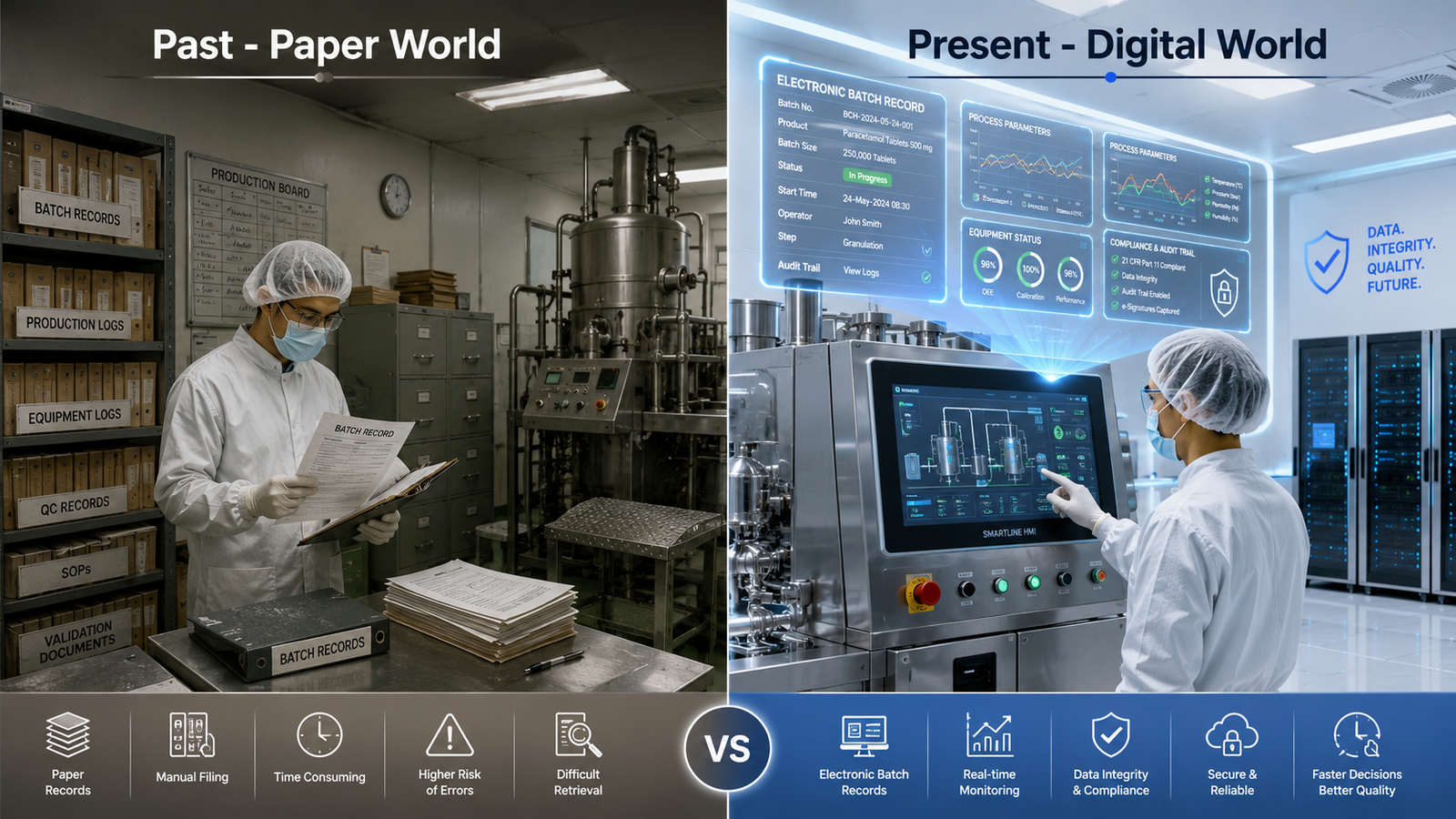
Walk into a pharmaceutical filling facility from fifteen years ago and walk into one today. The difference isn’t subtle. What used to be clipboards, paper batch records, and a lot of manual sign-offs have become touchscreen HMIs, PLC-driven process logging, and electronic batch records that update in real time.
The shift in the food packaging industry has been fast, and for the most part, it’s been genuinely positive across many industries, especially where technology and automation are reshaping how critical operations are managed. Less transcription error. Faster batch review. Better traceability when something goes wrong. Smarter business decisions are also emerging from this digital shift, supported by evolving technology and automation frameworks.
But here’s the problem nobody talks about enough: the compliance frameworks that govern manufacturing were largely written for a paper world. And when you move to digital systems without specifically addressing what that transition means for your data, you don’t just inherit the benefits of digitalization: you inherit a whole new category of risk tied to operations, technology, and automation failures.
Data integrity in packaging has become one of the most cited areas in FDA warning letters and EMA inspection reports over the past several years. And the failures aren’t usually in the product: the cream is fine and the ointment meets spec. The problem is in the records, where weak operations or poorly controlled technology systems allow deleted raw data, shared login credentials, or overwritten batch entries. Even something as simple as a misplaced tape label in hybrid documentation systems can introduce traceability issues in some environments.
These aren’t theoretical scenarios. They’ve happened at real facilities, impacting business continuity, and the consequences have ranged from import alerts to full production shutdowns.
Why Basic GMP is No Longer Enough for Smart Equipment
Standard GMP covers a lot of ground. Facilities, equipment qualification, raw material testing, process controls, documentation. It’s a solid foundation, and none of what follows here replaces it. But GMP was designed around physical manufacturing operations, not digital ecosystems driven by technology and automation.
GMP validation packaging equipment requirements will confirm that your machine equipment fills to the right volume and seals at the right temperature. They won’t automatically confirm that the data generated during that process is protected, attributable, or even retrievable six months later when a customer complaint triggers a record review.
That gap is where ALCOA+ data integrity principles and specific regulatory frameworks like FDA 21 CFR Part 11 come in. They don’t replace GMP. They extend it into territory GMP doesn’t cover, using more advanced technology and stricter operations governance.
Understanding Data Integrity and the ALCOA+ Principles
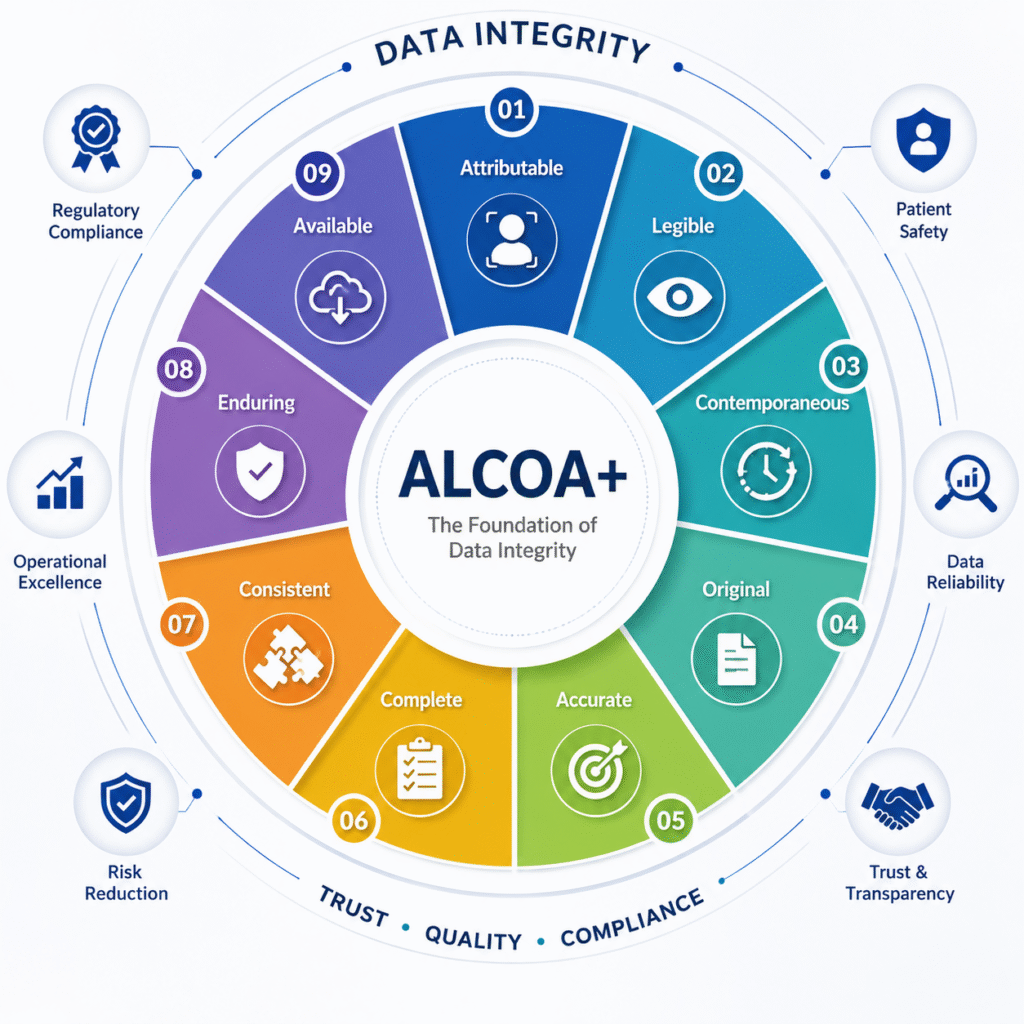
ALCOA started as a shorthand used within pharmaceutical quality circles — a way of summarizing what “good data” actually looks like in a regulated environment. Over time, regulators formally adopted it, and the “+” was added to address the realities of digital systems and modern technology.
These principles are essential to modern regulated operations, especially in digitally controlled environments.
The original five: Attributable, Legible, Contemporaneous, Original, Accurate.
Attributable means that every record can be traced back to whoever or whatever created it. In a digital context, that means individual user accounts. Not “Line 3 Operator.” An actual person, logged in with their own credentials.
Legible means the data can be read now, and in ten years when a different software version is installed. File format choices, backup protocols, and migration planning all feed into this.
Contemporaneous means the record was created at the time of the activity. A timestamp applied the next morning because someone in the business forgot to log in isn’t contemporaneous. Regulators are not lenient about this one.
Original means the first-captured record is the authoritative one. Copies are fine, certified copies are fine, but the original or a verified equivalent has to exist and be preserved.
Accurate stands for the data that reflects what actually happened in operations. This seems obvious until you’re in a facility where there’s quiet pressure to make the numbers look right.
The “+” additions are essential for digital transformations. These are: Complete, Consistent, Enduring, and Available. This addresses what digital systems make both easier and more dangerous. These principles become even more important as automation increases across systems.
Complete means all data, including OOS results and failed runs, gets retained. Consistent means the internal logic of a batch record holds together — timestamps don’t jump backward, lot numbers match. Enduring and Available speak to long-term storage, backup integrity, and the ability to produce records promptly when an inspector asks for them.
What Does ALCOA+ Mean for Filling Machines and Packaging Lines?
In practical terms, on a tube filling production line running 60 to 180 tubes per minute, ALCOA+ data integrity means the PLC isn’t just controlling the process: it’s building a contemporaneous, attributable, tamper-evident record of it. Every cycle. Every parameter deviation. Every operator interaction. That record needs to be readable, retained, and retrievable.
In modern machine equipment, this level of automation is not optional; it is fundamental. If your current system doesn’t do that (or does it partially) your operations face a compliance gap, and it’s worth knowing exactly where it is before an inspector finds it for you.
Key Compliance Standards for Digitalized Packaging Equipment
FDA 21 CFR Part 11 compliance is the US standard for electronic records and electronic signatures in regulated operations. It governs how technology is used in documentation systems.
EU Annex 11 places additional emphasis on validated machine equipment and supplier controls provided by equipment manufacturers supporting regulated operations.
For manufacturers selling into both markets, the practical path is to design for both simultaneously. The overlap is substantial, and a system built to satisfy one will cover most of the other.
Modern compliance strategies rely heavily on automation to ensure traceability across systems.
Audit Trails, Electronic Signatures, and User Access Control
An audit trail packaging machine should be automatic, continuous, and read-only. It should support controlled operations and secure technology environments. It should capture what changed, when it changed, who changed it, and what the value was before. No operator (and no administrator) should be able to delete an audit trail entry. If an admin needs to make a correction, the correction itself gets logged.
Electronic signatures under Part 11 require at least two identification components (typically username and password) and the link between the signature and the signed record must be permanent. The system has to prevent one person from signing as another. This sounds straightforward until you look at how many facilities still have shared “admin” accounts.
User access control is where a lot of compliance programs fall apart in practice. The principle is simple: give people the minimum access they need to do their job. Operators can run the machine and acknowledge alarms. Engineers can modify recipes with a documented justification. Administrators can manage accounts but not delete records. If everyone on the shop floor has full admin rights because “it’s just easier,” that’s a finding waiting to happen.
Securing Data on Automatic Tube Filling and Sealing Machines
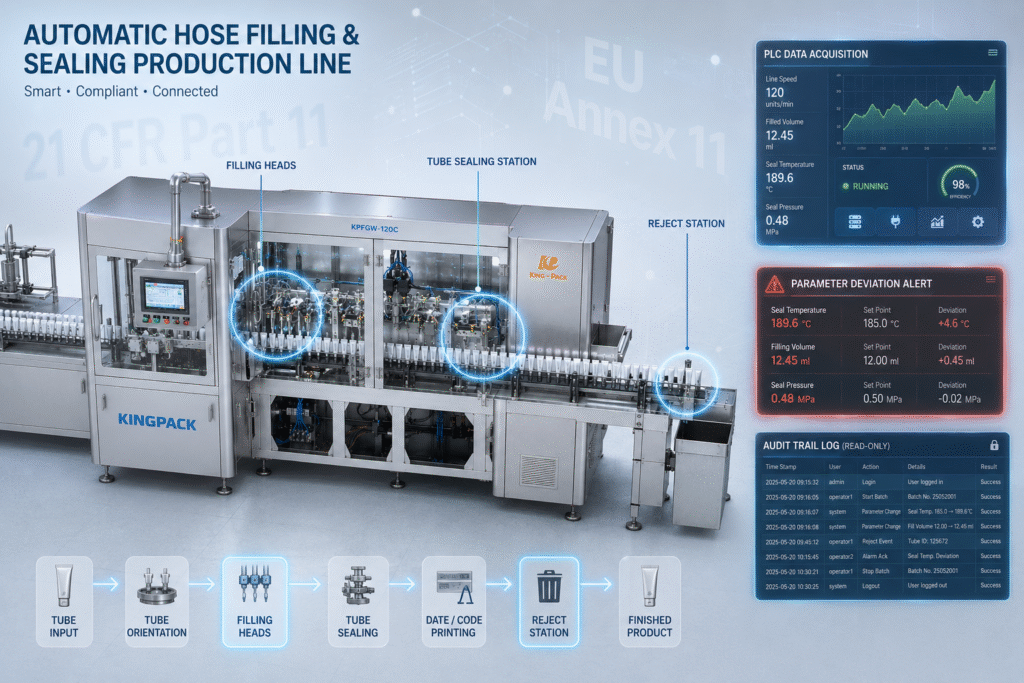
Modern machine equipment in the food packaging industry operates at high speeds, where automation is the only way to maintain real-time accuracy. This level of technology ensures that every production line cycle is recorded properly.
Tube filling is a fast process. A modern automatic tube filling machine can run well over 100 tubes per minute. At that speed, the idea of manually recording process parameters is almost comical. By the time you’ve written one reading, a hundred more cycles have passed. Automated data capture isn’t just a compliance preference on these machines. It’s the only way the data could possibly be contemporaneous.
Real-Time Data Logging: Parameter Tracking for Every Tube
PLC data logging equipment on a modern tube filling and sealing machine should be capturing fill weight (or volume), sealing temperature, dwell time, and cycle count on a continuous basis throughout the run. Deviations in operations from set points should be flagged in automation: not dependent on an operator noticing something looks off on the HMI.
Reject events should be logged with reason codes. Alarm events should be timestamped, with operator responses recorded. At batch end, the system should be able to produce a complete electronic batch record that compiles all of this into something quality can actually review without hunting through separate spreadsheets and paper notes.
There’s also a practical payoff here that goes beyond compliance. Continuous parameter data is genuinely useful for process optimization. Gradual drift in fill weight can indicate nozzle wear before it becomes an OOS result. Sealing temperature creep can signal a heater element approaching failure. The same data that satisfies your QA team can tell your maintenance team something useful if it’s captured cleanly and consistently.
This is essential for modern business requirements.
This is a quieter risk than it sounds. An operator notices fill weight drifting slightly low. Rather than logging a deviation and waiting for a supervisor to authorize an adjustment, they bump the fill time up a fraction and the batch finishes within specification. No alarm. No paperwork. And now there’s a mismatch between the approved recipe parameters and what the line actually ran on.
From a product quality standpoint, maybe nothing bad happened. From a data integrity standpoint, the batch record is inaccurate and there’s no trace of why.
Technical controls help here: recipe parameter modifications during a run should require supervisor credentials, and any change should automatically generate an audit trail entry requiring a typed justification. Access restrictions and documented changes also support safety during line adjustments and troubleshooting. But the procedural side matters too. If operators feel that raising a deviation is going to result in them being blamed for the line stopping, they’ll find ways around the process. The culture has to support proper documentation, not just demand it.
Both a pharmaceutical tube filler and a cosmetic tube filling machine face this challenge. The regulatory stakes differ somewhat between the two, but the underlying data integrity dynamic is identical.
The Role of Validation (IQ/OQ/PQ) in Digital Data Management
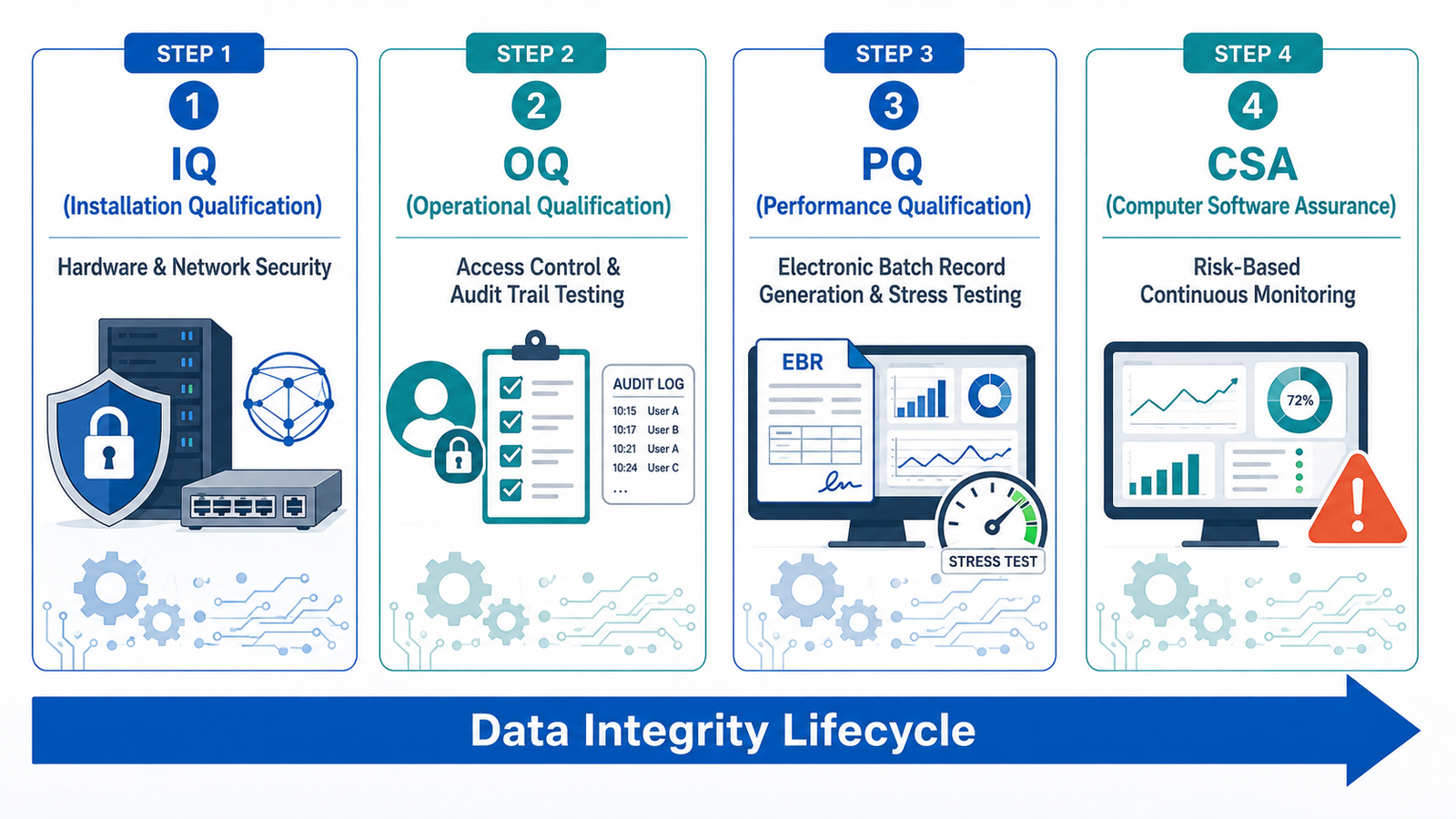
IQ, OQ, PQ (Installation Qualification, Operational Qualification, Performance Qualification) is well-established territory for most people in regulated manufacturing. What’s sometimes less well understood is how the scope of validation needs to expand when the equipment includes significant software components and electronic data management functions.
Confirming that a machine fills to specification is OQ work. But GMP validation packaging equipment for a digitalized system also needs to address: does the audit trail capture all required events? Are timestamps accurate and tamper-proof? What happens to data if power is interrupted mid-batch? Can users access recipe modification screens without authorization? Can a standard operator disable the audit trail?
These aren’t edge cases. They’re real failure modes that have been cited in real inspections, and they need to be explicitly tested as part of the qualification process.
Integrating Computer Software Assurance (CSA) into Machine Qualification
The FDA published its Computer Software Assurance guidance as a shift away from the documentation-heavy approach of traditional Computer System Validation. The core idea is risk-based: focus validation effort on functions that directly affect product quality or data integrity, and apply proportionate effort to lower-risk functions rather than scripting exhaustive tests for everything.
For a tube filling line, that means the data logging, audit trail, recipe management, and electronic signature functions get intensive validation attention because a failure in any of those areas has direct regulatory consequences. The language selection menu and the production statistics dashboard get lighter treatment.
This doesn’t reduce what’s required. It refocuses effort where it actually matters. In practice, CSA-aligned validation packages tend to be more defensible during inspections because the rationale for what was tested, and why, is explicit rather than a stack of protocols that tested everything equally because no one made a decision about risk.
Upgrading to Smart Packaging: King Pack’s Approach to Data Security
There’s a real split in the tube filling equipment market between machines built for production throughput and machines built with regulated manufacturing genuinely in mind. The difference isn’t always visible in a spec sheet. Two machines can have similar fill speeds and similar footprints while being very different in terms of their control architecture, their data management capabilities, and how much compliance work lands on the customer after purchase.
King Pack has been manufacturing filling and packaging equipment for over 20 years, with customers in pharmaceutical, cosmetic, and nutraceutical manufacturing across more than 20 countries. The design philosophy (for both their pharmaceutical tube filler lines and their cosmetic tube filling machine configurations) has been to build compliance requirements into the machine rather than treat them as something to solve in validation afterward.
Intelligent Control Systems Built for Pharma and Cosmetic Compliance
Modern machine equipment from leading equipment manufacturers integrates cutting edge technology for secure operations.
King Pack’s smart packaging machinery runs on industrial-grade PLCs with HMI systems configured for role-based access control, continuous PLC data logging equipment functionality, and tamper-evident audit trails that meet FDA 21 CFR Part 11 compliance requirements.
Liquid filling machines and other filling machines can be integrated into packaging systems, with product characteristics such as viscosity guiding equipment selection, including gravity fillers for thin liquid products, piston systems that handle different containers, and auger fillers for powder and liquid applications. Integrated liquid filling lines can also include cleaning, capping, conveyors, and labeling, with capping or corking used to secure bottles and labels applied for branding and required package information. User permissions are defined by role i.e., operators, supervisors, and engineers each have clearly bounded access, and parameter changes during production require supervisor credentials and generate automatic audit log entries.
Recipe management is password-protected. Set point modifications are logged with before/after values, timestamps, and user attribution. Electronic batch record output is structured for quality review without manual compilation.
For customers working through IQ/OQ/PQ, King Pack‘s engineering team provides documentation that specifically addresses the electronic system components and not just mechanical performance. For companies operating under both FDA and EU Annex 11 requirements, this matters: the qualification package needs to cover both, and building it from scratch without supplier support adds considerable time and cost.
The product range spans high-speed fully automatic tube filling machine configurations for large-scale pharmaceutical manufacturing down to smaller, specialized lines for premium cosmetic applications. Across all of it, the position is the same: reliable performance, documented reliability, and integrated controls support efficiency and productivity, so data integrity in packaging isn’t a documentation problem to be solved after the machine is installed. It’s an engineering problem, and the time to solve it is before the equipment ships.
FAQs on Data Integrity in Packaging Machinery
What actually counts as a data integrity failure?
It’s broader than most people assume. Obviously, falsified records are a failure. But so is a system where two operators share a login (because now the audit trail is unattributable). So is deleting raw data and keeping only the summary.
So is a batch record that was completed the following morning rather than in real time. Regulators look at the complete picture, not just whether someone deliberately falsified something, but whether the system design made falsification too easy to prevent.
Does FDA 21 CFR Part 11 apply to cosmetic manufacturers?
Not directly in the same way it applies to pharmaceutical manufacturers. But FDA 21 CFR Part 11 compliance principles are increasingly expected across regulated and semi-regulated industries, and many cosmetic manufacturers supplying pharmaceutical customers or operating in EU markets voluntarily align with them. ISO 22716 (the cosmetics GMP standard) also calls for documented, controlled record-keeping that in practice points in the same direction.
What should a compliant audit trail actually look like?
At minimum: every parameter change captured with a before/after value, a timestamp, and the identity of the user who made the change. Alarm events with operator responses. Recipe modifications flagged separately from in-process adjustments.
The trail should be read-only to all users (including admins) and retained for the required period. If your current system lets any user delete or edit audit trail entries, that’s a finding.
We’re running legacy equipment. Do we need to replace it entirely?
Not necessarily, but you do need to assess it honestly. Some older machines can be retrofitted with compliant control systems. Others have fundamental architecture limitations that make retrofit impractical. The EU Annex 11 expectation is that legacy systems are formally assessed and that gaps are either remediated or risk-managed with compensating controls. “We’ve always done it this way” isn’t a risk management strategy.
What’s the difference between CSV and CSA, and does it matter for my equipment purchase?
Computer System Validation (CSV) is the traditional approach with extensive documentation, scripted test protocols for every system function. Computer Software Assurance (CSA) is the FDA’s more recent, risk-based alternative that focuses testing effort on functions with actual quality or data integrity impact.
From an equipment purchase standpoint, what matters is that your supplier can support whichever approach your quality system requires, and that their documentation is structured in a way that’s actually usable, not just voluminous.
Contact Us to Future-Proof Your Packaging Line
The regulatory direction on data integrity in packaging isn’t ambiguous. Both the FDA and EMA have made electronic data integrity a priority area for inspection, and the body of warning letters and inspection observations from the last few years makes it clear that equipment-level gaps are being found and cited.
Getting ahead of this doesn’t require a complete line replacement or a six-month validation project. It starts with an honest assessment of where your current equipment stands, and a clear plan for closing the gaps.
King Pack works with manufacturers at all stages of this process i.e., new line builds, equipment upgrades, and validation support for existing installations. If you’re evaluating a new tube filling and sealing machine or trying to understand what it would take to bring an existing line into compliance, the conversation is worth having sooner rather than later.
We also advise on food applications and end-of-line planning, where the right packaging process for food packaging machines and other equipment depends on product and format: primary packaging protects food products from contamination, modified atmosphere packaging removes oxygen and replaces it with inert gas, helps preserve freshness by preventing oxidation and slowing bacterial growth, and MAP tray sealers seal trays to extend shelf life by over 50% without preservatives or freezing.
That can include solutions for various food products, beverages, snacks, and other food items in bags, pouches, cups, boxes, and containers, with VFFS systems that form bags from flat film, weigh fillers that package solids by weight, cartoners that load cardboard boxes, canners that sanitize, fill, seam, and test cans, palletizers that stack finished cases onto pallets for transport, and systems built to heat seal and seal each pack while reducing waste through recyclable, sustainability-focused formats customers increasingly prefer.
Reach out through kpfillingmachine.com or contact the engineering team directly. Tell us what you’re running, what you’re producing, and what your regulatory environment looks like AND we’ll give you a straight answer on what’s needed.