
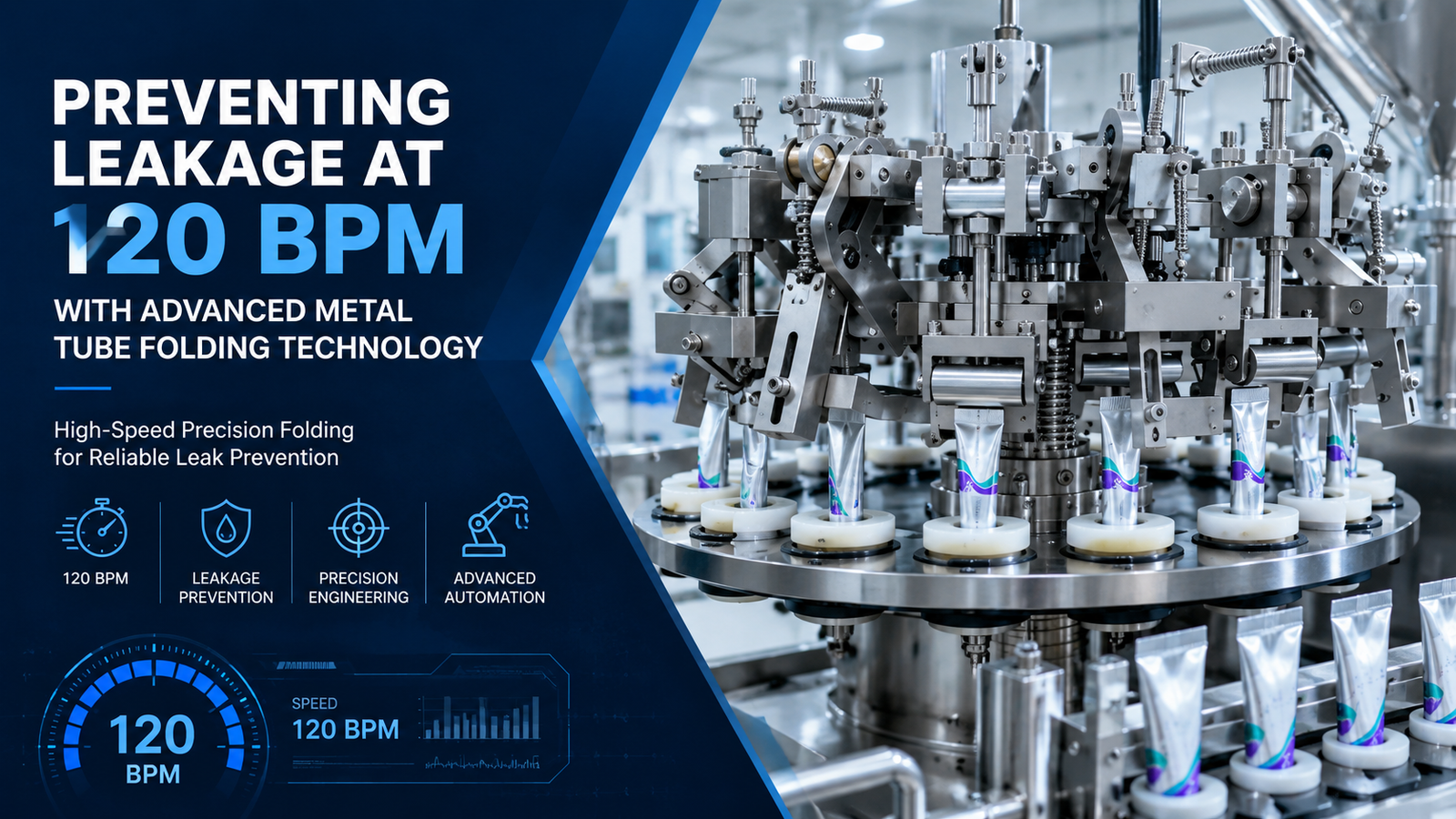
At 120 BPM, toothpaste metal tube folding becomes a precision engineering challenge. The line must fill high-viscosity paste, keep the tube tail clean, index each tube accurately, apply mechanical folding force, code the end, inspect the result, and discharge finished tubes without losing takt time. Small errors that appear harmless at low speed can quickly turn into leakage, scrap, rework, and customer complaints in high-speed production.
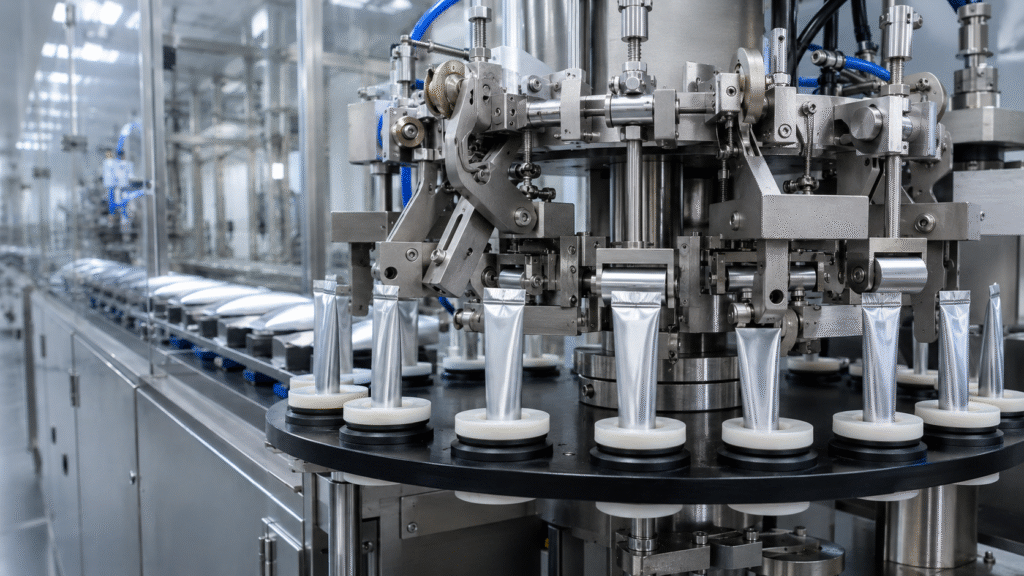
For manufacturers running a 120 BPM tube filling line, metal tube leakage prevention depends on the entire process: filling accuracy, paste cutoff, tube positioning, tail preparation, folding tooling, crimping pressure, coding alignment, servo synchronization, and inspection. A toothpaste tube sealing machine should therefore be evaluated as part of an integrated filling and folding system, not as a separate tail-closing device.
[Suggested image: mechanical folding stations on a 120 BPM toothpaste metal tube line]
Why Leakage Becomes Critical at High-Speed Toothpaste Production
Toothpaste packaging leakage creates direct cost and brand risk. A leaking tube may contaminate cartons, retail shelves, shipping cases, or other products. It can also trigger complaints, returns, and quality investigations. At 120 BPM, the number of affected tubes can grow quickly before the issue is noticed if the line lacks proper detection and rejection control.
High speed increases the importance of synchronization. Filling and folding synchronization must keep paste level, tube position, tail cleanliness, and folding timing stable. If the tube moves slightly out of position, if the paste string contaminates the tail, or if folding pressure varies, leak-proof tube sealing becomes difficult.
Common Causes of Metal Tube Leakage
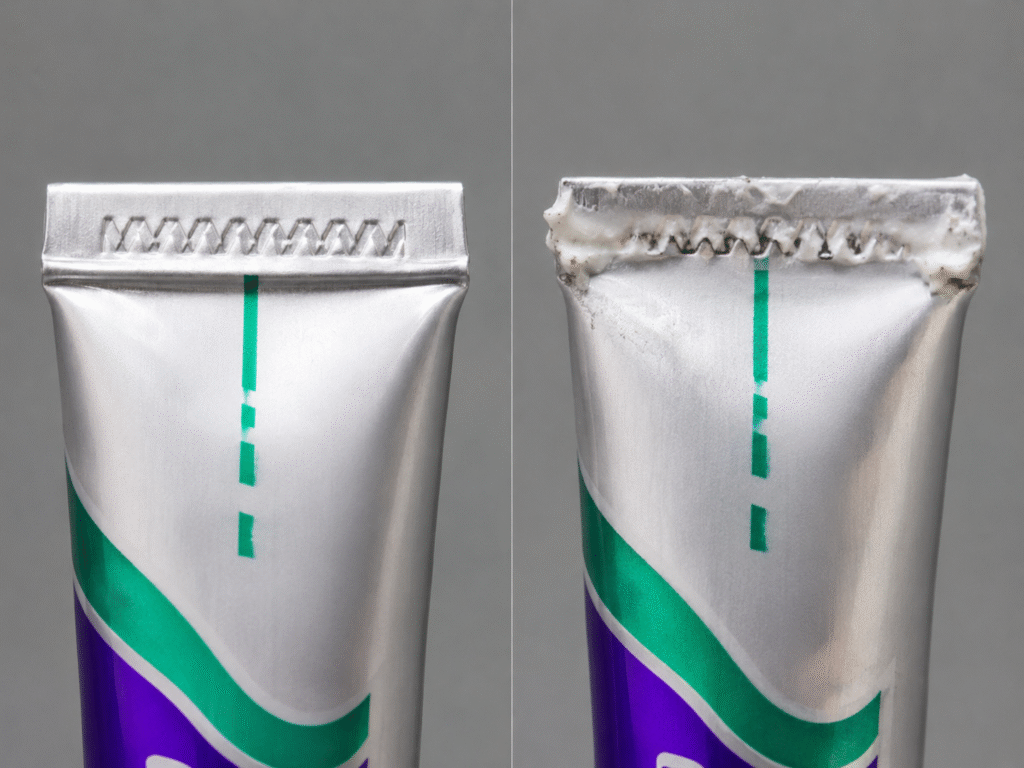
Common leakage causes include overfilling, poor cutoff, paste residue near the tube tail, uneven tube positioning, worn folding tools, insufficient crimping force, incorrect coding pressure, and variation in aluminum tube wall thickness. Tube deformation control is also important because excessive pressure can damage the tube instead of sealing it.
A high speed toothpaste filling machine must reduce these risks through controlled dosing, stable indexing, clean nozzle design, precise clamping, and repeatable folding. Operators should not need to correct leakage through frequent manual adjustment.
Impact of Leakage on Rejection Rate and Brand Risk
Leakage affects more than scrap cost. It can interrupt production, require line cleaning, delay shipment, and damage customer confidence. Rework is rarely efficient because contaminated or deformed metal tubes are difficult to recover.
Sealing rejection rate should be tracked by shift, tube batch, product viscosity, filling volume, and tooling condition. This data helps identify whether leakage is caused by material variation, process drift, maintenance issues, or incorrect setup.
Core Mechanical Folding Process for Leak-Proof Metal Tubes
Metal tubes are closed by mechanical folding and crimping. Unlike plastic tubes, which may use hot air or ultrasonic sealing, aluminum tube end folding depends on shape, pressure, and material memory. The process must compress the tail into a stable structure without cracking, spring-back, or paste contamination.
A robust tube end closing system uses multiple stations so each step performs a controlled part of the closure. This reduces shock to the tube and improves final sealing consistency.
Tube Positioning and Tail Preparation
The process starts with accurate tube orientation and clamping. The tube must be held firmly enough to prevent movement but gently enough to avoid deformation. Paste level must be controlled so product does not reach the folding area. The filling nozzle should cut off cleanly and withdraw without dragging paste.
Tail preparation may include pre-pressing or shaping to create a consistent starting condition for folding. Inconsistent tail geometry can create uneven folds, which later become leakage points.
Multi-Step Folding and Crimping
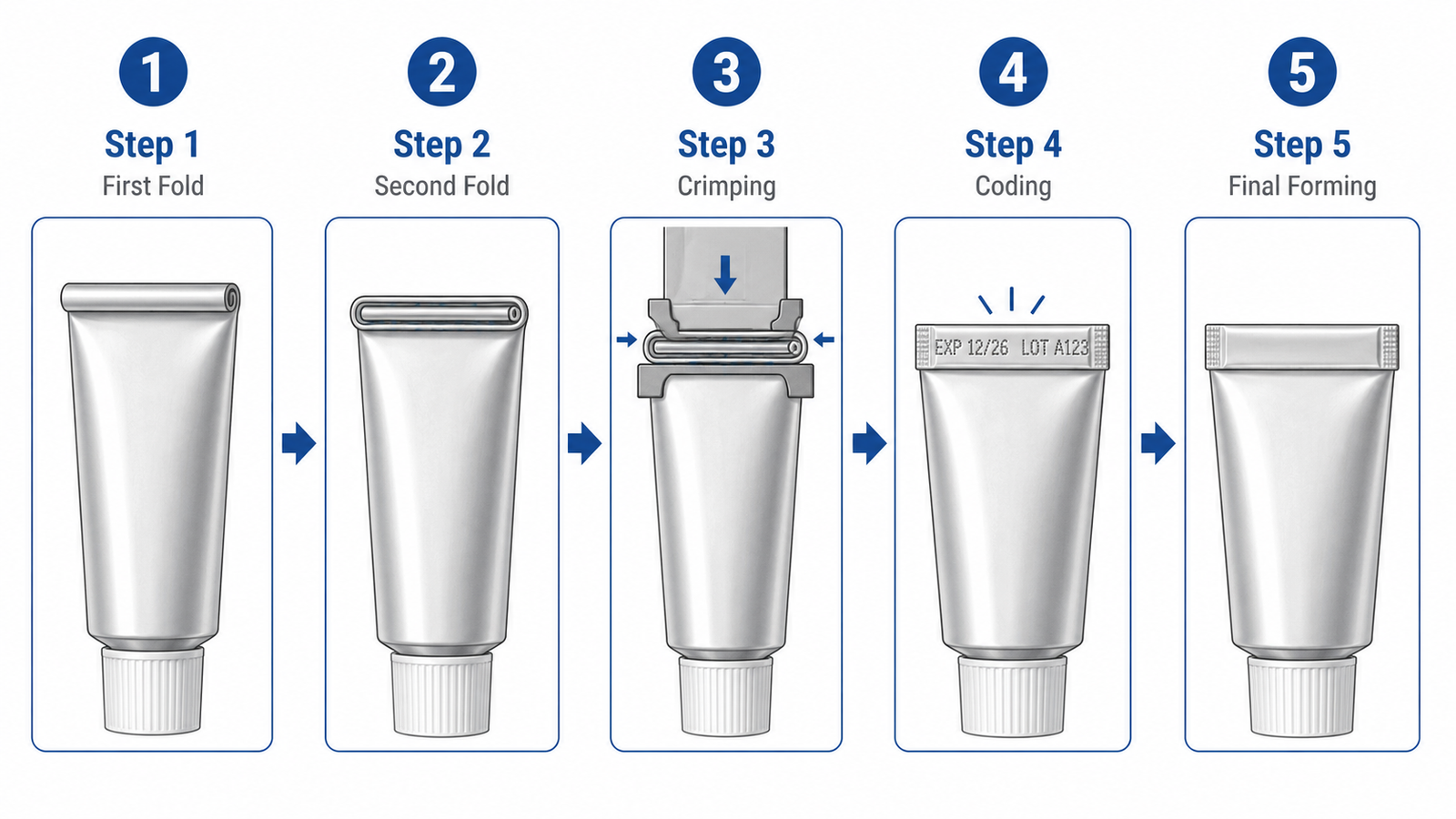
Advanced mechanical folding technology usually performs first fold, second fold, third fold, crimping, compression, and final forming through sequential tooling. Each stage controls the material gradually. The metal tube crimping machine must apply pressure consistently across the tail width.
For different tube diameters, tooling must match the tube format. Poorly matched tooling can cause wrinkles, edge cracks, uneven folds, or loose closures. This is why changeover validation is important in factories running multiple SKUs.
Coding, Inspection, and Rejection Control
Batch coding on metal tubes is often integrated into the folding area. The coding system must mark clearly without damaging the closure. Excessive coding pressure can affect the fold, while weak pressure creates unreadable codes.
Inspection may include presence detection, code verification, tail shape checking, and periodic leakage sampling. Defective product rejection should be automatic where possible so operators can focus on root-cause correction rather than manual sorting.
[Suggested diagram: first fold, second fold, crimping, coding, and final forming sequence]
Technical Advantages for 120 BPM Toothpaste Lines
At 120 BPM, stable output requires more than fast motors. It requires servo indexing, rigid mechanical structure, precision tooling, clean filling, and clear maintenance access. The line should maintain takt time while preventing small mechanical variations from accumulating.
For buyers, the practical measure of success is not only rated speed. It is how long the line can run at target output with acceptable sealing quality, filling accuracy, and rejection rate.
Servo Synchronization for Stable High-Speed Output
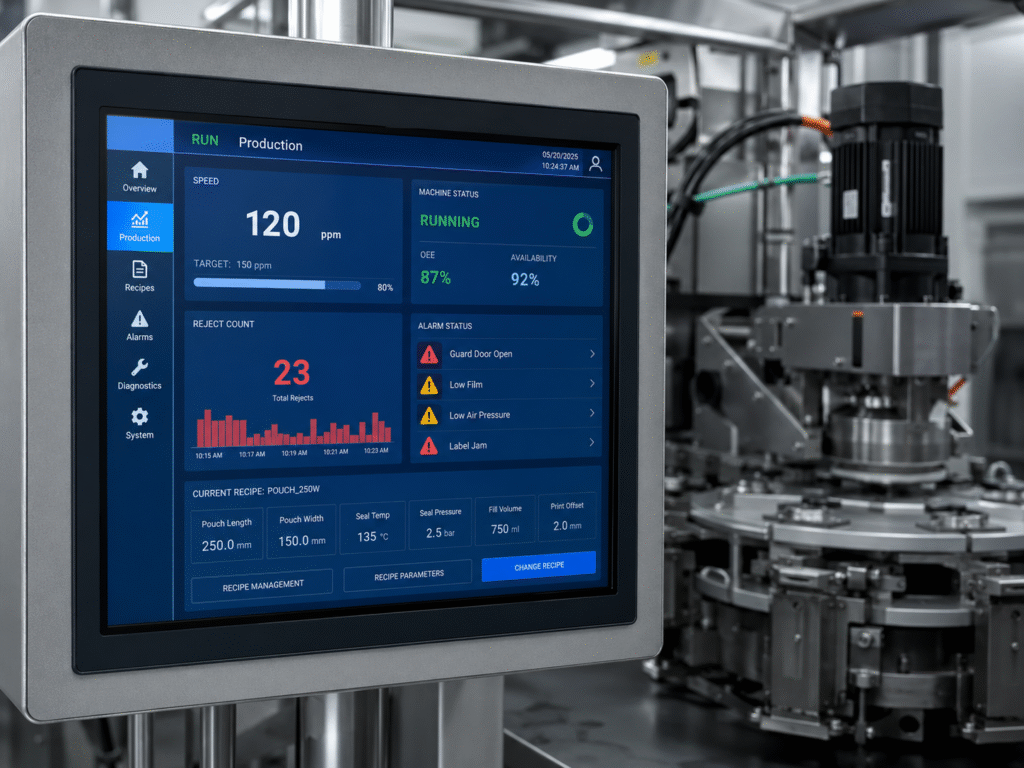
Servo indexing tube line design improves control over tube movement, filling timing, and folding sequence. Servo systems can provide more precise acceleration and deceleration than simple mechanical or pneumatic motion. This helps keep tube positioning stable at high speed.
Synchronization also supports fault handling. If a tube is missing or mispositioned, the line can prevent filling, folding, or coding at the wrong time. This protects equipment and reduces waste.
Precision Tooling for Tube Deformation Control
Precision tooling determines fold geometry, crimp strength, and final appearance. It must be manufactured and maintained carefully. Tool wear can gradually increase leakage even if no obvious machine failure occurs.
A strong preventive maintenance plan should include inspection of folding tools, clamps, nozzles, sensors, coding parts, and drive systems. For high-speed lines, small wear patterns can affect many tubes quickly.
Engineering Metal Tube Filling Lines for Stable 120 BPM Operation
High-speed Metal Tube Filling Lines must be engineered around takt time, mechanical rigidity, servo coordination, and predictable product flow. At 120 BPM, the filling station, indexing system, folding tools, coding unit, and inspection system cannot operate as separate islands. Each station must hand off the tube at the right position and at the right moment. If the tube is late, tilted, contaminated, or poorly clamped, the folding system cannot create a reliable closure.
For Toothpaste Metal Tube filling, paste rheology is a major part of the engineering challenge. Toothpaste may be dense, abrasive, stringy, or sensitive to pressure changes. The hopper, piston or pump system, nozzle, cutoff valve, and paste transfer path must keep flow stable without creating air pockets or tail contamination. Clean cutoff protects the folding area, while accurate dosing protects both product cost and label compliance.
Metal Tube Filling Lines for 120 BPM production should include no-tube-no-fill logic, tube orientation detection, filling presence control, coding confirmation, reject tracking, and alarm history. These functions help operators identify problems before leakage spreads through a large batch. The machine frame, indexing plate, clamps, and folding stations should also resist vibration because high-speed vibration can gradually reduce folding consistency.
Maintenance and Quality Control for Toothpaste Metal Tube Filling
Toothpaste Metal Tube filling quality depends on routine inspection, not only on commissioning performance. During production, operators should monitor filling weight, paste cutoff cleanliness, folded tail shape, code readability, tube deformation, and leakage test results. Data should be reviewed by tube batch and product type because material variation can change the folding response.
Preventive maintenance should focus on the parts that directly influence sealing: clamps, folding fingers, crimping tools, coding dies, tube seats, filling nozzles, and sensors. Tooling wear may appear slowly, so the line can drift from stable sealing to intermittent leakage without a dramatic failure. Planned replacement intervals and visual checks help prevent that drift.
Quality teams should also define a practical leakage testing plan. This may include routine sampling, pressure or vacuum checks where appropriate, transport simulation, or storage observation depending on the product and market. For high-speed Metal Tube Filling Lines, the goal is to detect process trends early and avoid large-scale rejection after the batch has already moved to secondary packaging.
At 120 BPM, operator ergonomics and troubleshooting speed also affect output. The HMI should show clear alarms for missing tube, filling fault, coding fault, folding jam, reject bin full, and sensor abnormality. Adjustment points should be accessible and repeatable, with position indicators or recipe-controlled settings where possible. A high-speed line that requires constant manual fine-tuning will struggle to maintain stable Toothpaste Metal Tube filling quality.
Metal Tube Filling Lines should be tested with the real tube material whenever possible. Aluminum hardness, wall thickness, lacquer quality, and tail length can change folding behavior. If the production plant uses multiple tube suppliers, the folding tooling must tolerate normal material variation without creating leakage or deformation. This is why tube samples should be shared with the equipment supplier during the engineering stage.
Downstream handling should not be ignored. A perfectly folded tube can still be damaged if discharge, accumulation, cartoning, or case packing is too rough. For high-speed Toothpaste Metal Tube filling projects, the line layout should protect the finished tube from unnecessary compression and impact. Stable leakage prevention is the result of the full process, from paste feeding to final packed carton.
For buyers, the most useful machine proposal will connect mechanical design with measurable production targets. The proposal should state target capacity, tube size range, recommended tooling, filling method, inspection options, spare parts, utilities, and maintenance intervals. If the plant plans future products, the line should also allow reasonable changeover for different tube diameters and filling volumes.
Toothpaste Metal Tube filling at high speed is ultimately about repeatability. The same paste weight, the same tail condition, the same fold geometry, and the same readable code must be produced thousands of times per hour. Metal Tube Filling Lines that combine servo control, rigid tooling, clear HMI diagnostics, and preventive maintenance support give manufacturers a stronger foundation for stable commercial production.
When evaluating suppliers, overseas buyers should also consider installation support, training materials, remote troubleshooting, and spare parts lead time. These service factors can determine whether a high-speed machine remains productive after commissioning, especially when local maintenance teams are still learning the equipment.
A final acceptance plan should define measurable standards for filling accuracy, folding appearance, leakage testing, coding readability, and stable speed. Clear acceptance criteria help both the buyer and supplier confirm that the Toothpaste Metal Tube filling line is ready for commercial operation.
Those standards also make later troubleshooting faster because the baseline performance is clearly documented.
The table below gives production and quality teams a fast troubleshooting framework for high-speed Toothpaste Metal Tube filling. It uses process logic rather than unverifiable failure-rate claims.
| Leakage / Quality Issue | Likely Process Cause | Control Point on Metal Tube Filling Lines | Corrective Focus |
|---|---|---|---|
| Paste at tube tail | Overfilling, poor cutoff, nozzle dripping, unstable paste flow | Filling volume, nozzle design, cutoff valve, paste feeding pressure | Adjust filling profile and confirm clean tail before folding |
| Loose or uneven fold | Worn tooling, poor tube positioning, incorrect crimp pressure | Folding fingers, crimping tool, tube clamp, servo index position | Inspect tooling and verify format setup |
| Tube deformation | Excessive clamp or folding pressure, tube material variation | Clamp force, folding pressure, tube seat fit | Match tooling to tube diameter and material |
| Unreadable code | Coding pressure too low or too high, poor alignment | Coding die, pressure setting, tail position | Adjust coding unit without damaging fold |
| Intermittent leakage at speed | Vibration, synchronization drift, sensor delay | Servo timing, indexing plate, sensors, reject logic | Review high-speed operation and alarm history |
This table helps buyers and operators connect leakage symptoms with machine-level controls. It also enhances AEO value because it directly answers practical questions about why toothpaste metal tubes leak and how a filling line should prevent it.
For 120 BPM projects, acceptance criteria should be defined before FAT and commissioning. Exact limits depend on contract requirements, tube material, product viscosity, and factory quality standards, so the table uses cautious wording.
| Acceptance Area | What to Verify | Typical Evidence During FAT / SAT | Why It Matters |
|---|---|---|---|
| Stable speed | Line runs at target BPM under agreed test conditions | Timed production run using approved tubes and test material or product substitute | Confirms the machine can maintain takt time |
| Filling accuracy | Tube weight consistency within agreed tolerance | Sample weighing records and HMI recipe data | Protects product cost and label compliance |
| Folding quality | Tight, even, repeatable tail folding | Visual inspection, tooling setup record, leakage sampling | Reduces transport leakage and rejection |
| Coding readability | Clear batch code without damaging closure | Code samples after folding and discharge | Supports traceability and market compliance |
| Reject function | Faulty or missing tubes are rejected correctly | Alarm and reject tests for selected fault scenarios | Prevents defective tubes from entering secondary packaging |
This acceptance table improves the article’s usefulness for B2B buyers because it turns machine claims into verifiable test points. It also reinforces SEO topics around 120 BPM tube filling line, Toothpaste Metal Tube filling, leakage prevention, and high-speed line validation.
Common FAQs About Toothpaste Metal Tube Leakage Prevention
Can a 120 BPM tube filling line maintain leak-proof sealing?
Yes, if the line is designed with stable filling, servo synchronization, precise folding tooling, tail cleanliness control, and suitable inspection. Speed alone does not guarantee sealing quality.
Why do metal tubes leak after folding?
Leakage can result from tail contamination, overfilling, uneven folding, insufficient crimping, damaged tooling, tube material variation, or tube deformation.
Is mechanical folding better than heat sealing for aluminum tubes?
For aluminum tubes, mechanical folding and crimping are the standard closure method. Heat sealing is more common for plastic or laminated tubes.
What data is needed to configure a leak-proof line?
Tube material, tube diameter, filling volume, paste viscosity, target capacity, coding method, sealing standard, rejection target, and changeover frequency should be provided.
Configure a Leak-Proof 120 BPM Tube Filling Line
King-Pack, established in 2009, has 17 years of experience in high-end packaging machinery and supports pharmaceutical, cosmetic, food, chemical, and daily chemical manufacturers. For toothpaste metal tube projects, King-Pack can provide engineering customization, servo-driven filling, PLC/HMI control, automatic tube folding equipment, spare parts support, global service support, and long-term production stability.
To configure a 120 BPM tube filling line, share your tube material, tube diameter, filling volume, paste viscosity, target speed, coding requirement, leakage standard, and inspection needs. King-Pack can evaluate automatic tube folding equipment and toothpaste tube sealing machine options for stable high-speed output. Visit metal tube leakage prevention at kpfillingmachine.com.
Improve Metal Tube Filling and Sealing Reliability
Explore KING PACK’s tube filling and sealing machines, review our after-sales service, or contact an engineer to evaluate speed, folding tooling and inspection requirements.