
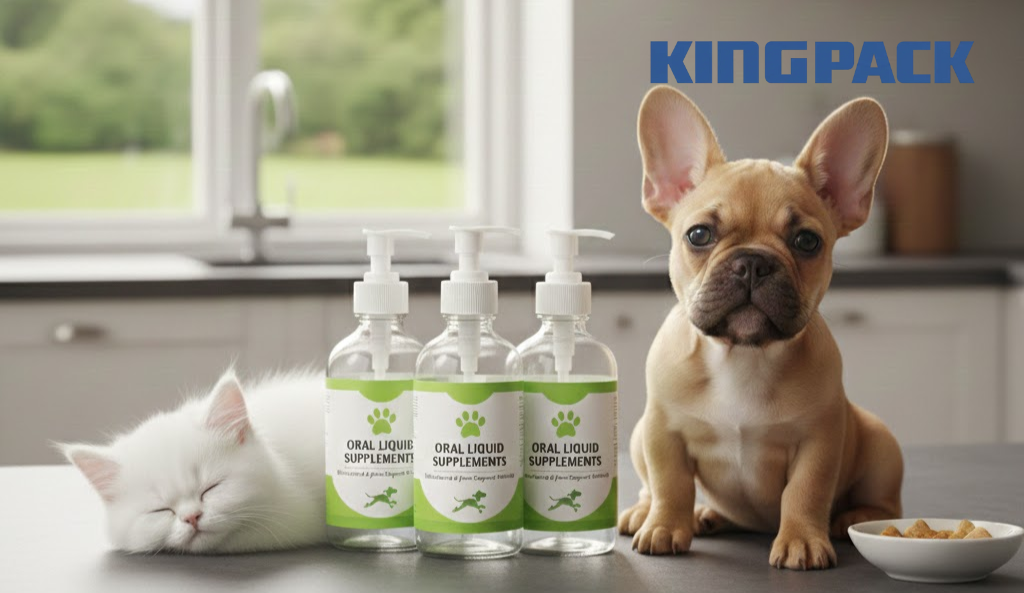
Oil-based anti-parasitic medicines play a critical role in modern pet care. Flea and tick treatments, ear oils, and long-acting topical solutions rely on viscous formulations to deliver active ingredients over time. These products protect pets effectively, but they create real challenges during filling and packaging.
At King Pack, we design filling systems specifically for viscous liquid filling for pet drops. Our focus is precision oil dispensing, yield protection, and stable output for manufacturers working with thick, high-value formulations.
This article explains why oil-based medication packaging needs specialized engineering and how the right filling technology solves these problems.
Why Oil-Based Pet Medicines Are Challenging to Fill
Oil-based pet medicines behave very differently from water-based or alcohol-based liquids. Their thickness comes from long-chain actives, carrier oils, and stabilizers that allow the product to stay on the skin or inside the ear for longer periods. While this improves treatment results, it creates real challenges during filling.
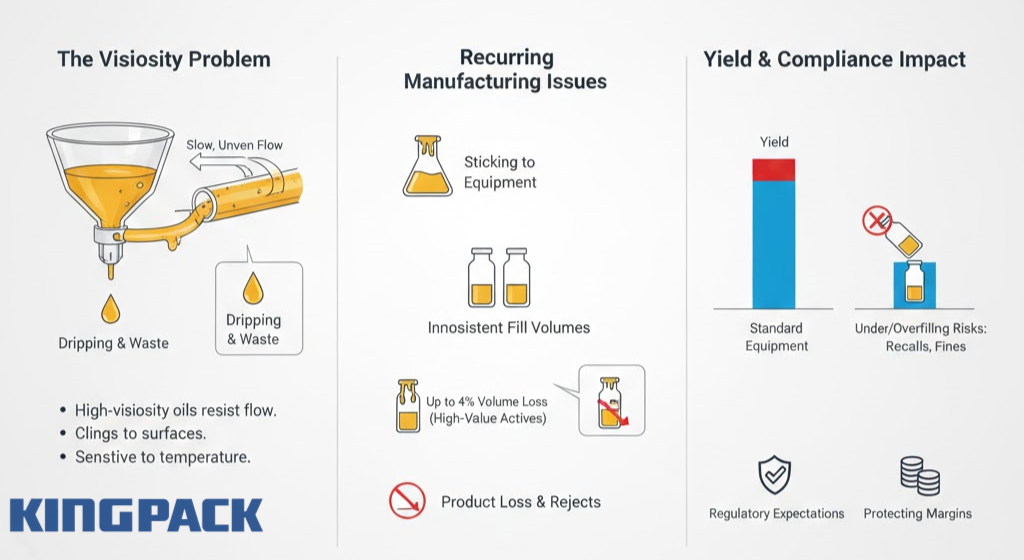
High-viscosity oils resist smooth movement through pumps and transfer lines. They move slowly, cling to internal surfaces, and respond strongly to temperature changes. When flow becomes unstable, dosing accuracy starts to drift. Oil that hangs at the nozzle after shut-off often drips onto the container or machine surface, which leads to waste and cleanup issues.
Manufacturers typically face several recurring problems when filling oil-based pet medicines:
- Oil sticking to hopper walls, tubing, and nozzles
- Inconsistent fill volumes caused by uneven flow
- Dripping after fill cut-off, leading to product loss and rejects
These issues have a direct impact on yield. Anti-parasitic formulations use costly active ingredients and are often produced in limited volumes.
Compliance adds another layer of pressure. Anti-parasitic shampoos, and other veterinary medicines must meet strict dosing requirements. Overfilling increases material cost, while underfilling risks failed inspections or recalls. For manufacturers operating at scale, precision oil dispensing systems are essential to maintain accuracy, protect yield, and meet regulatory expectations.
Recommended Reading: Packaging Machine Solutions – King Pack Packaging Equipment – King Pack Machinery
Common Problems in Oil-Based Pet Drop Production
Hanging on Hopper or Tube Walls
One of the most common issues with viscous oils is wall adhesion. Thick liquids cling to the sides of hoppers, transfer tubes, and filling nozzles. Instead of flowing cleanly, part of the product stays behind as residue.
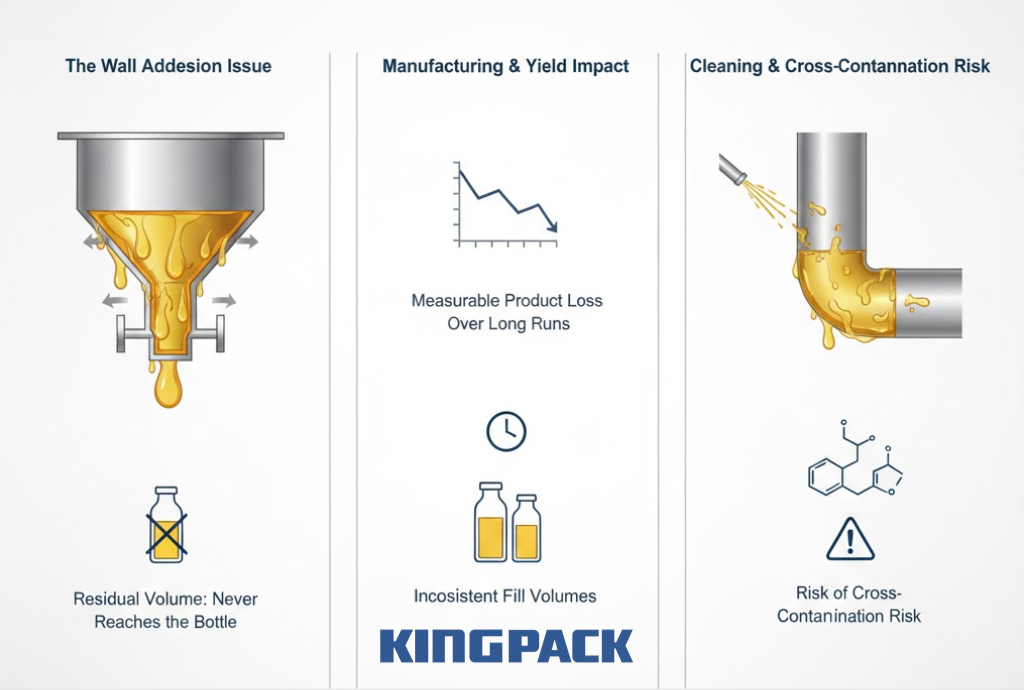
This leads to residual volume that never reaches the bottle. Over long runs, the loss becomes measurable. Residue also creates inconsistency, as later fills may receive less product once the system starts to empty unevenly.
From a cleaning standpoint, wall adhesion increases downtime. Oil buildup requires more frequent wash cycles and more aggressive cleaning methods. Without proper design, this also raises the risk of cross-contamination between batches.
Pump Flow Issues
Standard filling pumps are often designed for low- or medium-viscosity liquids. When used with thick pet oils, these pumps struggle to maintain stable flow. Pressure builds unevenly, which causes surging during filling.
Air bubbles and cavitation are common side effects. When air enters the oil stream, dosing accuracy drops. Bubbles also create gaps in micro-dose filling, especially for pipettes or spot-on containers.
Temperature Sensitivity
Oil viscosity changes with temperature. When oils cool, they become thicker and harder to pump. When overheated, active ingredients may degrade or separate.
Cold spots inside hoppers or transfer lines are especially problematic. Oil may flow well at the center but stall near the walls. This uneven flow causes dosing drift and increases mechanical stress on pumps.
Temperature control must balance flow stability and product safety. Heating alone is not enough. It must be controlled, uniform, and integrated into the full filling system.
Recommended Reading: Multi-Lane Sachet Packing Machines – King Pack High-Speed Liquid & Paste Packaging – King Pack Machinery
Technologies to Handle Viscous Liquid Filling
Effective viscous liquid filling for pet drops relies on a combination of mechanical design and process control. No single feature solves every issue. Performance comes from how systems work together.
At King Pack, we design oil-based medication packaging lines around three core engineering solutions. These systems focus on flow stability, dosing accuracy, and waste reduction without damaging sensitive APIs.
Heated Hopper and Jacketed Tanks
Heating jackets play a key role in oil filling lines. By maintaining oil at a controlled temperature, viscosity stays within a predictable range. This improves pump performance and reduces wall adhesion.
Jacketed hoppers surround the product tank with a heating layer that distributes warmth evenly. This prevents cold zones that slow down flow. Digital temperature control allows fine adjustments based on formulation needs.
Specialty Piston and Peristaltic Pumps
Pump choice defines the heart of any precision oil dispensing system. For thick pet oils, specialty piston pumps and reinforced peristaltic pumps perform best.
High-viscosity piston pumps use strong seals and short flow paths to move oil without air entrapment. Their controlled stroke action delivers stable micro-doses even at slow speeds. This is especially important for viscous pipette filling machines used in flea and tick treatments.
Peristaltic pumps, when properly sized, offer another advantage. Since the product only contacts the tubing, cleaning is simpler and contamination risk drops. For some oil-based formulas, this design supports gentler handling.
King Pack designs both pump types with wall-sweeping flow paths to minimize residue and support consistent output across long runs.
Blow-Off and Wall-Sweeping Nozzle Techniques
Even with the right pump, nozzle behavior matters. Thick oils tend to hang at the nozzle tip after filling. Drips waste product and contaminate container threads.
Blow-off and wall-sweeping nozzle designs address this issue. A controlled burst of air or mechanical cutoff clears residual oil from the nozzle after each fill. This captures the last drops and directs them into the container.Bottom-Up and Diving Nozzle Filling for Pet Anti-Parasitic Oils
Bottom-up filling is ideal for viscous liquids like oral granules, liquid suspension, or oil-based anti-parasitic treatments. The nozzle enters the container and rises as filling progresses, reducing splashing and helping the product settle smoothly.
For Flea & Tick oils, ProHeart 12, or Mycodex Flea & Tick formulations, this approach maintains laminar flow, minimizes air entrapment, and prevents foam formation, improving dosing accuracy. Properly controlled filling also ensures full container volume without overflow, supporting liquid medication or Vet-Administered Injection preparations.
With synchronized pump speed and diving nozzle movement, bottom-up filling maintains accuracy within ±1–2 percent. King Pack integrates diving nozzle systems into pet anti-parasitic oil filling lines to support bottles, pipettes, or oral granules with repeatable, consistent results.
Line Integration for Oil-Based Pet Drops
Filling performance depends on the full production line. Poor integration can cause pressure fluctuations, temperature changes, and unnecessary stops.
A properly designed line links the hopper, Viscous Liquid Filling Machine, and plugging or capping units into a continuous flow. Wall-sweeping pump designs and synchronized heating systems maintain stable viscosity for anti-parasitic treatments, oral medications, or herbal tonics.
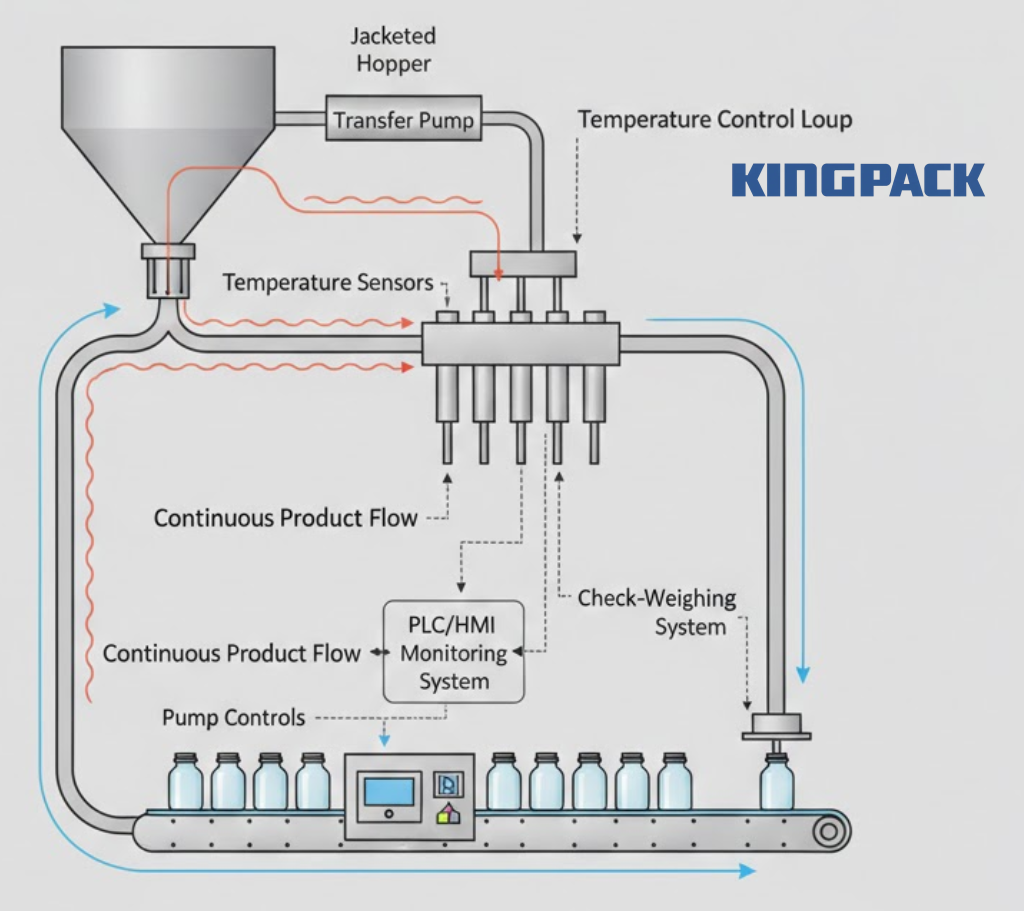
Inline quality control adds another layer of precision. Check-weighing and monitoring systems provide real-time feedback on fill volume for liquid suspensions, ProHeart 12, or Flea & Tick oils. This data helps fine-tune pump performance, detect early drift, and reduce rejects, ensuring reliable dosing for veterinary parasiticides.
Examples of Oil-Based Anti-Parasitic Products
Oil-based anti-parasitic formulations are used across several pet care categories. These products rely on viscosity to hold active ingredients in place, extend contact time, and improve treatment effectiveness. From a filling perspective, this same viscosity creates challenges that require specialized equipment.
Each product type places slightly different demands on the filling system. Bottle size, dose volume, and oil composition all affect how the liquid behaves during dispensing.
This is why a one-size filling solution rarely works for pet anti-parasitic oils. King Pack designs pet anti-parasitic oil filling lines to handle this variety without sacrificing accuracy or cleanliness. Below are common product categories seen in veterinary production.
Ear Oils for Cats and Dogs
Ear oils are thick, slow-flowing veterinary formulations designed to coat the ear canal thoroughly. They may contain anti-parasitic agents, herbal tonics, or Flea & Tick compounds. These oils are often packaged in small bottles with dropper tips or liquid suspension containers. Accurate dosing is essential to avoid irritation, inflammation, or allergic reactions.
Wall adhesion and dripping are common challenges. King Pack filling systems use heated tanks, piston dosing fillers, and Vet-Administered Injection-capable setups to maintain stable flow. Blow-off nozzles and proper feed cylinder structures prevent residue buildup on droppers, keeping packaging consistent and clean.
Long-Acting Topical Oils
Topical spot-on oils are designed to spread slowly across skin and hair follicles, providing extended protection against parasites, heart worms, and paralysis ticks. These products are typically packaged in pipettes, oral granules, or liquid suspension formats.
Filling accuracy is crucial, as under-dosing reduces protection and overfilling increases waste. King Pack lines use bottom-up filling, wall-sweeping flow paths, and synchronized pump control to deliver precise doses with minimal residue. Quick-disconnect product contact parts allow faster changeover between formulations like ProHeart 12 or Mycodex Flea & Tick.
Flea and Tick Spot-On Oils
Spot-on oils are high-value veterinary parasiticides, often containing Dirofilaria immitis protection or Flea & Tick active ingredients. These formulations are sensitive to air, temperature, and handling.
King Pack precision filling systems integrate synchronized piston movement, heated reservoirs, and automated blow-off mechanisms to prevent bubbles and ensure consistent dosing. For veterinary practice and long-term use applications, this approach protects yield, supports compliance, and ensures safe administration of oral medications, liquid suspension treatments, and anti-parasitic oils.
Recommended Reading: Packaging Machine Solutions – King Pack Packaging Equipment – King Pack Machinery
ROI and Waste Reduction from Optimized Oil Filling
Oil-based anti-parasitics carry high material costs. Even small improvements in yield can produce meaningful financial returns over time. Optimized filling systems reduce waste at several points in the process.
First, improved flow control reduces residual oil left in hoppers, tubing, and pumps. Second, accurate cut-off at the nozzle prevents dripping and container contamination. Third, stable temperature control reduces batch variability.
Manufacturers who upgrade from standard liquid fillers to dedicated viscous oil systems often see immediate improvements in material usage and reject rates.
A 2024 analysis by Pet Manufacturing Economics found that optimized oil filling lines reduced average product loss by 2.5 percent per batch. For anti-parasitic oils, this translated into measurable cost savings within the first year of operation.
Typical Savings Areas in Oil Filling Optimization
- Reduced residual oil left inside hoppers, hoses, and nozzles
- Lower reject rates from underfilled or contaminated containers
- Faster changeovers with heated and CIP-ready systems
These gains compound over long production runs and across multiple SKUs. For contract manufacturers, improved yield also strengthens client trust and pricing flexibility.
How King Pack Designs Precision Oil Dispensing Systems
King Pack focuses on engineering solutions that address viscosity directly rather than compensating for it after problems appear. Our oil filling systems are designed as complete dispensing platforms, not isolated machines.
Each component plays a role in maintaining stable flow, clean dosing, and efficient cleaning. This approach supports both single-product lines and complex multi-SKU production.
Below are the core design elements used in King Pack pet anti-parasitic oil filling lines.
Jacketed Hopper and Heating Control
Temperature control begins at the hopper. King Pack uses jacketed tanks with uniform heat distribution to prevent cold spots and uneven flow.
Digital controllers maintain oil within a narrow temperature range suited to the formulation. This keeps viscosity predictable and reduces stress on pumps and seals. Heating systems are integrated with safety limits to protect active ingredients.
High-Viscosity Piston and Peristaltic Pumps
Pump selection depends on oil thickness, dose volume, and packaging format. King Pack offers high-viscosity piston pumps for thick oils and reinforced peristaltic systems for gentler handling.
Both pump types are designed with short flow paths and strong sealing to prevent air entry. This supports stable micro-dosing and repeatability across long production runs.
Blow-Off and Wall-Sweeping Nozzle Modules
Nozzle performance often defines final yield. King Pack integrates blow-off and wall-sweeping designs that clear residual oil after each fill. This improves dose accuracy and keeps containers clean. It also reduces cleanup time at the end of each batch, which supports faster line turnover.
Integration with Multi-Product Lines and CIP
King Pack systems are built for real production environments. Oil filling modules integrate with capping, labeling, and inspection systems. CIP-compatible designs simplify cleaning between formulas. This is especially valuable for manufacturers producing multiple anti-parasitic products on shared lines.
Recommended Reading: The Differences Between Homogenization and Emulsification – King Pack Machinery
Comparing Filling Technologies for Oil-Based Pet Drops
Different filling technologies handle viscosity in different ways. Selecting the right system depends on oil thickness, dose size, and sterility needs.
The table below outlines common filling pump options used in oil-based medication packaging.
| Filling Technology | Suitable Oil Viscosity | Typical Application | Key Advantage |
| High-Viscosity Piston Pump | Medium to very thick oils | Spot-on treatments, topical oils | Strong dosing control, stable micro-volumes |
| Reinforced Peristaltic Pump | Low to medium oils | Ear oils, oral oils | Minimal contamination, easy cleaning |
| Time-Pressure System | Stable but variable oils | Small-dose bottles | Simple control for consistent flow |
King Pack designs filling platforms that support multiple pump options. This allows manufacturers to adapt systems as product portfolios evolve.
Recommended Reading: Tube Filling Machines: Uses, Types, and Benefits Across Industries – King Pack Machinery
How to Choose a Viscous Liquid Filling System for Pet Medicines
Selecting the proper filling system begins with understanding the formulation. Flea medication oils and liquid anti-parasitic treatments can change viscosity with temperature, batch composition, and storage conditions. Equipment must manage this range reliably without frequent recalibration.
Pump selection is the next consideration. Thick oils, including those containing chemical substances or Arsenic-based melarsomine dihydrochloride, often require piston-driven systems, while sensitive formulas benefit from peristaltic handling. Nozzle design and cut-off control should match dose size, container format, and active ingredient stability.
Cleaning and changeover are critical. Residues from oils or chemical substances must be removed completely to prevent contamination of subsequent batches. Systems with smooth surfaces and CIP compatibility minimize downtime and reduce operator effort.
Here are Key Evaluation Points When Selecting Equipment
- Viscosity range across operating temperatures
- Required dose accuracy and repeatability
- Cleaning time between different formulations
King Pack works with manufacturers during the evaluation stage to ensure machine configuration matches product characteristics and production goals. Inline monitoring using insect toxicity data, pharmacokinetic analysis, or liquid chromatography tandem mass spectrometry can support validation and maintain safety for non-target species, soil health, and environmental contaminants.
FAQ – Oil-Based Pet Drop Filling
How can thick oils be handled in micro-dose filling?
Thick flea medication oils and liquid anti-parasitic treatments need controlled temperature, short flow paths, and pumps built for high resistance. Heated hoppers and piston-based systems maintain stable micro-dosing.
Can heating damage active ingredients?
Heating must be uniform and regulated. King Pack systems use controlled jackets to keep oils within safe limits, protecting chemical substances and sensitive APIs like Arsenic-based melarsomine dihydrochloride.
How does wall-sweeping improve yield?
Wall-sweeping designs reduce residue in pipes and nozzles, allowing more liquid medication or anti-parasitic oils to reach containers instead of staying in the system.
Which pump type works best for viscous anti-parasitics?
High-viscosity piston pumps are preferred for thick oils. Peristaltic pumps suit lower-viscosity flea medications or formulations requiring strict sterility.
Can one filling line handle multiple oil-based products?
Yes. With controlled heating, interchangeable pumps, and CIP-ready design, a single line can safely fill multiple flea medications, liquid suspensions, or other veterinary anti-parasitic treatments.