 Skip to content
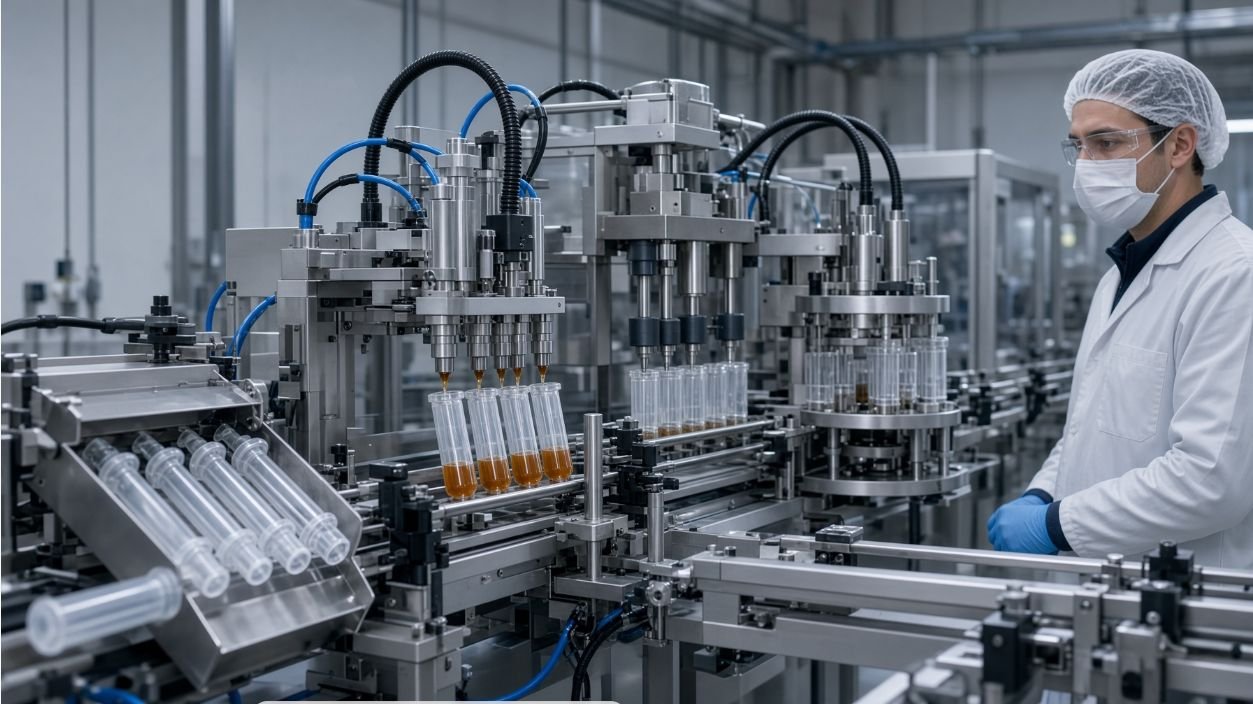
The question of when to move from manual to automatic gel bait syringe filling is usually asked as a speed question: how many syringes can a line produce per shift? The honest answer rarely depends on the cycle rate. It depends on where the team is losing minutes today—on dosing accuracy, on piston insertion, on closure seating, on inspection—and on whether those losses are matters of operator skill, of repetitive strain, of inconsistent quality or of plain volume that no shift can reach by hand. A line that runs “automatically” but still relies on an operator to correct piston seats or wipe nozzles is a manual line in an automatic frame; a line that runs manually but on a well-organised bench with proper fixtures can be the right answer at low volume.
This article walks through how to map the bottlenecks that justify an investment, how to define the boundary that separates manual work from automated work, and how to plan a staged upgrade that starts with a sample trial before the buyer commits to a full line.
Map the Manual Tasks and Identify the Real Bottlenecks
Before anyone discusses an automatic gel bait syringe filling line, the current operation should be visible at task level. Not the headcount, not the planned output per shift, but what each operator does, in what order, on what cycle, and where the shift loses minutes. A useful exercise is to write down the sequence of manual tasks in the order they happen, then mark the ones that take a varying amount of time, the ones that produce measurable defects, and the ones that operators tend to skip when the line is behind.
Tasks that often appear on a gel bait bench:
- Bulk paste handling. Decanting or pumping product into the dosing reservoir, sometimes with manual stirring or warming.
- Syringe loading. Loading loose or pre-oriented barrels into a fixture or nest.
- Dosing. Drawing paste into a syringe, often using a hand gun, a dispenser or a bench-top volumetric filler.
- Piston insertion. Pressing the piston into the barrel by hand or with a small tool.
- Tip / cap application. Pressing or screwing the closure onto the barrel.
- Inspection and weighing. Removing samples for weight checks, visual inspection and leakage tests.
- Labelling and coding. Applying labels and printing batch codes by hand or with a desktop device.
- Cartoning and case packing. Packing syringes into cartons and cases.
Looking at this list, “dosing” is rarely the bottleneck in a manual gel bait operation. The bottlenecks usually live upstream (paste handling, syringe loading) or downstream (closure, inspection, labelling). An automation project that focuses only on replacing the dosing step without addressing the upstream supply or the downstream inspection tends to expose a different bottleneck immediately and is often the first reason such projects stall.
A practical version of this exercise is to time each task across one full shift, with a sample of operators and a sample of products, and to record where defects are produced. The result is not a labour savings number; it is a list of the tasks that an automated line must take over without loss of quality. That list becomes the specification the upgrade is built against.
Define the Automation Boundary by What the Line Owns

Once the bottlenecks are visible, the next question is what to automate and what to keep manual. The wrong answer is to automate everything; the wrong answer in the other direction is to automate only the part the supplier has a standard product for. The right answer is the boundary at which moving the work from operator to machine removes the bottleneck without introducing new manual steps at the interfaces.
The boundary should be defined by four questions:
- Which tasks are constrained by the operator’s hand time? These are candidates for automation and usually include dosing and closure placement.
- Which tasks are constrained by the operator’s consistency? These are also candidates; dosing accuracy and closure torque are typical examples.
- Which tasks are constrained by product variability? Some product behaviour resists automation until the formulation is stabilised; an upgrade decision taken before the product is stable will look like an automation failure when it is really a product problem.
- Which tasks are constrained by inspection or regulatory record-keeping? These are not always automated at the same time as the filling step; sometimes the right staged upgrade automates fill first and inspection second.
Most gel bait producers find the boundary sits between “paste in, barrel in” and “barrel out, labelled and sealed.” Between those two, the dosing, piston insertion, tip/cap placement and a minimal inspection can be automated as a single unit. The paste handling before the line and the cartoning after the line usually stay partly manual until volume justifies their own automation.
Match the Upgrade to Volume, Format Variety and Labour Economics
Volume is the headline number, but it is not the deciding number. Format variety is often the deciding number, because a line that handles three formats is a very different project from a line that handles one format running in three shifts. Labour economics, including the local market for operators and the cost of corrective work caused by manual defects, also change the answer.
The rough staging that most gel bait producers work through looks like this:
| Stage | Typical scope | What changes | What stays manual |
| Manual bench | Dosing by hand gun, hand capping, hand labelling | — | All tasks |
| Bench-top semi-automatic | Bench-top volumetric filler, manual loading and unloading | Dosing accuracy and throughput at the fill station | Syringe handling, closure, inspection, labelling |
| Integrated semi-automatic | Volumetric filler + piston insertion + cap placement, manual loading/unloading | Fill, piston, closure | Syringe orientation, inspection, labelling, cartoning |
| Full automatic line | Integrated semi-automatic plus auto-orientation, inspection, labelling, cartoning | The full bench | Paste handling in bulk, line clearance and changeover |
The table is not a recommendation; it is a map of where different investments land. A producer running 800 units per shift of a single 30 g format on a stable bench is in a different position from one running 150 units per shift across three formats with frequent changeovers. The former can justify a full automatic line; the latter usually lives well at the integrated semi-automatic level for some time.
Format variety also changes the answer because every format change is a manual operation unless the line has been built with changeover capability from the start. A line that is justified by volume alone but ignores format variety may still make economic sense only after the formats are reduced or a separate line is added.
Plan the People, Maintenance and Spare-Parts Side of an Upgrade
A line that is sold with a cycle rate and a footprint is only half an upgrade. The other half is operators, maintenance, spare parts and training, and these are usually where first-year costs land. A “from manual to automatic” decision that ignores the maintenance side tends to come back as unplanned downtime, not as labour savings.
A useful checklist for the operations side:
- Operators. What does the new role look like? At minimum, line-clearance, changeover, first-off checks, alarm response and CIP/cleaning where applicable. Operators are not removed; they are moved up the skill ladder.
- Maintenance technicians. Daily checks, lubrication points, dosing element service, sensor calibration, recipe management. The line is expected to live for years; the maintenance plan must live with it.
- Spare parts. A first-year spare-parts list is part of the upgrade budget, not an extra. Wear parts on the dosing and closure stations and sensors across the line are the most common items.
- Training and documentation. Operator manuals, maintenance manuals, recipe management procedures and a fault-response guide are part of the deliverable. A line that arrives without these tends to operate informally until something fails.
- Local service capability. Either a local agent or a documented remote-support path should be agreed in the contract. A line that is only serviceable from the supplier’s factory is a real cost in any unplanned stop.
The maintenance side is often the difference between a line that runs at the rated cycle rate and a line that runs at the agreed cycle rate. Both numbers exist; the second one is the one the production plan should be built against.
Run a Sample Trial Before Committing to a Full Line
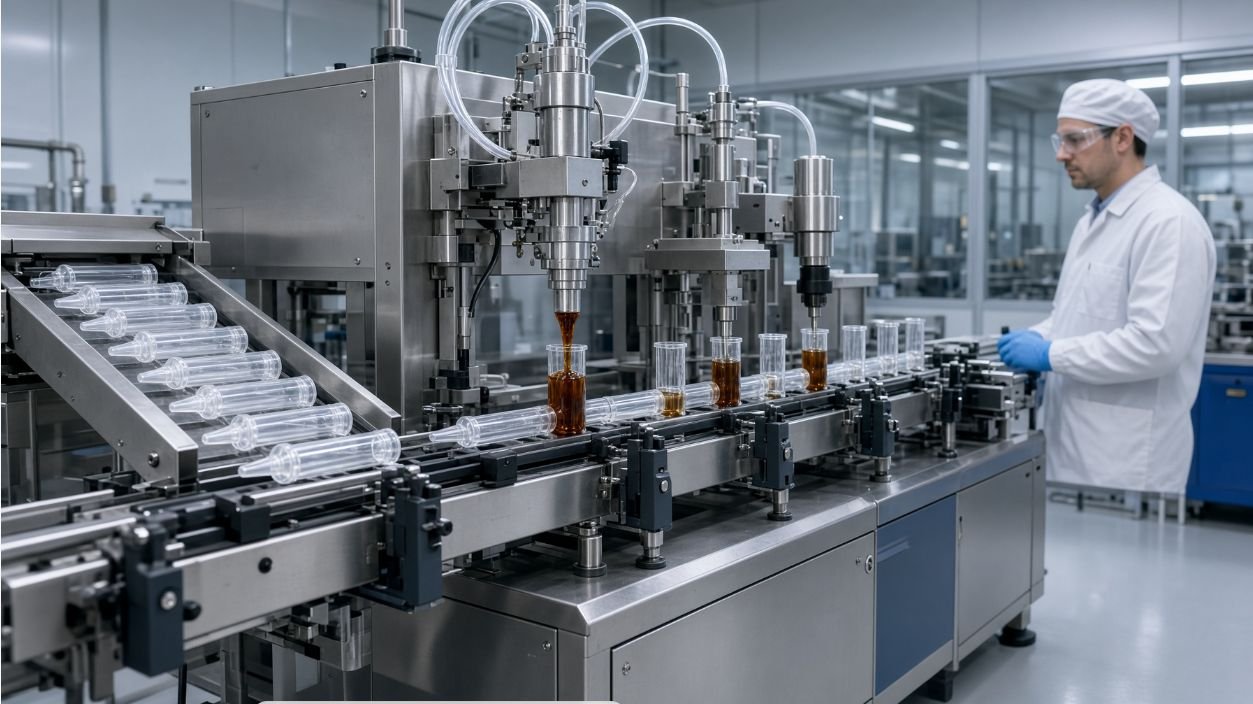
The single largest avoidable mistake in moving from manual to automatic gel bait syringe filling is buying a full line before running a controlled sample trial on the actual product and packaging. The sample trial is not a sales demonstration; it is the buyer’s first data point on whether the boundary the buyer drew on paper is achievable on the supplier’s equipment with the buyer’s paste, in the buyer’s barrel.
A useful sample trial for an upgrade decision:
- Bring actual product, packaging and operators’ working instructions. Trial conditions should match production conditions as closely as possible.
- Run a defined protocol. Cycle rate, fill weight target, defect definitions, sampling plan and the list of stops/alarms to expect.
- Record changeover. If the buyer runs more than one format, the trial should include at least one change, even if informal.
- Compare with the manual baseline. The output of the trial is compared against the same measures taken on the manual bench, on the same product.
- Carry an experienced operator and an experienced engineer. Each side’s expertise is needed; the trial is where their languages meet.
The deliverable is a written record of where the automatic line exceeds the manual baseline, where it matches it, and where it falls short. That record becomes the input to the upgrade decision and, later, to the user’s requirements specification (URS) and FAT for the full line.
Common Risks and Mistakes
- Automating only the dosing step. The bottleneck often sits upstream or downstream of dosing; a line that replaces only dosing exposes a different bottleneck.
- Assuming volume alone drives the decision. Format variety, changeover frequency and labour economics change the answer; volume is one of several inputs.
- Skipping the sample trial. A line purchased on a brochure cycle rate, without a trial on the buyer’s product and packaging, often runs below that cycle rate from day one.
- Ignoring maintenance and spare parts. A first-year operating budget that does not include spare parts and training tends to lose the savings the line was supposed to deliver.
- Buying a full line for the wrong reason. Brand visibility, not operational need, is the wrong reason; the line ends up oversized for the actual production plan.
- Underestimating changeover. A line sold as automatic but run with manual changeovers is an automatic line with a manual heart.
How King Pack Supports This Application
King Pack Machinery (Wuxi King-Pack / Wuxi Jingpai Machinery Co., Ltd., founded 2009, with a core technical team carrying more than 20 years of industry experience) supports the manual-to-automatic transition for gel bait syringe filling as a staged decision built on the buyer’s actual operation, not on a target cycle rate. The relevant support is:
- Bottleneck review before quotation. King Pack reviews the buyer’s current manual operation at task level, identifies the actual bottlenecks, and only then proposes which automation boundary makes sense.
- Sample-validated configuration. The line that arrives at the buyer’s site is the configuration tested on the buyer’s product and packaging in a sample trial, with documented results.
- Staged upgrade path. A buyer who needs a semi-automatic step today and a full line tomorrow gets a staged plan, not a forced upgrade; the format choice and the changeover capability are aligned to the formats the buyer actually runs.
- Documentation, training and spare-parts planning. Operator manuals, maintenance procedures, recipe management, training and a first-year spare-parts list are part of the line supply, not extras.
King Pack does not present a faster cycle rate as a reason to replace a manual operation. A manual operation is the right answer at many volumes and format mixes; a staged upgrade, built on a sample trial, is the right answer when the bottlenecks justify it.
Conclusion
Moving from manual to automatic gel bait syringe filling is a staging decision, not a speed decision. The work is done before the line is ordered: mapping bottlenecks, drawing the automation boundary, matching the upgrade to volume and format variety, and running a sample trial that produces evidence rather than enthusiasm. When those are in place, the upgrade is justified. When they are not, the line is usually the wrong size for the operation.
Ready to evaluate where automation makes sense for your operation? Send your current batch size, format range, shift schedule and a short description of the manual steps you run today, and request a staged upgrade review.
