

Last reviewed: September 7, 2026.
An intramammary syringe filling project should be specified around the product, the unit-dose applicator and the method used to confirm the delivered dose. A machine that fills a thick veterinary preparation consistently must keep the hopper feed stable, limit air pickup, cut off the product cleanly and place the cap without contaminating the closure interface. These decisions require representative material and package samples.
This article is deliberately narrower than the KING PACK veterinary syringe and applicator solutions overview. It focuses on intramammary applicators used for products delivered through the teat canal, including the filling and closing operations that affect dose presentation. It does not describe injectable prefilled syringe processing, make universal sterility claims or replace a product manufacturer's approved process-validation strategy.
Quick answer: Select the line from five linked inputs: viscosity across the operating temperature range, required expelled dose, air sensitivity, syringe and cap geometry, and the approved cleaning boundary. Then confirm hopper feed, dosing, nozzle cutoff, bubble control and cap placement with the actual product and package in a written FAT protocol; catalogue output alone is not sufficient evidence.
1 Define the Product and Applicator Boundary
Direct answer: Treat the formulation, syringe barrel, dispensing tip and cap as one tested system.
The equipment URS should identify the product form, target dose, density where relevant, viscosity versus temperature, solids or suspended phase, tendency to separate, sensitivity to aeration, allowed bulk hold and the state in which the product reaches the filler. Note whether the batch is homogeneous without agitation or needs slow controlled motion during the filling window.
Package inputs should include dimensioned drawings and samples for the barrel, flange, tip, cap and any plunger or piston component handled on the line. Tolerance at the holding and capping surfaces can matter as much as nominal dimensions. Define which surfaces may contact product and which must remain clean for closure placement and use.
EMA guidance on veterinary pharmaceutical development makes the dosage form, manufacturing process and container system part of the development evidence. Use that principle to connect product data to machine design, while allowing the manufacturer and its market-specific quality system to set the actual acceptance criteria.
| URS input | Why the line needs it | Evidence to request |
|---|---|---|
| Viscosity over temperature | Affects feed pressure, pump response and cutoff | Representative curve and trial temperature range |
| Expelled dose requirement | Connects filled unit to delivered use | Approved test method and acceptance rule |
| Air sensitivity | Affects hopper, transfer and dosing sequence | Bubble inspection method and sample limits |
| Syringe and cap tolerances | Affects holding, insertion and closure seating | Drawings, samples and dimensional range |
| Cleaning boundary | Defines removable parts, rinse path and verification | Approved procedure concept and sample points |
2 Build the Dose Strategy Around Expelled Product
Direct answer: For a unit-dose intramammary presentation, verify the amount the applicator delivers, not only what the filler deposits.
The 2022 EMA veterinary development guideline specifically notes that expelled weight should be considered for unit-dose intramammary preparations. That distinction matters because product can remain on the internal wall, behind the piston or in the dispensing geometry. Fill-weight checks still help control the process, but they should be related to the approved delivered-dose method.
Define how tare is established, when units are weighed, how temperature and density are handled and whether the product requires conditioning before testing. Separate machine repeatability from package emptying performance. A stable filler cannot correct an applicator design that retains an unacceptable amount of product after normal use.
During development, compare filled weight, expelled weight, visible residue and any approved assay result using traceable samples. The acceptance plan should state which result releases the filling operation and which result verifies the product-package system.
3 Stabilize Hopper Feed Before Tuning the Pump
Direct answer: A dosing pump cannot remain consistent if the product entering it changes in pressure, temperature, air content or uniformity.
Review how the batch transfers into the filler and how much working volume the hopper needs. A hopper that is too large may create long residence time, while a very small hopper may cycle the feed repeatedly and disturb product level. Level sensing, venting and agitation must match the way the formulation behaves rather than a standard liquid setting.
Keep the product path short, supported and accessible. Avoid unnecessary high points that trap air and low points that retain material. If the product requires agitation, define its purpose and speed window. Excess motion can draw air into a viscous preparation, while insufficient motion can allow an inhomogeneous feed.
Record hopper level, product temperature, fill sequence and pauses during trials. These observations help explain drift and bubbles that might otherwise be blamed on the dosing head alone.
4 Match the Dosing Principle to Rheology and Cleaning
Direct answer: Choose the dosing concept from product behavior, dose range, air tolerance and cleanability, then prove it with the formulation.
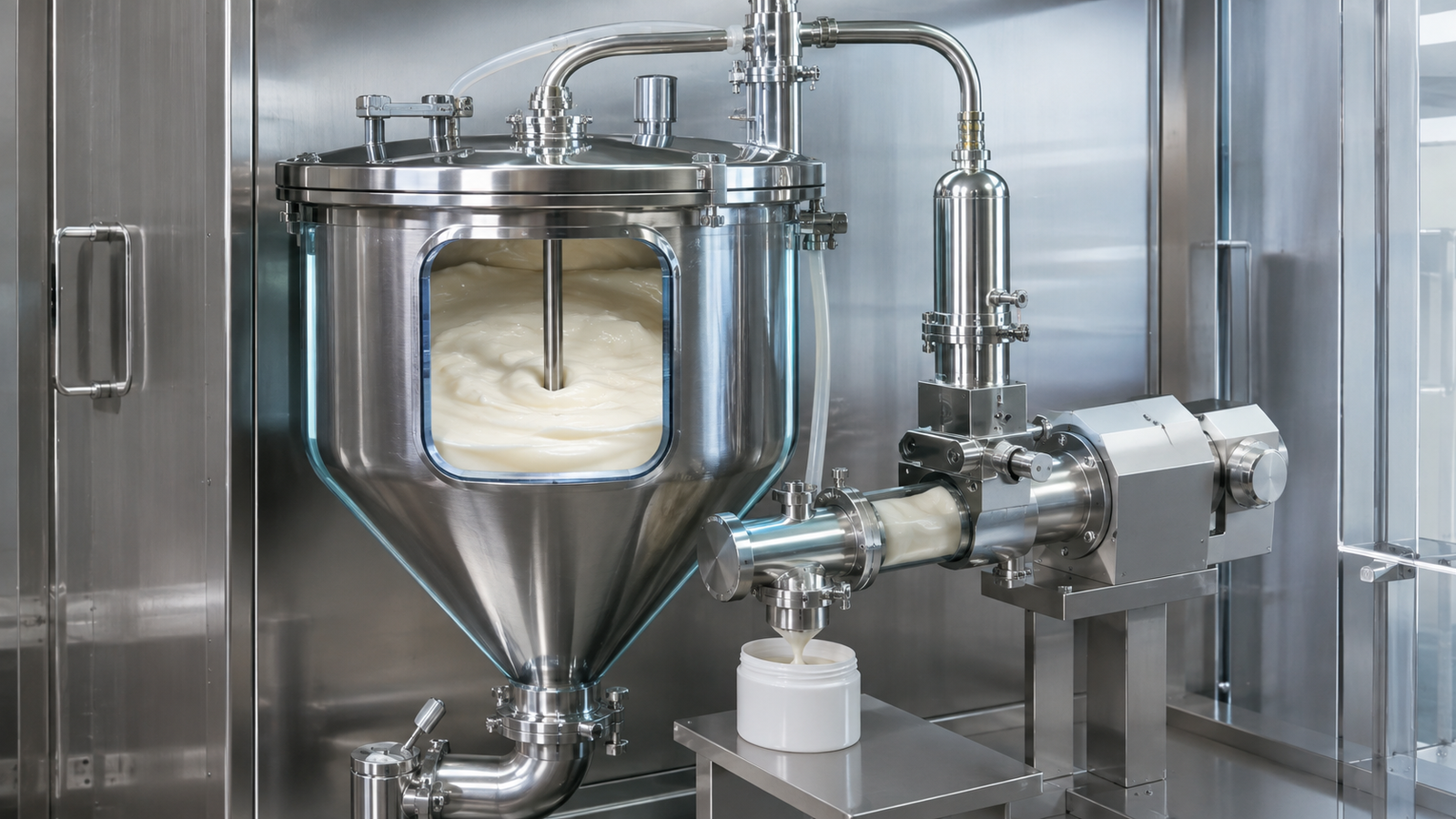
A viscous intramammary product may need positive-displacement dosing, but the label of the pump family does not prove suitability. Review the product-contact chamber, seals, inlet and outlet restrictions, suction behavior, adjustment range and how the system responds when the hopper level changes. Check whether the design can recover product without introducing an uncontrolled manual step.
Ask the supplier to explain the expected pressure path and the reason for the proposed nozzle diameter and valve action. A design that requires excessive pressure can worsen stringing or stress components. A larger opening may reduce restriction but must still fit the applicator and maintain clean cutoff.
The existing KING PACK high-viscosity veterinary gel accuracy guide provides a focused discussion of dose accuracy. This page keeps a separate role by covering the complete intramammary applicator interface.
5 Remove Air at the Source
Direct answer: Prevent air pickup during preparation and transfer before trying to reject bubbles at the end of the line.
Map potential air sources from batch discharge through the transfer pump, hose connections, hopper refill and dosing chamber. Air can enter through vortexing, loose fittings, product falling into the hopper, incomplete priming or an aggressive return path. Thick preparations may retain bubbles long enough for them to affect the filled unit.
If upstream vacuum deaeration is used, confirm that it is compatible with the formulation and approved manufacturing process. At the filler, use a controlled priming method and avoid repeated manual cycling. The first-off procedure should state when the product path is considered stable and how startup units are handled.
Bubble inspection can be visual, gravimetric or based on another validated method, depending on product opacity and package design. Define the method before FAT so the test does not become a subjective discussion after the run.
6 Develop a Clean Nozzle Cutoff
Direct answer: Nozzle cutoff must stop flow without leaving a tail that contaminates the syringe tip, holder or closure area.
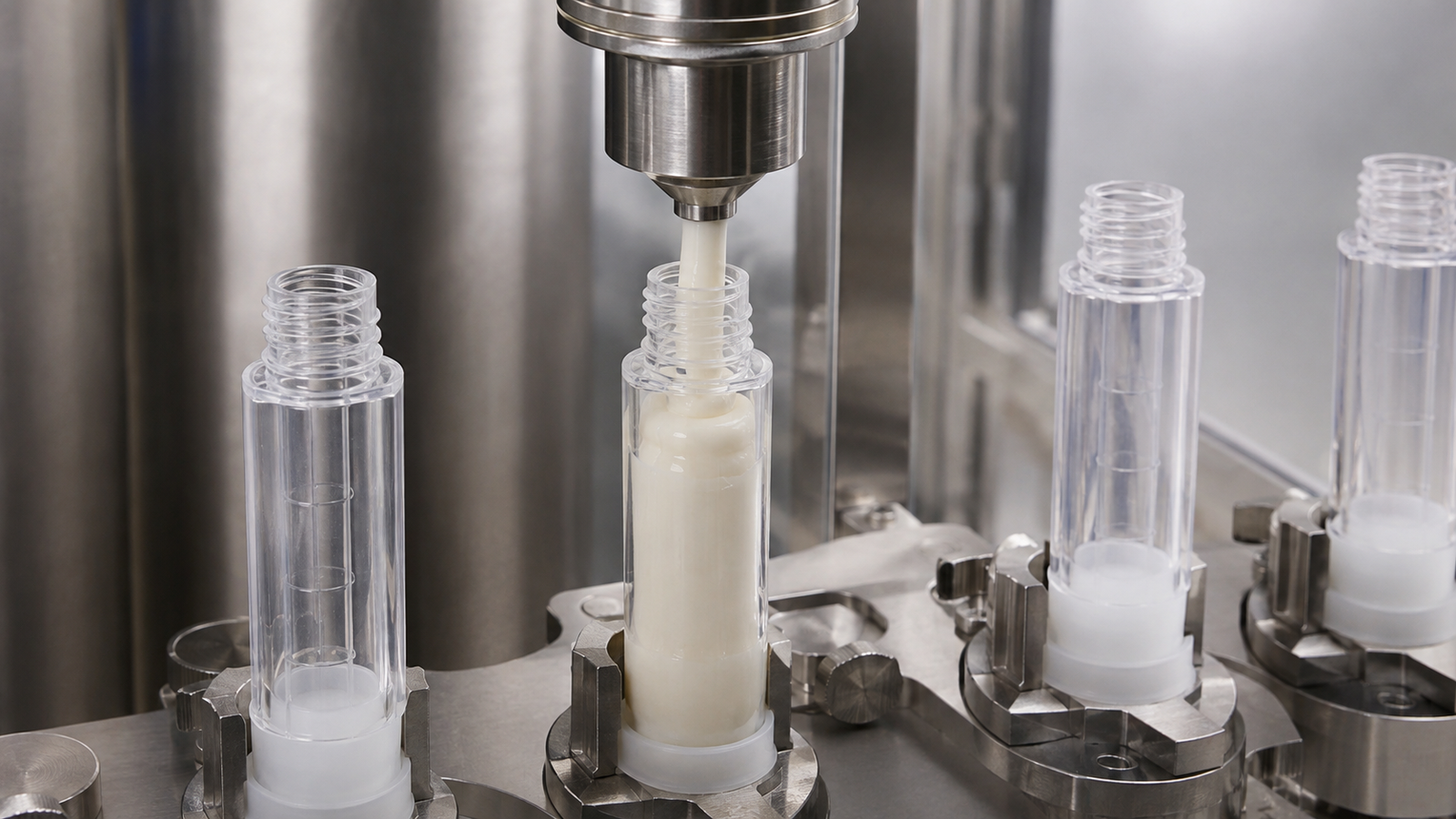
Stringing depends on rheology, temperature, nozzle geometry, closing action, suck-back setting and the distance between nozzle and product surface. Test normal filling, low hopper level, planned stops and restart. A setting that looks clean for the first ten units may behave differently after the nozzle warms or product remains stationary.
Use the shortest effective nozzle travel and verify alignment with the applicator opening. If bottom-up filling is required, synchronize withdrawal with dosing so the nozzle does not trap air or drag product onto the rim. Protect the closure zone from drips and include a defined cleaning response when contamination is detected.
Document the final nozzle, valve or cutoff parts by identification. A change in tip diameter, seal condition or timing can change the result, so these items belong in setup and maintenance records.
7 Hold and Index the Syringe Repeatably
Direct answer: The holder must locate every applicator at the filling and capping stations without distorting the barrel or masking dimensional variation.
Use sample lots that represent the expected dimensional range. Check flange support, barrel orientation, tip position and transfer between stations. If printed or molded orientation matters, define how it is detected and what happens when the mark is missing or ambiguous.
Verify no-syringe-no-fill logic and the response to a misloaded component. Sensors should detect the condition they claim to control under actual material, color and reflectivity. Include manual loading and recovery from a jam in the test protocol.
For buyers comparing layouts, the KING PACK syringe filling machine range provides equipment-family context. Final holder, dosing and capping decisions still depend on the supplied applicator and product.
8 Control Cap Feeding and Placement
Direct answer: Cap placement needs controlled orientation, insertion or tightening force, final position and reject logic suited to the closure design.
Document how caps are fed, separated, presented and transferred to the applicator. Check for scuffing, inversion, double feeding and deformation. The cap path should avoid collecting product and allow cleaning or controlled part replacement when contamination occurs.
Define the measurable result for closure placement. Depending on design, this may include seated height, presence, orientation, insertion force, torque or a package-specific functional test. Do not substitute a cap-present sensor for evidence that the cap is correctly seated.
Challenge missing, inverted and damaged caps during FAT. Verify that rejected units are segregated and counted and that the line response is documented. The site quality system determines whether additional integrity testing is required.

9 Plan In Process Inspection and Reject Handling
Direct answer: Inspection should connect each critical defect to a method, sampling plan and disposition rather than relying on one generic camera claim.
Create a defect list for fill result, bubbles, product on the tip, missing or mispositioned cap, damaged syringe, wrong orientation and coding where applicable. Decide which defects require automatic detection and which are sampled offline. State the limits of visual systems when product or package color reduces contrast.
Trace rejected units to the relevant station and reason. A locked reject bin, reject confirmation and reconciliation may be appropriate depending on the quality system. Confirm that a full bin, sensor failure or removed bin creates the intended machine response.
Use trend data to distinguish isolated packaging variation from process drift. Investigation records should link the unit result to product lot, package lot, recipe, time and any alarm or stop.
10 Define Cleaning and Formula Changeover
Direct answer: Cleaning design must cover every product-contact surface and every place where paste can drip into later operations.
List the hopper, transfer hose, dosing chamber, valves, manifolds, nozzles and removable parts. Separate clean-in-place, clean-out-of-place and manual steps. Review drainability, disassembly access, gasket identification and the risk of reassembling a part incorrectly.
21 CFR 211.65 and 211.67 provide U.S. drug-manufacturing context for suitable equipment construction and written cleaning and maintenance procedures. Applicability depends on product and market, so the manufacturer should translate the relevant requirements into its approved procedure and validation plan.
During changeover studies, include the most difficult product-contact locations and non-contact areas exposed by stringing or splashing. Visual inspection is useful, but the manufacturer defines whether analytical or microbiological evidence is also needed.
11 Write a Product Sample FAT Protocol
Direct answer: A useful FAT proves the agreed equipment functions with representative material and package samples under defined normal and challenge conditions.
The protocol should identify material status, syringe and cap lots, target dose, temperature, hopper operating band, speed range, startup method, planned stops, restart, inspection methods and acceptance criteria. If a surrogate product is necessary, state exactly which risks it does and does not represent.
Collect filled and expelled-dose results, bubble observations, tip cleanliness, cap placement, rejects, alarms and process settings. Include low hopper level and a controlled stop because these conditions often expose feed and cutoff problems that a short steady run misses.
FDA process-validation guidance describes a lifecycle of process design, qualification and continued verification for human and animal drugs. FAT is one useful equipment-evidence step within that lifecycle, not a substitute for site qualification or product validation.
| FAT challenge | Observe | Record |
|---|---|---|
| Startup and priming | Air removal and first acceptable unit | Priming sequence and rejected quantity |
| Normal run | Dose, bubbles, cutoff and cap placement | Settings, sample results and alarms |
| Low hopper level | Feed stability and dose response | Level range and measured results |
| Planned stop and restart | Drip, stringing, air and recovery | Stop duration and restart disposition |
| Missing or damaged closure | Detection, rejection and reconciliation | Challenge result and reject count |
12 Evaluate the Supplier Evidence
Direct answer: Choose a supplier that converts the product and applicator inputs into drawings, a test protocol and traceable acceptance evidence.
Request a tagged product-path drawing, product-contact material list, dosing rationale, holder and capping concept, format-part list, recipe and alarm matrix, layout, utilities, electrical documents, spare-parts list and cleaning boundary. Ask how the proposed design handles startup, stoppage, recovery and end-of-run residuals.
Review the supplier's plan for package samples, representative product, data collection and open actions. Confirm exactly what will be tested at FAT, repeated at SAT and supported through IQ and OQ documentation. Avoid assuming that general machine certification proves product-specific performance.
The KING PACK pharmaceutical and veterinary solution overview can help frame the wider project. The final URS should remain specific to the intramammary product, applicator and market requirements.
13 Review the Application with KING PACK
Direct answer: KING PACK can review intramammary product, syringe and cap inputs to prepare a filling, closure and FAT configuration for technical discussion.
KING PACK Machinery is a China-based manufacturer of pharmaceutical, veterinary, cosmetic and liquid filling and packaging equipment, with core solutions covering tube filling and sealing, vacuum emulsifying, liquid filling, pet spot-on filling and prefilled syringe production systems.
For an intramammary applicator project, the review can cover product transfer, hopper management, dosing principle, nozzle cutoff, syringe holders, cap handling, sensors, rejects, cleaning access and documentation scope. Product specifications, regulatory strategy, analytical methods and final release criteria remain with the manufacturer.
Send the dose range, viscosity versus temperature, batch size, syringe and cap drawings, representative samples, desired output, cleaning concept and test methods through the KING PACK contact page. These inputs allow the sample trial to focus on the actual dose, air, cutoff and closure risks.
Frequently Asked Questions
What is the main selection rule for an intramammary syringe filling machine?
Select from the product's viscosity and air behavior, the required expelled dose, applicator and cap geometry, cleaning boundary and the evidence expected at FAT.
Why should expelled dose be checked?
For unit-dose intramammary products, the amount expelled from the applicator may differ from the amount filled because product can remain in the package. Use the manufacturer's approved method.
Can a catalogue accuracy value prove performance with veterinary paste?
No. Accuracy depends on the product, dose, temperature, feed condition, package and test method. Representative sample trials are required.
How can the line reduce trapped air?
Control upstream deaeration where appropriate, prevent vortexing and air leaks, prime the product path consistently and verify bubble results during startup, normal operation and restart.
What causes product stringing at the syringe tip?
Rheology, temperature, nozzle geometry, shutoff action, suck-back, travel and stop time can all contribute. Test the combined condition with the actual product.
Is cap presence detection enough?
No. Presence detection does not prove correct seating. Define a package-specific result such as height, orientation, force, torque or functional performance.
Which tests belong in FAT?
Include startup, normal running, low hopper level, stop and restart, dose and bubble checks, nozzle cleanliness, cap challenges, reject logic and documented deviations.
Does FAT complete process validation?
No. FAT provides agreed equipment evidence. Site qualification, product validation and continued verification remain part of the manufacturer's quality system.
Updated buyer checklist for an intramammary syringe filling line
Before issuing an RFQ, send the supplier representative product data, syringe and cap samples, the target fill or delivered-dose method, expected batch size, working hours, changeover frequency and cleaning boundary. Ask the supplier to return the proposed process sequence, product-contact parts, utility list, format-parts list, sample-testing plan, FAT protocol, documentation package and open assumptions.
| Review point | Evidence to request before purchase |
|---|---|
| Product and dose | Representative product trial, fill-weight method and expelled-dose method |
| Air and viscosity | Temperature window, hopper strategy, bubble inspection and restart observations |
| Applicator package | Barrel, tip, cap and plunger samples tested across stated tolerances |
| Cleaning and changeover | Removable-parts list, cleaning access, changeover steps and verification points |
| Acceptance | FAT sample size, operating conditions, deviations and document handover |
For a related purchasing framework, see How to Choose an Intramammary Syringe Filling Machine and the Intramammary Filling Line URS and FAT Checklist. For a project quotation, send your product and package requirements to King Pack so the filling and closing boundary can be reviewed together.
FAQ: practical questions before equipment selection
Can a catalogue speed prove an intramammary line is suitable?
No. Speed must be tied to the actual formulation, applicator format, component presentation, inspection and changeover assumptions. Confirm the condition in a sample trial or FAT.
Should fill weight or expelled dose be the main acceptance test?
Use the approved product and package test method. Fill weight controls the machine process, while expelled dose may verify the user-facing unit-dose performance. The relationship should be defined in the project quality plan.
What should be checked during shipment inspection?
Check the packing list, product-contact parts, loose format parts, manuals, spare parts, protected surfaces and visible machine condition. Reconcile the shipment against the agreed FAT punch list before installation.
Need a practical review? Send the formulation description, applicator drawings or samples, target dose, cap or plunger sequence and required evidence. King Pack can use those inputs to define a testable filling and closing concept.