
Introduction
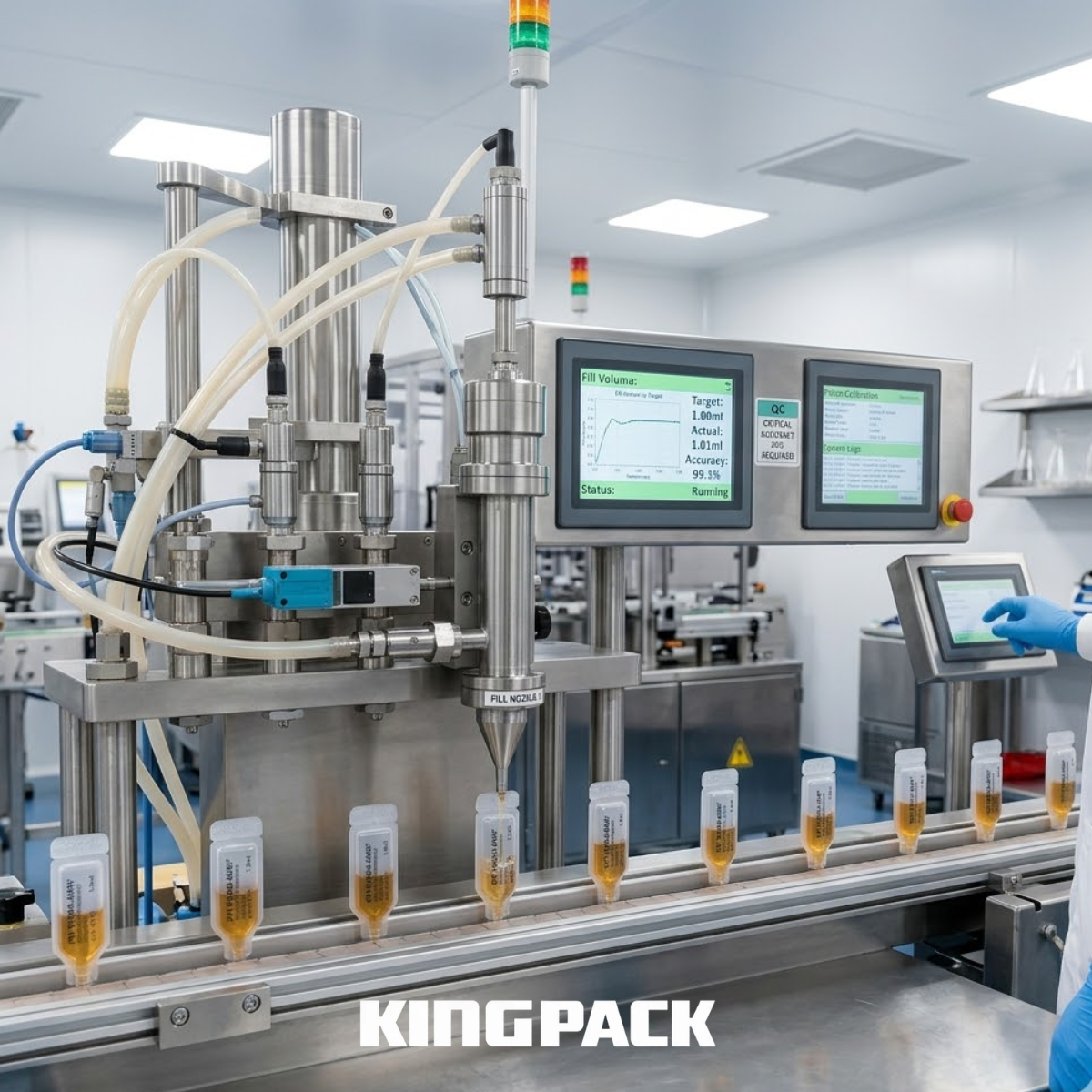
For veterinary pharmaceutical manufacturers, filling accuracy is not a production detail. It is the foundation of product safety, regulatory compliance, and profitability. In spot-on and deworming production, where fill volumes are small and active ingredients are expensive, a deviation of even a few microliters per unit carries real financial and clinical consequences.
In this article, we will explain why ±1% filling accuracy is the accepted industry standard for pet antiparasitic production, what happens when that standard is not met, and how the right pet deworming filling machine and pet spot-on filling machine design achieves it consistently at production speed.
Understanding Pet Deworming and Spot-On Treatments
What is “Pet Spot on Filling Machine”?
A pet spot-on filling machine is specialized equipment used to fill small, single-dose topical treatments into pipettes or similar containers. These treatments are applied to an animal’s skin and release a measured amount of active ingredient over a set period.
The machine controls the exact fill volume in each unit. That control defines how much active ingredient the animal receives, since dosing is based on body weight. Even a small variation in volume can affect treatment results, so the system is designed to deliver high accuracy and repeatability across every cycle.
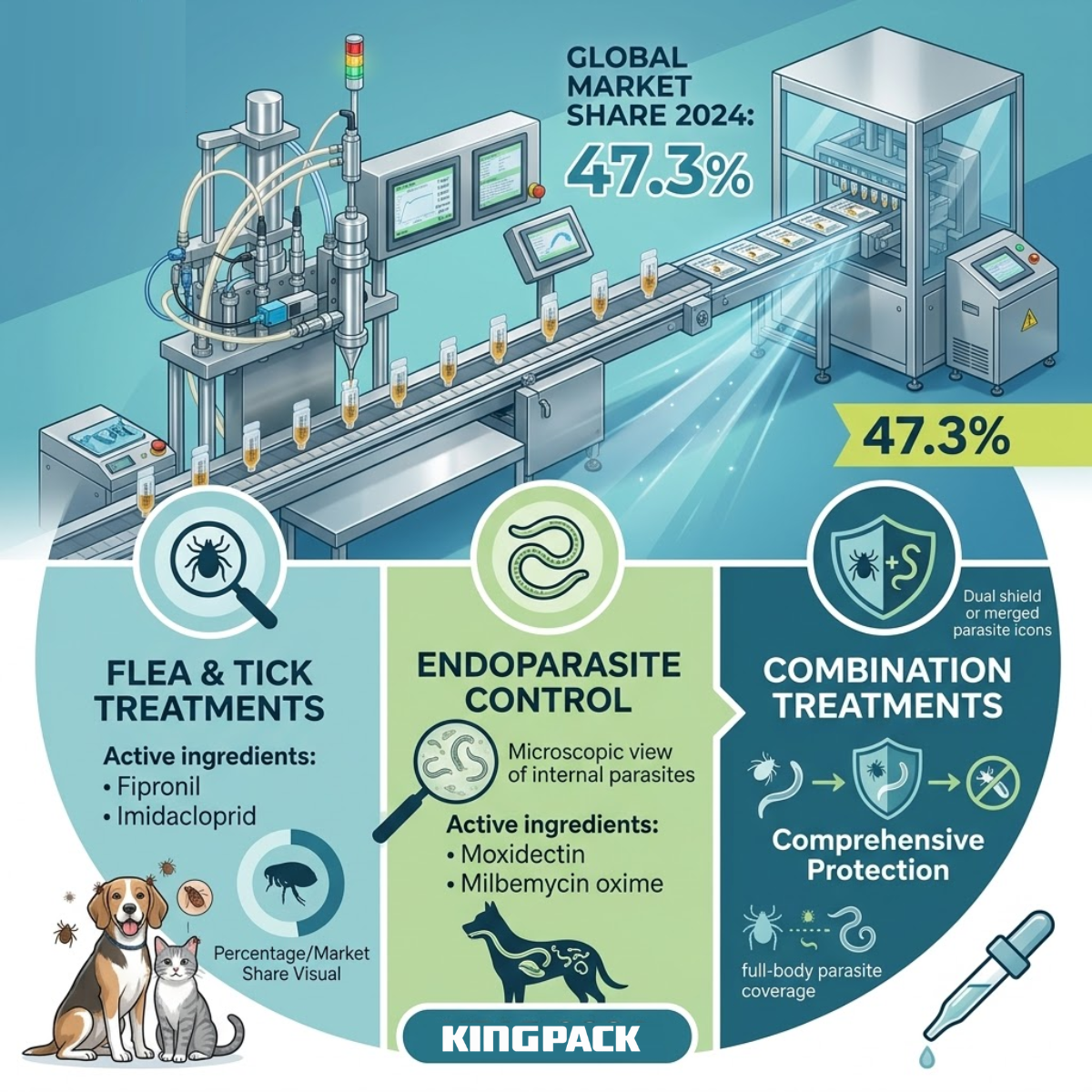
According to Mordor Intelligence’s veterinary parasiticides market report, topical spot-ons accounted for 47.3% of the veterinary parasiticides market by mode of administration in 2024. That share represents a substantial production volume, and every unit in that volume must be filled to specification.
The three main product categories that run on a spot-on treatment filling line are topical flea and tick treatments using active ingredients like fipronil or imidacloprid, endoparasite control solutions targeting internal worms, and combination antiparasitic formulations covering both internal and external parasite categories simultaneously.
Typical Filling Volumes in Veterinary Spot-On Packaging & Filling Process
Spot-on products are sized by animal weight. A product for a 2 kg kitten carries a different fill volume and active ingredient load than one for a 40 kg dog. The fill volume is the primary dosing control, which means accuracy at the filling stage is the accuracy of the dose delivered to the animal.
| Animal Category | Typical Fill Volume | Packaging Format |
| Small cats and kittens | 0.3 ml to 0.5 ml | Single-dose plastic pipette |
| Medium cats and small dogs | 0.5 ml to 1.0 ml | Single-dose plastic pipette |
| Medium to large dogs | 1.5 ml to 4.0 ml | Single-dose plastic pipette or ampoule |
| Multi-dose deworming | Up to 5.0 ml | Plastic ampoule |
Every one of these formats is small. The smaller the fill volume, the larger the proportional impact of any deviation. A 0.05 ml deviation on a 0.5 ml fill is a 10% error. On a 5.0 ml fill, the same 0.05 ml deviation is 1%. The filling mechanism must be precise enough to hold ±1% across the entire volume range the line produces.
Recommended Reading: How to Achieve ±1% Filling Accuracy for High-Value Pet Spot-on Treatments – King Pack Machinery
The High Cost of Inaccurate Filling in Pet Antiparasitic Production
Overfilling and Expensive API Waste
Active ingredients in veterinary antiparasitic formulations are specialty chemicals with high synthesis cost. In a pet spot on filling machine, the filling process must maintain a consistent flow under stable ambient temperature and controlled environment. Fipronil, imidacloprid, selamectin, and similar compounds are priced at levels where a small overfill creates direct loss.
Consider a production run of 500,000 units on automated machinery using a precision filler. A consistent 0.05 ml overfill across that run means 25,000 ml of formulation above the label claim, with no added revenue and no clinical value. For a formulation valued at $400 per liter, that run carries $10,000 in avoidable loss. Poor control of filling speeds or unstable air pressure inside the system often drives this deviation.
At high filling speeds on a modern beverage-style filler adapted for veterinary use, this loss builds across batches. The result is rising product loss tied directly to poor process control.
Underfilling and Dosage Compliance Risk
Underfilling brings a different risk. When a pipette or bottle carries less active ingredient than stated, the dose drops below target. The animal receives less protection, and parasite control weakens before the stated period ends.
Stable forming of each dose depends on precise filling speeds, controlled air displacement, and a well-calibrated filler. Any drift in the environment or ambient temperature affects viscosity and flow, which leads to variation inside each bottle.
According to Mordor Intelligence, surveillance data shows that pour-on dewormers failed to meet 90% efficacy on 76.5% of tested farms. This reflects what happens when dosing accuracy breaks down across production. Filling precision is one upstream factor.
There is also a regulatory impact. Many export markets require strict batch accuracy. Inconsistent fills across each bottle create compliance risk. That risk can lead to recalls, blocked shipments, and loss of approvals.
Market Reputation and Veterinary Trust
Veterinarians rely on fixed-dose performance from each bottle. If results vary due to poor fill control, trust declines over time. Once confidence drops, recovery is slow.
Modern machinery development now focuses on cleaner environment control, better hygienic conditions, and more stable filler calibration. These upgrades are essential for maintaining uniform output. A system that keeps a steady consistent flow, controlled air, and accurate filling speeds supports reliable dosing.
According to Precedence Research’s veterinary parasiticides analysis, the global veterinary parasiticides market was valued at USD 12.94 billion in 2024 and is projected to reach USD 21.77 billion by 2034. Manufacturers competing for a share of that market cannot afford the brand damage that comes from inconsistent product performance driven by filling inaccuracy.
Recommended Reading: Explosion-Proof Requirements for Pet External Sprays: Safe Filling for Alcohol-Based Formulations – King Pack – King Pack Machinery
Why ±1% Accuracy Is the Industry Standard for Veterinary Filling
Weight-Based Dosing Accuracy & Consistent Flow
Spot-on dosage is expressed as milligrams of active ingredient per kilogram of body weight. A 1.0 ml pipette for a 5 kg cat carries a specific API load calculated for that animal weight category. A ±1% tolerance on 1.0 ml allows a measured deviation of ±0.01 ml, which translates to a proportional difference in the active ingredient delivered.
At larger fill volumes the absolute deviation is slightly larger but remains clinically acceptable. At smaller volumes, each microliter matters more. The ±1% standard holds this balance across the full range of spot-on formats.
GMP and Veterinary Regulatory Compliance
GMP guidelines for veterinary pharmaceuticals require that individual units within a batch meet the label claim, not just the batch average. A filling machine producing units at ±3% accuracy will generate individual units that fall outside label claim tolerance even if the batch mean is correct.
Regulatory inspections in EU, US, and major Asian export markets routinely examine filling validation records as part of batch release review. Demonstrating ±1% accuracy through documented in-process control data is the threshold that satisfies most inspection frameworks.
Equipment capable of consistent performance at this tolerance, equipped with real-time monitoring, makes that documentation possible at every production stage.
Stable Clinical Performance & Filling Speed
Consistent fill volume across every unit in a batch means consistent active ingredient delivery to every animal treated. This predictability supports post-market surveillance, adverse event investigation, and the efficacy claims submitted during product registration.
It also protects the manufacturer’s image when clinical performance is questioned in a regulatory context. Hygiene at every product contact point remains essential to maintaining that performance record without contamination introducing a compounding variable.
Technical Challenges in Pet Deworming Filling
Micro-Volume Precision
At fill volumes between 0.3 ml and 2 ml, the physics of liquid dispensing create challenges that do not exist at larger volumes. Surface tension, droplet formation at the nozzle tip, and minor pressure variation in the supply pipeline all have proportionally larger effects on a 0.5 ml fill than on a 50 ml fill.
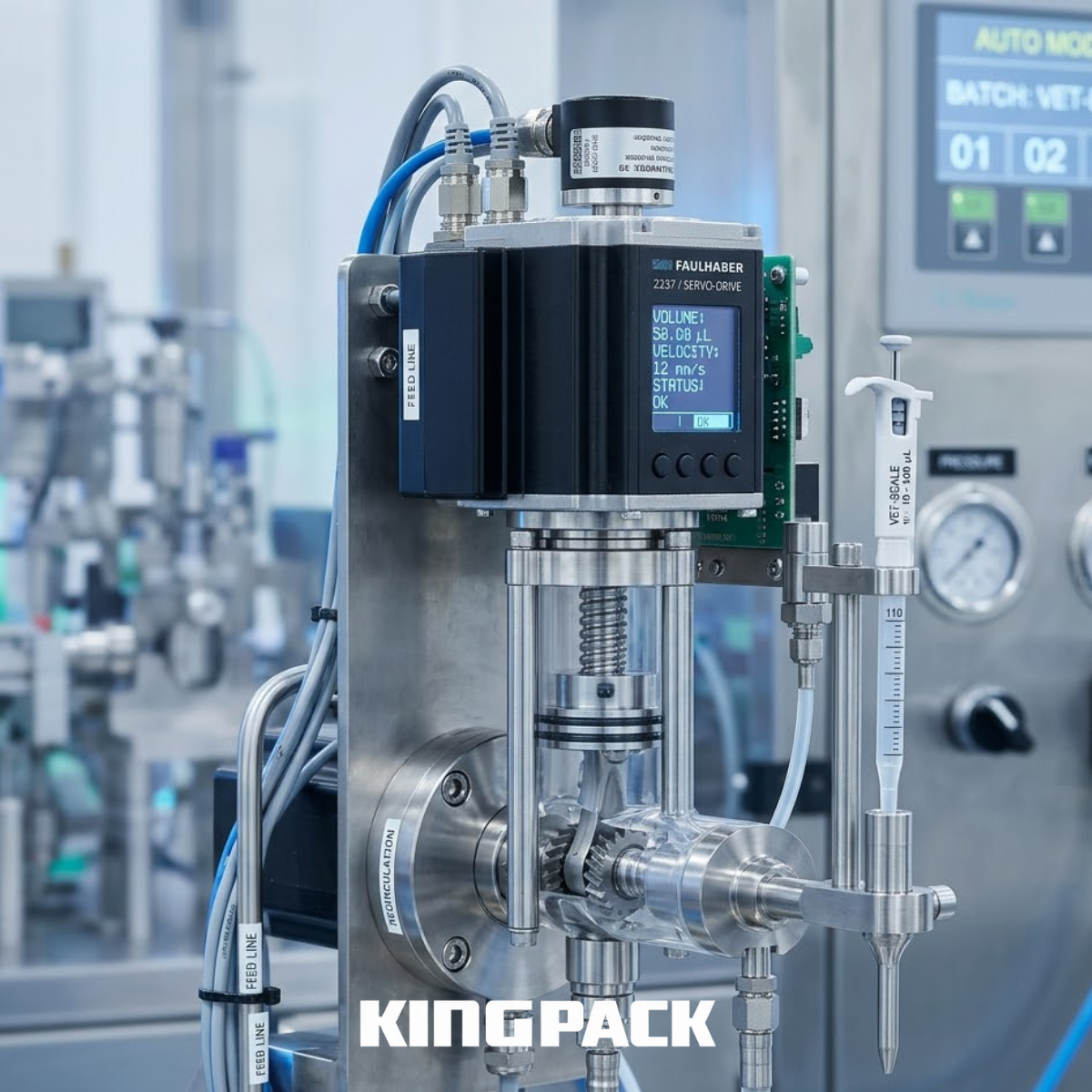
A servo-controlled piston filling system addresses this by controlling fill volume through physical displacement rather than time or pressure. The piston stroke is set digitally and executed with the same precision on every cycle, regardless of fill volume. A compact table-top configuration can deliver this level of control in facilities where floor space constrains machinery selection.
Oil-Based and Viscous Formulations
Most antiparasitic spot-on formulations use oil-based carrier solvents. These liquids are more viscous than water, temperature-sensitive, and prone to stringing at the nozzle after each fill cycle. Without anti-drip nozzle design and positive shut-off mechanisms, nozzle residue introduces fill-to-fill variability that standard filling equipment cannot control.
Gravity-fed systems with dedicated mixer integration help maintain a consistent product feed under these conditions, supporting both accuracy and sustainability targets by reducing formulation waste per production run.
Lightweight Plastic Pipette Handling
Spot-on pipettes are thin-walled and light. They deform under mechanical pressure. Their positioning at the fill station directly affects where the nozzle delivers the liquid and how completely the fill volume enters the container. The filling machine must position each pipette precisely and fill it without exerting deforming pressure, at production speed.
How High-Precision Veterinary Filling Machines Achieve ±1%
Servo-Controlled Piston Filling System
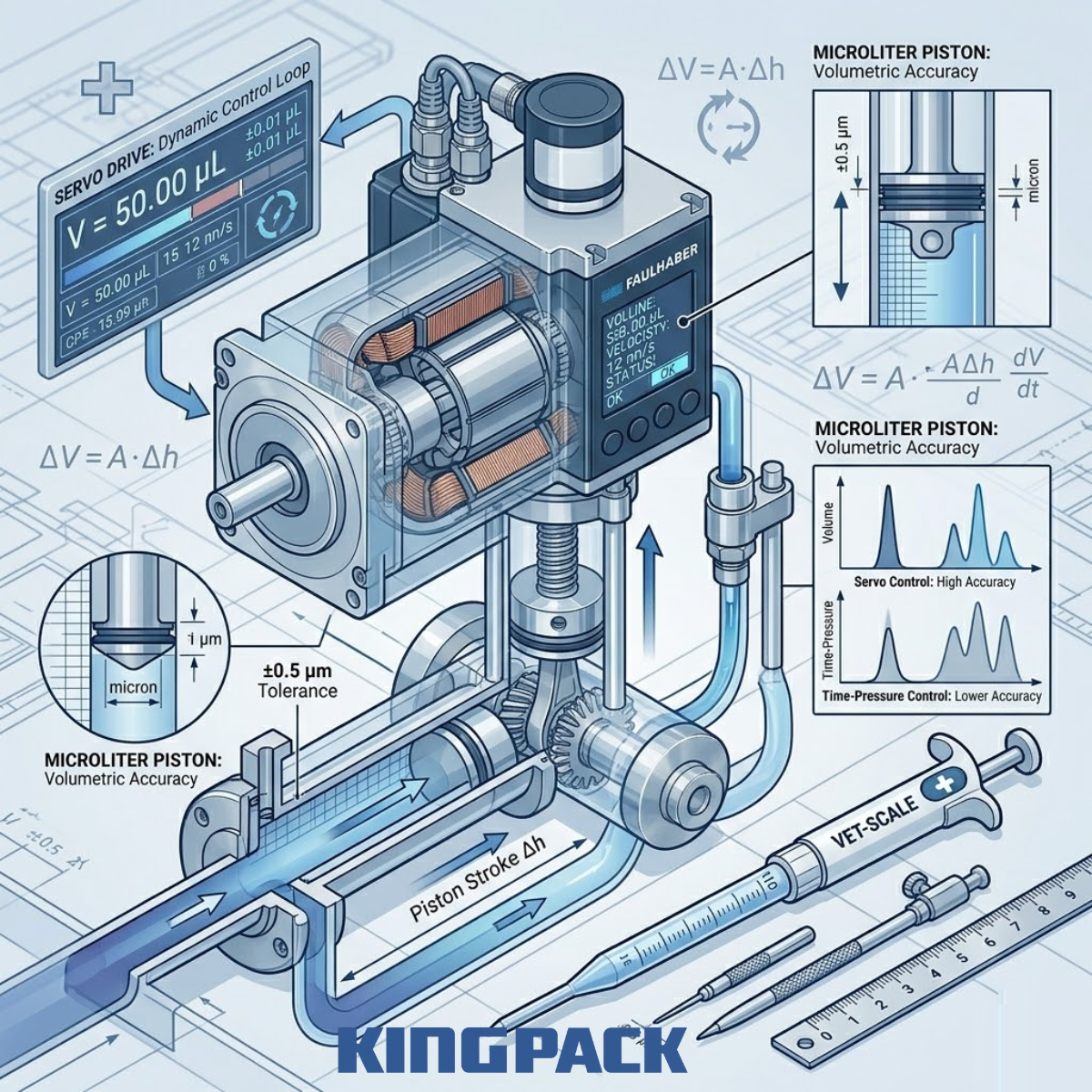
The servo-driven piston mechanism is the correct filling technology for small-volume veterinary liquid dosing. It operates on positive displacement: the piston physically sweeps through the cylinder and pushes a defined volume of liquid into the container. The fill volume is set as a digital parameter, controlled by a high-resolution servo motor, and repeatable to within fractions of a microliter on every cycle.
This is fundamentally different from time-pressure filling, where volume is inferred from how long a valve stays open at a given supply pressure. Time-pressure systems are sensitive to viscosity variation, temperature change, and supply pressure fluctuation. Servo piston systems are not, because the volume is mechanically defined, not inferred.
For a pet deworming filling machine or spot-on filling machine handling oil-based formulations at sub-milliliter volumes, servo precision is the only mechanism that reliably holds ±1% across a full production shift.
According to Grand View Research’s pharmaceutical filling equipment analysis, servo-driven filling systems are increasingly the technology of choice for high-value pharmaceutical and veterinary liquid production, where dosing accuracy directly affects both product safety and manufacturing profitability.
No-Drip Filling Nozzle Design
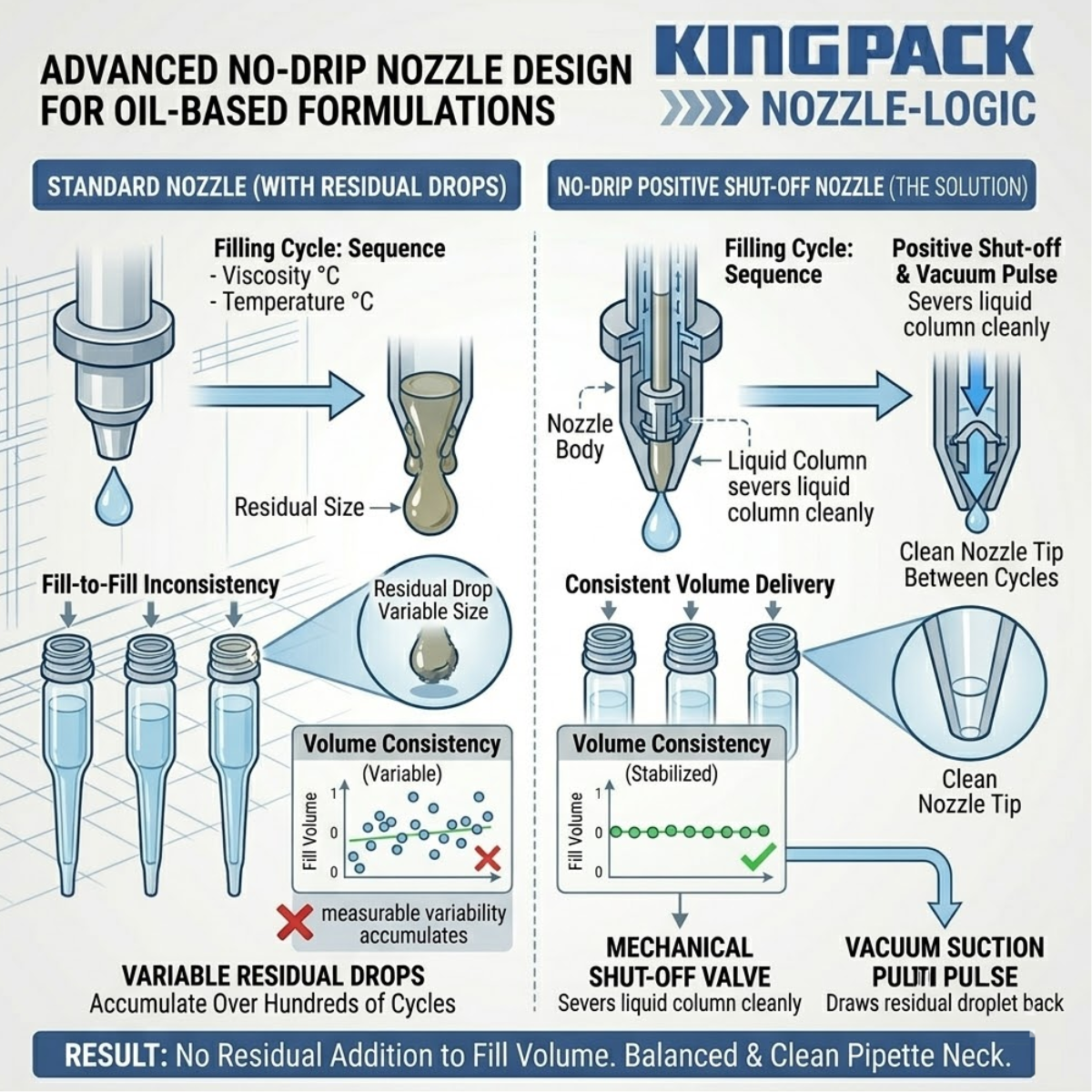
Our no-drip nozzle design for oil-based liquid filling uses a mechanical positive shut-off valve that severs the liquid column cleanly at the end of each fill stroke. A vacuum suction pulse draws the residual droplet back into the nozzle body rather than letting it fall into the pipette as an uncontrolled addition to the fill volume.
The result is a clean nozzle tip between cycles, a clean pipette neck, and consistent volume delivery from the first fill of the shift to the last.
Real-Time PLC Control and Volume Calibration
A veterinary liquid filling machine running multiple spot-on SKUs across a production week needs digital parameter management. Each product SKU carries its own fill volume, fill speed, capping torque, and inspection thresholds. Reconfiguring these parameters manually between products introduces human error and extends changeover time.
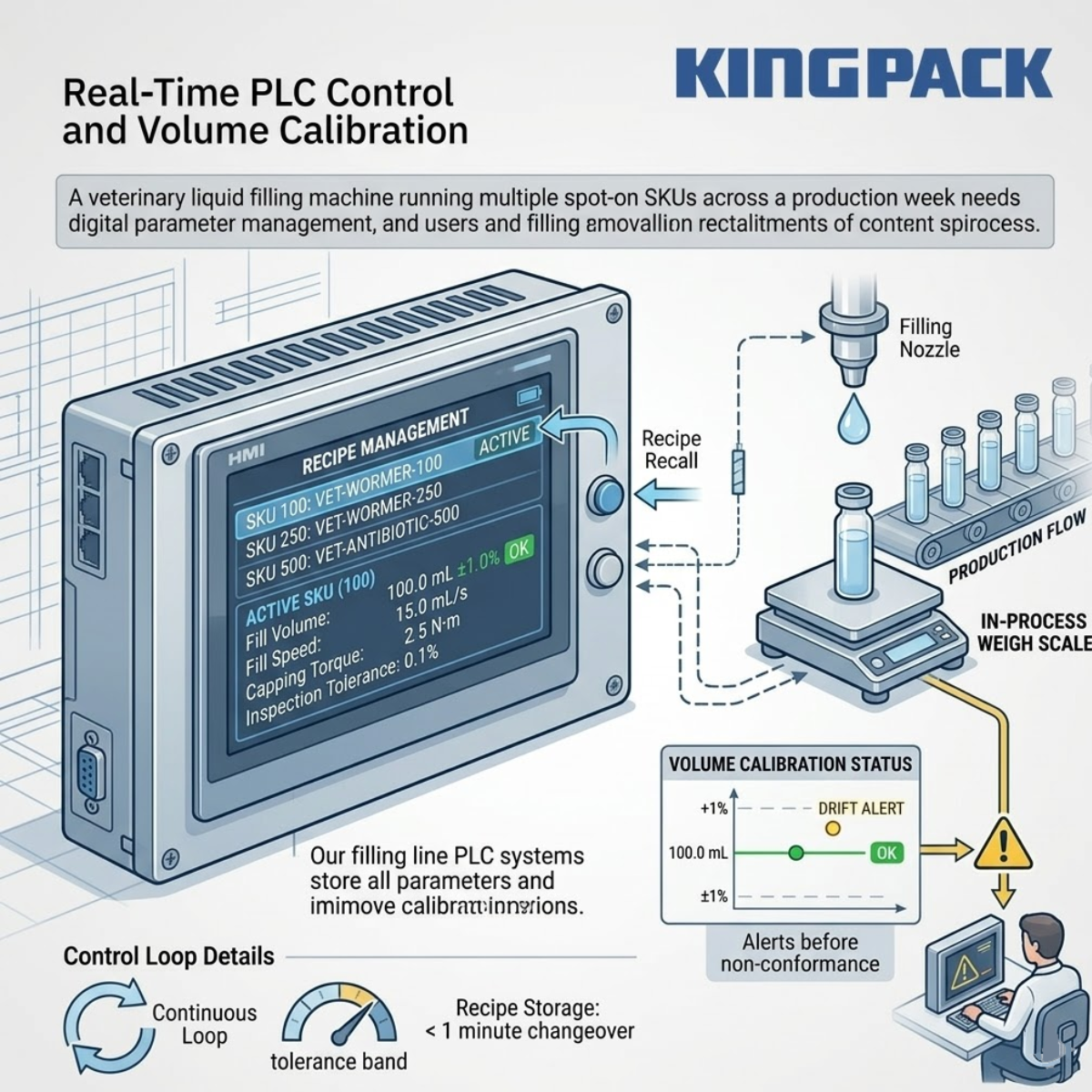
Our filling line PLC systems store all parameters for each SKU as named product recipes. When a new SKU is scheduled, the operator recalls the recipe through the HMI. All parameters update simultaneously. The line is ready to run the new format immediately after the physical tooling change is complete.
Real-time volume calibration during production uses in-process weight checks at defined intervals to verify that the delivered volume stays within the ±1% tolerance window throughout the batch. If volume drifts toward the tolerance limit, the PLC alerts the operator before non-conforming units accumulate.
Integration with Automatic Capping and Sealing
A precisely filled pipette that receives a poorly applied cap creates a secondary dosing problem. Evaporation through an inadequate seal reduces the active ingredient concentration in the container over time. Contamination through a compromised seal affects product safety.
Our spot-on treatment filling line configurations integrate filling with automatic capping and sealing in a single continuous process. The pipette moves from the fill station to the capping station without manual handling. Cap application is servo-controlled at a defined torque. Seal integrity is verified inline before the unit exits the line.
This integration also reduces the number of manual intervention points in the sterile zone, which directly lowers the contamination and handling damage risk between fill and final seal.
ROI Benefits for Pet Antiparasitic Manufacturers
Reduced Active Ingredient Loss
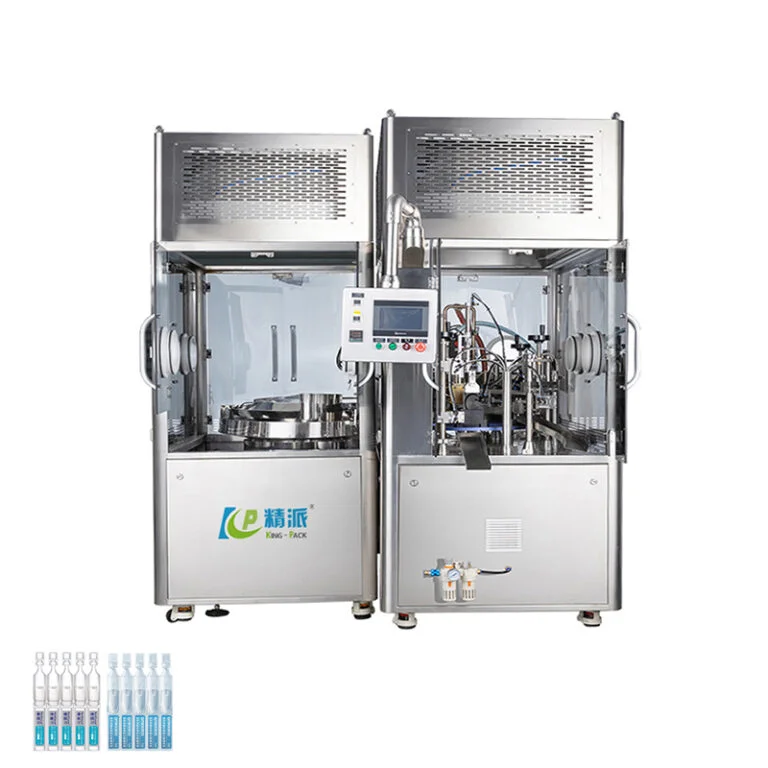
KPGFW-RC150 Single-Dose Filling Machine – King Pack Machinery
The most immediate financial return from upgrading to a precision pet antiparasitic filling system is the reduction in API waste. A filling machine consistently holding ±1% accuracy does not need to overfill to compensate for variability at the lower end of its tolerance range. The fill volume stays close to the label claim, and the recovered API value accumulates across every batch.
According to Pharma Manufacturing’s production efficiency analysis, reducing filling deviation from ±3% to ±1% on high-value pharmaceutical formulations typically recovers between $15,000 and $80,000 in annual API costs depending on formulation value and production volume, with the recovery increasing proportionally as production scale grows.
Lower Rejection Rate
Batches rejected for fill volume non-conformance carry two costs. The direct cost covers destroyed product, wasted API, and lost production time. The indirect cost covers the investigation, the corrective action documentation, and the regulatory exposure of a non-conforming batch record. Both costs disappear when the filling machine holds ±1% consistently across every batch.
Higher Production Stability
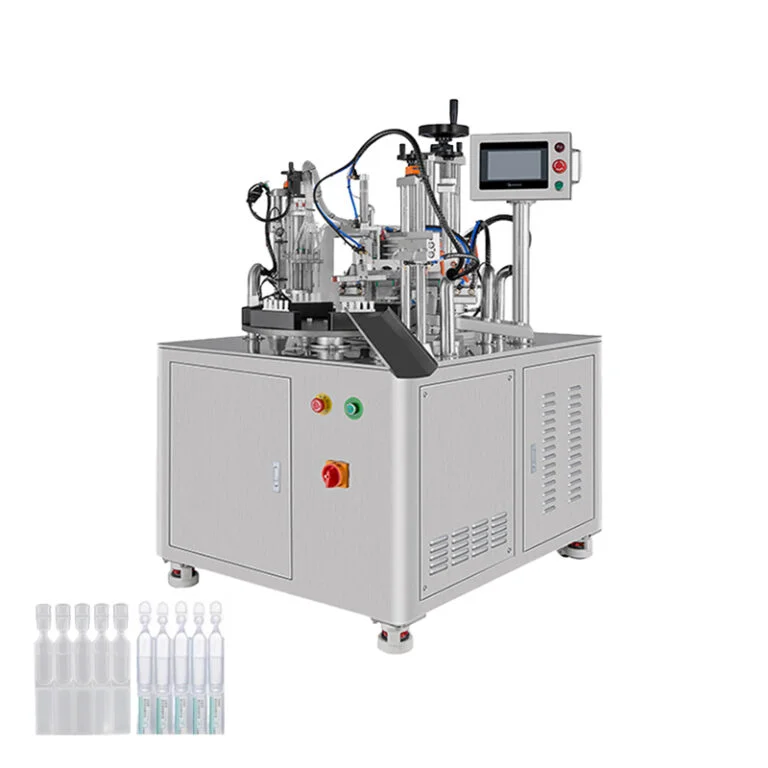
KPHX-50 secondary casting filling machine – King Pack Machinery
A servo-driven automatic veterinary filling line running at consistent accuracy does not require frequent mid-run recalibration. Operators spend less time pulling samples and adjusting parameters. The line runs longer between interventions, and that run time converts directly to output. For manufacturers running multiple shifts, even a 15-minute reduction in recalibration frequency per shift adds meaningful production capacity per week.
Faster Return on Investment
According to DEVELOP LLC’s manufacturing automation ROI analysis, precision filling equipment investments in pharmaceutical and veterinary production typically return to zero within 12 to 24 months through combined savings from reduced API waste, lower rejection rates, and decreased manual intervention costs.
The combination of recovered API, reduced rejection, and higher line efficiency creates a compounding return that accelerates as production volume grows.
Recommended Reading: Cross-Contamination Prevention: The Gold Standard for Multi-Formula Pet Drop Production – King Pack – King Pack Machinery
How to Choose the Right Pet Deworming Filling Machine
Accuracy Testing Standards
Request documented fill accuracy test data before committing to any filling machine purchase. The data must cover the actual fill volume you intend to run, at the actual production speed you intend to operate, using a liquid of equivalent viscosity to your formulation. Accuracy figures demonstrated at slow speed with water do not translate to accuracy at production speed with an oil-based antiparasitic solvent.
The test sample size must be statistically meaningful. A 30-unit test at slow speed is not an adequate demonstration of ±1% capability on a line that will produce 6,000 units per hour.
Compatibility with Pipette and Plastic Ampoule Formats
Spot-on pipettes vary in neck diameter, wall thickness, base geometry, and cap type across different packaging suppliers. A pipette filling machine that handles one supplier’s pipette format precisely may perform poorly with a nominally identical pipette from a different supplier.
Before purchasing, verify format compatibility with your current pipette specifications and confirm that the machine can accommodate at least one alternative supplier’s format, in case your packaging source changes. Also confirm the fill volume range the machine can cover with a single set of wetted components, and the volume range that requires component changes.
Ease of Cleaning and Changeover
Antiparasitic oil-based solvents leave residue on every internal surface. A filling machine with threaded connections, inaccessible internal cavities, and components that require tools to remove will accumulate residue between batches, creating both cross-contamination risk and extended cleaning time.
Our filling head designs at King Pack use tri-clamp connections throughout the wetted pathway, tool-free component removal, and electropolished internal surfaces that do not retain oil residue. Cleaning validation for our spot-on filling machine configurations is straightforward because every wetted surface is accessible and verifiable.
Expandability for Future Product Lines
A veterinary pharmaceutical manufacturer’s product portfolio rarely stays static. Oral dewormers, ear drops, ophthalmic formulations, and injectable products all share the small-volume, high-accuracy requirement of spot-on treatments. A filling platform that supports multiple nozzle configurations, fill volume ranges, and container formats gives a manufacturer the flexibility to add product lines without a proportional increase in capital expenditure.
Our modular filling line architecture at King Pack allows additional modules to be added to an existing filling core, covering new container formats and fill volumes without replacing the servo dosing system or the PLC infrastructure.
Recommended Reading: No More Overflow: Bottom-Up Filling Technology for High-Foam – King Pack Machinery
Why King Pack Is a Reliable Partner for Veterinary Filling Solutions
At King Pack, we have over 20 years of experience building precision liquid filling equipment for pharmaceutical and veterinary production. Our veterinary liquid filling machine configurations for spot-on and deworming production are engineered specifically for the small-volume, high-accuracy, oil-based formulation requirements of this product category.
Our commitment to veterinary manufacturers covers five specific areas:
- ±1% or better filling accuracy, validated at production speed with oil-based test liquids that represent actual spot-on formulation viscosity
- Servo-driven piston dosing systems covering 0.3 ml to 5 ml fill volumes across all standard spot-on pipette and plastic ampoule formats
- Anti-drip nozzle design with mechanical positive shut-off and vacuum suction cut-off, validated for oil-based solvent behavior
- Full GMP-compliant design with 316L stainless steel wetted parts, electropolished internal surfaces, and tool-free disassembly for cleaning validation
- Modular filling line architecture that integrates filling, capping, sealing, and inspection in a single continuous automated process
We work with veterinary manufacturers at the project planning stage to review fill volume requirements, formulation viscosity, packaging format specifications, and production throughput targets before specifying any equipment. This front-end engineering investment ensures that the filling line we deliver matches the production requirement precisely, rather than requiring adaptation after installation.
Contact King Pack to discuss your spot-on or deworming filling requirements and receive a technical consultation tailored to your production needs.