
Introduction
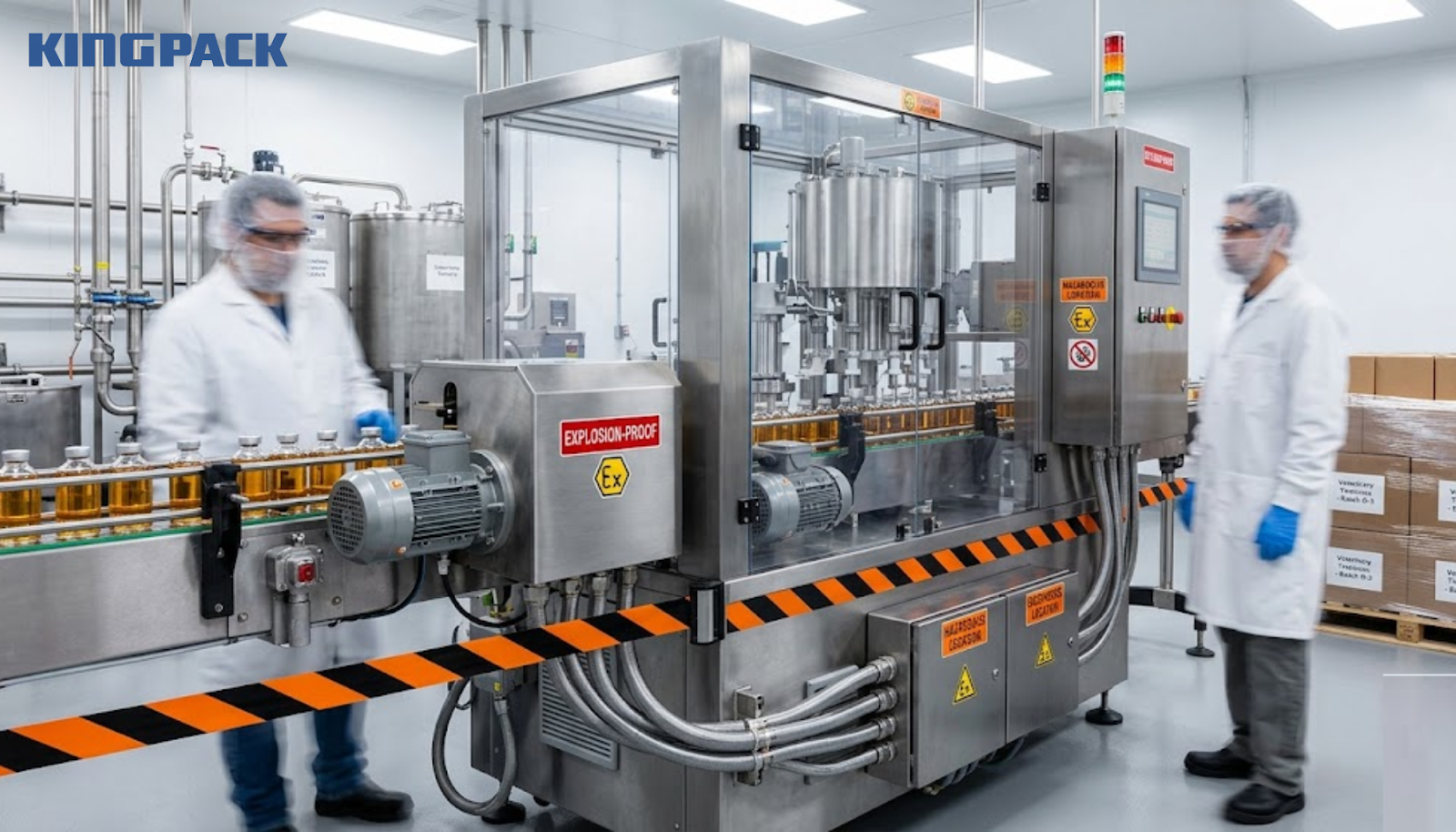
Alcohol-based veterinary formulations for pet medicine filling line occupy a specific and serious position in pharmaceutical manufacturing. Ethanol, isopropyl alcohol, and solvent-based antiparasitic carriers all carry meaningful ignition risk during the filling process. Without a properly designed explosion-proof filling system, that risk is present in every production shift.
In this article, we cover how to design and operate a safe filling line for flammable veterinary drug filling. We explain the hazardous area classification requirements and specific needs, the ATEX compliant filling line components that eliminate ignition sources, and the grounding and ventilation strategies that keep alcohol-based veterinary formulations contained and controlled throughout production.
Why Explosion-Proof Design Is Critical in Veterinary Alcohol-Based Production
Common Alcohol-Based Veterinary Products
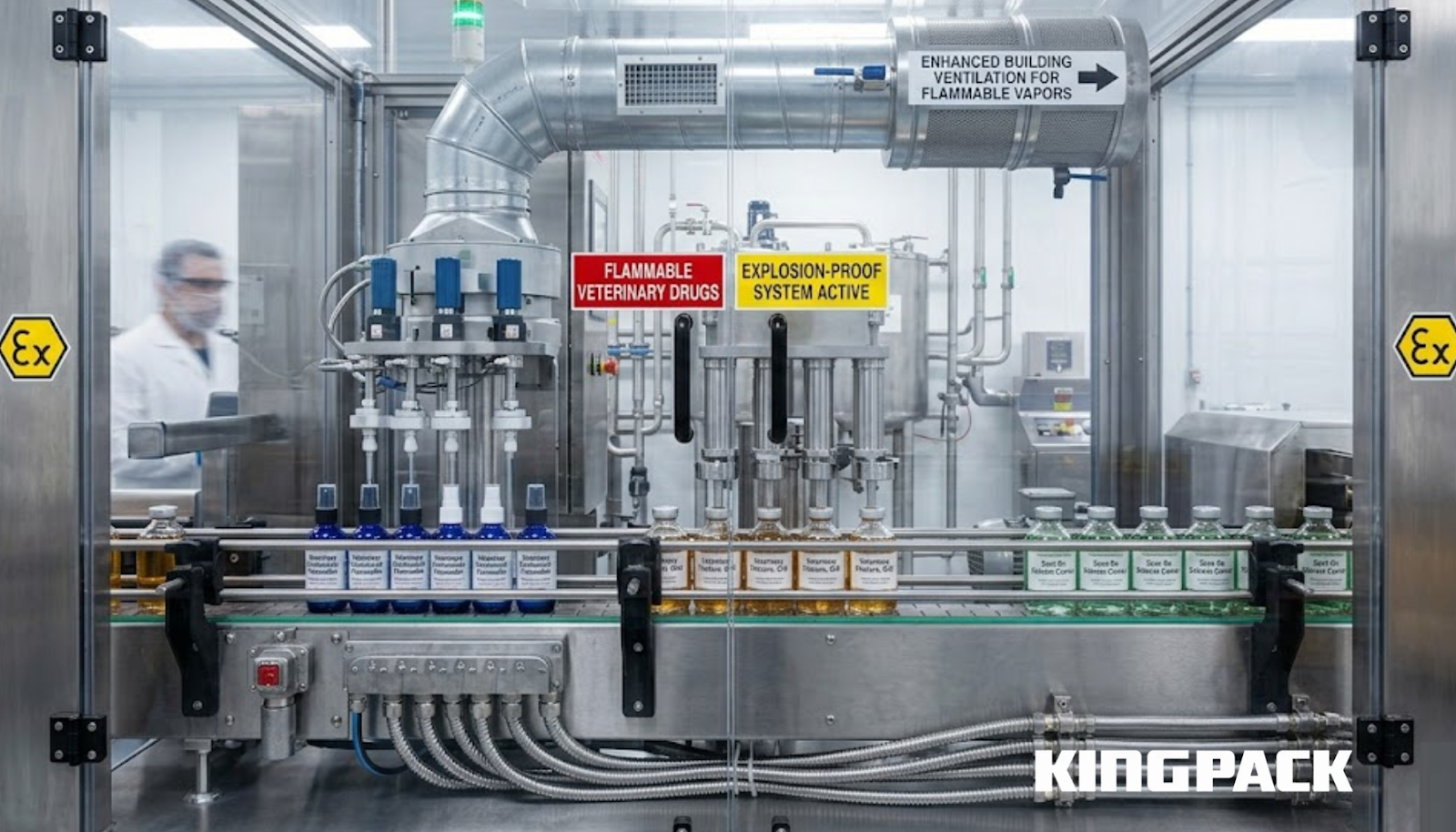
A wide range of veterinary products rely on alcohol as a primary solvent, carrier, or active component:
- Alcohol-based disinfectant sprays for wound care, skin preparation, and surgical site preparation
- Ethanol-based topical antiseptic solutions applied to skin and mucous membranes
- Solvent-based spot-on treatments using isopropyl myristate or similar alcohol-derived carriers
- Tinctures and oral veterinary preparations using ethanol as the extraction solvent
Each product requires a flammable liquid filling machine and a carefully controlled production line. The filling machine, capping equipment, labeling machines, electrical systems, and facility ventilation all influence the explosion risk once alcohol enters the fill zone.
Flash Points, Vapor Formation and Ignition Risks
Ethanol has a flash point around 13°C, while pure isopropyl alcohol (IPA) forms flammable atmospheres in air at 12°C. Under normal production temperatures, both generate vapor continuously. Even without visible spills, open containers, dripping nozzles, or partially sealed glass bottles can create explosive atmospheres at the fill point.
Proper ventilation in reactors, distillation units, coating equipment, and automatic labeling machines is essential. The fill zone of liquid fillers is a constant vapor source and must be treated as a hazardous area.
Consequences of Improper Hazard Control in Automatic Filling Machines
Ignition in a flammable liquid environment can result from static discharge, ungrounded containers, or standard motors lacking explosion-proof design. Any of these, in the presence of alcohol vapor above the lower explosive limit, may trigger a catastrophic event.
A tragic industrial accident in Scotland, caused by leaking gas and triggered by a simple switch, killed nine workers and injured 40. Though it involved gas, the ignition mechanism mirrors what can occur in poorly designed alcohol filling operations using semi automatic or specifically designed positive displacement fillers.
Recommended Reading: Explosion-Proof Requirements for Pet External Sprays: Safe Filling for Alcohol-Based Formulations – King Pack – King Pack Machinery
Understanding Hazardous Area Classification
Zone 0, Zone 1, and Zone 2 Definitions
ATEX defines safety categories based on how often and how long explosive atmospheres are present. Zone 0 has continuous or long-term exposure. Zone 1 is likely to experience explosive atmospheres during normal operation. Zone 2 sees occasional or minor exposure.
For an alcohol-based liquid filling line handling veterinary formulations, including animal essential oils, the typical zone classification looks like this:
| Location | ATEX Zone | Reason |
| Inside the filling nozzle and liquid contact surfaces | Zone 0 | Continuous presence of flammable liquid and vapor |
| Immediate fill zone around open containers and nozzles | Zone 1 | Vapor present during normal filling operation |
| General filling room within 1 to 3 meters of fill point | Zone 2 | Vapor present in the event of minor leak or spill |
| Outside the filling area with adequate ventilation | Non-hazardous | Below vapor concentration limits under normal conditions |
This classification guides every equipment choice on the liquid filling line. Motors, sensors, and control cabinets must match or exceed the zone rating. A Zone 2 certified component cannot be used in Zone 1. Certification ensures safety and reduces product waste caused by improper handling.
ATEX and International Compliance Standards
ATEX compliant liquid filling lines follow ATEX, IECEx, and NEC standards for hazardous environments. The EU ATEX Equipment Directive 2014/34/EU governs design and certification for explosive atmospheres. Outside the EU, IECEx provides an internationally recognized framework. In North America, NEC Class I Division ratings apply.
These ratings ensure equipment on high-speed liquid filling lines, including touch screen controls, labeling systems, various pumps, and free flowing formulations, maintains product consistency, supports well being, and meets safety regulations. Manufacturers exporting globally must confirm certifications are valid in all target markets.
Selecting Filling Equipment Based on Area Classification
Every component in a hazardous zone must carry an ATEX or equivalent certification appropriate to its location. Risk analysis identifies hazards linked to flammable liquids or gases generated during liquid filling. The resulting zone map dictates which motors, small bottles, container sizes, and customization options can be used.
Skipping proper certification introduces ignition risks, increases labor costs, and can create product waste. Correct equipment selection ensures case packing, product viscosity control, and allows operators to apply labels safely. Tailored solutions for personal care and animal essential oils formulations can also be implemented without compromising safety or efficiency.
Core Explosion-Proof Components for Accurate Filling
Explosion-Proof Motors and Drives
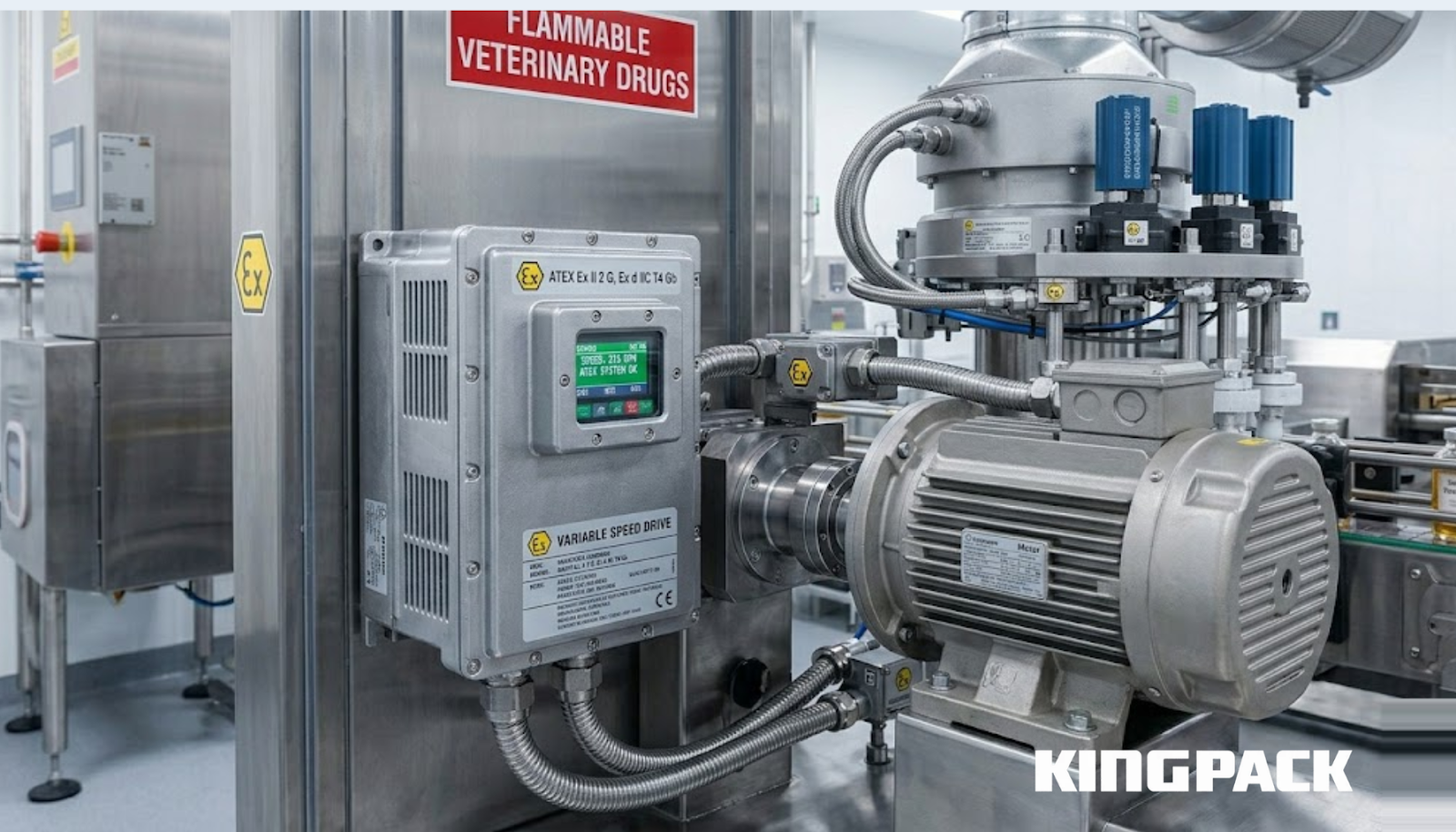
Every motor on the filling line that operates within or adjacent to a hazardous zone must carry the correct ATEX category certification for that zone. Explosion-proof motors use flameproof enclosures that contain any internal ignition event, preventing it from propagating into the surrounding atmosphere.
Variable speed drives and servo motors used in precision filling systems for alcohol-based veterinary formulations must be housed in certified flameproof enclosures, or located outside the hazardous zone and connected to the fill head through certified drive shafts or pneumatic actuators.
Intrinsically Safe Electrical Control Panels
The control system for a flammable veterinary drug filling line must be either located outside the hazardous zone entirely, or built as an intrinsically safe control cabinet. Intrinsic safety limits the electrical energy in any circuit within the hazardous zone to levels below the minimum ignition energy of the flammable atmosphere present.
Intrinsically safe design using electropolished 316L stainless steel construction with no electrical contacts in the fill zone eliminates ignition risks from the most critical part of the filling process. The PLC, HMI, and all monitoring systems should be located in a purged and pressurized enclosure or positioned in a non-hazardous area with certified cable entry points into the hazardous zone.
Explosion-Proof Sensors and Wiring
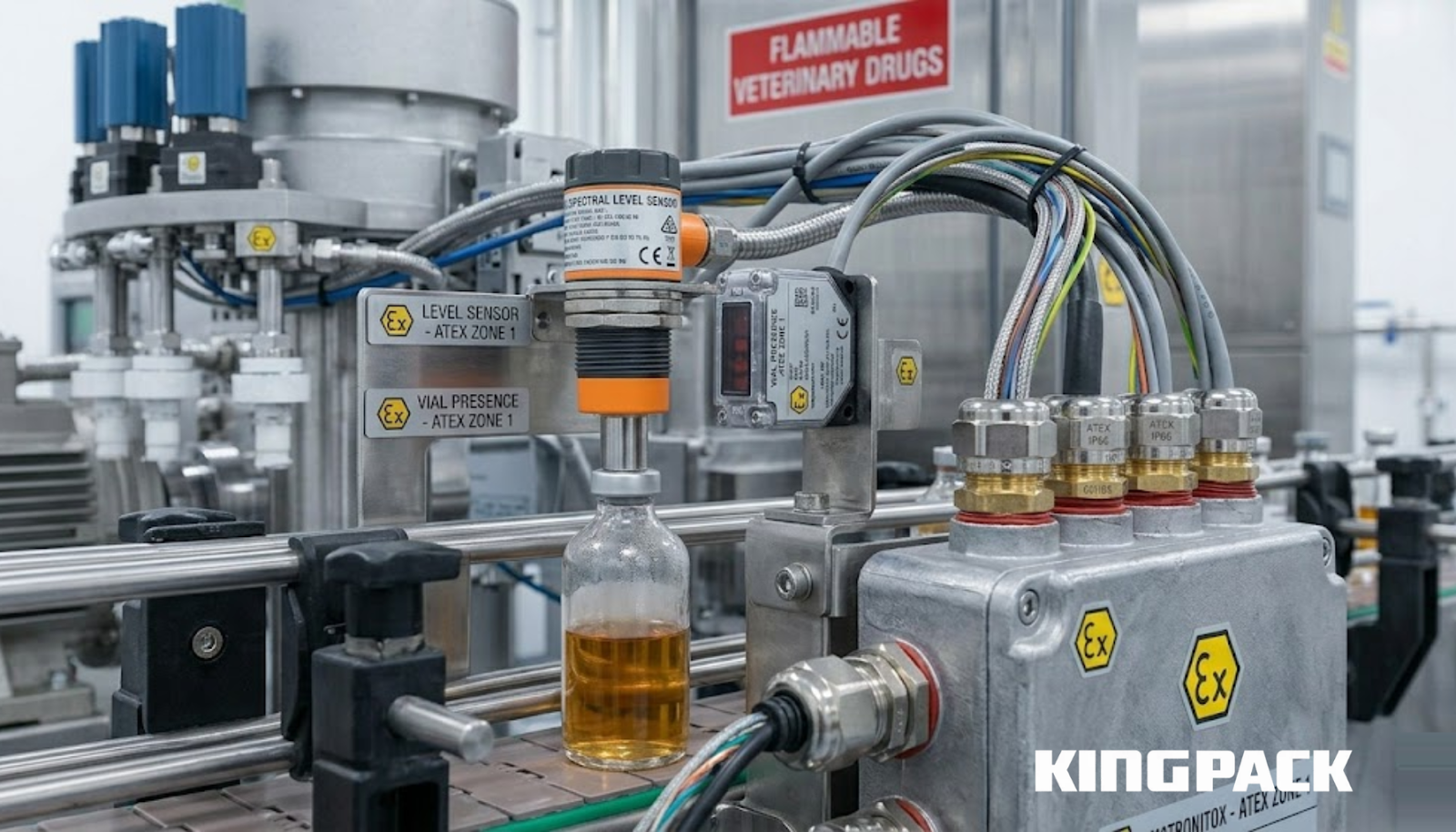
All sensors inside the hazardous zone, including level sensors in the supply tank, fill volume sensors, and container presence detectors, must be ATEX certified for the zone in which they operate. Wiring between the hazardous zone and the control cabinet must run through certified cable glands with appropriate ingress protection ratings.
Recommended Reading: No More Overflow: Bottom-Up Filling Technology for High-Foam – King Pack Machinery
Static Electricity and Grounding Control
Anti-Static Design for Filling Nozzles and Containers in Complete Packaging Lines
Static electricity is one of the least visible and most dangerous ignition sources in an alcohol-based veterinary formulations filling environment. When a non-conductive liquid like ethanol moves through a pipeline, through a nozzle, and into a container, charge separation occurs at every surface contact point. That charge accumulates on ungrounded surfaces until it discharges as a spark.
According to the Health and Safety Executive (HSE), electrostatic discharge is a recognized ignition source for flammable atmospheres and must be controlled as part of any ATEX compliant filling line design. The control measures must be engineered into the equipment, not added as a procedural afterthought.
Filling nozzles in our explosion proof filling machine designs are manufactured from conductive stainless steel and bonded directly to the grounding circuit of the line. Containers, both during filling and while waiting in the conveying queue, are grounded through conductive contact points on the conveyor surface.
Proper Grounding and Bonding Systems
Grounding and bonding are different but related requirements. Bonding connects two conductive objects to each other, equalizing their electrical potential and preventing a discharge between them. Grounding connects the bonded system to earth, providing a controlled pathway for any accumulated charge to dissipate safely.
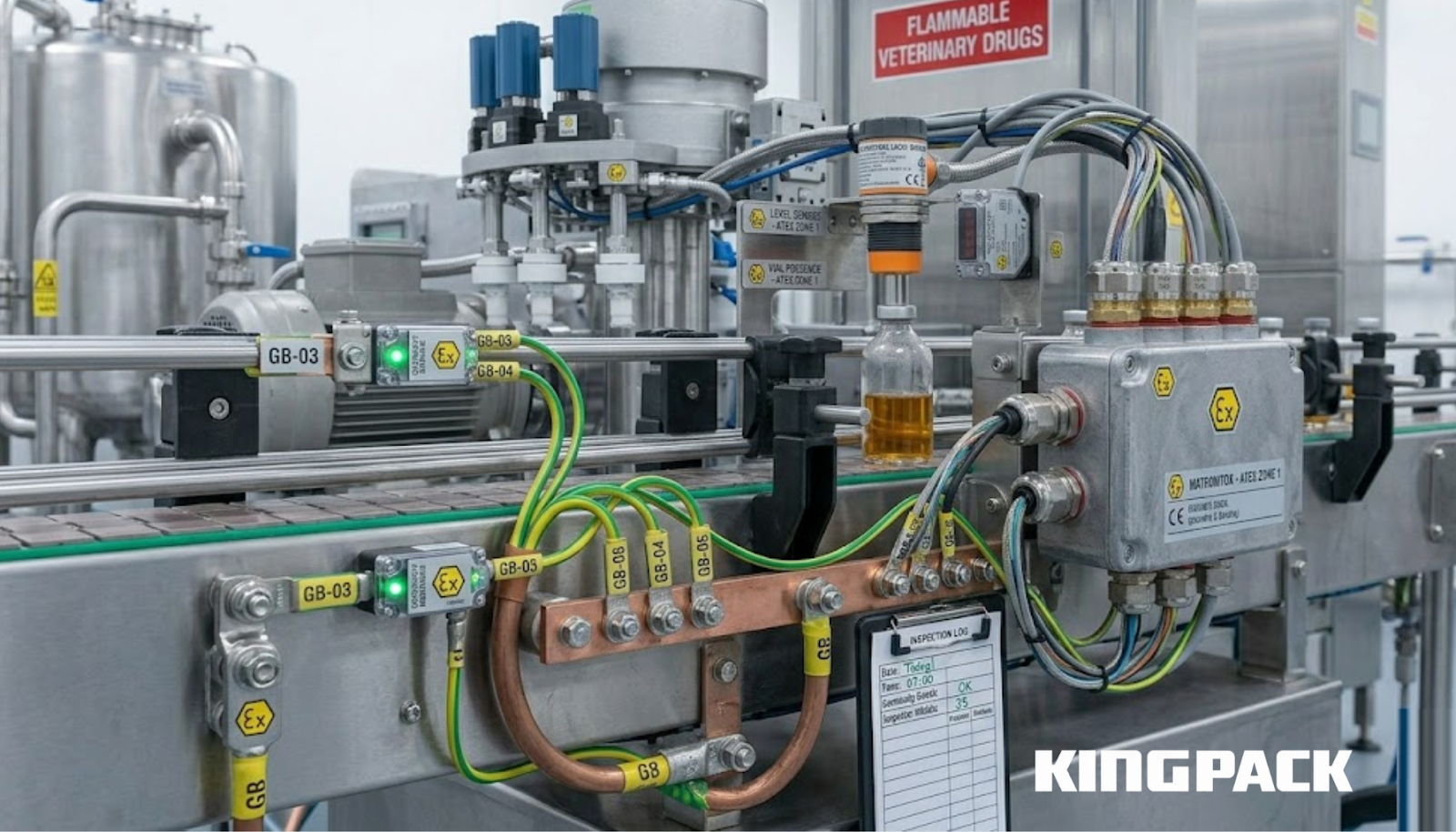
In a flammable liquid packaging line handling ethanol or isopropyl alcohol filling system applications, the grounding circuit must cover:
- The bulk formulation tank and all connected pipework
- The filling head assembly and all wetted metal components
- The conveyor system transporting containers through the fill zone
- The containers themselves at the point of filling
Continuity of the grounding circuit is checked and documented at the start of each production shift. A broken ground connection anywhere in the circuit creates an uncontrolled static accumulation point, and must be treated as a production stop condition.
Use of Conductive Hoses and Stainless-Steel Components
Standard polymer hoses are not acceptable in a Zone 1 or Zone 2 hazardous area filling environment. They accumulate static charge as liquid moves through them and provide no path for that charge to dissipate. Conductive hoses with embedded metallic grounding wire are required for all flexible connections in the wetted pathway of an explosion proof liquid filling system.
All rigid pipeline components, valves, and fittings in contact with alcohol-based veterinary formulations use 316L stainless steel as standard. This material is conductive, chemically compatible with ethanol and IPA, and meets GMP surface finish requirements simultaneously.
Ventilation and Vapor Management
Different Types of Forced Ventilation Systems for Vapor Dilution
The primary engineering control for flammable vapor in a filling environment is dilution ventilation. By supplying clean air to the filling room at a sufficient rate, the concentration of ethanol or IPA vapor in the general room atmosphere is kept below the Lower Explosive Limit (LEL) at all times during normal operation.
According to ATEX guidelines published by the European Chemicals Agency (ECHA), ventilation system design for hazardous area filling must be based on the maximum expected evaporation rate of the flammable liquid at the highest anticipated production temperature. The required air change rate is calculated from this figure, not from a generic rule of thumb.
For ethanol-based veterinary formulation filling at production scale, air change rates in the general fill room typically range from 20 to 40 air changes per hour, depending on the fill volume, line speed, and room size.
Local Exhaust at Filling Points
General room ventilation alone is not sufficient at the immediate fill point. Local exhaust ventilation (LEV) captures vapor at the source before it disperses into the room atmosphere. In an anti static filling system for alcohol-based products, LEV nozzles are positioned directly above and to the side of the fill zone, drawing vapor away from the open container at the moment of filling.
The extracted air is either discharged to atmosphere through a safe external outlet or passed through a solvent recovery system. In high-volume production facilities, solvent recovery reduces both the environmental impact and the raw material cost of the ethanol used in formulation.
Monitoring Volatile Organic Compound Levels
Continuous VOC monitoring inside the fill room provides real-time confirmation that vapor concentration stays below the LEL throughout production. Fixed gas detectors calibrated for the specific flammable substance being processed trigger alarms at a defined percentage of the LEL, typically 10% to 20%, providing time to investigate and correct before the concentration reaches a dangerous level.
Our explosion proof liquid filling system configurations include VOC monitoring integration as a standard safety feature. The monitoring system is interlocked with the filling line controls so that the line cannot operate if vapor concentration exceeds the alarm threshold.
Recommended Reading: Complete Guide to Pet External Parasite Drop Production Equipment: Filling + Capping + Packaging All-in-One – King Pack Machinery
Filling Technology for Flammable Veterinary Liquids
Closed-Loop Filling Systems to Reduce Vapor Release
Every point where the formulation is exposed to the fill room atmosphere is a vapor generation source. Open-top containers waiting to be filled, nozzles retracted between fill cycles, and return lines from the filling head all contribute to the vapor load in the fill zone.
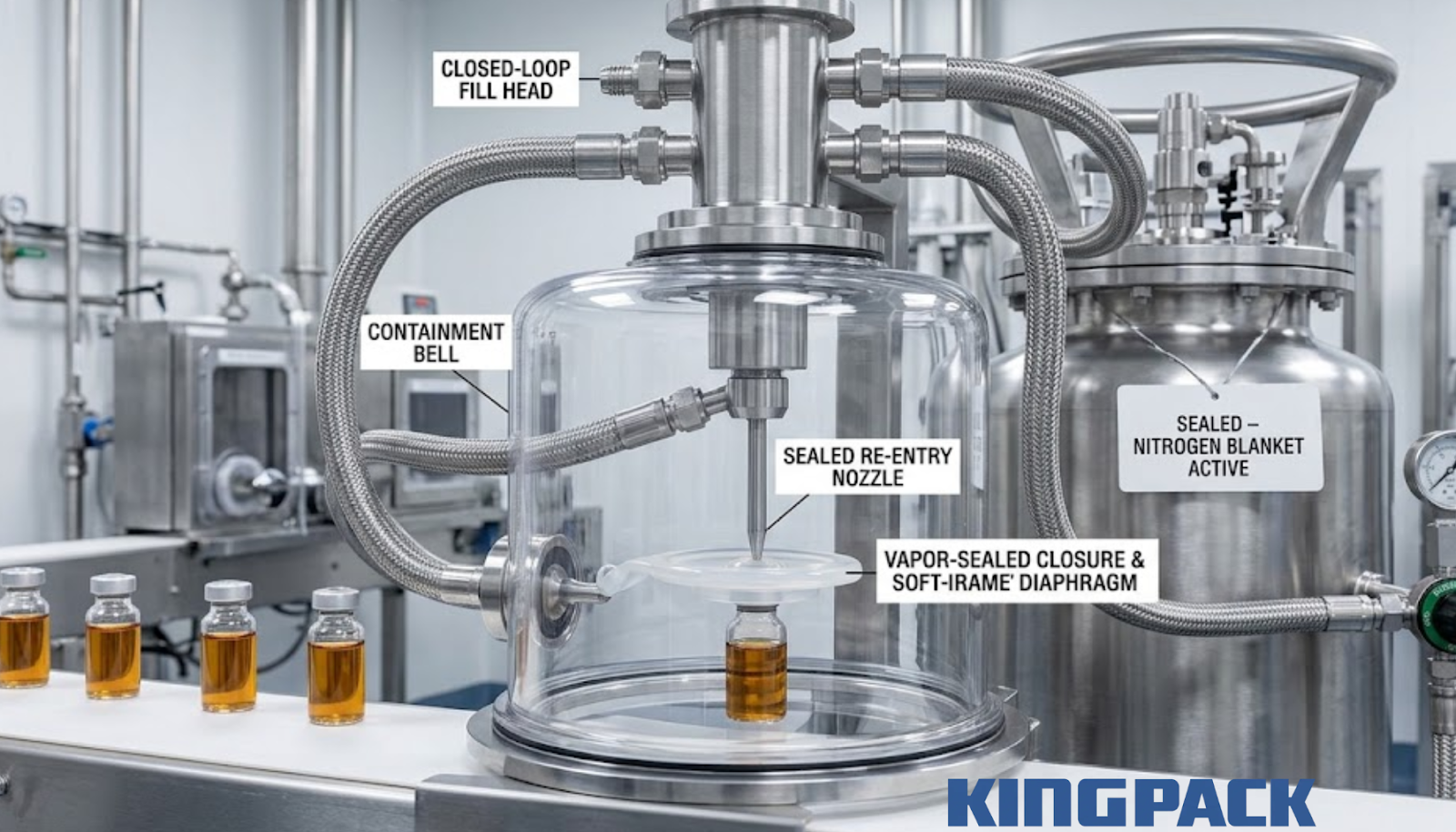
Closed-loop filling minimizes these exposure points. The formulation tank is sealed, with a nitrogen blanket above the liquid surface to prevent both evaporation and oxidation of sensitive active ingredients. The pipeline from tank to filling head is fully enclosed. The nozzle enters the container for the fill stroke and retracts into a vapor-sealed position between cycles.
Anti-Drip and Vapor-Sealing Nozzle Design
The nozzle is the highest-risk vapor release point in any ethanol filling machine design. After each fill stroke, a standard nozzle retains a droplet of formulation at the tip. That droplet evaporates between cycles, contributing directly to the vapor concentration in the immediate fill zone.
Our vapor-sealing nozzle design for hazardous area filling equipment uses a mechanical shut-off valve at the nozzle tip combined with a vapor-tight retraction housing. When the nozzle is not in the fill position, the tip is sealed inside a closed chamber with local exhaust connection. Evaporation from the nozzle tip is captured rather than released into the fill zone.
Precision Pump Selection for Alcohol-Based Formulations
According to Filling Equipment Review, 2023, servo-driven piston pumps outperform peristaltic and time-pressure systems for accuracy when handling low-viscosity flammable solvents like ethanol at production speeds above 3,000 units per hour. The positive displacement mechanism delivers consistent fill volumes regardless of the vapor pressure fluctuations that affect time-pressure systems when handling volatile liquids.
All pump components in contact with ethanol or IPA in our explosion proof filling machine configurations are manufactured from 316L stainless steel or PTFE, both of which are chemically compatible with alcohols and carry no static accumulation risk.
Automation and Safety Interlock Systems
Emergency Stop and Automatic Shutdown Mechanisms
An explosion proof filling system for alcohol-based veterinary formulations requires emergency stop circuits that function reliably in a hazardous atmosphere. Standard emergency stop buttons use certified flameproof or intrinsically safe designs appropriate for the zone in which they are located.
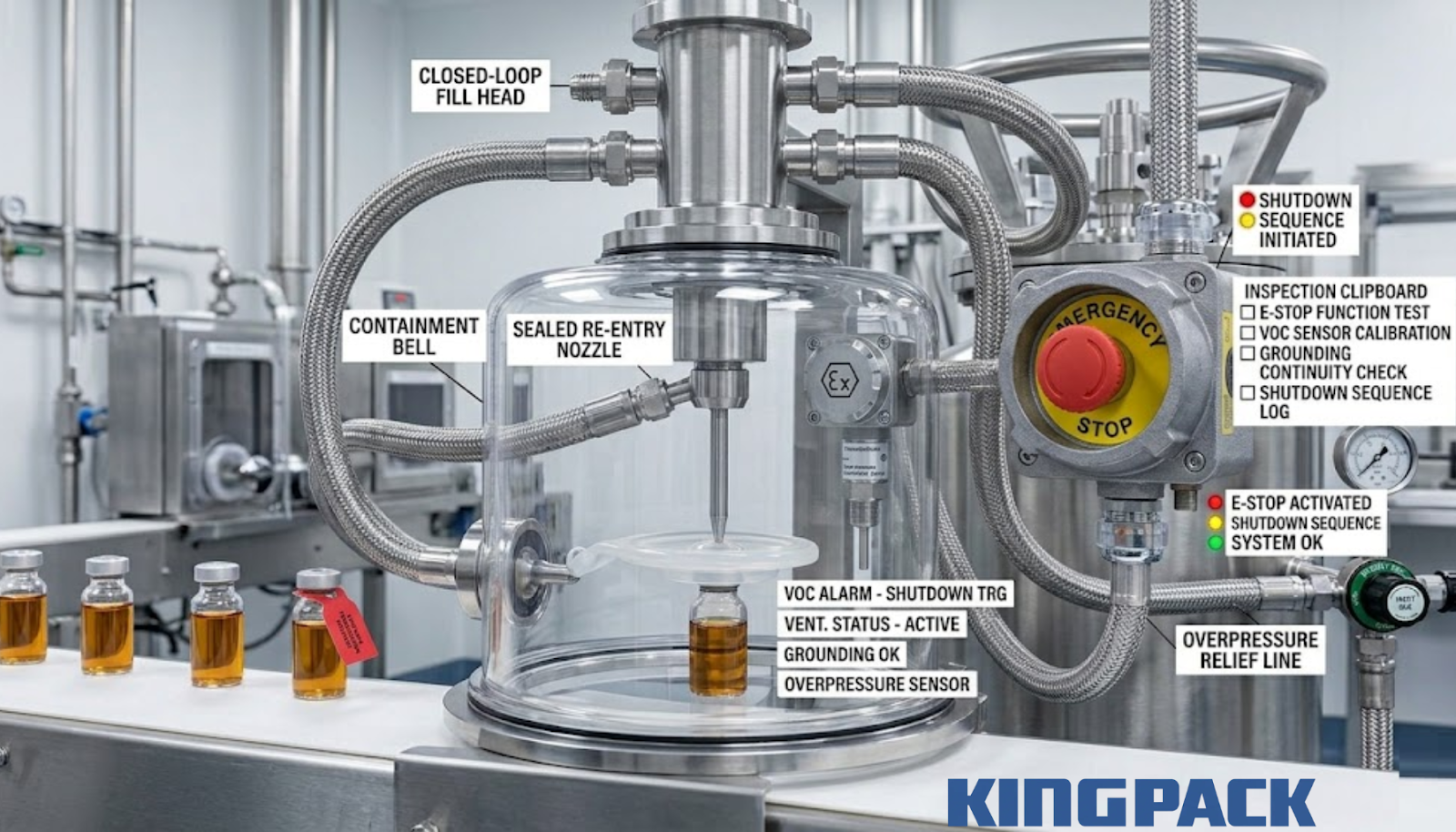
Automatic shutdown triggers include VOC concentration alarms, ventilation failure signals, grounding continuity loss, and filling head overpressure detection. Each trigger initiates a controlled shutdown sequence rather than an abrupt stop, preventing pressure surges in the pipeline that could cause spillage.
Explosion-Proof PLC and HMI Integration
The filling line control system uses an explosion proof PLC housed in a purged and pressurized enclosure located outside the hazardous zone. Remote HMI panels inside the fill room carry Zone 1 or Zone 2 certification appropriate to their location. All signal cables entering the hazardous zone pass through certified barrier modules that limit electrical energy to intrinsically safe levels.
Interlocking Between Ventilation and Filling Operation
The filling line cannot start unless ventilation is confirmed as operational. This interlock is a fundamental safety requirement, not an optional feature. If the ventilation system fails during production, the filling line stops automatically. The interlock is hardwired into the safety circuit, independent of the PLC, so that a control system fault cannot inadvertently allow production to continue without ventilation.
Recommended Reading: Trends in Veterinary Drop Packaging Equipment: From Manual to Fully Automated Sterile Filling – King Pack Machinery
GMP Considerations for Flammable Veterinary Drugs
Combining GMP Compliance with Explosion Protection
Manufacturers of alcohol-based veterinary formulations must satisfy two regulatory frameworks simultaneously. GMP compliance requires cleanable surfaces, documentation, process control, and batch traceability. ATEX compliance requires certified components, zone-appropriate design, and verified grounding and ventilation systems.
These requirements are compatible but must be planned together from the start. A filling room designed for GMP alone may use electrical fittings, lighting, and control panels that cannot be installed in a hazardous area without replacement or relocation.
Validation and Documentation Requirements
According to OSHA’s Process Safety Management standard (29 CFR 1910.119), facilities handling flammable liquids above threshold quantities must maintain documented Process Hazard Analysis records, including equipment specifications, grounding verification records, and ventilation performance data. These documents are reviewed during both safety inspections and GMP audits.
Our explosion proof filling system documentation package includes ATEX component certification records, zone classification drawings, grounding circuit diagrams, and ventilation performance validation data, all formatted for regulatory submission.
Common Design Mistakes in Alcohol-Based Filling Projects
Even well-resourced manufacturers make avoidable errors when designing flammable veterinary drug filling lines. The most consequential ones are:
- Ignoring hazardous area classification during the facility layout stage, then discovering that standard electrical installations cannot be used in the fill zone
- Using non-certified motors or sensors because certified alternatives were not sourced during procurement, creating a line that cannot legally operate in the intended zone
- Relying on general room ventilation without local exhaust at the fill point, allowing vapor to accumulate to dangerous concentrations near the nozzle
- Poor grounding design with missing bonds between containers and the fill head, creating a static discharge risk at the highest-risk point in the process
- Overlooking operator training on static control, grounding verification, and emergency shutdown procedures, leaving a competent-designed line vulnerable to human error during operation
Engineering a Safe and Efficient Explosion-Proof Filling Line
Balancing Safety with Production Efficiency
Safety engineering in a flammable liquid packaging line does not require accepting lower production efficiency. Closed-loop filling, automated grounding verification, and integrated VOC monitoring all reduce manual safety checks during production, freeing operators to focus on quality monitoring rather than safety compliance tasks.
Our explosion proof liquid filling systems for alcohol-based veterinary formulations are designed to run at production speeds comparable to standard pharmaceutical filling lines, without compromising any element of the hazardous area safety design.
Modular Design for Future Capacity Expansion
The capital cost of an ATEX compliant filling line is significant. Building modularity into the design from the start protects that investment as production volumes grow. Our filling line architecture allows additional filling heads, conveying lanes, and inspection stations to be added within the existing hazardous zone without redesigning the grounding, ventilation, or control systems.
Integration with Capping, Labelling, and Packaging Systems
Downstream equipment handling filled containers of flammable veterinary formulations must also be specified for the hazardous area zone in which they operate. Capping machines, labellers, and cartoning systems located within Zone 2 require the same certified motor and control panel specifications as the filling machine itself.
Our complete flammable veterinary drug filling line configurations cover the entire process from bulk tank to labelled secondary packaging, with consistent hazardous area certification across all equipment in the line.
Why Choose King Pack for Explosion-Proof Veterinary Filling Lines
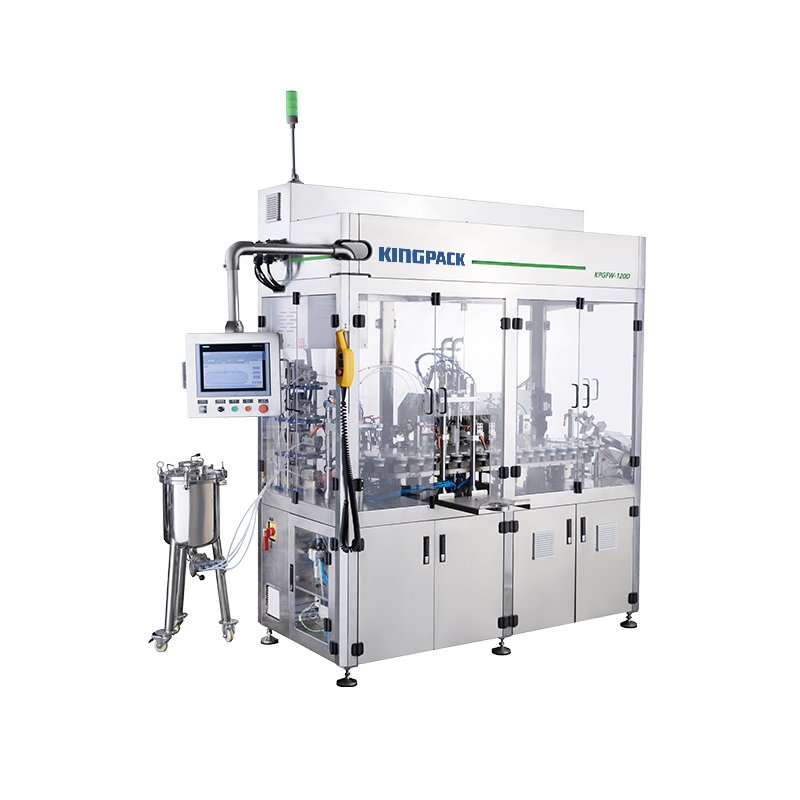
At King Pack, we engineer explosion proof filling machine solutions specifically for manufacturers producing alcohol-based veterinary formulations. Our hazardous area filling equipment is designed with ATEX certified components, anti static grounding systems, closed-loop vapor control, and intrinsically safe control architecture as standard features, not optional upgrades.
We work with manufacturers at the design stage to produce zone classification drawings, select certified components for each zone, and configure the ventilation and grounding systems to meet both ATEX requirements and GMP standards simultaneously.
Our pharmaceutical and medical filling lines include configurations for ethanol filling machine applications, isopropyl alcohol filling system requirements, and solvent-based veterinary formulation filling across a range of production speeds and container formats.
Contact King Pack to receive a customized explosion-proof filling solution for your alcohol-based veterinary production requirements.