
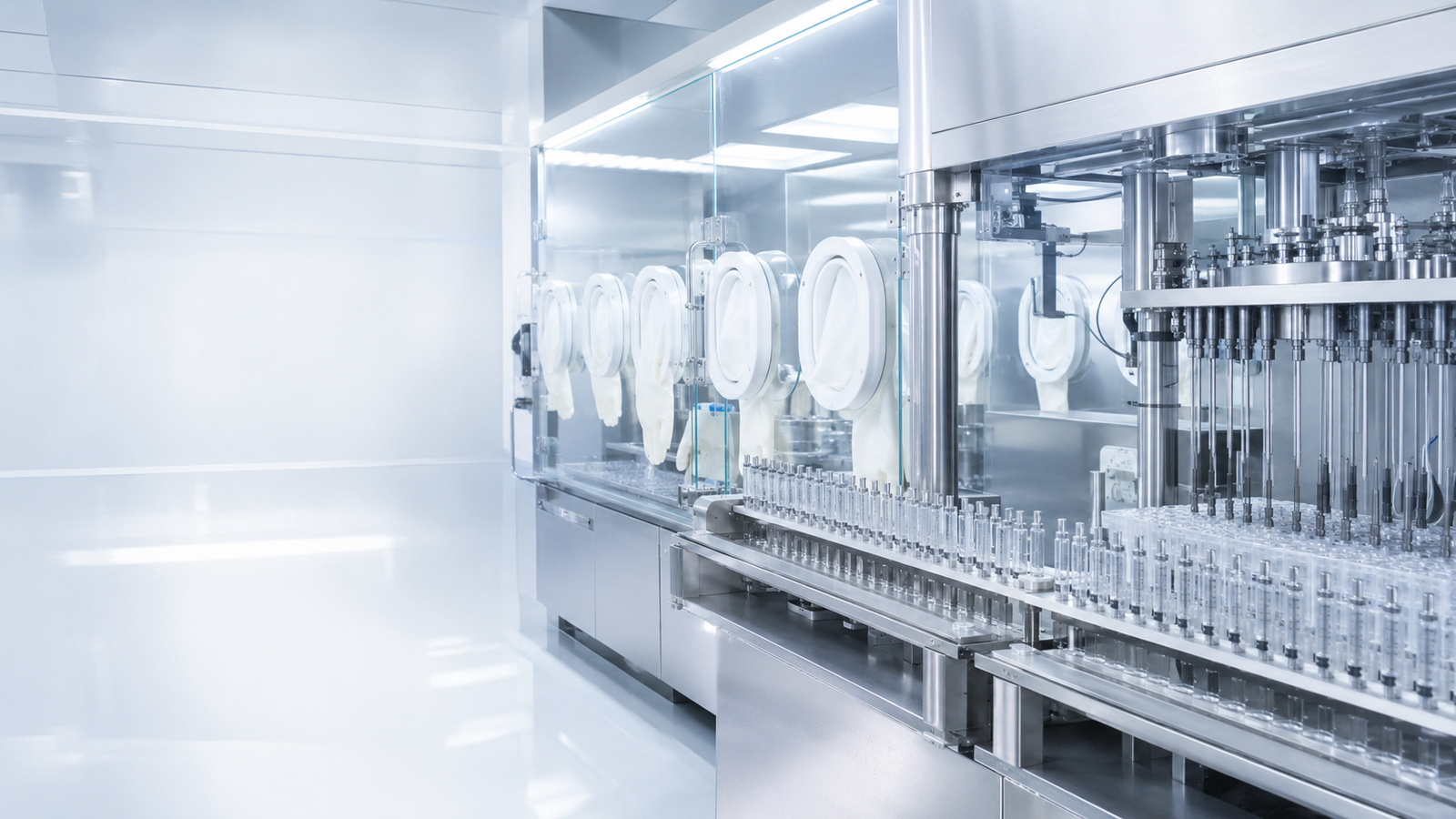
Let’s be honest! Most people outside the pharmaceutical manufacturing world don’t give much thought to how a prefilled syringe gets made. They see a ready-to-inject product and assume it was, well, just filled. But the reality of producing a sterile prefilled syringe (reliably, at scale, in compliance with global regulatory standards) is far more involved than that.
The aseptic prefilled syringe filling machine is the centerpiece of a process that demands near-perfect environmental control, precision engineering, and rigorous quality oversight. Get it right and you have a product that’s safe, stable, and ready for patient use. Get it wrong (even slightly) and you’re looking at batch failures, regulatory action, or worse.
This guide is for pharma professionals who want a clear, practical understanding of how the aseptic filling process works: what the key steps are, what equipment makes it possible, and what to think about when building or upgrading a production line.
Introduction to Aseptic Prefilled Syringe Filling
The Evolution of Injectable Drug Delivery in Pharma
Injectable drug delivery has gone through several distinct phases. For most of the 20th century, vials were the default. A vial would be filled, stoppered, capped, and shipped, then reconstituted or drawn up by a clinician at the point of care. It was functional, if imperfect.
The problems with that model are well-documented by now. Dosing variability. Contamination risk during preparation. Medication errors, particularly with high-alert drugs. The development of modern sterile syringe filling systems was, in large part, a response to those problems.
Prefilled syringes take the preparation step out of the clinical environment and move it into a controlled manufacturing setting. Here, conditions can be validated, documented, and audited. For biologic drugs, where molecular stability is often fragile and contamination risks are especially serious, this shift wasn’t just convenient. It was necessary.
Today, the global PFS market is growing steadily. Vaccines, insulin analogs, anticoagulants, monoclonal antibodies: the list of drug classes migrating to prefilled formats gets longer every year. And with that growth comes increased demand for filling technology that can keep pace.
Why Prefilled Syringes (PFS) Are Replacing Traditional Vials
The shift from vials to prefilled syringes isn’t driven by a single factor. It’s a convergence of clinical, regulatory, and economic pressures that together make PFS the more compelling option for a growing number of drug products.
Clinically, the benefits are clear. Prefilled syringes reduce preparation time, support patient safety with better dosing accuracy, and simplify administration especially for self-injection therapies. Automated systems can ensure dosing accuracy within ±1% for medications, which helps prevent medication errors and supports reliable therapeutic outcomes. Patient adherence tends to improve when devices are easier to use, which matters for chronic disease management.
On the regulatory side, agencies like the FDA and EMA have become more explicit about contamination control expectations. A well-specified prefilled syringe filling machine operating under validated aseptic conditions gives manufacturers a more defensible sterility assurance position than open vial filling ever could.
Economically, the math often works out too. For pre filled syringes, machines can reduce drug overfill from 20-25% to under 2%, while also eliminating ancillary components like separate needles and diluents to meaningfully lower cost per dose. Not always but often enough that the business case holds up under scrutiny.
Key Steps in the Aseptic Syringe Filling Process
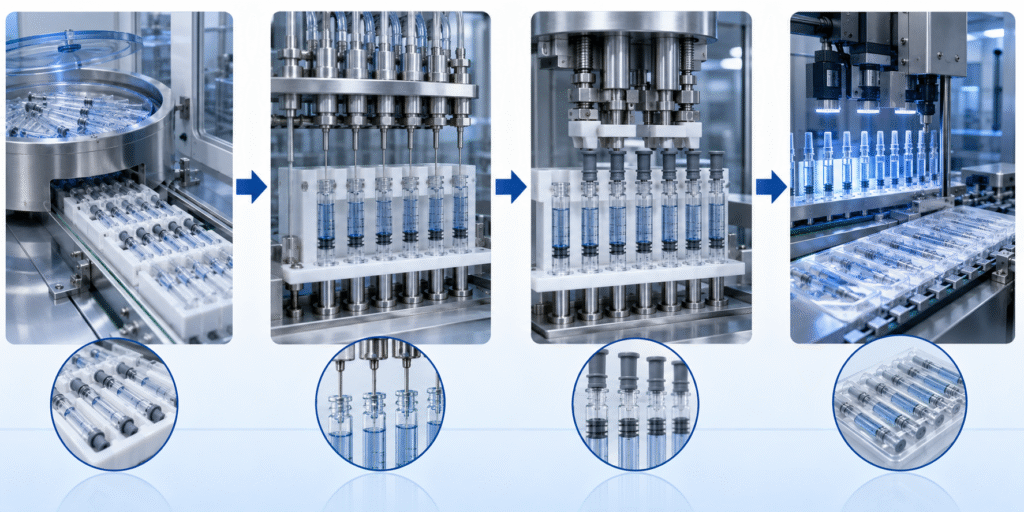
A properly configured high-speed syringe filling line is really a series of tightly linked unit operations. Each one feeds into the next, and a problem at any stage can affect the quality of everything downstream. Understanding the process as a whole (not just individual steps in isolation) is important for anyone responsible for line design or process validation.
Step 1: Syringe Tub/Nest De-nesting and Preparation
Before any liquid is filled, the syringes themselves need to be handled correctly. Most modern aseptic lines work with ready to use syringes supplied as rtu containers in nested trays inside sterile tubs. These come pre-washed, pre-siliconized, and pre-sterilized. This is convenient, but also means the sterile barrier needs to be maintained throughout the de-nesting process.
An automatic syringe molten denesting unit (sometimes called a nest syringe filling machine) handles this transfer automatically. The tub lid is removed under aseptic conditions, and the nest of syringes is transferred to the filling line by no touch transfer to minimize human contact. Enclosed transfer systems support aseptic processing and help reduce microbial contamination. It sounds straightforward, but the mechanical precision required to handle glass syringes at high speed without breakage or contamination is genuinely demanding.
Manufacturers sometimes underestimate the importance of this step. A poorly designed de-nesting system can be a significant source of particulate matter, glass breakage, and syringe-to-syringe variation entering the line. These are the problems that don’t show up until inspection or, worse, in the field.
Step 2: High-Precision Liquid Filling (Peristaltic vs. Rotary Piston Pumps)
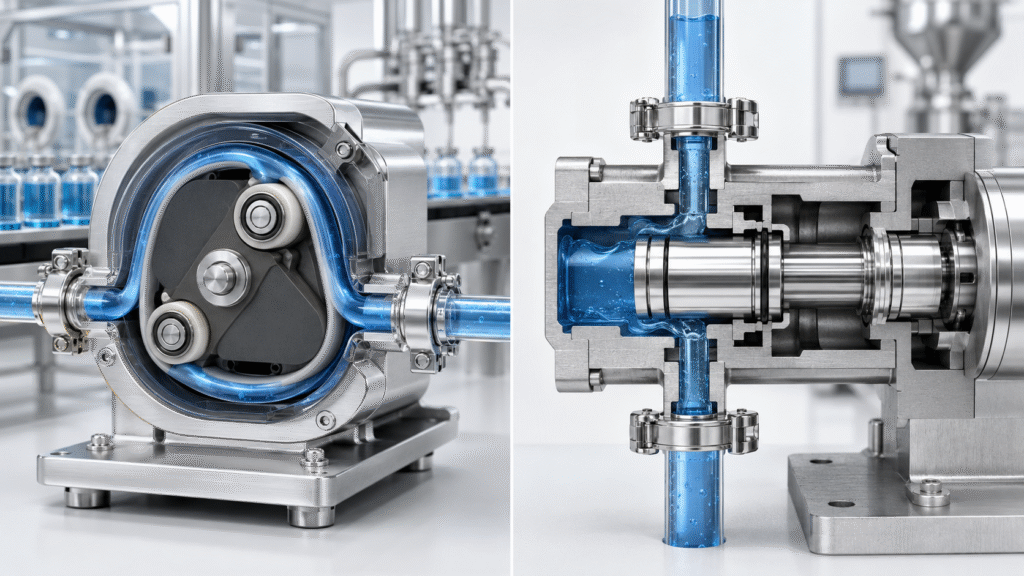
The filling step is where the drug product actually enters the syringe, and the engineering requirements are, frankly, demanding. You need high filling accuracy, with automated systems ensuring dosing accuracy within ±1% for medications, low product shear (critical for biologics), minimal foaming, and reliable performance across thousands of cycles per hour to support product safety.
Defining the filling range helps maintain precision and reduce overfill and medication waste.
Two pump technologies are used most commonly:
- Peristaltic pump syringe filling works by compressing flexible tubing in a rotating motion, pushing fluid through without direct contact between the pump mechanism and the product. This makes it inherently suited to biologics. There’s no metal-to-product contact, cleaning validation is simpler, and single-use fluid path options are available. The tradeoff is that fill accuracy can be slightly lower than piston-based systems, though modern peristaltic technology has closed that gap considerably.
- A piston pump syringe filler delivers more consistent volumetric accuracy by using a precision-machined piston to displace a fixed volume of liquid per stroke. It’s the preferred choice for high-viscosity products, aqueous solutions with stable formulations, and applications where fill accuracy is the primary concern. The cleaning and maintenance requirements are more involved, but for the right product type, the precision is worth it.
Some manufacturers run both on the same line, switching between them based on the product being filled. This kind of flexibility requires careful line design, and modular designs can support various container formats during changeover to significantly increase equipment utilization.
Step 3: Vacuum Plungering and Stoppering (Sealing)
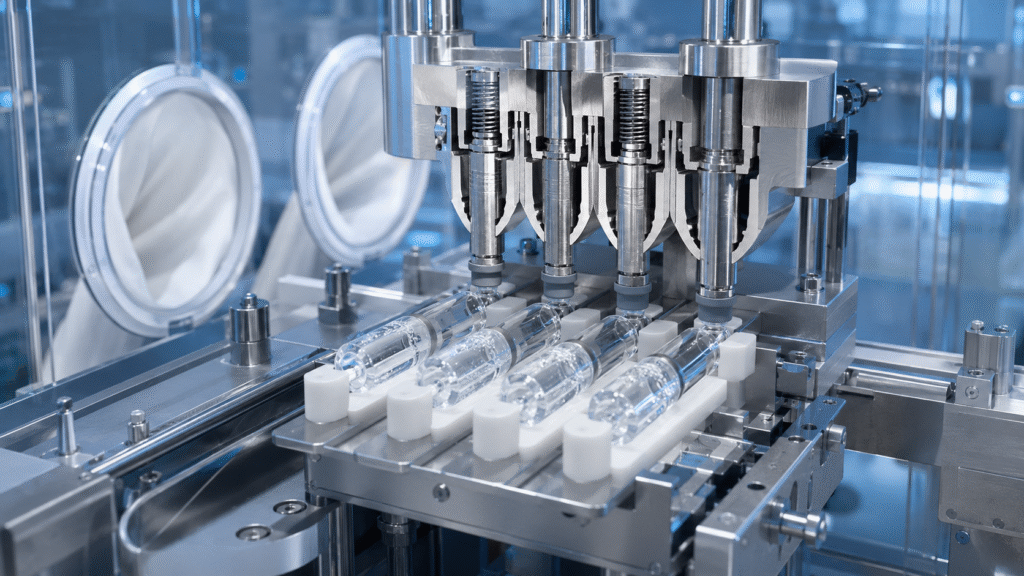
Once filled, the syringe needs to be sealed, and the stoppering operation is a critical sealing step with a direct and lasting impact on product quality. The stopper has to be inserted smoothly, at a controlled depth, without trapping air inside the barrel.
Trapped air is a problem for several reasons. It can affect the dose delivered. It can accelerate oxidative degradation in sensitive formulations. And it can cause visible bubbles that, even if clinically insignificant, raise quality concerns during inspection. A vacuum syringe filling machine addresses this by evacuating the headspace before stopper insertion, ensuring a clean, air-free seal.
The key word is integration. A syringe filling and sealing machine that handles both filling and stoppering in a single enclosed environment for sterile liquids is preferable to a system that physically transfers syringes between two separate units. Every transfer point is a potential contamination risk. The fewer of them, the better.
Stopper placement consistency is also worth noting. Variation in stopper depth (even within specification) can affect breakout force and glide force measurements, which matter for auto-injector compatibility. A well-designed stoppering machine controls this precisely.
Step 4: Visual Inspection and Final Packaging
No syringe leaves the filling environment without passing inspection. Syringes inspection equipment has advanced significantly in recent years. Modern automated systems use high-resolution cameras, multiple lighting angles, and machine vision algorithms to detect particulate matter, fill volume deviations, cosmetic defects, and container integrity issues: often at line speeds that would make 100% manual inspection impractical.
That said, automated inspection isn’t a complete replacement for human judgment in all cases. Many manufacturers use a combination: automated systems for high-throughput particle detection and fill volume checks, supplemented by periodic manual inspection for defect types that are harder to characterize algorithmically.
Validation of the inspection system (including setting defect thresholds and documenting detection rates) is a significant regulatory requirement. It’s not something to bolt on at the end of line qualification. It needs to be planned from the beginning.
Essential Equipment & Technologies in Syringe Production Lines
A production-ready syringe filling operation supports the broader pharmaceutical production process, not just a single filling step. The surrounding infrastructure (the barrier systems, the environmental controls, the auxiliary equipment) all contribute to sterility assurance across pharmaceutical production and to the overall performance of the line. Selecting the right pharma syringe filling equipment means thinking about the full system, not just individual components. Strong system integration improves operational efficiency and helps deliver consistent quality.
Automatic Syringe Filling & Plugging Machines: Core Features
The filling and plugging machine is the heart of the line. A modern automatic prefilled syringe filler does considerably more than dispense liquid into a barrel: in pre filled syringe filling, these systems automate washing, sterilizing, filling, and capping, while also managing syringe infeed, nitrogen overlay (if required), stopper delivery, and seating typically within a single enclosed machine footprint.
Features worth scrutinizing when evaluating machines:
- Servo-driven filling heads for accurate, repeatable volume control across the full batch
- Integrated CIP/SIP capability, so cleaning and sterilization can be performed without dismantling the machine
- Rapid format changeover with documented procedures and minimal tool use
- 21 CFR Part 11-compliant HMI with electronic batch records and audit trail
- In-process weight control with automatic rejection of out-of-spec units
- Full automation helps increase speed and repeatability while reducing operator intervention and waste
High-speed filling lines can process over 18,000 syringes hourly, while some prefilled syringe filling machines can reach up to 36,000 units per hour.
An aseptic filling and plugging machine that consolidates filling and stoppering into one unit reduces the number of moving parts in the system: both literally and operationally. Fewer machines mean fewer qualification protocols, fewer maintenance schedules, and fewer opportunities for things to go wrong between steps.
King Pack designs its filling and plugging systems with this integration philosophy at the core. The goal is a machine that’s capable, reliable, and (critically) one that your validation and quality teams can actually work with, ideally suited to both established pharmaceutical companies and start ups handling small batches.
Isolation Barriers (RABS & Isolators): Ensuring Maximum Sterility
The filling machine operates inside a controlled environment with laminar flow, and the nature of that environment has a substantial effect on sterility assurance levels. Two main approaches exist: Restricted Access Barrier Systems (RABS) and full isolators.
An isolation technology filling machine fitted with a full isolator provides the highest achievable sterility assurance. The filling zone is physically separated from the operator and the wider cleanroom. This also improves operator protection. Decontamination is typically done with vaporized hydrogen peroxide (VHP), and any interaction with the product zone is handled through glove ports. For products classified as high-risk, an isolator is often the only defensible option.
A RABS syringe filling line is a middle-ground solution. It physically separates the operator from the fill zone using panels and glove ports, with HEPA-filtered unidirectional airflow maintaining the aseptic environment. RABS systems generally involve lower capital cost and faster turnaround between batches than isolators. They can be appropriate for many product types, particularly when batch frequency is high and product risk classification is moderate.
The decision between RABS and isolator should be driven by a formal contamination control strategy (CCS). Don’t let it be driven primarily by budget.
Nitrogen Purging Systems: Protecting Oxygen-Sensitive Drugs
Oxygen is the enemy of a surprising number of pharmaceutical products. Biologics, lipid emulsions, and various small-molecule drugs can degrade significantly when exposed to ambient oxygen levels: even for short periods during filling.
Integrating nitrogen overlay into the filling process addresses this directly. A pre-sterilized syringe filler equipped with nitrogen purging capability displaces oxygen from the syringe headspace before, during, and after filling, creating an inert environment that protects the product throughout the sealing step.
The technical challenge is achieving consistently low residual oxygen (RO2) levels across every unit in the batch, not just at the start. RO2 specifications for sensitive products can be as tight as 1% or even lower, and maintaining that across thousands of units per hour requires careful system design and validated monitoring.
It’s the kind of capability that’s easy to dismiss during initial equipment selection especially if your current product portfolio doesn’t require it. But formulation strategies change, product licenses get amended, and the cost of retrofitting nitrogen capability into a finished line is almost always higher than building it in from the start.
How Filling and Stoppering Systems Work Together
It might seem obvious that filling and stoppering should be treated as a unified operation. In practice, though, the two steps are sometimes sourced from different equipment suppliers or designed without full consideration of how they interact. A syringe filling and sealing machine that handles both in a single, coordinated system consistently outperforms piecemeal configurations.
Achieving Zero-Bubble Sealing via Vacuum Technology
Bubbles inside a parenteral product are a serious quality issue. Beyond the cosmetic concern, air bubbles can affect delivered dose volume and, in the case of oxygen-sensitive formulations, accelerate product degradation. Manual removal is not an option at scale.
Vacuum-assisted stoppering solves this. The vacuum syringe filling machine applies negative pressure to the syringe barrel during stopper insertion, which draws the stopper into place smoothly while eliminating any residual air. The result is a consistently sealed syringe with no trapped headspace, helping support shelf life for oxygen-sensitive products: a measurable improvement over stoppering under ambient conditions.
This isn’t new technology. But what’s changed is the level of process control available. Modern vacuum stoppering systems can monitor and log vacuum level, dwell time, and stopper placement depth for every unit, as part of a wider validated equipment strategy that can also include terminal sterilization between batches. Data that feeds directly into batch records and process trending analysis.
Weight Control & In-Process Checkweighing (IPC)
Fill volume verification used to mean pulling samples at fixed intervals and weighing them on a bench scale. That approach catches problems, but it catches them late after out-of-spec units have already been filled. Integrated checkweighing inside a pharmaceutical liquid filling machine changes that dynamic, bringing IPC and in process control directly into the line.
Modern IPC systems weigh syringes continuously (every unit, or at a statistically defined sampling rate) and compare results against upper and lower control limits in real time. When a filling head drifts out of tolerance, the system responds immediately: flagging the affected units, pausing that head, and logging the event with a timestamp. That real-time response is one of the key considerations when selecting systems for process control, because it helps the rest of the line keep running.
From a regulatory standpoint, continuous IPC data is also far more defensible during inspections than periodic manual sampling records. It demonstrates process control in a way that interval-based sampling simply can’t.
Why Choose King-Pack’s Aseptic Syringe Filling Equipment?
There are a lot of filling equipment manufacturers in the market. Some are excellent. Others sell equipment that looks good in a brochure but creates headaches during validation or struggles to hit rated speeds under real production conditions. Evaluating suppliers carefully beyond the spec sheet is genuinely important.
King Pack has built its equipment range around the realities of pharmaceutical manufacturing, not just the theoretical requirements. A King Pack syringe filling machine reflects years of accumulated application knowledge from the mechanical design of the filling heads to the documentation structure that supports regulatory submissions.
GMP & FDA Compliant Engineering for Global Pharma Standards
Regulatory compliance is non-negotiable in this industry, and it can’t be treated as an afterthought. Machines that are designed for compliance from the ground up are dramatically easier to qualify and maintain in a validated state.
All pharma syringe filling equipment from King-Pack is developed with FDA 21 CFR Part 211, EU GMP Annex 1, and ICH Q10 requirements as baseline design criteria. That means material traceability, cGMP-compliant surface finishes, full IQ/OQ/PQ documentation packages, and software built to 21 CFR Part 11 requirements.
For manufacturers selling into multiple regulatory jurisdictions (the US, the EU, Japan, and increasingly stringent emerging markets) this compliance-by-design approach is more than convenient. It’s a competitive advantage that pays dividends throughout the product’s market life.
Flexible and Modular Design for Various Syringe Sizes (1ml – 5ml)
Product portfolios evolve. A manufacturer who starts with a single 1ml vaccine product may add a 2.25ml autoinjector format two years later and needs equipment that can accommodate that without purchasing an entirely new line.
King-Pack’s modular approach means that format changes across the 1ml to 5ml syringe range are handled through interchangeable tooling and format parts, not machine replacement. A prefilled syringe filling machine designed this way extends its useful production life considerably and makes it much easier to respond to portfolio changes without capital-intensive equipment decisions.
This flexibility is designed in, not bolted on. The machine architecture supports different barrel diameters, stopper formats, fill volumes, and container formats within the same platform, with changeover procedures that are documented, reproducible, and validation-friendly.
FAQs About Prefilled Syringe Filling Machines
What is the difference between RABS and an isolator in aseptic filling?
A RABS (Restricted Access Barrier System) uses physical panels and HEPA-filtered airflow to restrict operator access to the filling zone while still relying on the surrounding cleanroom environment as part of the overall contamination control strategy.
An isolator creates a fully sealed, independently controlled environment with its own air handling and decontamination system. Isolators provide a higher sterility assurance level and are preferred for high-risk products or facilities where the surrounding cleanroom classification is lower. RABS systems are appropriate for many product types and offer faster batch turnaround and lower capital cost.
How does vacuum stoppering improve product quality?
Vacuum stoppering removes residual air from the syringe barrel before the stopper is seated, eliminating trapped bubbles that could affect dose accuracy or trigger oxidative degradation. It also produces more consistent stopper placement depth across units, which matters for auto-injector compatibility and glide force performance. For oxygen-sensitive products, vacuum stoppering combined with nitrogen overlay is the standard approach.
Can one filling line handle multiple syringe sizes?
Yes! with the right platform design. Modular pharma syringe filling equipment like King-Pack’s range supports format changes across the 1ml to 5ml syringe range using interchangeable tooling. Changeover time depends on the specific formats involved and the level of validation documentation required, but well-designed systems can complete a format change in under two hours under normal conditions.
Request a Quote for Your Advanced Pharma Production Line
Specifying a filling line is one of the more consequential equipment decisions a pharma manufacturer makes. The technology you choose shapes your production capacity, your regulatory exposure, and your operational flexibility for the next decade or more. It’s worth taking the time to evaluate options carefully including suppliers who bring genuine application expertise to the table, not just a catalog of machines.
King-Pack’s team works with manufacturers at every stage across the pharmaceutical industry, from established producers to emerging teams, from initial line concept through equipment specification, commissioning, and technical support. Whether you’re building a new aseptic line from scratch or upgrading an existing one, the conversation usually starts with a clear-eyed look at your specific product requirements, batch volumes, and regulatory targets — not a generic proposal based on list pricing.
If you’re at that stage or even just starting to think through your options, visit kpfillingmachine.com to learn more about King-Pack’s full range of aseptic prefilled syringe filling machine solutions, or reach out directly to discuss your project.