
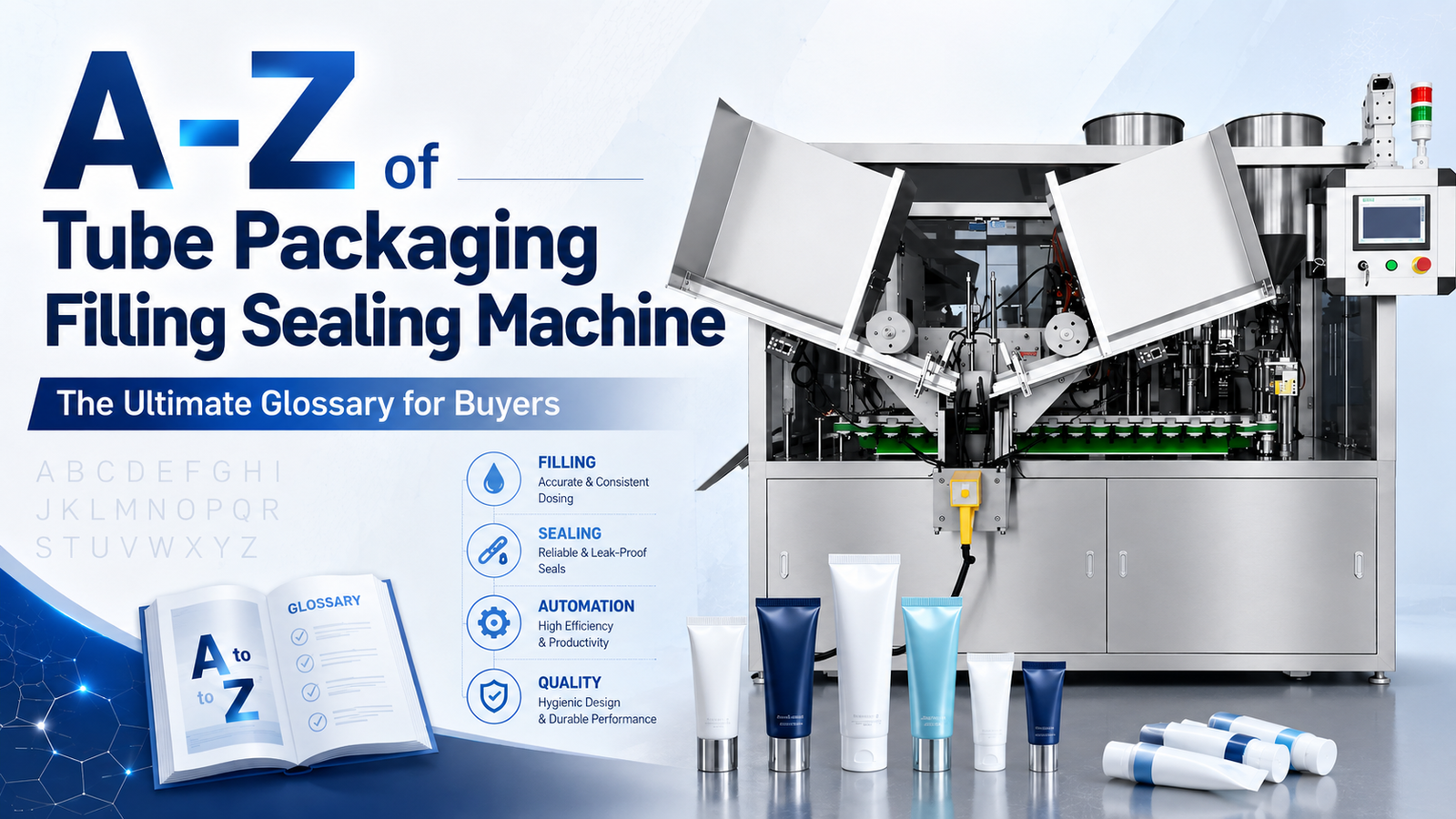
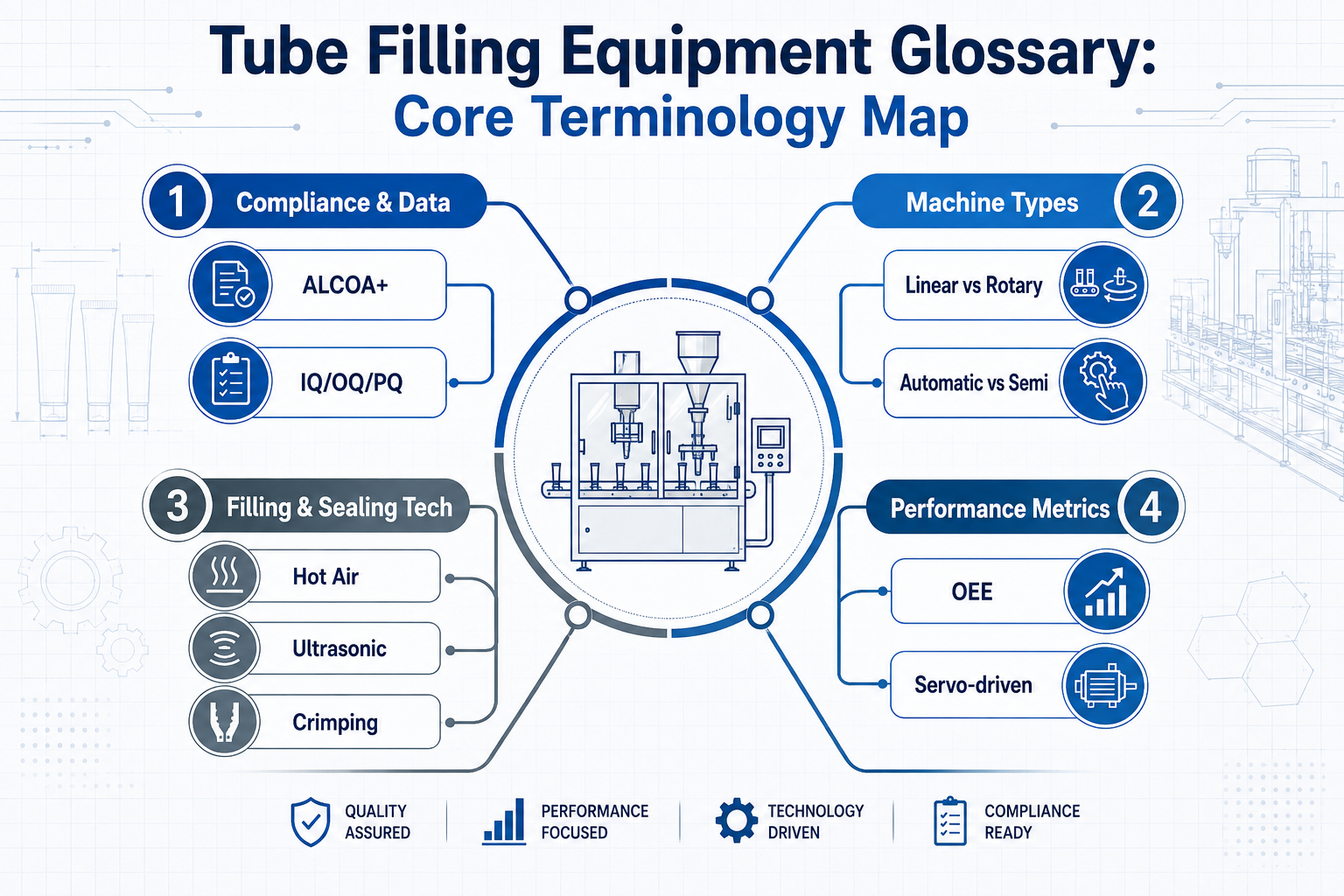
Nobody tells you this when you start evaluating tube filling equipment: the terminology is half the battle. You get into a conversation with a supplier, and within five minutes there are acronyms flying around (IQ/OQ/PQ, OEE, ABL, PLC, CIP) and if you’re not already familiar with them, it’s very easy to nod along and miss something important.
That’s what this tube packaging glossary is for. It is written for the people who are actually making the purchasing decisions. This could include the procurement leads, production managers or business owners who are specifying equipment, reading quotes, and trying to figure out whether two machines that look similar on paper are actually comparable. Spoiler: they usually aren’t.
The packaging machinery dictionary you’ll find here covers the terms that genuinely come up. Not an exhaustive academic index but a practical reference organised A to Z, covering filling mechanisms, sealing technologies, different types of machines, compliance frameworks, and the components you’ll hear discussed in every serious equipment conversation. If a term matters when you’re buying or operating a tube filling line, it’s in here.
We’ve structured it by letter groups so it’s easy to scan. Read it end-to-end if you’re new to the space, or use it as a reference when a supplier drops a term you want to look up quickly. Either way, the goal is the same: buyers who understand the language make better decisions.
A-E: Core Concepts, Compliance, and Components
A – ALCOA+

If you are buying equipment for a pharma or regulated manufacturing environment, you will run into ALCOA+ sooner or later. This is a data integrity standard. Its acronym covers Attributable, Legible, Contemporaneous, Original, and Accurate, with the “+” adding Complete, Consistent, Enduring, and Available.
So practically, ALCOA+ applies to everything that your machine generates. This can include things like batch records, electronic logs, alarm histories or any data that’s captured by the HMI or PLC during production.
Regulators expect this data to be trustworthy by being traceable. Therefore, when you are evaluating machines, it’s worth asking directly how the supplier handles ALCOA+ compliance at the software level and not just whether they claim it, but what that actually looks like in the system.
Automatic Tube Filler (Automatic Filling Machines)
This phrase gets used very loosely which ends up causing confusion. To decide between automatic filling machines and a semi automatic setup, look at whether the full filling and sealing machine cycle runs without operators handling individual tubes. But some machines described as “automatic” still rely on manual tube loading at the infeed. This distinction matters when you are calculating real production speed.
True automatic machines range from compact units that are running 30 – 40 tubes per minute up to high speed rotary systems that are exceeding 150 per minute. Semi-automatic machines are ideal for small to medium-sized businesses, while fully automatic systems are chosen for higher production requirements.
The right output level depends on your volume requirements, but more automation generally means more consistency. The price of advanced models is usually higher because automatic machines require a greater initial investment than semi-automatic options. Each tube gets the same fill weight, the same dwell time, the same seal. When reviewing automatic tube filler terms in any specification sheet, always ask which steps are genuinely automated and where manual involvement remains, because the right filling sealing machine choice should match your specific requirements for output while helping maximize filling sealing efficiency and product freshness.
C – CIP (Clean-In-Place)
CIP allows the machine’s internal product pathways (i.e., nozzles, valves, hoppers, pipes) to be cleaned without dismantling them.
For manufacturers that produce multiple products on the same line or work in regulated hygiene categories, this is a significant operational benefit.
Teardown cleaning is time consuming and introduces risk. Components can be reassembled incorrectly, seals can be damaged, and cleaning validation becomes harder to document.
A proper CIP system will have validated cleaning cycles specific to your product types. Don’t accept a general claim that the machine “supports CIP”. Ask to see the cleaning protocol documentation and, ideally, speak to another user running similar products on the same platform.
Crimping
Crimping is the sealing method for metal tubes, almost always aluminium. At the sealing station, the open tail of the tube is mechanically folded and compressed (typically in a double or saddle fold) to create a hermetic closure. The pattern of the crimp affects both appearance and seal strength, so it’s specified carefully for each application.
From the standpoint of tube sealing definitions, crimping is entirely distinct from the heat based methods. If your product range includes both metal and plastic tubes, you’ll need either a machine that accommodates both sealing types (with tooling changes) or separate lines.
Change Parts
Change parts are the tooling components swapped between production runs when tube dimensions change. On paper, a machine with a 20-minute format change time sounds fine. On the floor, if the change parts are poorly designed or require specialist tools to swap, that 20 minutes becomes two hours.
Before committing to a machine, request a full change parts list for your tube range, get a realistic estimate of changeover time, and — if possible — watch a live format change demonstration.
E – Emulsification
Most tube-filled products in personal care and pharmaceuticals are emulsions — combinations of oil and water phases held stable by emulsifiers. What’s relevant for equipment specification is that emulsions can be sensitive to shear. High-shear filling mechanisms can break the emulsion and end up causing visible separation in the finished product.
For formulas that are shear sensitive, a piston filler is usually preferred for thicker products because piston fillers dispense exact volumes of thick liquids, while pump-based liquid filling is better suited to thin fluids, as liquid pumps dispense thin fluids using timed flow or weight scales. Providing your supplier with accurate rheological data before specifying the equipment is important, especially for products that sit between thin liquids and thicker creams, such as liquid paste, where rheology directly affects mechanism choice. Products that behave fine in the lab can respond very differently when processed at speed through a filling head.
Eyemark (Registration Mark)
An eyemark is a printed mark on the tube’s surface that the machine’s sensor reads to establish rotational orientation before sealing. If your tube has a design that needs to be aligned consistently (a logo, a direction arrow, a printed pattern) eyemark detection is what makes that possible.
Machines without eyemark capability rely on mechanical orientation only, which works well enough for plain tubes but can’t guarantee print registration on decorated ones. For branded packaging in cosmetics or consumer health, this is a non-negotiable feature. Worth checking: what type of eyemark sensor is fitted, and whether it can read the contrast level on your specific tube artwork.
F-J: Filling Mechanisms and Control Systems
F – Filling Nozzle (Piston Fillers)
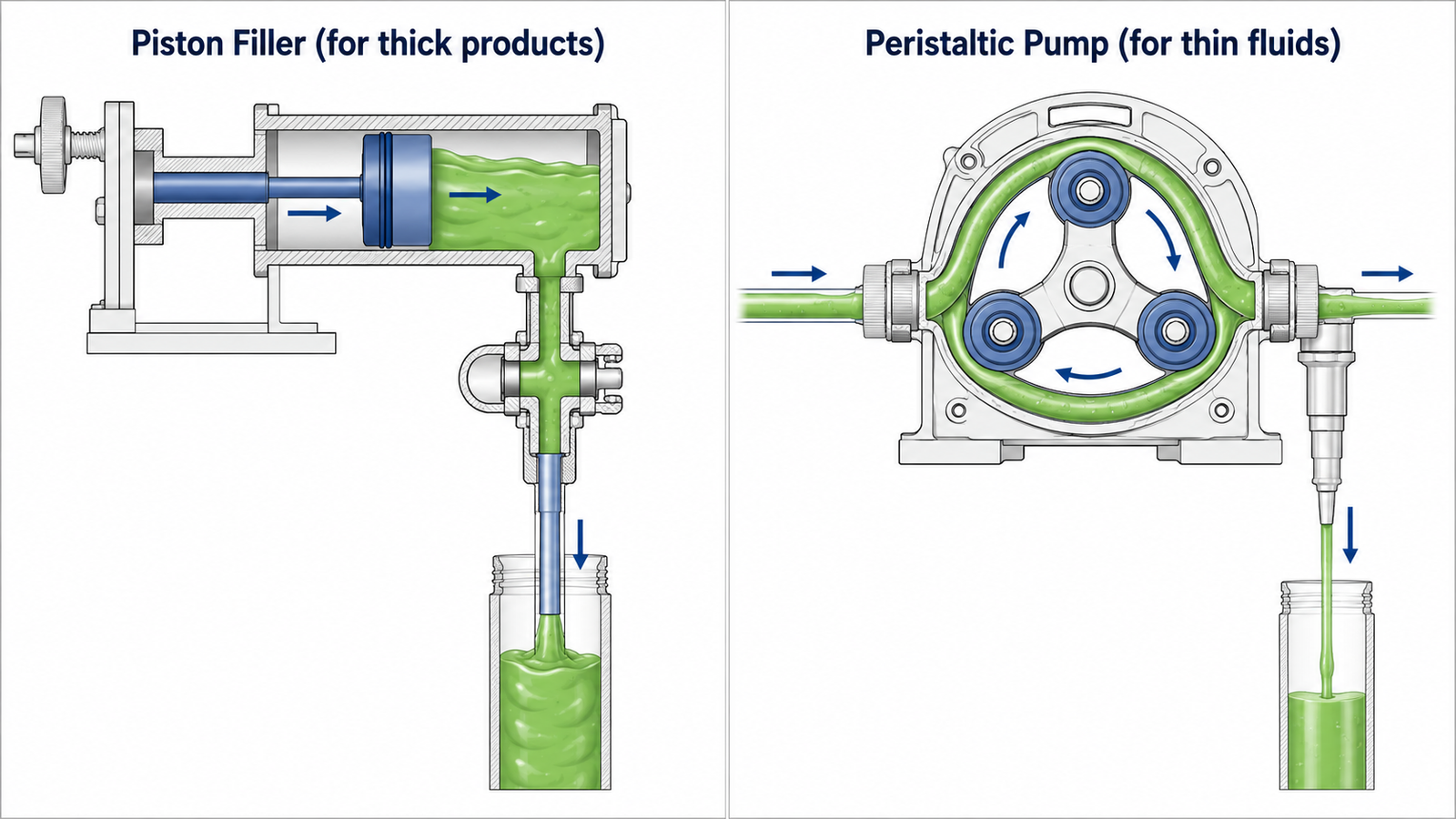
The filling nozzle is where product actually enters the tube, and its design has more downstream impact than it might seem. Dive nozzles descend into the tube before dispensing begins, which helps prevent air entrapment and is particularly useful for thicker products. Flush nozzles sit at the tube opening and are better suited to thin, free-flowing liquids, especially in liquid filling, where liquid pumps dispense thin fluids using timed flow or weight scales. The wrong nozzle for your product will show up as inconsistent fill weights, air pockets, or contamination of the tube interior in tubes and other containers.
Nozzle material matters too. 316L stainless steel is standard for pharmaceutical applications. Surface finish affects cleanability, and nozzle geometry needs to match your product viscosity. If you’re running multiple products, check whether nozzle changeovers are tool-free and how the cleaning procedure works.
Form-Fill-Seal (FFS) in Tube Filling and Sealing
FFS is a process where packages are created from a roll of film, formed into their final shape, filled, and sealed in a continuous automated sequence within one filling sealing machine. In tube packaging, this is more commonly associated with flexible pouches, sachets, and bags, including vertical form systems, but the concept is increasingly being applied to certain tube formats.
The main benefit is reduced product exposure to the environment because the tube is formed just before filling, there’s a shorter window for contamination. For buyers navigating packing machine and packaging machine industry terms, understanding whether you need pre-formed tubes or an FFS-capable system is a foundational decision. The two approaches have very different capital cost profiles and supply chain implications.
H – Hot Air Sealing
Hot air tube sealing works by directing precisely heated air into the open tail of the tube, softening the inner surface of the material before the sealing jaws close and compress it into a bond. It’s the most widely used sealing method for plastic and laminate tubes, and for good reason. It’s
- reliable,
- relatively straightforward to maintain, and
- compatible with a wide range of tube materials, helping protect contents from leakage and contamination.
Temperature control is where most problems occur. Too low and the seal won’t form properly. Too high and you get material deformation, discolouration, or weakened tube walls near the seal. Good hot air tube sealing equipment uses closed-loop temperature monitoring to keep air temperature consistent across the full production run, not just at startup.
King Pack‘s hot air sealing systems include real-time temperature feedback as standard, which is one reason they perform consistently in both plastic tube sealing machine applications and laminate tube production. If you’re comparing machines, ask how the system handles temperature variation during extended runs across different packaging materials, it’s a telling question.
HMI (Human-Machine Interface)
The HMI is the operator control panel: in modern machines, almost always a touchscreen. It’s where operators set production parameters, monitor machine status, manage recipes, and respond to alarms. A good HMI reduces training time and operator error. A poor one creates frustration and workarounds that eventually cause production problems.
When evaluating an HMI, look beyond the screen size. What languages does it support? How intuitive is recipe changeover? Does it log production data in a format your systems can use? Can it be accessed remotely for troubleshooting? These practical questions matter more than whether the interface looks modern.
Hopper
The hopper is the product reservoir that feeds the filling system. Capacity determines how often operators need to replenish it, which affects line efficiency particularly at higher speeds where a small hopper becomes a constant interruption. Some products require heated hoppers to maintain viscosity, agitation to prevent settling, or insulated jacketing for temperature-sensitive formulations. Specifying hopper requirements correctly at the outset saves significant retrofitting costs later.
K-O: Materials, Machinery Types, and Metrics
L – Laminate Tubes (ABL/PBL)
Laminate tubes sit between pure plastic and aluminium in terms of barrier performance and tactile feel. ABL (Aluminium Barrier Laminate) incorporates a thin aluminium foil layer, giving excellent protection against oxygen and moisture. PBL (Plastic Barrier Laminate) replaces the foil with a polymer barrier, making the tube fully squeezable and, in many recycling frameworks, easier to process at end of life.
The sealing behaviour of ABL and PBL differs slightly, and machines need to be set up accordingly. If your product range will include both types, confirm with your supplier that the machine handles each without requiring a full tooling change. This detail often gets glossed over in initial sales conversations.
Linear vs. Rotary Machines
This comparison sits at the centre of most tube filling machine terminology discussions. Linear machines move tubes sequentially through a straight-line series of stations. They’re compact, mechanically simpler, easier to maintain, and generally the right choice for output requirements up to around 60 tubes per minute. Rotary machines use an indexed carousel that processes multiple tubes in parallel, achieving significantly higher throughput (typically 100 to 200 tubes per minute or above) with better consistency at speed.
The decision isn’t purely about speed. Rotary machines cost more, take up more floor space, and are more complex to maintain. For many producers, a well-engineered linear machine at 80% of theoretical capacity will outperform a rotary machine that’s poorly matched to their product or operation. Be honest about your actual volume requirements, not your aspirational ones.
O – OEE (Overall Equipment Effectiveness)
OEE measures how productively a machine is actually being used. It’s calculated across three factors: Availability (what percentage of scheduled time the machine is running), Performance (how close to theoretical maximum speed it operates), and Quality (what proportion of output meets specification, including accuracy from integrated weighing systems). In food production, quality checkpoints that affect reported good output may include checkweighers and metal detectors. World-class OEE in discrete manufacturing is generally considered to be around 85%.
The reason this matters during purchasing: supplier throughput claims almost always assume ideal conditions. A machine quoted at 120 tubes per minute running at 65% OEE tells a very different production story than one operating at 85%. When you’re comparing specifications, it’s fair to ask what OEE assumption underpins the quoted output figure. And once the machine is installed, tracking OEE gives you a clear, objective basis for maintenance decisions and operator performance conversations.
P-T: Precision, Parts, and Sealing Technologies
P – PLC (Programmable Logic Controller)
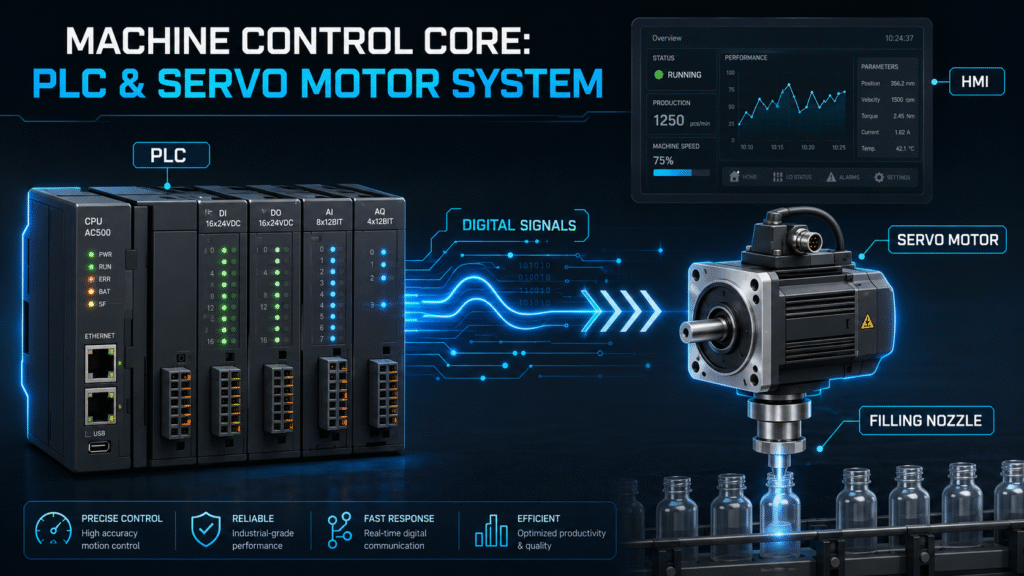
The PLC is the industrial computer that controls machine operations. This control includes coordinating timing, sequencing, and the interaction between motors, sensors, actuators, and valves. In modern tube filling equipment, the PLC is the brain behind everything from fill volume control to sealing dwell time to alarm management.
Brand matters here more than buyers often appreciate. Siemens, Allen-Bradley, and Mitsubishi are the most widely used globally. Each has different spare parts availability, local support infrastructure, and programming interfaces.
If your existing maintenance team knows Siemens systems, a machine built on Allen-Bradley will require either retraining or external support for any modifications. Also worth checking: is the PLC program open or locked? A locked program means every future modification (even a simple parameter change) has to go back to the supplier. That’s a dependency that can be expensive over a machine’s operational life.
Puck
A puck (also called a tube holder or nest) is the carrier that holds each tube as it moves through the machine’s processing stations. Pucks need to match the tube diameter precisely. They’re a primary change part when switching formats.
Their design affects tube stability during filling and sealing, which has a direct impact on fill accuracy and seal quality. On high-speed rotary machines in particular, puck engineering is a critical detail: any looseness in tube positioning at speed creates defects and machine faults. It’s worth examining puck construction and tolerances as part of any serious machine evaluation.
S – Servo Motor
Servo motors control machine movements (filling piston travel, including piston filler control, nozzle positioning, jaw closure) with a level of precision and repeatability that older pneumatic and cam-driven systems simply can’t match. Because servo parameters are set digitally through the HMI rather than adjusted mechanically, changeovers are faster and fill accuracy is easier to maintain across runs.
The practical difference shows up clearly in waste figures. Older pneumatic fillers typically require more startup waste to dial in the correct fill weight. Servo-driven systems get there faster and hold it more consistently, and piston fillers dispense exact volumes of thick liquids. For buyers comparing machines, servo-driven filling is a genuine differentiator and not just a marketing feature, especially for various product types that demand exact volume control.
Suck-Back Mechanism
Suck-back briefly reverses product flow at the end of each fill cycle to prevent dripping at the nozzle tip. Without it, viscous products in particular will form strings or droplets as the nozzle retracts.
That product ends up on the tube’s interior sealing surface, which degrades seal quality and, by keeping product off the sealing area, helps the filling sealing process prevent leaks and deter tampering. The suck-back function is controlled through the PLC and servo system, with adjustable parameters for the volume and timing of the reversal. For products with difficult viscosity profiles (like thick gels, honey-like consistencies) effective suck-back control is not optional across different applications.
Seal Integrity
Seal integrity refers to whether the sealed tube end is genuinely airtight, properly bonded, and structurally sound, so it protects contents from leakage and contamination. Poor seal integrity causes shelf-life failure, often with issues only becoming apparent once the product is in the supply chain.
The machine parameters that govern seal integrity include sealing temperature, jaw pressure, dwell time, and the compatibility of those settings with your tube material. In regulated industries, including pharmaceutical, hygiene-critical, and cosmetic products packaging, seal integrity testing is a formal requirement. Methods include dye penetration, vacuum decay, and burst testing.
For buyers in pharmaceutical or hygiene-critical applications, this is probably the most important cluster of tube sealing definitions to understand before specifying a machine.
T – Tube Orientation
Tube orientation is the controlled positioning of each tube (both rotationally and axially) before and during processing. It ensures that printed designs appear in the right place on the sealed end, that nozzles enter the tube centrally, and that sealing jaws engage uniformly.
For plain, unprinted tubes, orientation requirements are relatively forgiving. For branded packaging where a specific design needs to appear consistently facing outward on shelf, reliable orientation control becomes critical. Eyemark detection is the most accurate method; mechanical orientation alone won’t give you the consistency needed for premium decorated tubes.
Tube Magazine
The tube magazine stores empty tubes and feeds them one at a time into the machine’s infeed station. Magazine capacity determines how often operators need to reload. At high speeds, a small magazine becomes a real operational constraint.
Design matters too: vertical, horizontal, and inclined configurations each suit different tube dimensions and machine layouts. For thin-walled or pre-printed tubes, the magazine also needs to handle tubes gently. Damage at the loading stage often goes unnoticed until the sealed tube is inspected: by which point you’ve run a full batch.
Tail (Stringing)
Stringing (sometimes called tailing) refers to the thin threads of product that can form between the filling nozzle and the tube opening during nozzle retraction. It’s a viscosity-dependent problem, more common with semi-fluid products than with clearly liquid or clearly paste-like ones. The consequence isn’t just cosmetic: product on the tube’s sealing surface prevents proper bonding, which creates seal failures. Suck-back is the engineering solution. When evaluating machines for products with stringy viscosity profiles, test the suck-back system with your actual product before finalising the specification.
U-Z: Advanced Tech, Validation, and Physics
U – Ultrasonic Sealing
Ultrasonic tube sealing welds plastic films using high-frequency vibrations (typically 20 to 40 kHz), generating heat within the tube material itself rather than applying heat from outside. The result is a fast, clean, energy-efficient seal with minimal thermal stress on the surrounding tube wall. Compared to hot air tube sealing, ultrasonic sealing tends to produce a finer, more aesthetically consistent seal surface, and it works especially well across sensitive packaging materials because the vibrational energy displaces residual product rather than burning it in.
Those characteristics make ultrasonic sealing particularly valued in pharmaceuticals and premium cosmetics, where seal cleanliness and appearance both matter. It’s also increasingly the preferred method for laminate tube applications where tight heat tolerances are required.
King Pack offers ultrasonic tube sealing across its equipment range, and in our experience working with regulated industry clients, it’s become the default specification for anything going into a GMP environment. If you’re building out a pharmaceutical packaging glossary of must-have machine features, ultrasonic sealing belongs near the top of the list.
V – Validation (IQ/OQ/PQ)
Validation is the formal, documented process of proving that a piece of equipment works correctly and consistently within defined parameters. For pharmaceutical and regulated manufacturers, this follows three stages. IQ (Installation Qualification) confirms that the machine has been installed as specified. OQ (Operational Qualification) tests that the machine operates within its specified ranges under controlled conditions. PQ (Performance Qualification) demonstrates that the machine delivers the required output consistently in actual production conditions.
Suppliers with genuine experience in regulated industries will have validation documentation templates ready and should be willing to support your IQ/OQ/PQ activities directly. If a supplier doesn’t know what PQ means, that’s a clear signal they haven’t worked in regulated environments. It probably shouldn’t be your choice for a pharmaceutical packaging glossary-level application.
Viscosity
Viscosity measures a fluid’s resistance to flow. It’s probably the single most important product characteristic when specifying a tube filling machine, because the filling mechanism needs to be matched to your product’s viscosity range and, across different applications, the right mechanism depends on product state. Filling machines can be configured for liquid, paste, granule, solid, and powder products. Thin liquids (low viscosity) work well with piston or peristaltic pumps. Thick creams and pastes (high viscosity) need positive-displacement piston fillers capable of generating sufficient pressure. Some products (certain gels, concentrated suspensions) may require heated product pathways to maintain flowability during filling, while machines for various product types may need more specialized dosing setups.
The mistake buyers make is providing viscosity data at room temperature when their product will actually be filled at a different temperature. Give your supplier viscosity figures across the temperature range relevant to your production environment. Mismatched viscosity handling is one of the most common causes of underperformance after installation, and it’s almost entirely avoidable.
How to Use This Glossary for Your Next Machine Purchase
This tube packaging glossary is most useful as a working reference — something you come back to at different stages of the buying process, not just read once at the beginning. Here’s where it tends to add the most value:
- Before writing your RFQ: Use the terminology here to build a more precise specification. If you can define your sealing method, fill range, tube materials, and regulatory requirements accurately, suppliers can give you quotes that are genuinely comparable rather than each one answering a slightly different question. Broader production line planning may also include impulse heat sealers for small businesses and continuous band sealers for medium to high-volume packaging.
- During supplier conversations: Terms like OEE, servo-driven filling, suck-back control, and ALCOA+ compliance are questions you can ask directly. Any credible supplier should be able to discuss them without hesitation. For example, vacuum sealers extend shelf life by removing air before sealing, while induction sealers bond aluminum foil caps to a bottle format. Vague answers to specific questions tell you something.
- When comparing quotations: Specifications that look similar often aren’t. Knowing the difference between hot air and ultrasonic sealing, or between a PLC-driven servo system and a basic pneumatic filler, helps you evaluate what you’re actually being offered, not just the headline throughput number. It also helps when comparing complete line scope, including capping and labeling equipment, and how that affects overall price.
- Post-installation: ALCOA+ compliance, OEE tracking, and IQ/OQ/PQ validation remain relevant throughout the machine’s working life. These aren’t just procurement concepts. Mechanical capping applies force to crimp metal cans or screw caps on bottles.
The right machine is rarely the most expensive one, and it’s not always the fastest. It’s the one that fits your product, your volume, your regulatory environment, and practically your team’s ability to operate and maintain it. Understanding tube filling machine terminology at a real level puts you in a much stronger position to find that machine.
FAQs About Tube Packaging Equipment Terminology
In “automatic tube filler terms” — what does automatic actually mean?
It varies by supplier, which is the problem. Fully automatic means no manual tube handling at any stage. Some machines marketed as automatic still require operators to load tubes at the infeed. When you’re reviewing automatic tube filler terms in any specification, ask explicitly which stages require operator involvement. The answer affects your real throughput calculation and your staffing model.
How much does the PLC brand actually matter?
More than most buyers factor in. PLC brand affects spare parts availability, local technical support, and whether your own engineers can work on the system. It also determines whether the program is open (meaning you can modify it) or locked, meaning you need the supplier’s involvement for any future changes. That dependency has real cost implications over a machine’s lifespan. Ask about it upfront.
Should validation support be part of the supplier contract?
For pharmaceutical and regulated applications, yes! And it’s reasonable to require it in writing. IQ/OQ/PQ documentation templates, FAT (Factory Acceptance Test) protocols, and SAT (Site Acceptance Test) support should all be available from any supplier with genuine regulated industry experience. If they’re not familiar with the terminology, they’re not the right supplier for that type of application.
Need Help Decoding Your Equipment Specs? Contact Our Experts
Terminology is the starting point. The harder part is translating your specific situation (your product, your volume, your industry requirements, your facility constraints) into a machine specification that actually works in practice.
That’s the conversation the King Pack engineering team has with buyers every day. Across pharmaceuticals, cosmetics, food, veterinary, and industrial applications, we’ve helped manufacturers navigate everything from initial specification through to post-installation validation. We also support adjacent packaging needs where relevant, including sachet filling applications in food, cosmetic products, and agricultural uses.
Whether you’re trying to make sense of a competitor’s quote, evaluate sealing options for a new product, or build out a comprehensive tube packaging industry terms reference for your procurement team. We’re happy to get into the details with you.
You’ll find us at kpfillingmachine.com store. Bring your questions, your specs, or just the beginning of a brief. Our team helps customers compare customized solutions against specific requirements, from an auger filler for powder, where a rotating screw measures weights, to granule systems that use vibrating trays, and machine cup or volumetric cup dosing for free-flowing solids in cups. We’ll work through it from there.