
Introduction
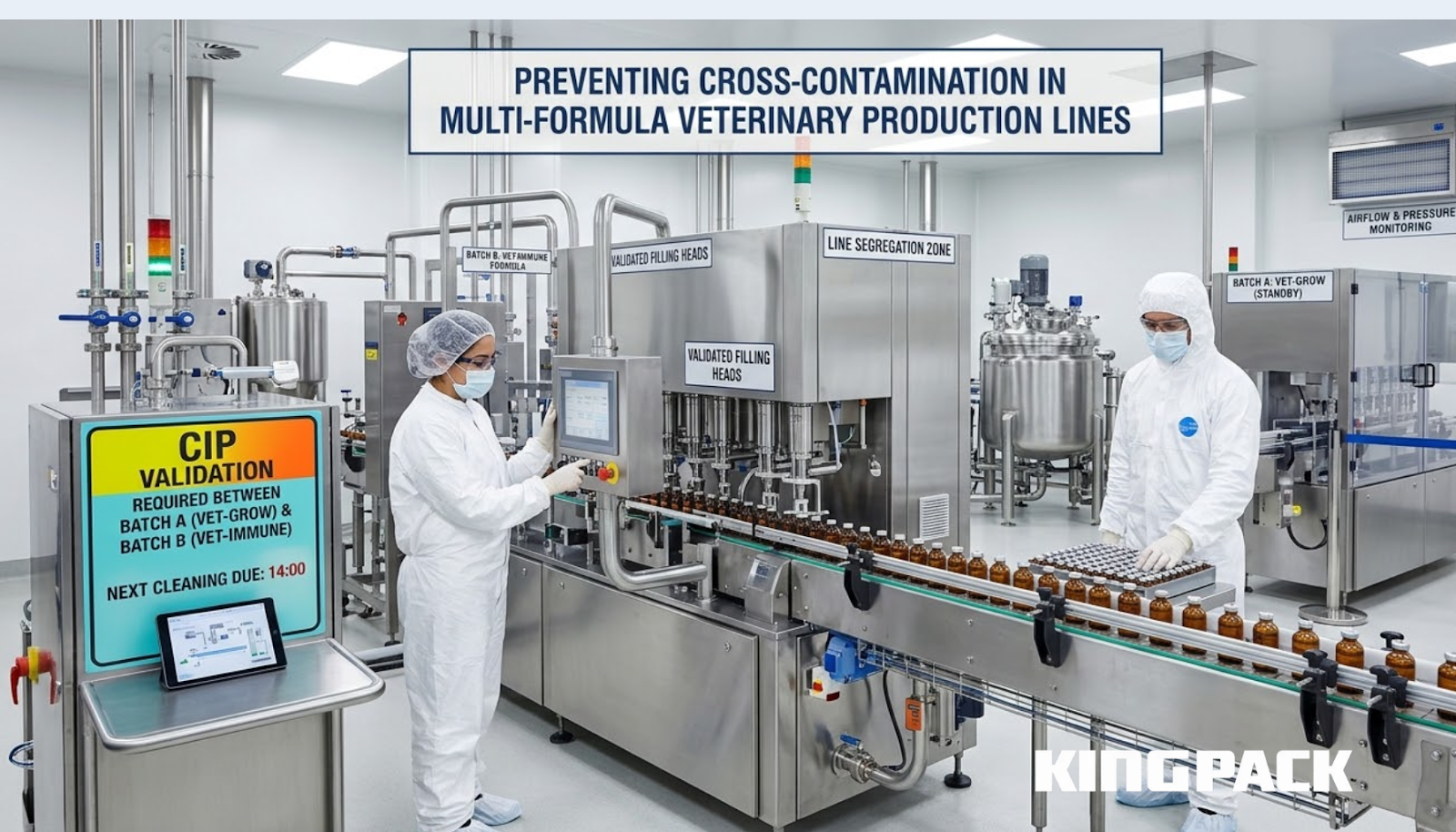
Running multiple formulations on a shared veterinary production and automatic capping machine lines is a commercial necessity for most manufacturers. Spot-on treatments, oral liquids, injectables, and alcohol-based sprays all share the same filling equipment, pipework, and production space in many facilities. That shared use creates one of the most persistent compliance risks in veterinary drug manufacturing: cross-contamination.
In this article, we cover the sources of cross-contamination in a multi-formula veterinary production line, how facility design and engineering controls prevent residue carryover between formulations, and what cleaning validation and automation strategies hold up under regulatory scrutiny.
We also explain how our veterinary GMP filling line configurations at King Pack are designed to address these challenges from the ground up.
Why Cross-Contamination Is a Critical Risk in Veterinary Manufacturing
Most veterinary manufacturers produce more than one product category. A facility running flea and tick spot-ons in the morning and oral deworming liquids in the afternoon is operating a multi-formula veterinary production line. The same pump, the same pipeline, and the same filling head service both products.
When a residue of the first formulation carries over into the second, the result is a contaminated batch. The contamination may be chemical, where an active ingredient from one formulation appears as an impurity in another. It may be microbiological, where biofilm from a previous product supports microbial growth in a subsequent one. Either way, the contaminated batch fails quality release and carries a recall risk.
Residue Carryover Risks Between Formulations
Recent regulatory inspection reviews show that over 35% of critical GMP observations in multi-product pharmaceutical sites are linked to cross-contamination, even when no confirmed product defect is identified. That figure tells you the scale of the problem. Contamination control in a veterinary drug manufacturing facility is not a background compliance task. It is one of the primary inspection priorities regulators bring to every audit of a shared facility.
Recall costs average $10 million per incident. For a veterinary manufacturer operating in multiple export markets, a recall triggered by cross-contamination also carries the risk of import suspension, loss of marketing authorization, and supply disruption that can take years to recover from.
Regulatory Consequences and Product Recall Risks
According to GMP Insiders, the consequences of cross-contamination extend across patient safety, regulatory compliance, and financial stability simultaneously. For veterinary products specifically, the EMA introduced improved Guidelines for Good Manufacturing Practice for Medicinal Products for Human and Veterinary Use, requiring adoption of adequate design and operation of manufacturing facilities, and appropriate use of Quality Risk Management principles to assess and control cross-contamination risk.
According to ScienceDirect’s retrospective FDA recall analysis, the most frequent causes for pharmaceutical recalls were sterility issues and inadequate compliance with current good manufacturing practices. For multi-formula veterinary lines, inadequate contamination control sits directly within that cGMP compliance category.
Recommended Reading: Trends in Veterinary Drop Packaging Equipment: From Manual to Fully Automated Sterile Filling – King Pack Machinery
Understanding Cross-Contamination Sources
Residual Product in Pipes, Pumps, and Filling Nozzles in Cap Feeding Systems
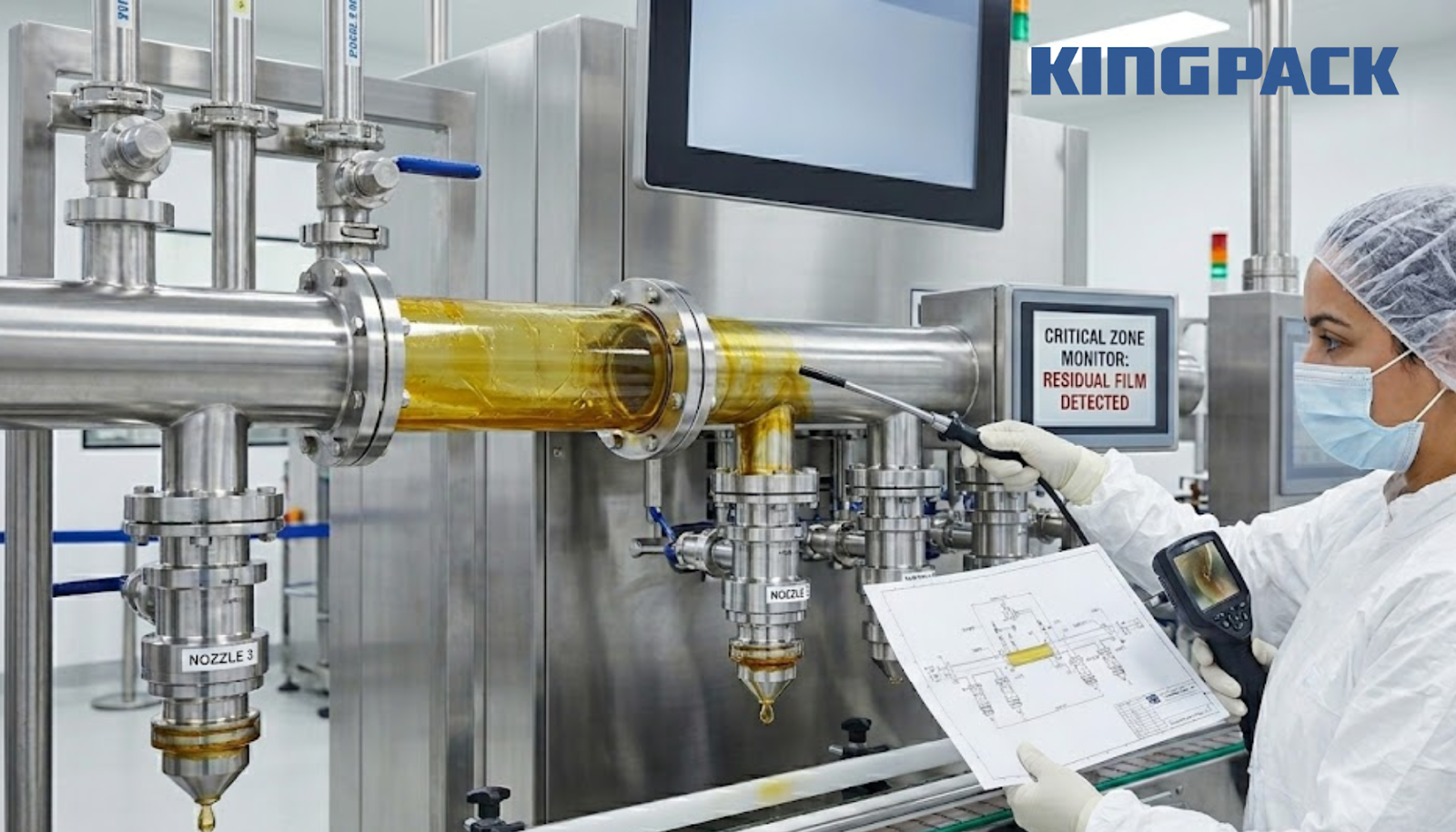
The most direct contamination source in multi-formula packaging lines is the residual product left in the wetted pathway after a batch ends. Every milliliter of formulation trapped in pipelines, pumps, or nozzles can contaminate the next run across different containers and container sizes.
In oil-based formulations, viscous carriers leave a thin film on internal surfaces. Without proper cleaning, this residue transfers during the next cycle. This risk extends beyond filling into bottle capping equipment, where leftover material can affect the capping process, including torque control and sealing performance in bottle capping systems.
Airborne Particles and Aerosols
Filling operations generate aerosols, especially with low-viscosity liquids and spray formats using trigger sprayers. These particles move through the air and settle on open containers, exposed surfaces, and components across packaging lines.
Pressure control between zones limits this movement. Clean areas operate at higher pressure, pushing air outward and reducing contamination risk. This control is critical in automated packaging lines where filling and bottle capping steps are closely linked.
Operator Handling and Manual Interventions
On average, the FDA has issued 1,279 drug recalls each year, many linked to cross-contamination. In 2019, 21 companies were cited, with many cases tied to manual handling during changeover.
Each manual step adds risk. Touching wetted parts, adjusting bottle cappers, or handling semi automatic capping machines without proper control introduces variation. Incorrect handling during bottle capping or when operators apply screw caps or snap on caps can spread residue across batches.
The more manual steps involved, the higher the risk. Reducing intervention through seamlessly integrated systems and consistent procedures is the right solution for stable production.
Improper Changeover Procedures
A weak changeover process creates serious risk. Visual checks alone are not enough. Residue may remain even when equipment appears clean.
This issue affects all stages, including filling and bottle capping equipment, where hidden residue impacts sealing quality. Proper validation, testing, and control across packaging machinery are essential to maintain clean transitions between batches and avoid contamination across different containers and various container sizes.
Recommended Reading: Trends in Veterinary Drop Packaging Equipment: From Manual to Fully Automated Sterile Filling – King Pack Machinery
Facility and Layout Design for Contamination Control
Cleanroom Zoning and ISO Class Segregation
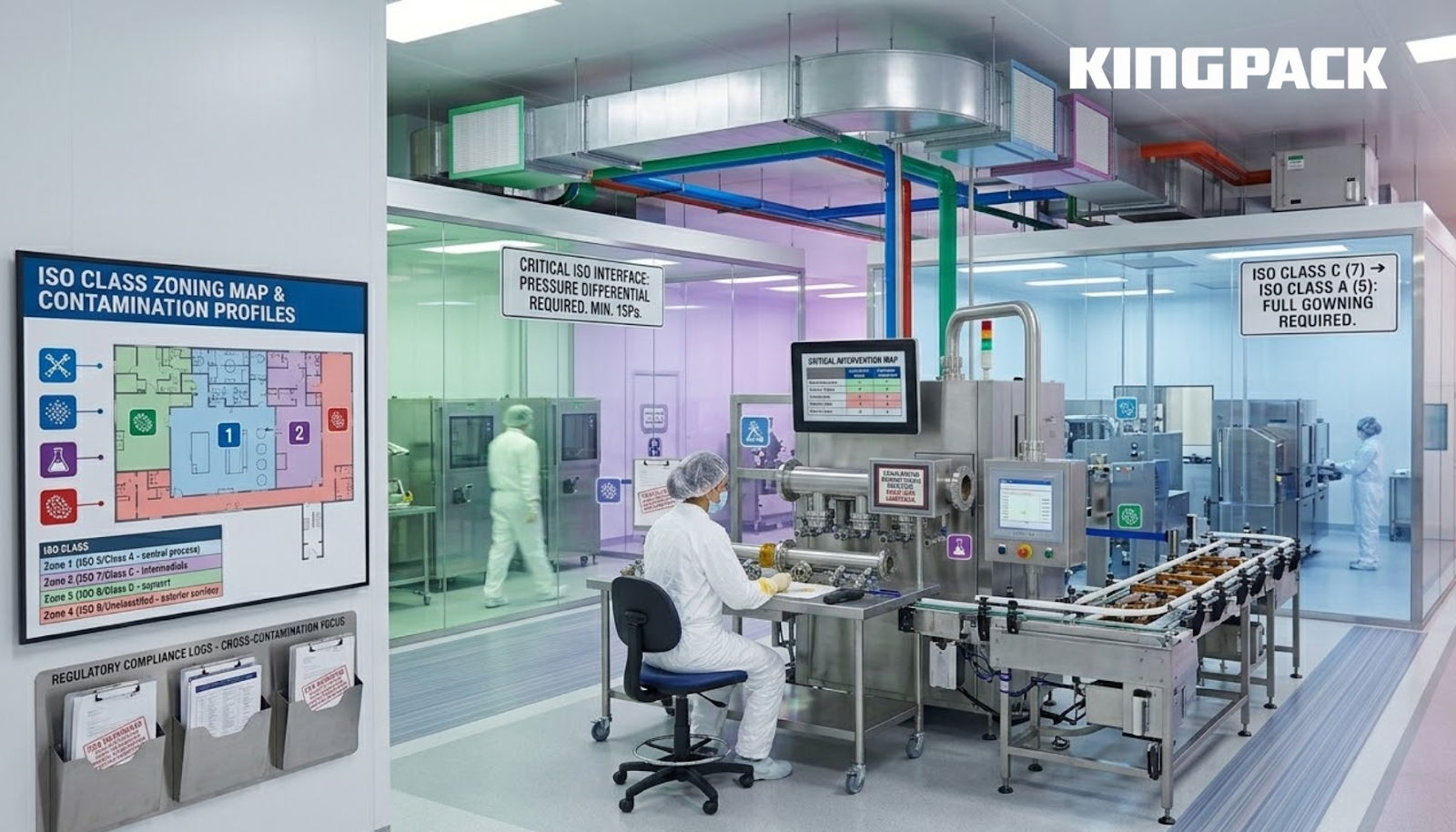
Effective contamination control in veterinary drug manufacturing hygiene starts with the physical layout of the facility. Products that share a filling line but carry incompatible contamination profiles should be separated by production scheduling, physical barriers, or dedicated equipment.
According to West Pharma’s analysis of EU GMP Annex 1, contamination in a pharmaceutical manufacturing facility can be broadly categorized into four main types: microbial, particulate, chemical, and cross-contamination, each posing significant risks to both patient safety and the manufacturer’s operational and reputational integrity. Cleanroom zoning separates these risk categories by assigning different production activities to different ISO-classified spaces.
| Zone Type | ISO Class | Typical Use in Veterinary Production |
| Sterile fill zone | ISO 5 (Grade A) | Sterile ophthalmic and injectable drops |
| Sterile background | ISO 7 (Grade B/C) | Solution preparation, component handling |
| Non-sterile liquid filling | ISO 8 (Grade D) | Spot-on, oral liquid, spray filling |
| General production support | Unclassified with controls | Cleaning, equipment storage, gowning |
Unidirectional Personnel and Material Flow
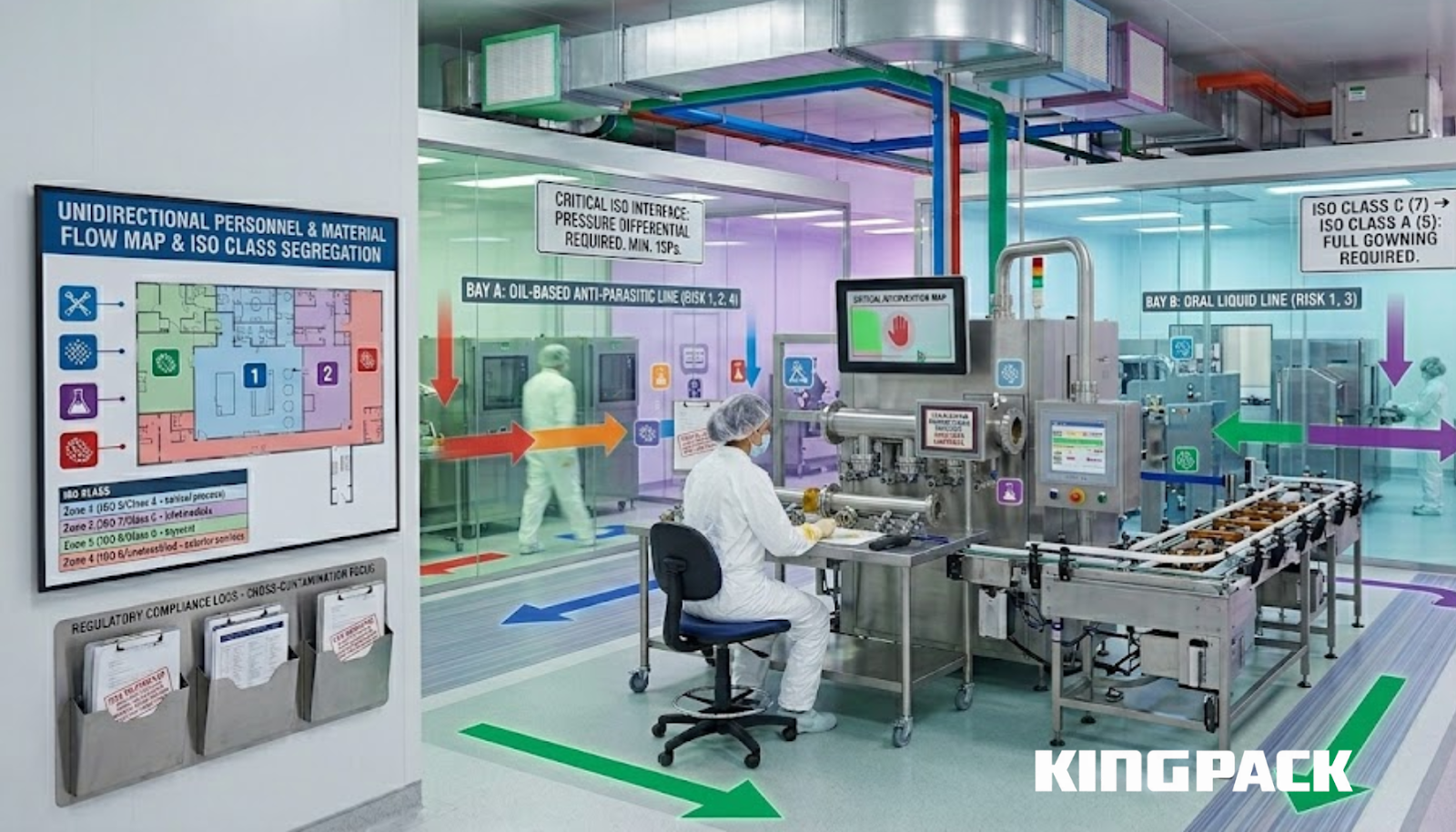
Personnel and materials entering a production area carry contamination from whatever they were previously in contact with. Unidirectional flow design ensures that personnel and materials move in one direction through the facility, from lower-cleanliness areas to higher-cleanliness areas, without backtracking through zones they have already passed.
This layout prevents a common contamination pathway: an operator who has been working near an oil-based anti-parasitic line re-entering a zone where an oral liquid is being filled, carrying residue on their gown or gloves.
Pressure Differentials Between Production Areas
Positive pressure in clean production zones relative to adjacent corridors and support areas prevents airborne contamination from entering the fill zone. The pressure differential must be large enough to maintain directional airflow even when doors are briefly opened during material transfer.
For facilities running multiple high-risk formulations, pressure cascade design assigns the highest positive pressure to the most sensitive fill zone and steps pressure down through each adjacent zone toward general support areas.
The decision to use dedicated or shared equipment for different formulations is a risk-based one. According to PIC/S guidance on cross-contamination in shared facilities, inspectors assess the level of hazard presented by the products handled in the context of shared facilities and equipment, considering health-based exposure limits and assessment for each substance.
Products containing hormones, antibiotics, or highly potent active ingredients typically require dedicated equipment. For lower-risk combinations, shared equipment with validated cleaning procedures between batches is acceptable, provided the cleaning validation demonstrates residue removal to below the health-based exposure limit for each product combination.
Recommended Reading: How to Achieve ±1% Filling Accuracy for High-Value Pet Spot-on Treatments – King Pack Machinery
Engineering Solutions for Multi-Formula Filling Lines and
Quick-Disassembly and Hygienic Design Components in Automatic Bottle Capping Machine
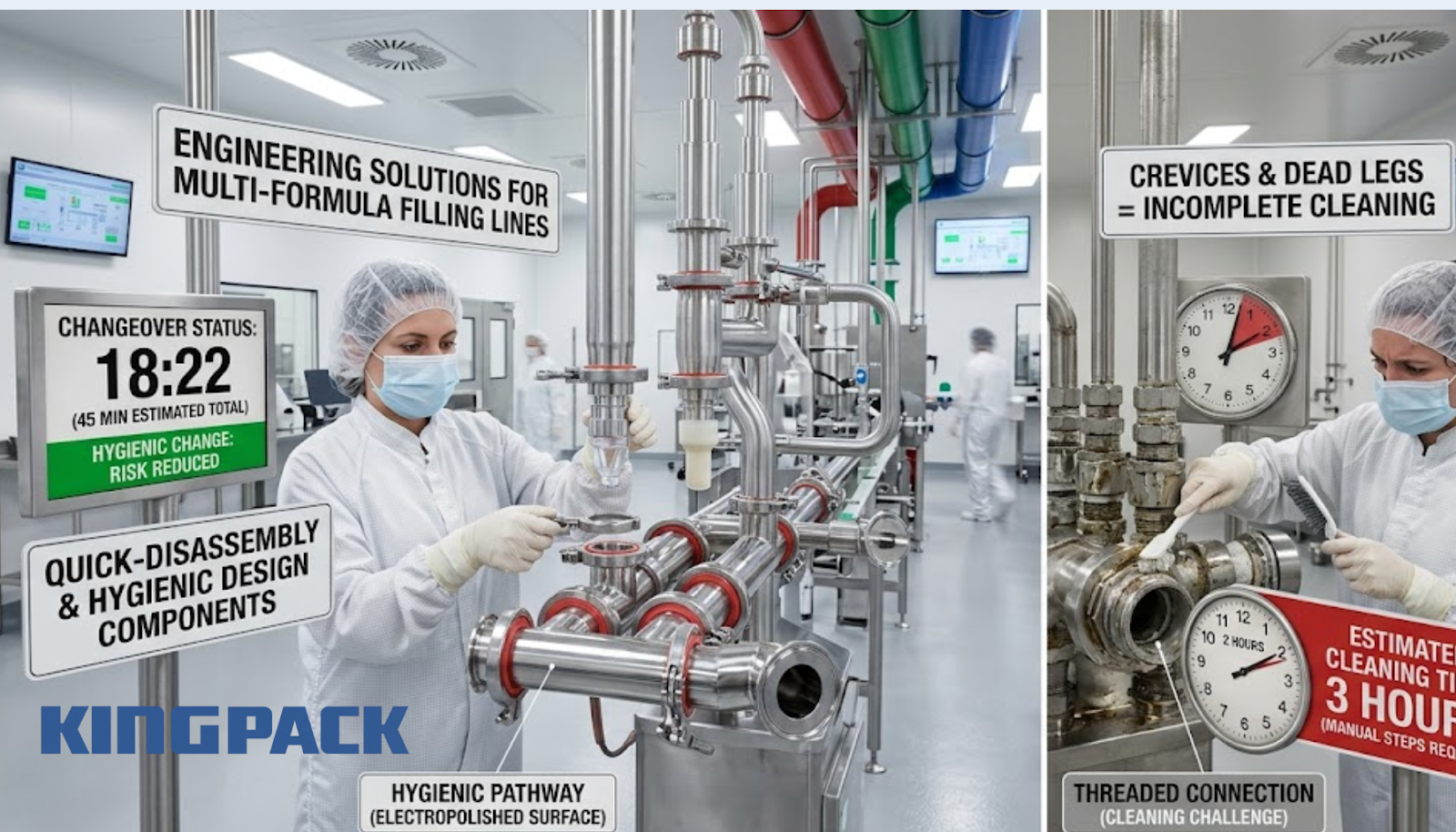
The physical design of filling equipment determines how thoroughly it can be cleaned between formulations. Components with threads, crevices, dead legs, or internal cavities that cannot be reached by cleaning solution will always retain residue, regardless of how long the cleaning cycle runs.
Our veterinary GMP filling line components use hygienic design principles throughout the wetted pathway. All internal surfaces are electropolished to a finish that prevents product adhesion. Connections use tri-clamp fittings rather than threaded joints, allowing tool-free disassembly in seconds. Every component that contacts the product can be removed, inspected, and cleaned individually before reassembly.
This design approach directly reduces the time required for product changeover and the risk of incomplete cleaning. When a changeover procedure can be completed in 45 minutes rather than three hours, the economic pressure to cut corners disappears.
Dead Volume Reduction in Pumps and Piping
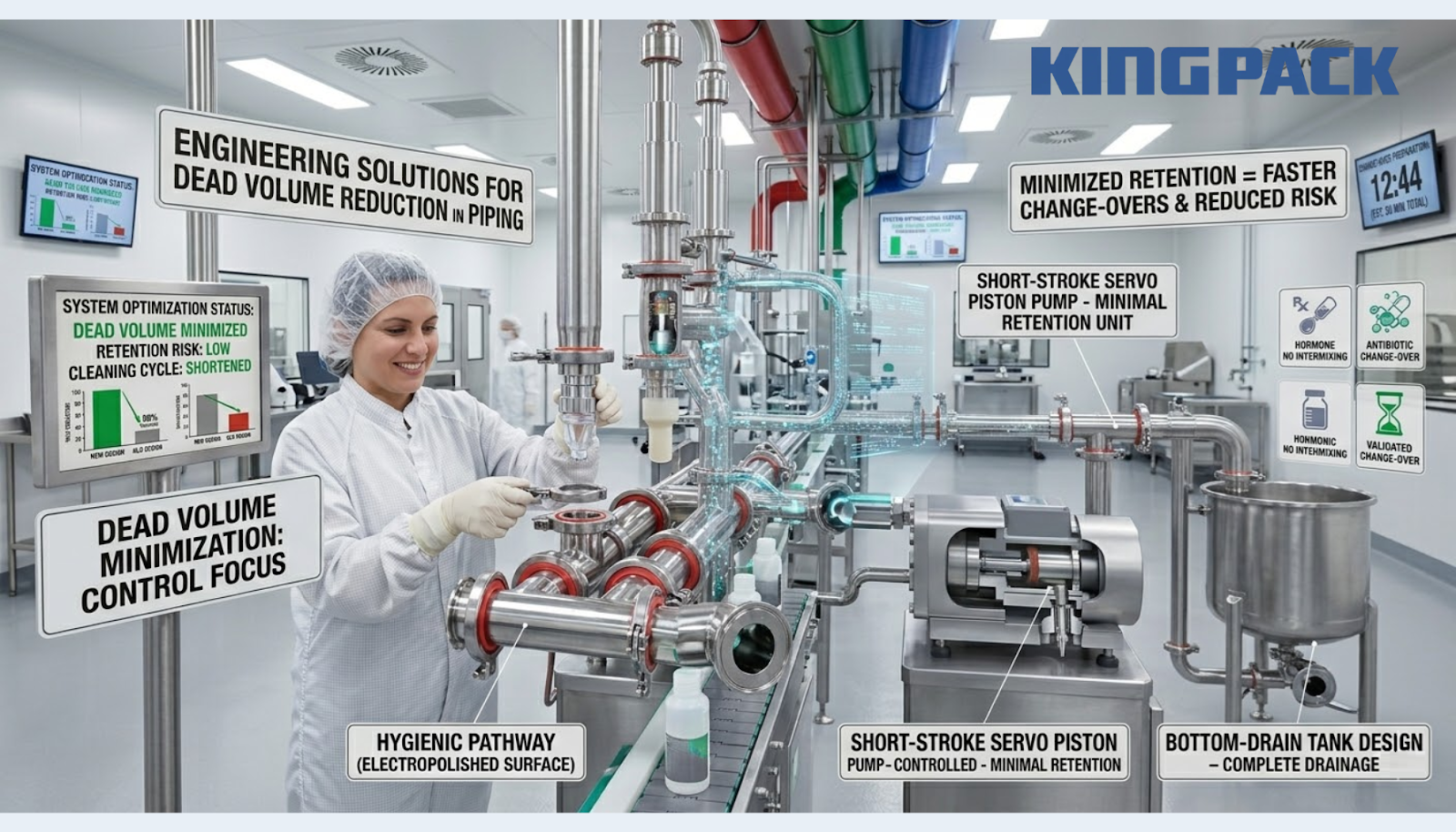
As we covered in our earlier article on precision pump design, dead volume in the wetted pathway is not just a financial problem. In a multi-formula veterinary production line, it is a contamination problem. Every milliliter of retained formulation after a batch is a potential carryover contaminant into the next product.
Our filling systems use short-stroke servo piston pumps, direct-route pipeline configurations, and bottom-drain tank designs to minimize the volume of product retained in the system after each batch. Less retained product means less contamination risk and shorter cleaning cycles.
Automatic CIP Systems
Manual cleaning of a multi-formula veterinary production line is a high-risk activity. The effectiveness of the cleaning depends on the operator following the procedure exactly, using the correct concentrations and temperatures, and spending the correct amount of time on each step. Variability in any of these factors produces variability in cleaning outcomes.
Automatic CIP systems remove operator variability from the cleaning process entirely. The cleaning sequence, detergent concentration, flow rate, temperature, and dwell time are all programmed, validated, and executed automatically. The system records every parameter for every cleaning cycle, producing a cleaning batch record that is as detailed and traceable as the production batch record.
According to EHEDG Guidelines on Hygienic Design of Food Processing Equipment, automated CIP systems consistently outperform manual cleaning in residue removal across all product contact surfaces, particularly in complex filling head assemblies with multiple internal passages. The same principle applies directly to veterinary pharmaceutical filling equipment.
SIP for Sterile Veterinary Products
For veterinary production lines that include sterile products alongside non-sterile formulations, CIP alone is not sufficient. Steam-in-place sterilization follows the CIP cycle and provides the sterility assurance required before filling a sterile product on equipment that was previously used for a non-sterile formulation.
SIP circulates saturated steam at 121°C through all wetted pathways for a validated dwell time. Temperature sensors at the coolest points in the system confirm that sterilization conditions were achieved throughout. The SIP cycle record is included in the batch documentation for the subsequent sterile fill batch.
Changeover Management and Cleaning Validation
Standard Operating Procedures for Formula Switching in bottling lines
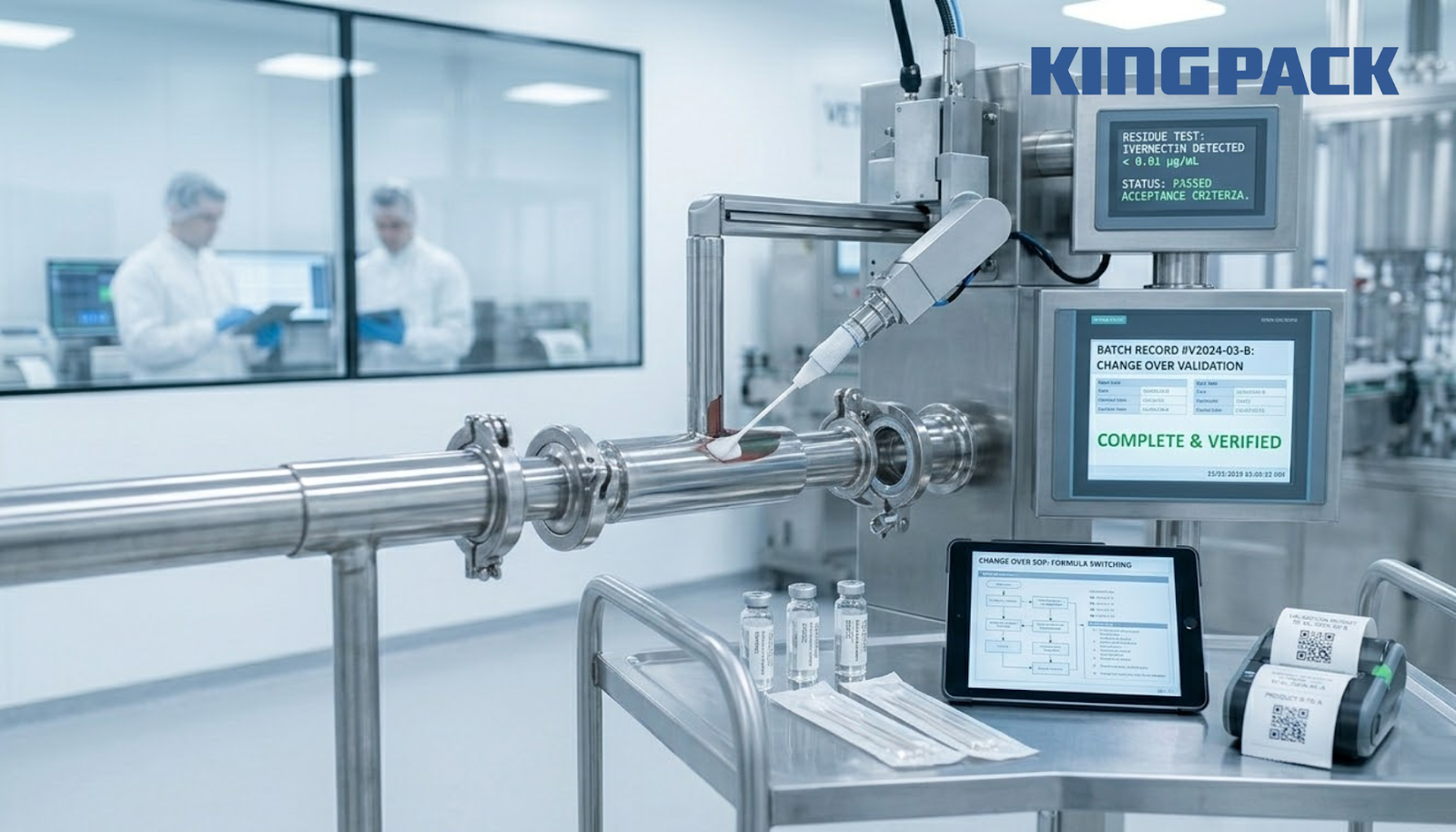
A changeover procedure is only as strong as its weakest step. In veterinary bottling equipment and packaging lines, the SOP for formula switching must remove ambiguity at every stage to protect accuracy and efficiency across the full range of products.
Effective SOPs define the sequence of disassembly, cleaning agents and concentrations, rinse volumes, and sampling plans. They also cover parameters across connected bottle capping machines, including cap feeder, chuck cappers, and inline capping machines, where residue can affect how caps tighten and how much force is needed to apply pressure. This level of control supports consistent performance across different container shape and diameter.
Swab Testing and Residue Detection Limits
Visual inspection is not enough. Swab testing across defined surfaces remains the standard for verifying cleaning in shared industries like veterinary and beverage production.
Residue limits are based on health exposure levels for each active ingredient. These limits are strict, so cleaning must reach a high level of accuracy and precision. Even small residue levels can affect how systems tighten closures or impact sealing consistency in downstream bottle capping machines handling flat caps or similar formats.
Validation Protocols and Documentation
According to WHO Technical Report Series 1025, Annex 3, cleaning validation for shared pharmaceutical equipment must demonstrate that the cleaning procedure consistently removes product residues, cleaning agents, and microbial contamination to below defined acceptance limits. The validation must cover worst-case conditions, including the most difficult product to clean and the longest hold time before cleaning.
For a multi-formula veterinary production line, cleaning validation is performed for each product combination run on the shared equipment, not just for the individual products in isolation.
Digital Batch Records and Traceability Systems
Paper-based batch records introduce transcription errors and make traceability across multiple product changeovers difficult to audit. Our cross contamination control system configurations include PLC-based electronic batch recording that captures production parameters, CIP cycle data, swab test results, and cleaning validation status in a single linked record for each batch.
This digital traceability means that if a contamination event is ever suspected, the full history of every product run on the line, including every cleaning cycle between them, can be retrieved and reviewed in minutes rather than hours.
Recommended Reading: Cross-Contamination Prevention: The Gold Standard for Multi-Formula Pet Drop Production – King Pack – King Pack Machinery
Automation to Minimize Human Contamination Risks
Closed Filling Systems and Enclosed Transfer
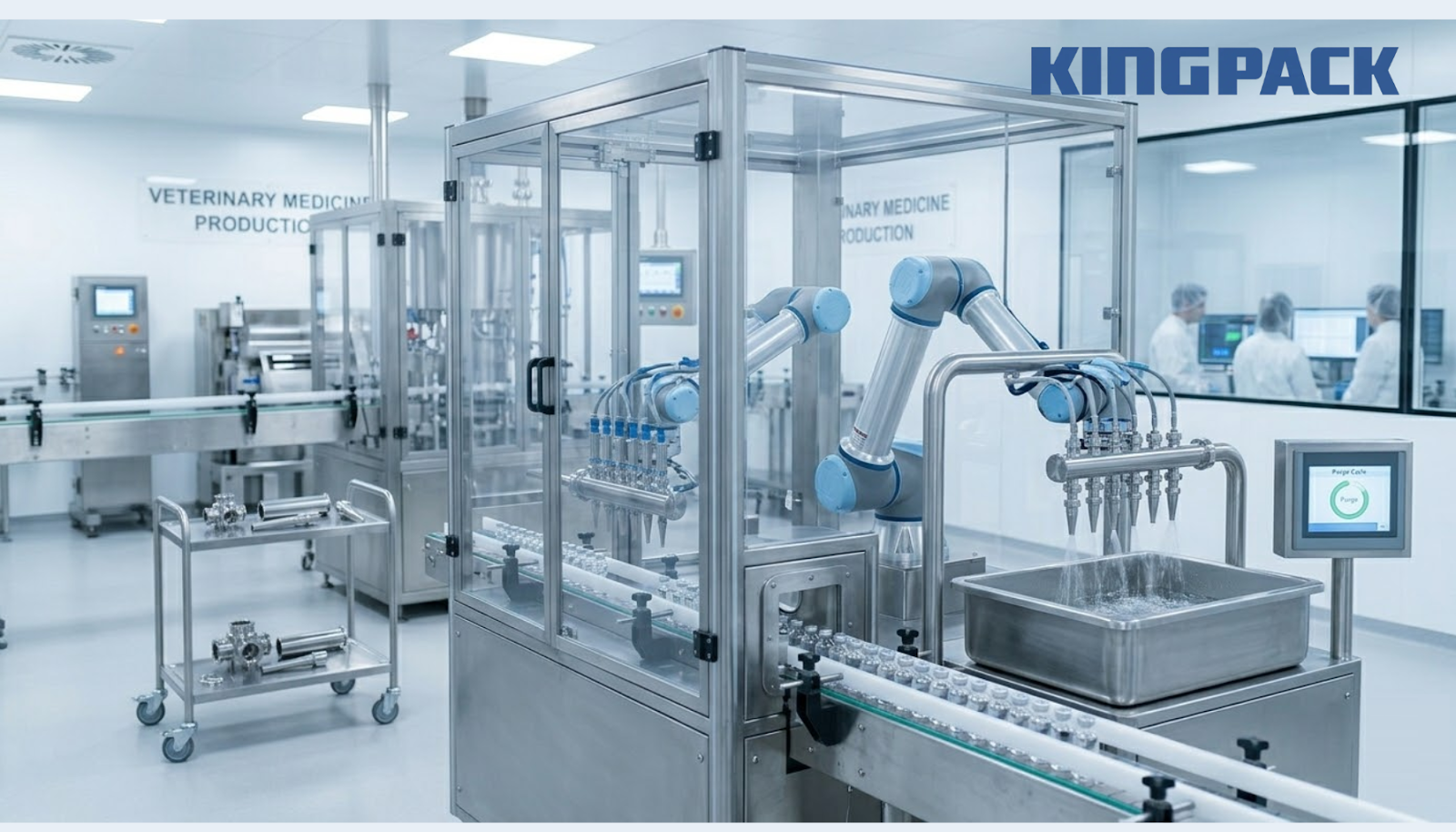
Open product transfer between vessels is one of the highest contamination risk steps in a multi-formula veterinary production line. Liquid poured from one vessel to another generates aerosols, exposes the product to the fill room atmosphere, and creates spillage risk on equipment surfaces.
Closed transfer systems connect the formulation vessel directly to the filling machine through sealed pipework. The product never contacts the fill room atmosphere during transfer. Aerosol generation is eliminated at the transfer step.
Automatic Nozzle Cleaning and Purging Cycles
Between formulations, filling nozzles require cleaning that is both thorough and verifiable. Our contamination control in liquid filling designs include automatic nozzle purging cycles that flush a defined volume of cleaning solvent through the nozzle assembly at the end of each batch, before the main CIP cycle begins.
This pre-purge removes the bulk of the product residue from the nozzle internals, reducing the contamination load that the CIP cycle must handle. It also prevents the residue from drying inside the nozzle between the end of production and the start of cleaning, which significantly reduces residue removal difficulty.
Smart Alarms and Interlock Controls
Automation reduces human contamination risk, but it requires interlock controls to prevent the filling line from operating outside validated conditions. Our veterinary pharmaceutical compliance filling systems include interlocks that prevent the filling operation from starting unless the CIP cycle for the previous product has been completed and recorded, the post-cleaning rinse conductivity is within specification, and the swab test result for the previous changeover has been entered and accepted in the batch record system.
These interlocks make it mechanically impossible to start a new product batch without completing the verified cleaning steps for the previous one.
Recommended Reading: Automatic Case Packaging Machine — Intelligent Transformation of End-of-Line Packaging – King Pack Machinery
Handling High-Risk Formulations
Different formulation categories carry different contamination risk profiles. Understanding those profiles is essential for designing an appropriate cleaning validation and segregation strategy.
| Formulation Type | Primary Contamination Risk | Recommended Control |
| Oil-based anti-parasitics | Viscous residue in pipework and pump chambers | Extended CIP with solvent-compatible detergent, residue swab testing |
| Alcohol-based veterinary sprays | Vapor carryover and surface residue | Local exhaust during changeover, dedicated nozzle assemblies |
| Hormone or antibiotic products | Potent active at very low carryover limits | Dedicated equipment or validated cleaning to health-based exposure limit |
| Allergen-sensitive products | Trace carryover triggers adverse reactions | Full line segregation or dedicated campaign production |
For hormone-containing veterinary products specifically, the health-based exposure limit for the active ingredient in the subsequent product may be so low that shared equipment cleaning validation is not practically achievable. In those cases, dedicated equipment or fully separate production campaigns are the appropriate engineering response.
Best Practices for Multi-Product Veterinary Facilities
Contamination control in veterinary drug manufacturing hygiene is most effective when it is built into the facility and equipment design, not added as a procedural layer after installation. The following practices apply across all multi-formula veterinary production lines:
- Conduct a formal contamination risk assessment for every product combination before the line is designed, identifying which formulations can share equipment and which require segregation
- Schedule production campaigns so that the most potent or most difficult-to-clean formulations are run last before a full line shutdown and deep clean, rather than between other products
- Train operators on the contamination rationale behind every step of the changeover SOP, not just the sequence of steps, so that deviations are recognized and escalated rather than worked around
- Perform regular environmental monitoring swabs during production, not only during cleaning validation, to confirm that the contamination control system is performing as validated under real production conditions
Common Mistakes in Multi-Formula Production Lines
The most costly contamination events in veterinary pharmaceutical facilities typically trace back to one of these design and operational failures:
- Underestimating residue volume in transfer pumps and assuming that a visual check of the nozzle is sufficient evidence of a clean system
- Poorly designed piping with dead legs, horizontal runs, and low-point traps that hold product regardless of how long the CIP cycle runs
- Lack of documented cleaning validation for specific product combinations, leaving the facility unable to demonstrate to an inspector that carryover has been controlled to an acceptable limit
- Excessive manual handling steps in the changeover procedure that introduce operator variability into what should be a controlled, verifiable process
- No physical or procedural separation between campaigns of hormone or antibiotic products and standard antiparasitic formulations, creating a contamination risk that cleaning alone cannot reliably control
Why Choose King Pack for Contamination-Controlled Veterinary Lines
At King Pack, our multi-formula veterinary production line designs are built around contamination control from the first engineering drawing. Hygienic component design, minimal dead volume, integrated CIP and SIP automation, and full electronic batch traceability are standard features of our veterinary GMP filling line configurations, not options added at extra cost.
Our pharmaceutical and medical filling lines support flexible multi-formula configuration with quick-change filling heads, validated CIP cycles for common veterinary formulation combinations, and interlock controls that enforce the changeover verification sequence before each new product batch can begin.
We work with manufacturers during the facility design stage to conduct product combination risk assessments, specify appropriate equipment segregation strategies, and develop the cleaning validation framework that will support regulatory submissions and inspection-readiness from day one of production.
If you are designing or upgrading a multi-formula veterinary production facility, contact King Pack to discuss a contamination-controlled filling line solution tailored to your specific product portfolio and production requirements.