
Introduction
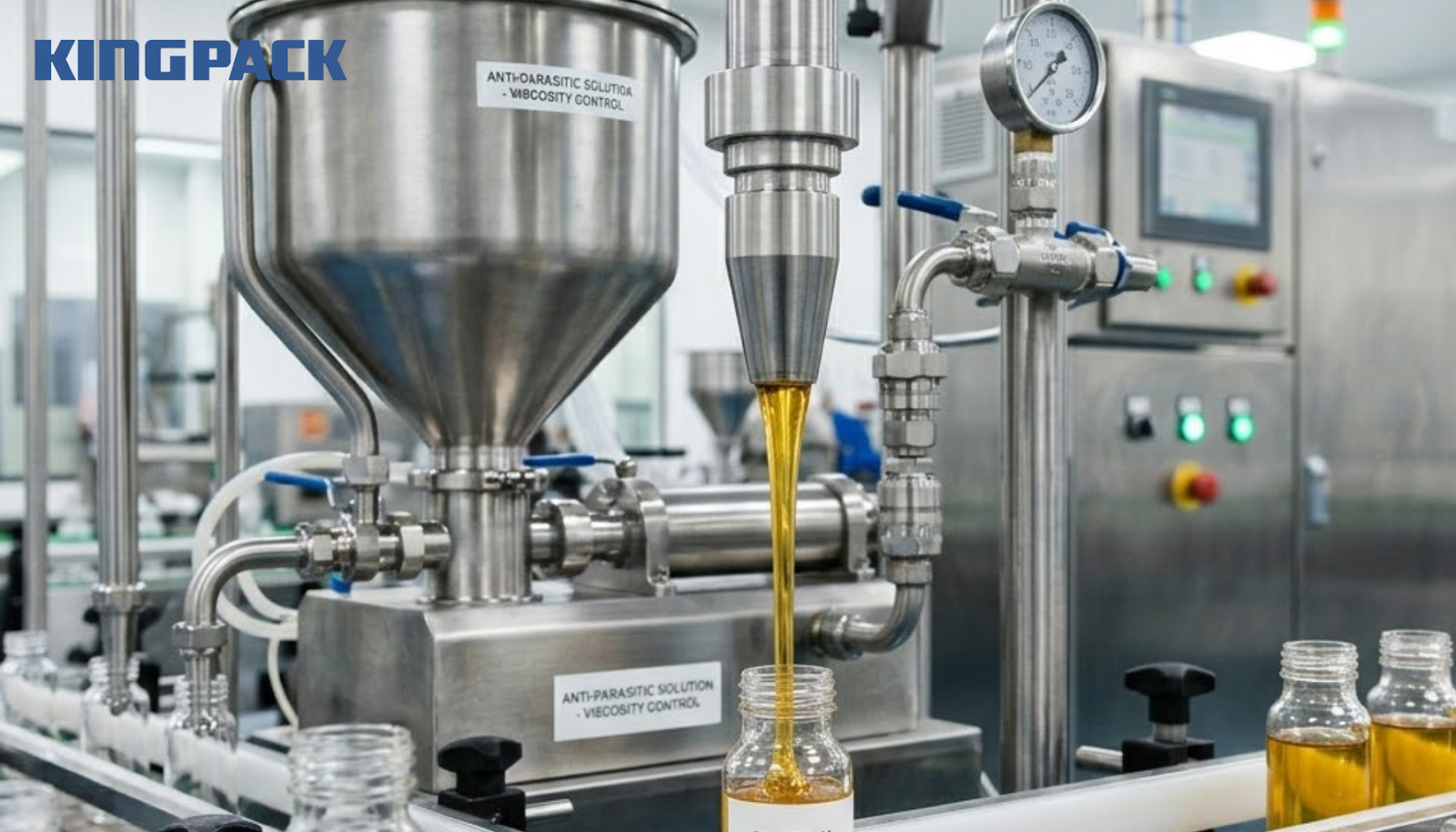
Filling oil-based anti-parasitic treatments is a different challenge from filling most other veterinary liquids. The formulations are viscous, temperature-sensitive, and prone to stringing at the nozzle. Standard filling equipment is typically designed around water-like liquids, and when it is used with oily antiparasitic solvents, accuracy and cleanliness both suffer.
In this article, we cover why oil-based spot-on formulations create specific problems in production, what goes wrong when viscosity is not properly controlled, and which pet spray filling machine solutions reliably solve these problems at scale.
According to POMAIS, topical spot-ons accounted for 47.3% of the veterinary parasiticides market by mode of administration in 2024. A large share of those products are oil-based. Getting the filling right is not optional for manufacturers competing in this segment.
Why Oil-Based Veterinary Formulations Are Challenging to Fill
Typical Characteristics of Oil-Based Spot-On Treatments
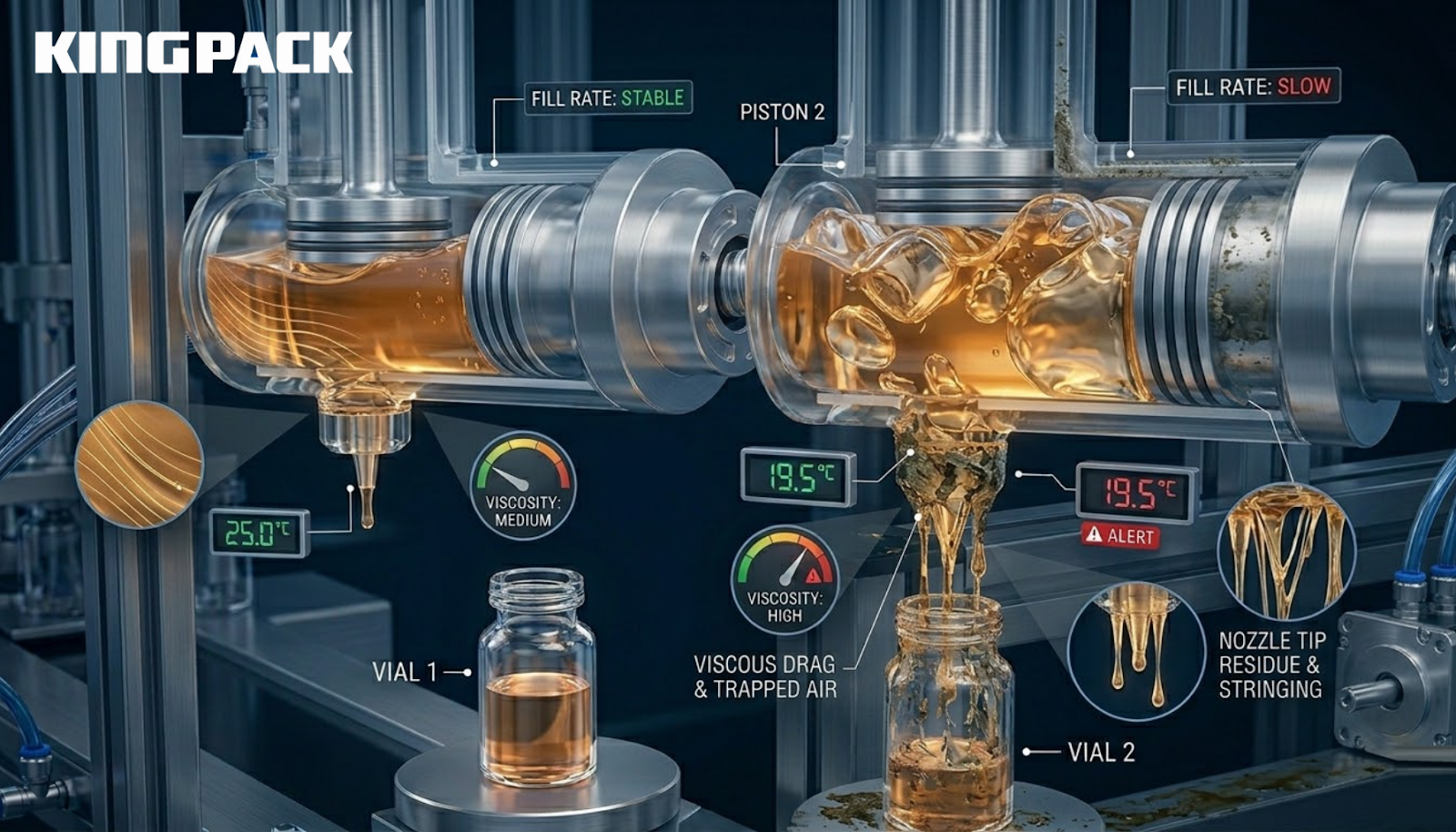
Oil-based antiparasitic formulations behave nothing like water. They flow slowly, respond to temperature, and leave residue on every surface they contact. Understanding these properties is the starting point for solving any filling problem.
The three characteristics that create the most production difficulty are:
- Medium-to-high viscosity that resists fast volumetric dosing and slows down refill cycles
- Temperature-sensitive flow behavior, where viscosity shifts measurably with ambient temperature changes of even a few degrees
- Sticky, slow-draining properties that cause oil to string and cling at the nozzle tip after each fill
Reanin study shows that isopropyl myristate is widely used as a vehicle for anti-parasitic pour-ons, and similar carrier solvents are found across most spot-on formulations. These solvents are chosen for their skin penetration properties, but their flow characteristics create real difficulties in a high-speed filling environment.
Recommended Reading: Handling Viscosity: Optimizing the Filling of Oil-Based Anti-Parasitics for Pets – King Pack – King Pack Machinery
Common Veterinary Applications of Different Types
The products most affected by viscosity-related filling challenges include flea and tick spot-on solutions, endoparasitic oil suspensions, and combination antiparasitic formulas covering both internal and external parasites. Each of these uses a carrier that behaves very differently from an aqueous base.
Water has a viscosity of roughly 1 centipoise at room temperature. Many oil-based veterinary carriers sit between 5 and 30 centipoise, and some combination formulas are higher still. That difference in flow resistance directly affects how quickly a filling chamber can refill, how cleanly a nozzle can cut off, and how stable fill volume remains across a long production run.
Key Problems Caused by Poor Viscosity Control
Inconsistent Filling Volume During Filling Process
When a filling machine is not designed for oil-based liquids, viscosity variation directly causes fill volume variation. This happens in three ways.
The refill cycle takes longer with viscous liquids. If the machine speed is set for a water-like product, the filling chamber does not have enough time to fully refill before the next fill stroke. The result is a short fill on every other unit, or worse, random variation across the run.
Air pocket formation is the second mechanism. Thick liquids trap air more readily than thin ones, particularly in pipelines and filling heads that are not degassed. Each air pocket displaces product volume, creating underfill events that are difficult to detect without 100% in-line weight checking.
The combined result is fill volume deviation that exceeds ±1%, the standard tolerance for veterinary spot-on production. The global veterinary parasiticides market was valued at USD 12.94 billion in 2024, according to Cnagrochem and with that level of market value at stake, manufacturers cannot afford the batch rejection and API loss that comes from inconsistent filling.
Recommended Reading: Complete Guide to Pet External Parasite Drop Production Equipment: Filling + Capping + Packaging All-in-One – King Pack Machinery
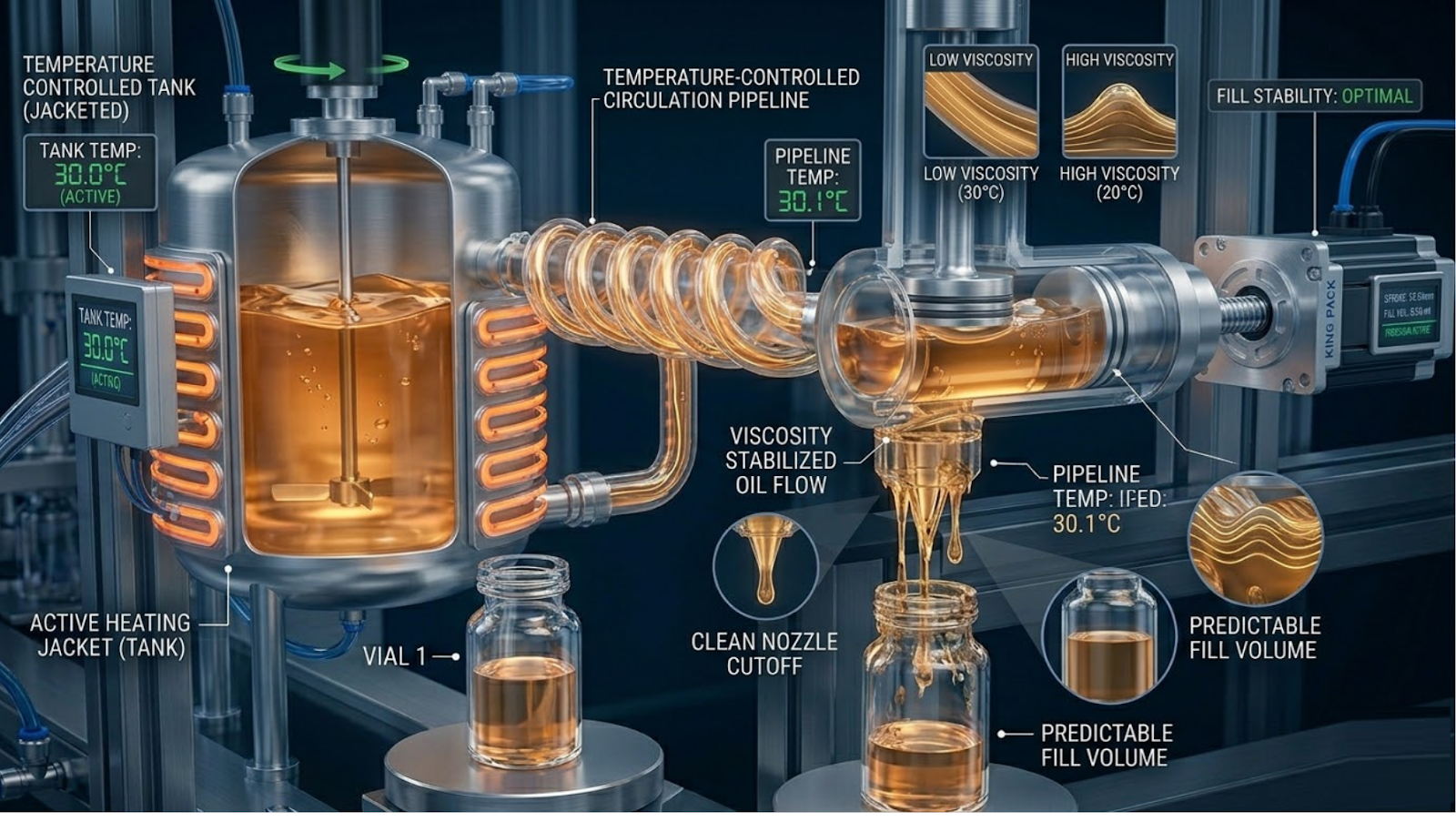
Dripping and Stringing at the Nozzle during Liquid Filling
Oil does not cut cleanly. After each fill stroke, a standard nozzle leaves a trailing film or droplet at the tip. That residue varies in size from cycle to cycle, which introduces a direct source of fill variation. It also contaminates the outside of the pipette neck, creating an unclean final package.
In a high-speed line, this is not a minor cosmetic issue. Contaminated pipette necks affect cap sealing integrity. Residue that drops into the filling zone becomes a cross-contamination risk if multiple formulations are run on the same line.
Production Instability at High Speed Filling Lines
At production speeds above 3,000 units per hour, the interaction between oil viscosity, pipeline pressure, and fill cycle timing becomes harder to control. Any imbalance in the feeding system causes pressure fluctuations. Those fluctuations create fill-to-fill variation that worsens as line speed increases.
The rejection rate climbs, and so does the frequency of operator intervention details. What starts as a filling accuracy problem becomes a throughput problem.
Core Technical Solutions for Oil-Based Anti-Parasitic Filling
Servo-Driven Piston Filling for Precise Oil Dosing
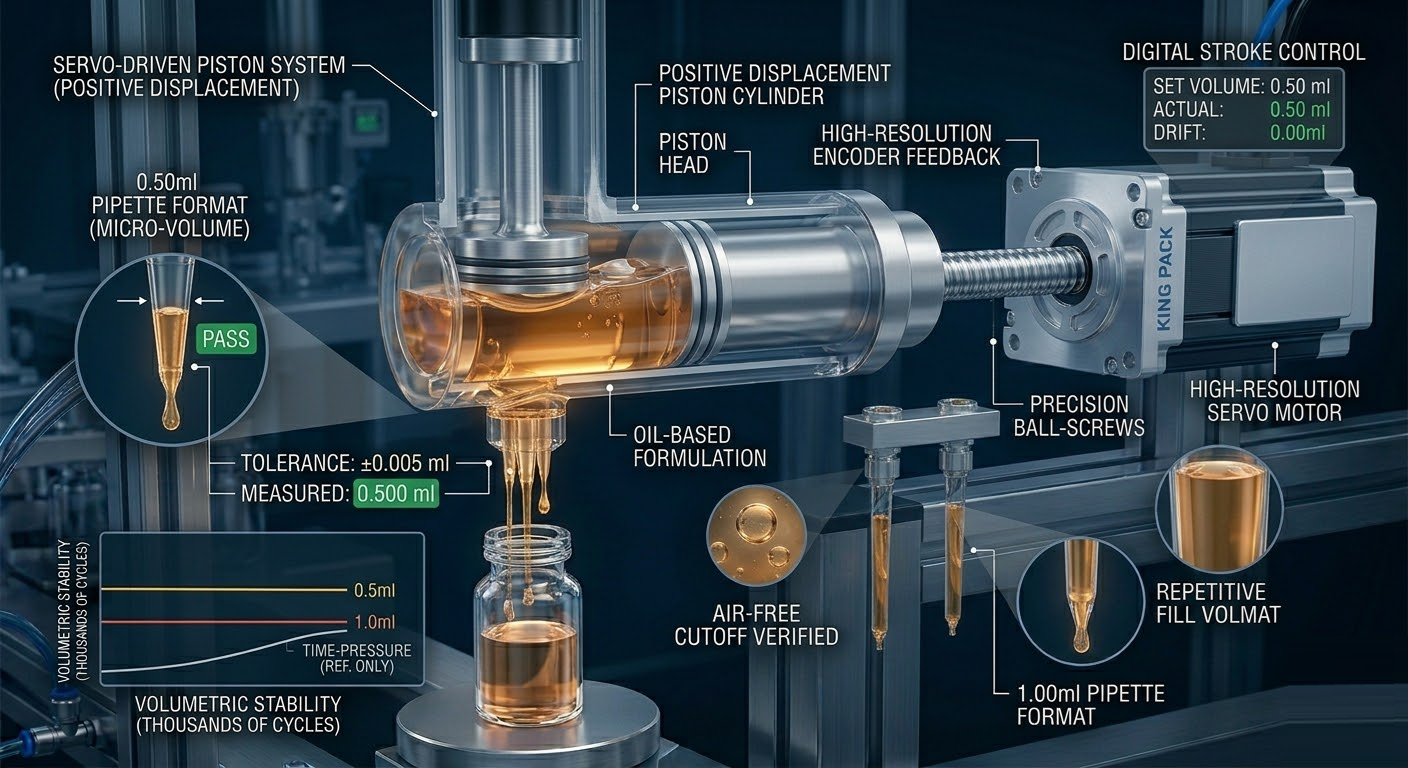
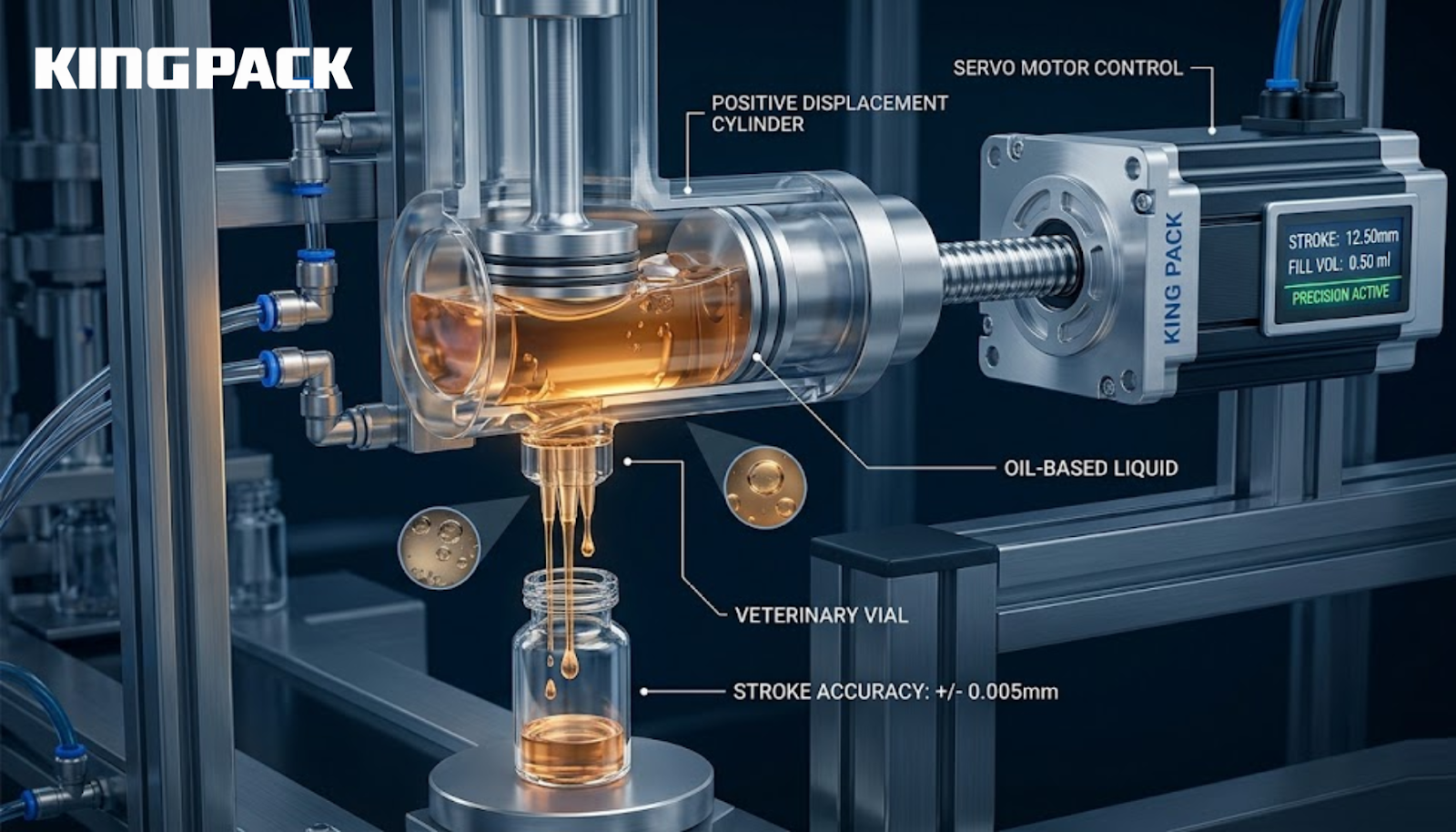
The piston filling mechanism is the right choice for viscous products like oil-based liquids because it uses positive displacement rather than time-pressure dosing. It does not rely on flow rate remaining constant. Instead, it physically displaces a fixed volume of liquid per stroke, regardless of viscosity.
In a servo-driven system, the piston stroke length is set digitally and controlled by a high-resolution servo motor. The fill volume is accurate and repeatable because it is mechanically defined, not inferred from pressure or timing.
This matters especially for micro-volume spot-on formats. At 0.5 ml or 1.0 ml fill volumes, even a 0.01 ml deviation represents 1% to 2% of the total volume. A servo piston system holds that tolerance across thousands of cycles without drift, making it suitable for cosmetic products, personal care formulations, and veterinary liquids alike.
Our pharmaceutical and medical filling lines at King Pack use servo-driven piston dosing as the standard mechanism for veterinary liquid filling. The system covers fill volumes from 0.5 ml to 5 ml and is calibrated specifically for oil-based solvent behavior. These filling machines are equally equipped to handle medicinal aerosol filling, cosmetics industry applications, cleaning agents, air fresheners, hair spray, and household chemicals across complete packaging lines.
Anti-Drip and Anti-String Filling Nozzle Design for Precise Filling
The nozzle is where most oil filling problems become visible. Our filling nozzles for oil-based veterinary liquids are designed around three specific technical details:
- Bottom-up filling, where the nozzle enters the pipette and dispenses from the base upward, reducing foam and air entrapment in plastic containers
- Mechanical shut-off with a positive cut-off valve that severs the liquid column cleanly at stroke end, with no trailing film
- Vacuum suction at cut-off, which actively draws the residual droplet back into the nozzle rather than letting it fall into the filling zone
The result is a clean fill, a clean pipette neck, and consistent volume delivery across the full production run — a safety and hygiene standard that applies equally to aerosol cans, filling cans, and precision veterinary containers.
Temperature Control for Viscosity Stabilization
Oil viscosity changes with temperature. A formulation at 20°C may be noticeably thicker than the same formulation at 30°C. In a production environment where ambient temperature varies between shifts or seasons, this creates an uncontrolled variable that directly affects fill accuracy.
The solution is a heated jacket on the material tank combined with temperature-controlled circulation through the filling pipeline. By maintaining the formulation at a defined temperature throughout the production run, viscosity stays within a fixed range.
Fill volume becomes predictable because the liquid’s behavior is predictable. This principle plays a critical role across industries where viscous products require thermal stabilization — from cosmetics industry lines filling aerosol cans to packing machines handling semi automatic aerosol formats for personal care and air fresheners.
This is particularly important for winter production in cold facilities, and for combination formulas that use higher-viscosity carriers.
Optimized Material Supply System for Accurate Filling
The pipeline between the bulk tank and the filling head is often where oil-based filling systems fail quietly. Long pipelines, sharp bends, and undersized pumps all create pressure drops that translate directly into fill inconsistency.
Our modular design approach applies three principles to keep material supply stable across complete packaging lines and semi automatic configurations:
- Short pipeline configuration, keeping the distance between tank and nozzle as short as practically possible to minimize pressure loss and temperature drop
- Pressure-stable gear pump feeding, which maintains consistent supply pressure regardless of tank fill level or line speed variation across packaging machines and packing machines
- Inline degassing to remove dissolved air from the formulation before it reaches the filling head, eliminating the air pocket problem at its source
Together, these elements mean the filling head receives a steady, air-free, temperature-controlled stream of product throughout the run. The mechanical accuracy of the servo piston then delivers that product into each pipette at ±1% tolerance — the standard that defines serious aerosol filling and veterinary liquid filling business alike.
Micro-Volume Accuracy in Oil-Based Spot-On Filling
Achieving accurate filling at ±1% with an aqueous liquid at 10 ml is straightforward. Achieving it with viscous products like oil-based solvents at 1 ml requires significantly more engineering precision, and the consequences of missing it are proportionally larger.
Why ±1% Is Harder with Oil
Oil has inertia that water does not. When a piston completes its stroke and the shut-off valve closes, the oil column does not stop instantly. It continues moving briefly due to its own momentum and the residual pressure in the pipeline. That post-stroke flow adds a small, controlled but variable volume to each fill.
At 10 ml, this effect is negligible. At 1 ml, a 0.01 ml post-stroke addition represents a full 1% overfill. At 0.5 ml, the same effect is a 2% deviation. Without precise filling calibration to account for this behavior, filling lines running at high speed on a 1 ml spot-on format will produce fills that are systematically high and variable across the entire liquid filling process.
Servo calibration solves this by allowing the piston stroke to be adjusted in fine increments until the actual delivered volume matches the target filling volume at the specific viscosity and temperature of the liquid products being filled. This calibration is stored as a product recipe and recalled for each SKU, giving the filling process reliable, controlled accuracy across different types of formulations.
The API Cost Implication
The financial argument for precise filling at ±1% accuracy is direct. Consider a 1 ml spot-on formulation where the active ingredient costs $80 per 100 ml. A consistent 0.02 ml overfill per unit represents $0.016 in waste per pipette. At a production volume of 500,000 units per year, that is $8,000 in recovered value from closing a deviation that most manufacturers do not even measure.
At higher API costs or larger production volumes, the number grows quickly. Production lines handling oil-based liquid products at this fill volume cannot rely on equipment calibrated to industry standards for less demanding solutions.
This is why precision calibration on oil-based filling lines is not just a quality matter. It is a direct production economics decision, and the difference between controlled accuracy and unmanaged deviation determines whether the filling process operates at the highest level of efficiency or generates avoidable waste at speed.
The table below shows how fill deviation at different volumes translates to annual API loss at a reference API cost of $80 per 100 ml:
| Fill Volume | Deviation per Unit | Units per Year | Annual API Loss |
| 0.5 ml | 0.01 ml (2%) | 500,000 | $4,000 |
| 1.0 ml | 0.02 ml (2%) | 500,000 | $8,000 |
| 2.5 ml | 0.05 ml (2%) | 500,000 | $20,000 |
| 5.0 ml | 0.10 ml (2%) | 500,000 | $40,000 |
Closing that deviation from 2% to ±1% halves those figures. Closing it further reduces them proportionally.
GMP and Veterinary Compliance Considerations
A filling machine running oil-based antiparasitic formulations must meet GMP requirements for veterinary pharmaceutical production. This is not only about accuracy. It is about the materials, construction, and cleanability of every part that contacts the product.
Material and Construction Standards
Wetted parts in our oil-based filling systems are manufactured from 316L stainless steel. This grade provides better corrosion resistance than the more common 304 grade, and it is specifically suited for contact with organic solvents used in antiparasitic formulations.
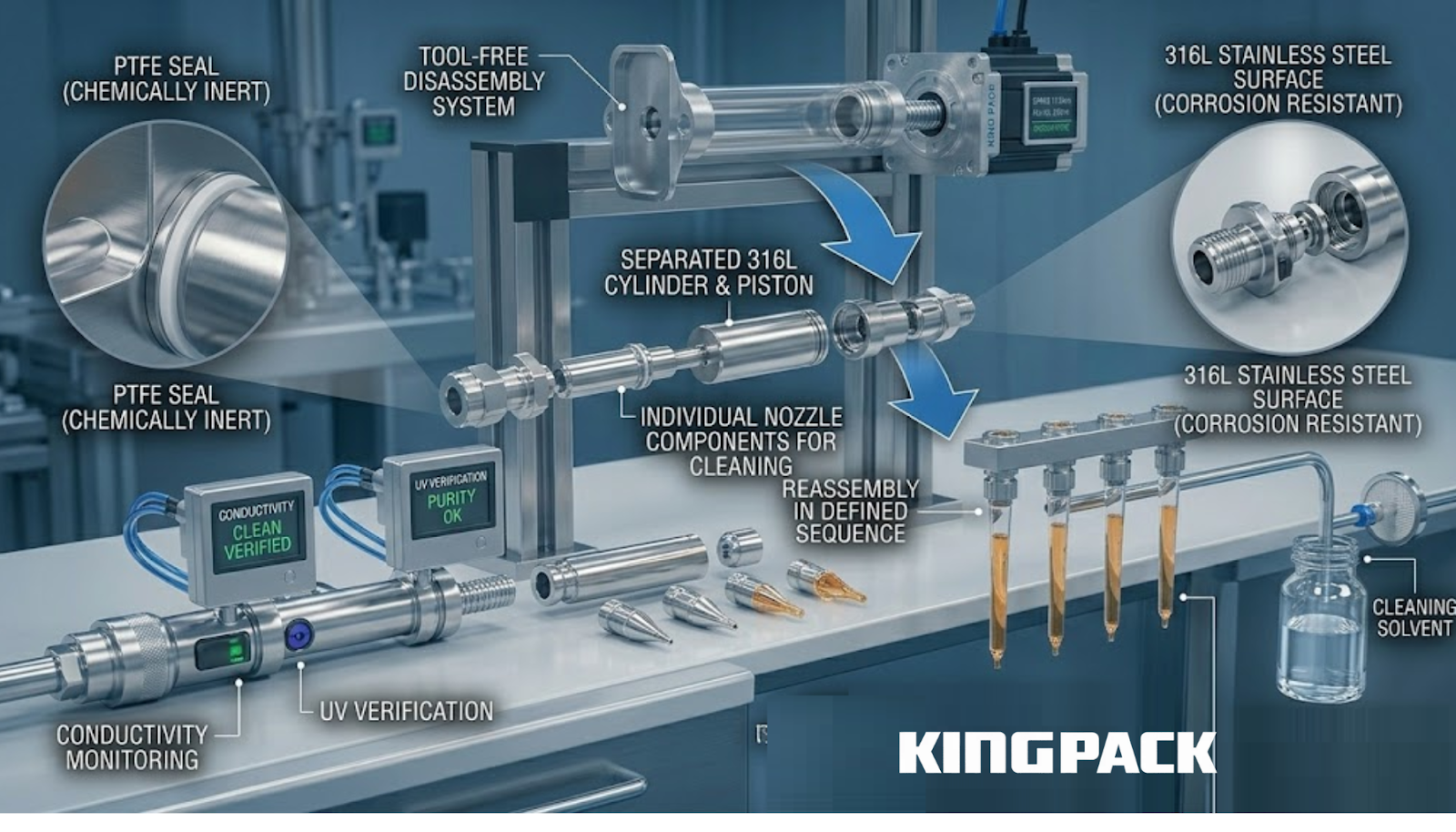
Seals and gaskets use PTFE or pharmaceutical-grade silicone, both of which are chemically inert to the solvent carriers commonly found in spot-on treatments. Using incompatible seal materials with oil-based solvents causes swelling and degradation over time, which introduces particulate contamination and changes the internal geometry of the filling head, directly affecting accuracy.
Cleaning and Changeover
Oil-based formulations leave a film on every wetted surface inside the filling machine. During changeover on production lines, or when switching between different product types, full cleaning is required to avoid cross-contamination. This step is critical for reliability and stable operation across all batches.
Our filling machine heads are designed for tool-free disassembly. The piston, cylinder, valves, and nozzle parts can be removed without tools. Each part can be cleaned separately and then reassembled in a fixed order that prevents errors. This setup supports fast operation on packing machines and reduces downtime across production lines. It also improves reliability by limiting residue carryover between runs.
This design works well for specific needs in industries handling small-dose liquids, where the same machine may run multiple product types in one shift. It also aligns with modern packaging machines used for sensitive packaging tasks, including applications similar to aerosol cans and small-dose liquid formats.
CIP (clean-in-place) support is available for lines where full disassembly is not practical. The system allows cleaning fluid to circulate through the filling machine under controlled conditions. Monitoring methods confirm that all internal paths are clean before the next run. This approach offers flexible solutions for continuous operation while maintaining high reliability in demanding environments.
Recommended Reading: How to Achieve ±1% Filling Accuracy for High-Value Pet Spot-on Treatments – King Pack Machinery
Selecting the Right Oil-Based Veterinary Filling Machine
Manufacturers evaluating filling equipment for oil-based antiparasitic production should assess these parameters before committing to any system:
| Evaluation Parameter | What to Confirm |
| Fill volume range | Minimum and maximum fill volume at target accuracy |
| Viscosity compatibility | Tested performance at the actual viscosity of your formulation |
| Speed vs. accuracy | Accuracy data at production speed, not just at slow calibration speed |
| Temperature control | Availability of tank heating and pipeline temperature management |
| Nozzle type | Anti-drip, shut-off mechanism compatible with oil-based solvents |
| Cleaning | Ease of disassembly, CIP compatibility, material certifications |
Ask for fill accuracy test data run with a liquid of equivalent viscosity to your formulation, at the target production speed. Claimed accuracy figures based on water testing do not translate to oil-based production performance.
Also confirm that the machine can integrate with your pipette forming, capping, and sealing equipment. A filling system that operates in isolation from the rest of the line creates manual handling steps, and manual handling introduces contamination and accuracy risks that the machine itself eliminates.
Why King Pack Oil-Based Filling Systems Ensure Stable Production
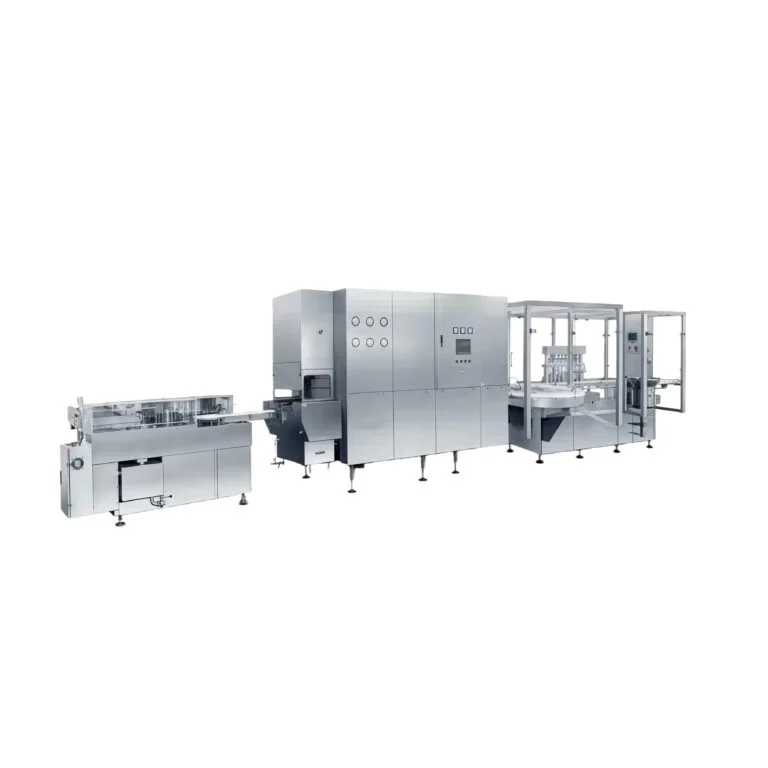
Vial Liquid Lyophilized Preparation Line – King Pack Machinery
At King Pack, our veterinary filling systems are built specifically for the challenges that oil-based antiparasitic formulations present. We do not adapt cosmetic or food filling equipment for pharmaceutical use.
For oil-based spot-on and deworming products, our systems deliver:
- ±1% or better filling accuracy, validated at production speed with oil-based test liquids
- Servo-driven piston dosing covering 0.5 ml to 5 ml fill volumes
- Anti-drip nozzle design with mechanical shut-off and vacuum suction cut-off
- Heated tank and temperature-controlled pipeline for viscosity stability across full production shifts
- 316L stainless steel wetted parts with tool-free disassembly for GMP-compliant cleaning
We also configure our lines for integration with automatic pipette capping and sealing, producing a complete spot-on filling line from a single equipment supplier. This simplifies validation, reduces integration risk, and gives manufacturers a single point of technical accountability for the entire process.
If you are producing oil-based anti-parasitic treatments and are evaluating filling equipment, we are ready to discuss your specific formulation, packaging format, and production volume requirements.
Contact King Pack to request a technical consultation.