
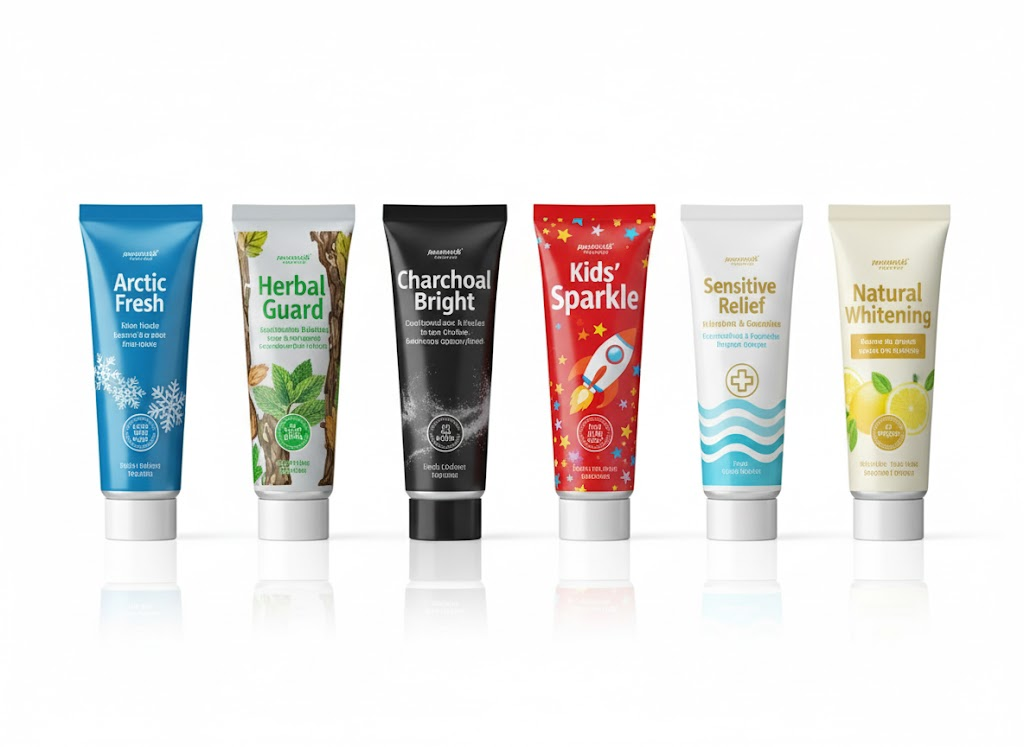
Toothpaste manufacturing GMP is a quality-system responsibility, not a certificate supplied with a filling machine. Equipment can support controlled production through hygienic design, cleanability, repeatable settings, inspection and documentation, but the manufacturer must define the product classification, process, facility controls, validation and release system.
This guide turns GMP expectations into practical equipment requirements for toothpaste mixing, transfer, tube filling, sealing, coding and secondary packaging. Requirements vary by formula, claims and destination market, so begin with the applicable regulations—not a generic machine checklist.
Toothpaste GMP Requirements at a Glance
| Project question | Equipment implication | Evidence to request |
|---|---|---|
| Cosmetic, drug, or both? | Different documentation, controls and qualification depth may apply | Regulatory assessment for every target market |
| How will product-contact parts be cleaned? | Accessible or validated automated cleaning design | Cleaning procedure, coverage study and acceptance criteria |
| What is the approved fill specification? | Suitable dosing system and in-process controls | Capability data using the actual toothpaste |
| Which tube and seal method are used? | Material-specific heating, ultrasonic or folding tooling | Seal trials, inspection method and challenge limits |
| Which electronic records are relied upon? | Access control, audit trail, backup and data review as applicable | Functional specification and validation plan |
| What must be qualified? | Defined DQ, FAT, SAT, IQ, OQ and PQ responsibilities | Approved validation and document matrix |
First Determine How the Toothpaste Is Regulated
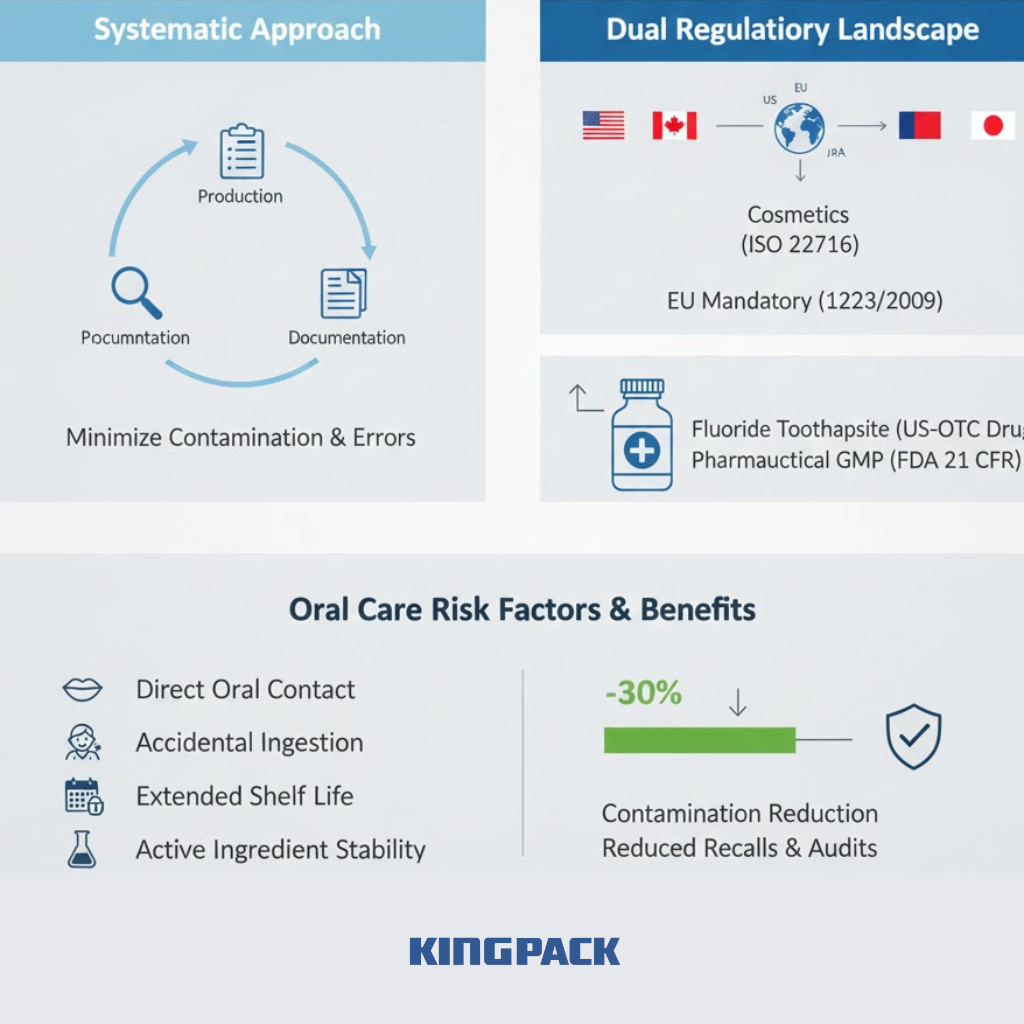
Do not assume every toothpaste follows the same GMP framework. In the United States, toothpaste used only to cleanse or freshen can fall within the cosmetic definition, while anticaries or fluoride toothpaste can be both a cosmetic and an over-the-counter drug. The FDA’s official cosmetic labeling summary explains this distinction and notes that products meeting both definitions must follow both sets of requirements.
For cosmetic production, review the FDA’s current cosmetic GMP guidance and inspection checklist plus obligations under the Modernization of Cosmetics Regulation Act. For drug products, the applicable drug CGMP requirements must also be addressed.
In the European Union, Article 8 of Regulation (EC) No 1223/2009 requires cosmetic manufacture to comply with good manufacturing practice. ISO 22716:2007, which ISO confirms remains current, provides GMP guidelines for cosmetic production, control, storage and shipment. Market-specific legal advice and an approved regulatory assessment should define the final URS.
What GMP-Oriented Equipment Design Means
“GMP-compliant machine” is often used as shorthand, but compliance is demonstrated by the operating manufacturing system. A better equipment description is “designed to support the approved GMP process.” That design should be traceable to risks and user requirements.
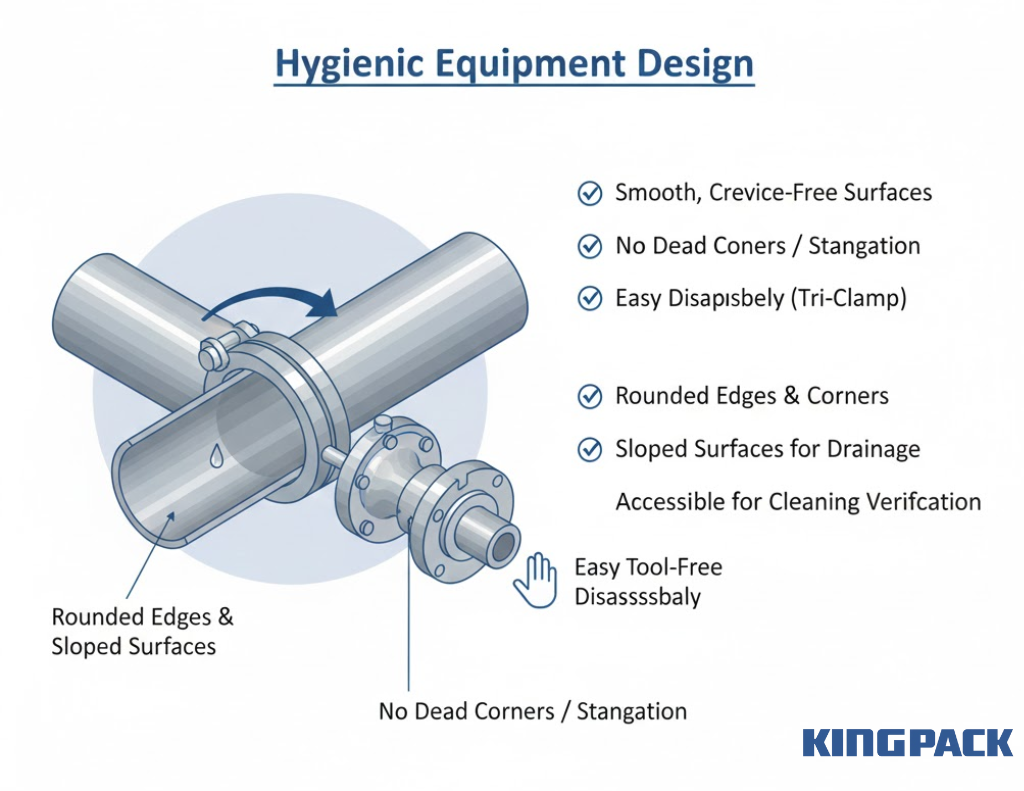
Product-contact design
- Materials compatible with the toothpaste, flavor oils, fluoride or other actives, and cleaning agents
- Documented surface finish where it is a justified critical requirement
- Joints, gaskets and seals designed to avoid inaccessible product traps
- Drainable piping or an approved method to remove residues
- Accessible pumps, manifolds, hoses and filling nozzles for inspection
- Lubrication and utilities arranged to prevent contamination of product-contact areas
Stainless steel 316L is common in hygienic processing but is not automatically required for every surface or compatible with every chemical. Select materials and elastomers from a documented compatibility assessment. Request certificates for specified product-contact materials rather than accepting a generic “food grade” statement.
Cleaning Must Be Defined and Validated
Toothpaste can dry in tanks, transfer lines and nozzles, while abrasives can settle and flavors can carry over. A cleaning strategy should identify residues, hard-to-clean locations, microbiological risks, allergens where applicable and the maximum allowed time before cleaning.
There is no universal CIP temperature, detergent concentration or cycle duration for toothpaste equipment. Define and, where required, validate the combination of time, temperature, flow or mechanical action, chemistry and rinse quality for the approved formulas and equipment. Manual cleaning may be acceptable when it is controlled, repeatable, accessible and verifiable.
| Cleaning design question | What to verify |
|---|---|
| Can every product-contact surface be reached? | Spray coverage or documented manual access |
| Can the system drain? | Low points, trapped volumes and residual rinse water |
| Are parts removable? | Tools, handling, mix-up control and reassembly checks |
| How is clean status protected? | Drying, storage, covers, hold time and status identification |
| How is cleaning accepted? | Visual, chemical and microbiological criteria based on risk |
Toothpaste Filling Controls
High viscosity, entrained air, abrasives and temperature can affect feeding and dosing. A servo piston, positive-displacement pump or another system may be suitable, but selection must be demonstrated with the actual formula and fill range.
- Define fill limits and sampling method from the approved specification and applicable net-content rules.
- Challenge the lowest and highest fill volumes and the full operating temperature range.
- Record head-to-head variation, start-up behavior, drift and product remaining in the hopper.
- Control nozzle diving, cut-off and suck-back to prevent strings and seal-area contamination.
- Assess air pockets and density variation before converting volume to mass.
Do not specify a universal “fixed GMP accuracy.” GMP requires an appropriate, controlled process; the numerical acceptance limit comes from the product, label, process capability and market requirements.
Tube Sealing, Coding and Inspection
The closure process must match the tube. Aluminum tubes use folding or crimping tools; laminated and compatible plastic tubes may use hot-air or ultrasonic systems. Seal parameters are material- and machine-specific, so fixed temperatures or frequencies should not be copied from another project.
| Control | Typical risk addressed | Possible verification |
|---|---|---|
| Tube orientation | Misaligned artwork or seal | Registration sensor and challenge test |
| Seal-area cleanliness | Leak or weak seal | Nozzle control and visual inspection |
| Seal process | Incomplete or damaged closure | Defined seal test and parameter monitoring |
| Code presence | Missing or unreadable batch information | Vision check with reject confirmation |
| Reject handling | Defective tube returned to good product | Locked reject bin and reconciliation |
Lot codes, dates and serialized data, where applicable, must follow the approved labeling and traceability system. A camera is useful only when the inspected attribute, reject logic, challenge method and data handling are defined.
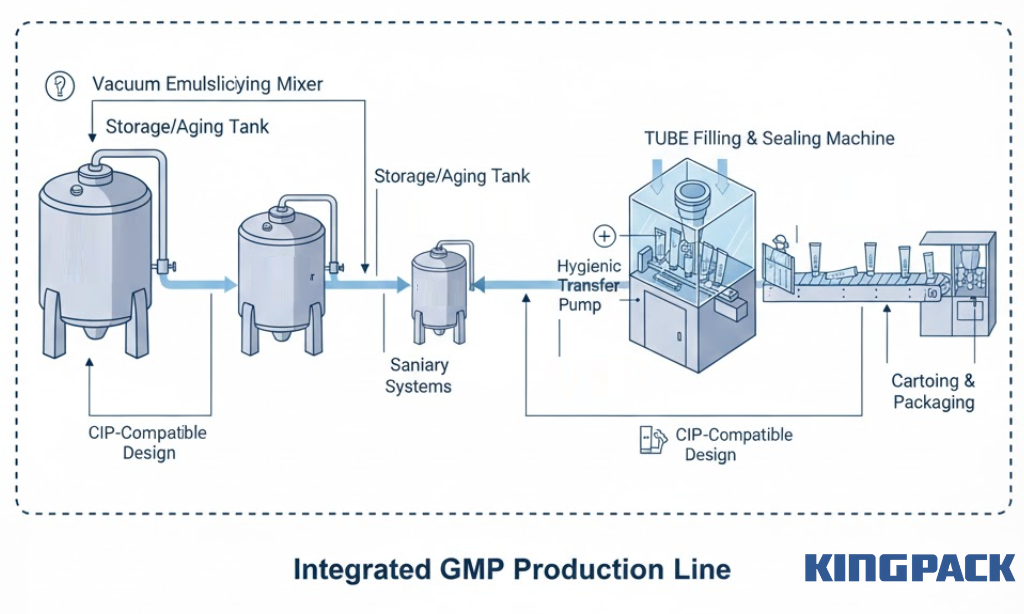
Mixing, Transfer and Filling as One System
GMP risks often occur at equipment interfaces. Product can change during deaeration, holding and transfer; a pump can add shear or heat; a long hose can retain residue; and an open connection can expose the batch. The URS should describe the complete route from mixer discharge to the final filling nozzle.
- Define maximum hold times and the method used to maintain uniformity.
- Confirm pump and pipe sizing at the actual viscosity and temperature.
- Identify every disconnect, sampling point, vent and cleaning boundary.
- Test whether recirculation changes air content, texture or temperature.
- Assign responsibility for alarms and interlocks between machines.
Facility Layout and Contamination Control
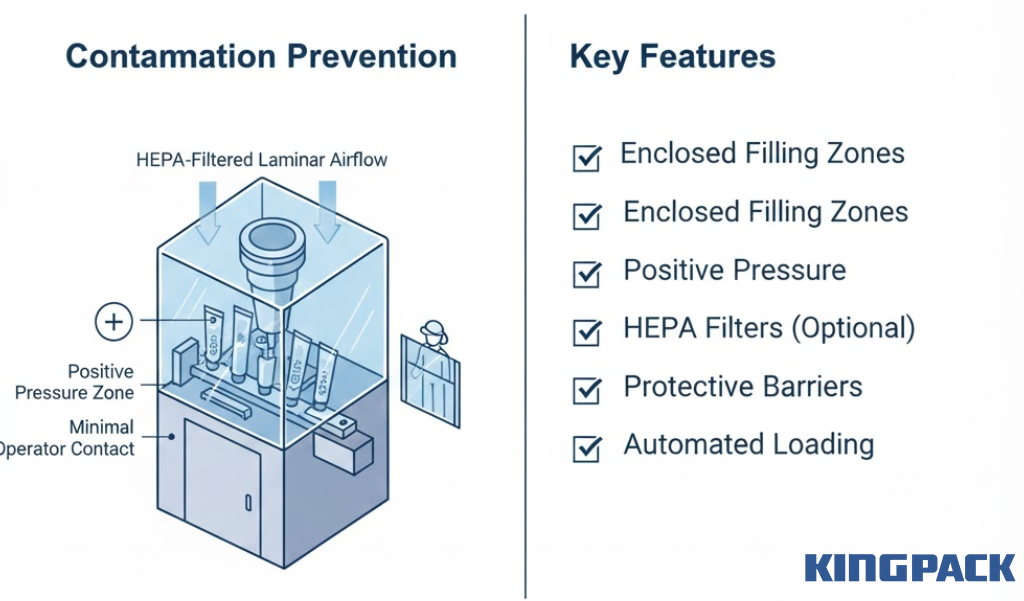
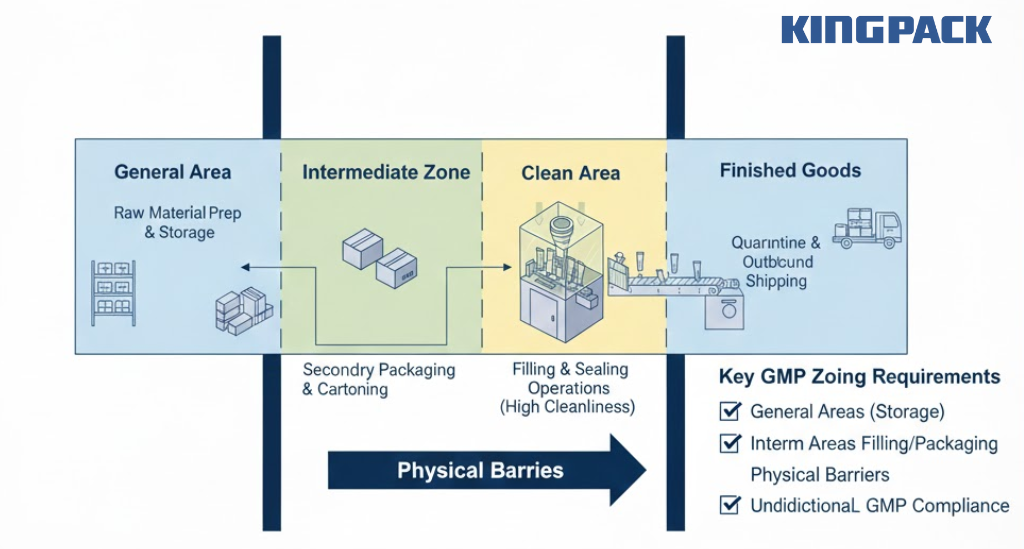
Room classification and airflow should come from the product and facility risk assessment. Conventional toothpaste filling does not automatically require aseptic-grade laminar airflow, positive pressure at the filling nozzle or a pharmaceutical cleanroom. These features add value only when justified by the approved contamination-control strategy.
Review personnel and material flow, cleaning access, waste removal, maintenance routes, dust from dry ingredients, utilities above open product, and separation of raw materials, bulk product and finished goods. The equipment layout must also provide safe access without forcing maintenance work through controlled product areas.
Automation and Electronic Records
PLC and HMI functions can improve consistency, but a touchscreen alone is not a GMP feature. Define recipes, parameter limits, user roles, alarms, time synchronization, audit trails, backup, restoration and data review according to risk and the records used by the quality system.
If electronic records or signatures are used to meet regulated record requirements, assess the applicable data-integrity and electronic-record rules. The required controls depend on intended use; do not claim “21 CFR Part 11 compliance” solely because the HMI has passwords or an audit-trail menu.
Qualification and Documentation Package
| Stage | Main purpose | Typical outputs |
|---|---|---|
| URS / risk assessment | Define intended use and critical requirements | Approved user requirements and traceability |
| Design qualification | Confirm the proposed design meets the URS | Design review, drawings and risk controls |
| FAT | Challenge functions before shipment | Executed protocol, deviations and punch list |
| SAT / installation qualification | Verify installation at the operating site | Utilities, components, calibration and documents |
| Operational qualification | Challenge operating ranges and controls | Alarm, interlock, recipe and parameter tests |
| Performance qualification | Demonstrate the process with approved products | Site-owned process and cleaning evidence |
Agree who authors, reviews and executes each document. A practical supplier package may include material certificates, weld and surface records where specified, manuals, drawings, spare-parts list, calibration certificates, software description, backup procedure and FAT/IQ/OQ templates. The exact package should follow the project’s risk and quality plan.
Toothpaste Line FAT Checklist
- Run the most difficult approved toothpaste and representative tubes.
- Verify fill results across all heads, speeds and target volumes.
- Challenge tube absence, incorrect orientation, low product, low air and guard-open conditions.
- Test seal quality, coding, vision inspection, rejection and reconciliation.
- Demonstrate recipe change, format change and defined cleaning access.
- Record product loss, accepted output, stoppages and restart behavior.
- Review software versions, backups, user roles, alarms and audit trails where applicable.
Toothpaste GMP Equipment FAQ
Can a filling machine be GMP certified?
A machine can be designed and documented to support GMP manufacturing, but GMP compliance applies to the manufacturer’s complete quality and production system. Ask which design standards, tests and documents the supplier will provide.
Does every toothpaste machine need 316L stainless steel?
Not automatically. Product-contact material selection should be based on the formula, corrosion and abrasion risks, cleaning chemicals, market requirements and the site’s standard. Document the final choice in the URS.
Is CIP mandatory for toothpaste filling equipment?
No universal rule makes CIP mandatory for every toothpaste line. The cleaning method must be effective, repeatable, safe and verifiable. Production scale, formula variety, hygiene risk and equipment access determine whether automated CIP or controlled manual cleaning is appropriate.
What should be tested with the actual toothpaste?
Test product feeding, fill consistency, air removal, nozzle cut-off, seal contamination, cleaning and changeover. Use the viscosity and temperature range expected in routine production.
Plan a GMP-Oriented Toothpaste Line
KING PACK can configure mixing, transfer, tube filling and sealing equipment and secondary packaging around an approved URS. Explore our packaging solutions and industry applications, or send your toothpaste, tube and validation requirements for a technical proposal.