
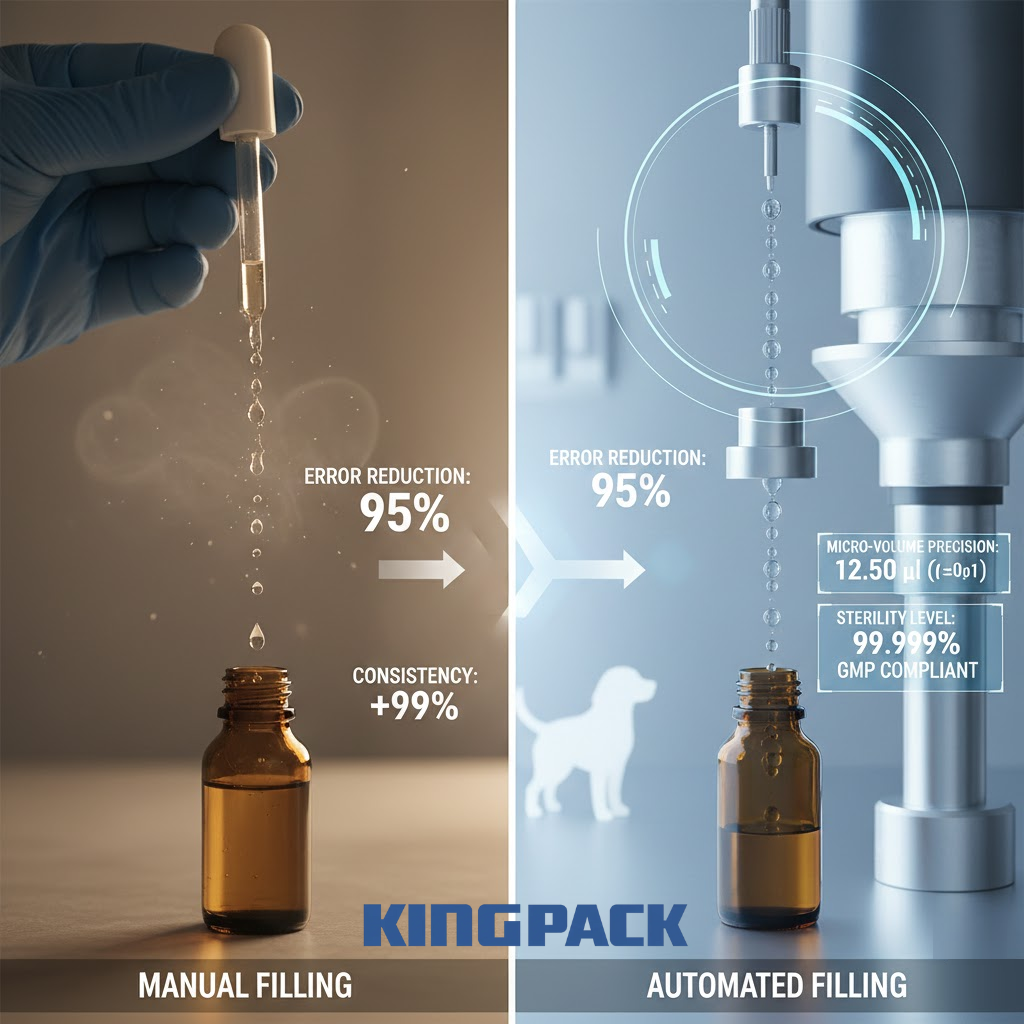
Pet spot-on treatments sit at the most demanding end of veterinary liquid production. Volumes are small, usually between 0.3 ml and 1 ml. Active ingredients are expensive. Packaging formats are compact and sensitive. A minor filling deviation has a direct financial and regulatory impact.
This article explains why traditional filling methods struggle at the 0.5 ml scale, how modern servo-driven and peristaltic systems solve these issues, and what manufacturers must control beyond the pump itself to reach stable accuracy.
Why ±1% Accuracy Matters for Pet Spot-On Products
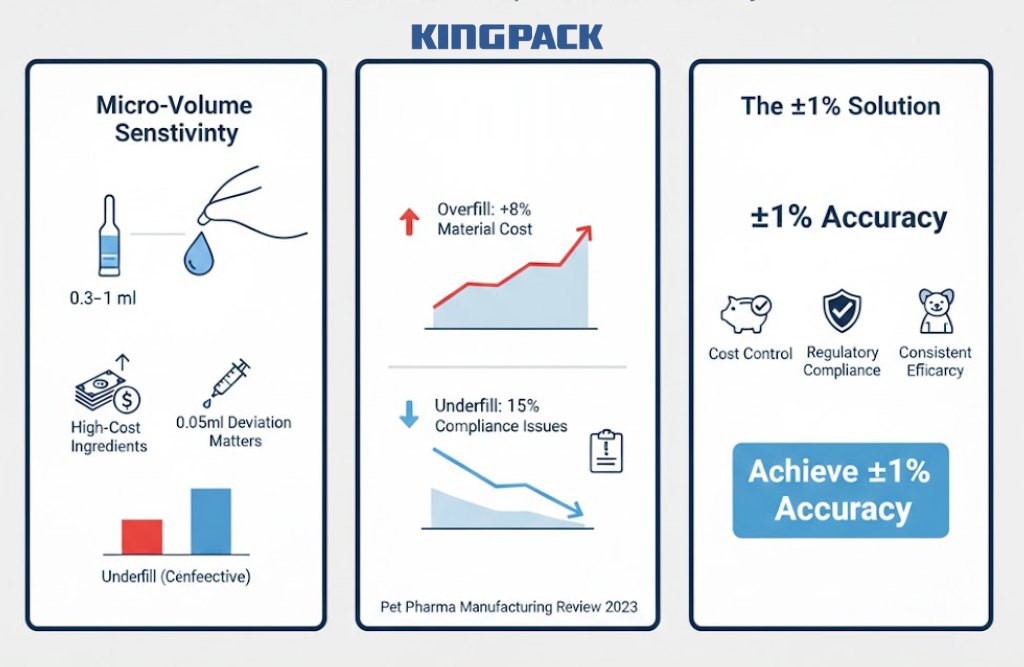
Pet spot-on doses typically range from 0.3ml to 1ml. Each pipette contains high-cost active ingredients, making precision critical.
- Overfill increases material costs and reduces profit margins.
- Underfill risks ineffective treatment, regulatory non-compliance, and potential recalls.
- Micro-volume sensitivity means even 0.05ml deviation can matter.
According to studies, overfilling micro-dose spot-on liquids can increase production costs by up to 8% per batch, while underfill incidents account for 15% of compliance-related product issues. Achieving ±1% accuracy ensures cost control, compliance, and consistent treatment efficacy.
The Reality of Micro-Dose Filling Challenges
Producing accurate micro-dose volumes is complex. Traditional fillers often fail to maintain consistent results, particularly at the 0.5ml scale.
Why Traditional Fillers Fail at 0.5ml
- Gravity fillers lack the stability needed for micro-dosing.
- Pneumatic pistons can suffer from air compressibility, causing inconsistent volumes.
- Viscosity sensitivity affects flow, especially with solvent-based parasite liquids.
These limitations result in overfill, underfill, and frequent rework.
Recommended Reading: The Realities of Recapping Single-Use Eye Drop Vials – King Pack Machinery
Expensive Liquid Waste in Spot-On Production
Manual or semi-automatic filling requires compensation for inconsistencies, creating:
- Overfill to avoid underdosing
- Batch giveaway (excess product given to meet nominal volume)
- Rework and rejection costs
A medium-size pet spot-on production line can waste 1–2 liters per 1,000 pipettes, translating to $500–$1,000 in lost high-value ingredients monthly.
Sensitivity to Viscosity and Temperature
Parasite liquids are often seasonal formulations, solvent-based, or contain oils. Viscosity can change with ambient temperature, affecting fill speed and accuracy. Automated temperature-controlled filling systems reduce these variations, maintaining consistent micro-doses.
Understanding Spot-On Packaging Formats
Accuracy depends not only on the filling system, but also on the container.
Pipettes, Small Bottles, and Dropper Containers
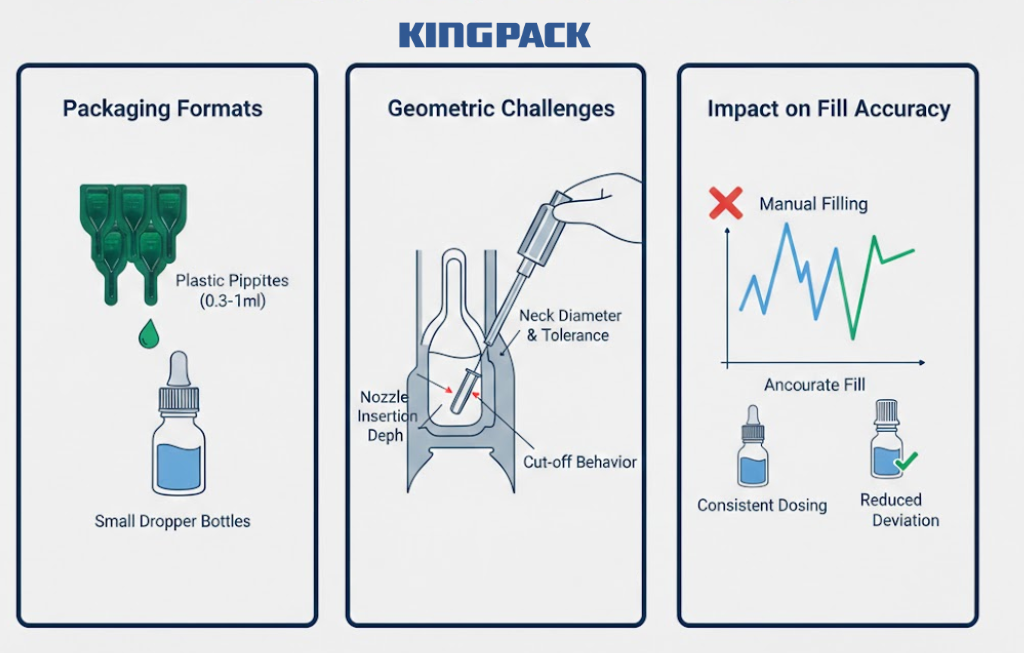
Spot-on products are commonly packed in plastic pipettes or small dropper bottles. These containers vary in material, neck diameter, and tolerance.
Minor differences in neck geometry affect nozzle insertion depth and cut-off behavior. If positioning is inconsistent, fill accuracy suffers.
Our experience at KPFilling shows that container handling and positioning often explain more variation than the pump itself.
Filling Volume Range Requirements
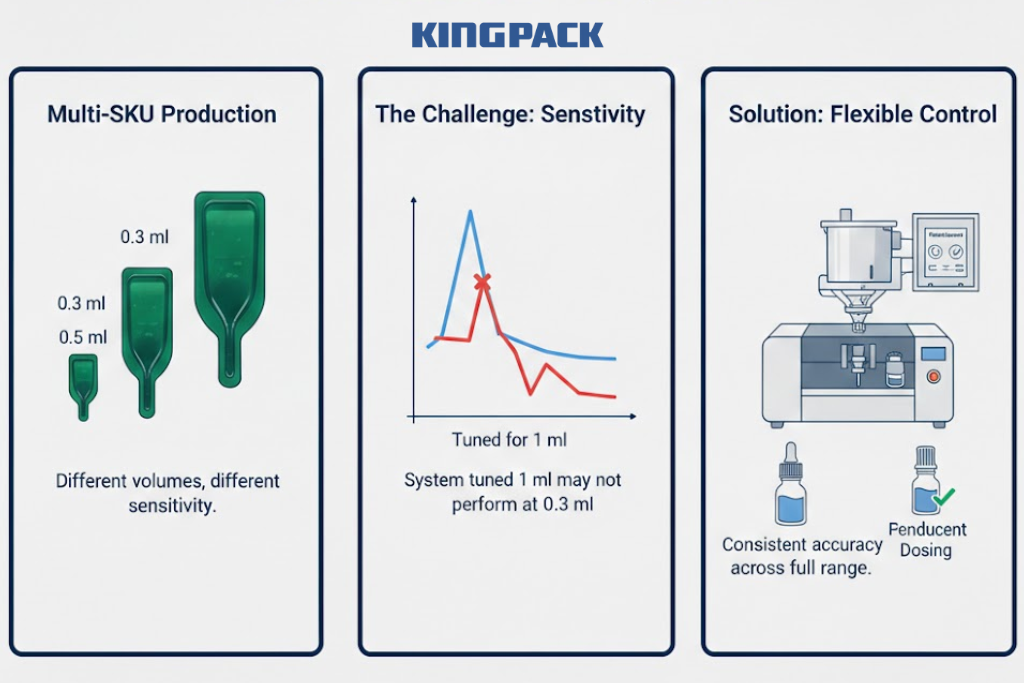
Most spot-on lines must handle multiple SKUs. Typical volumes include 0.3 ml, 0.5 ml, and 1 ml. Each volume has different sensitivity.
A system tuned for 1 ml may not perform well at 0.3 ml without recalibration. Flexible control is essential.
Leak Risk and Seal Integrity
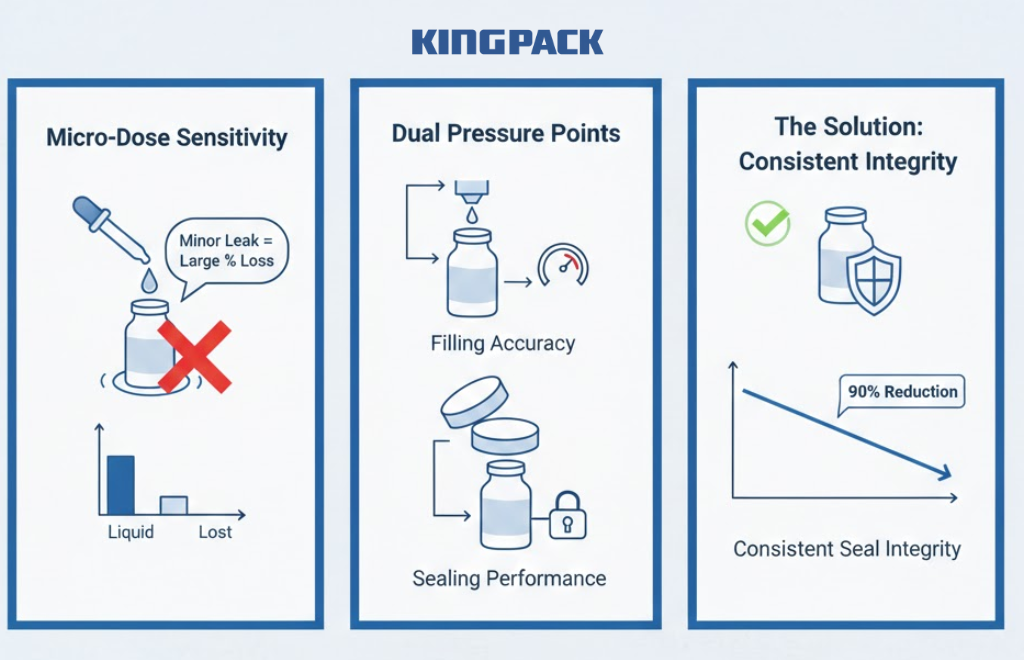
Micro-dose products amplify sealing problems. A minor leak represents a large percentage loss. Seal integrity must be consistent.
This places pressure on both filling accuracy and downstream plugging or sealing performance.
Recommended Reading: Pharmaceutical Filling Machine Filling Systems and Advantages – King Pack Machinery
Technologies That Enable ±1% Micro-Dose Filling
Achieving ±1% accuracy requires the right technology. Not all systems are suitable.
Servo-Driven Piston Filling Systems
Servo-driven piston filling systems are built for control. Unlike pneumatic systems, servo motors regulate piston movement with digital precision. Stroke length, speed, and timing are set through software, not air pressure. This removes variability caused by air compression, pressure drops, or seal wear.
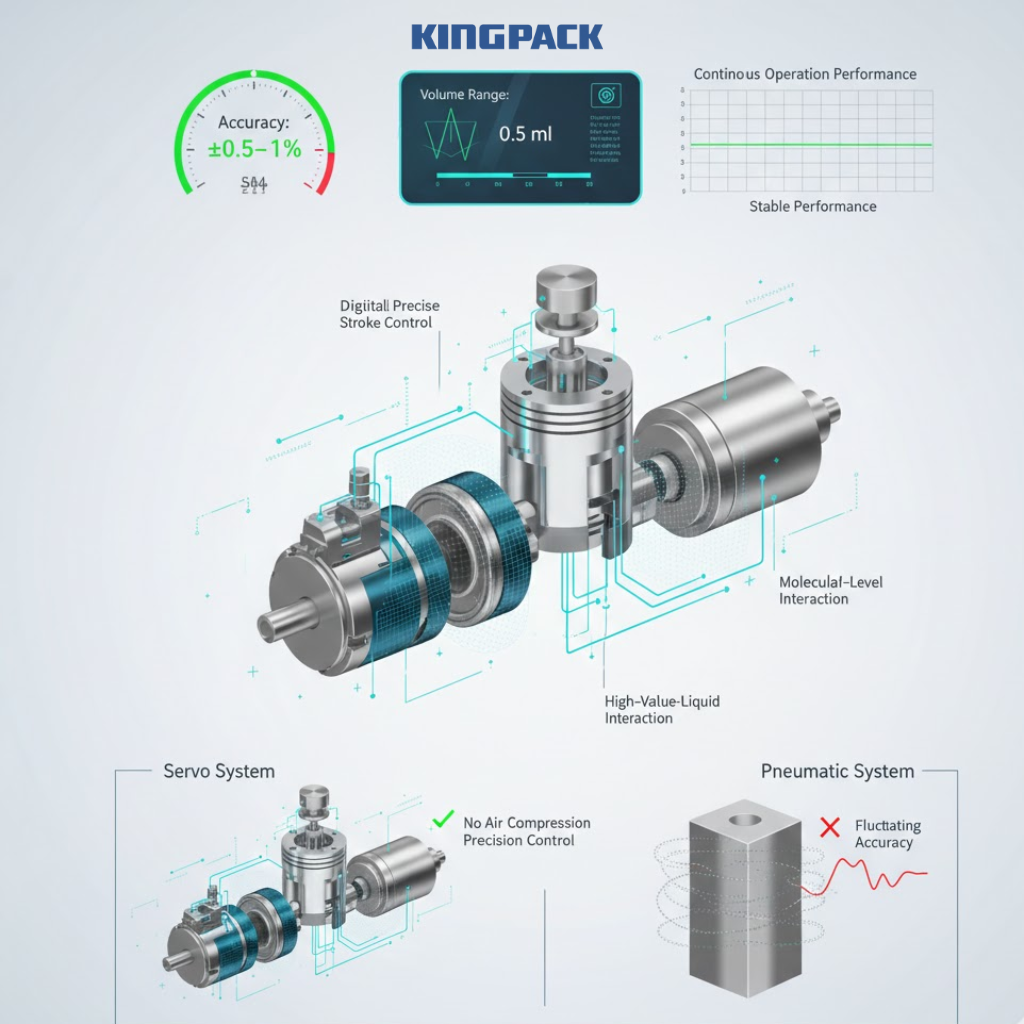
Each piston stroke displaces a fixed volume of liquid. Because motion is repeatable and measured in real time, dose accuracy stays stable across long runs. Fine adjustments can be made in small increments, which is critical when filling spot-on treatments below 1 ml. This level of control also supports fast changeovers between formulas without mechanical rework.
Servo-driven pistons work well with oil-based and mildly viscous formulations. Flow remains smooth even at low speeds, which helps prevent splashing or air intake. Internal performance data from King Pack filling systems shows stable ±0.5–1% accuracy at 0.5 ml under continuous production, even when ambient conditions vary.
Recommended Reading: Multilane Packing Machines – High‑Speed Multichannel Sachet & Stick‑Pack Solutions | King Pack – King Pack Machinery
Peristaltic Pump Micro Filling
Peristaltic pump systems meter liquid by compressing flexible tubing in a controlled rotation. The product stays inside the tube and never touches mechanical parts. This isolation is valuable when working with solvent-based or chemically active parasite treatments.
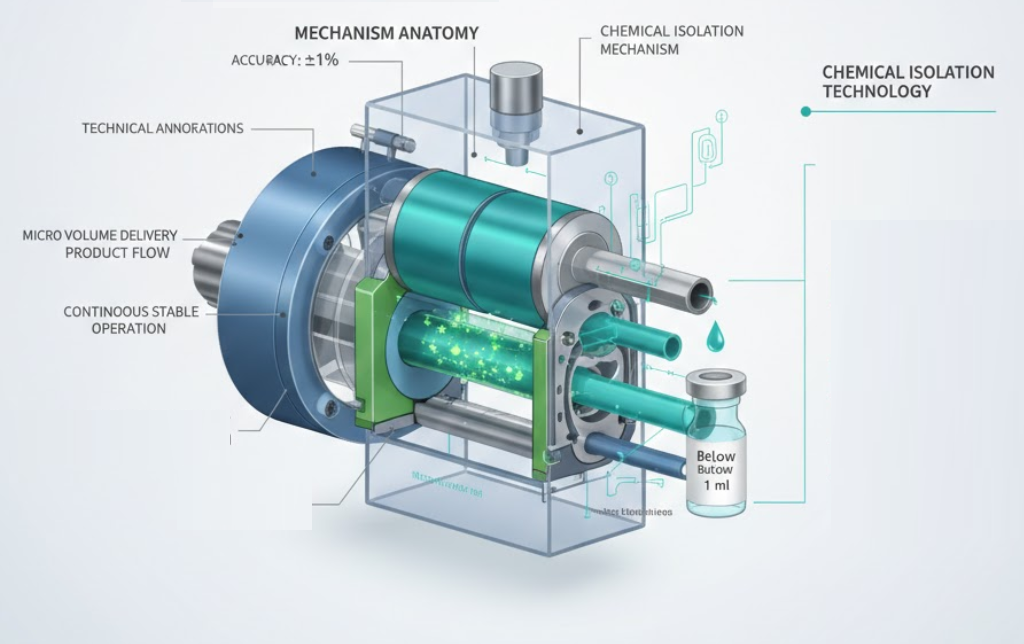
Dose control depends on tubing diameter, elasticity, and motor rotation. Once these parameters are set and calibrated, the pump delivers consistent micro volumes with very low drift. Because flow is gentle and continuous, peristaltic pumps reduce shear stress and help protect sensitive formulations.
These systems perform best when paired with stable temperature control and proper degassing. Air bubbles and viscosity shifts can affect volume at very small doses.
Nozzle Design for Anti-Drip Accuracy
At micro-dose levels, the nozzle becomes part of the dosing system. Even a small drip after cut-off can push fill volume outside tolerance or contaminate the container opening. This is a common issue with low-speed filling of oils and solvent-based liquids.
King Pack uses nozzles with controlled cut-off and suck-back function. At the end of each fill cycle, a brief reverse motion pulls liquid back into the nozzle. This stops tailing and prevents drops from forming at the tip. The result is a clean end to every dose.
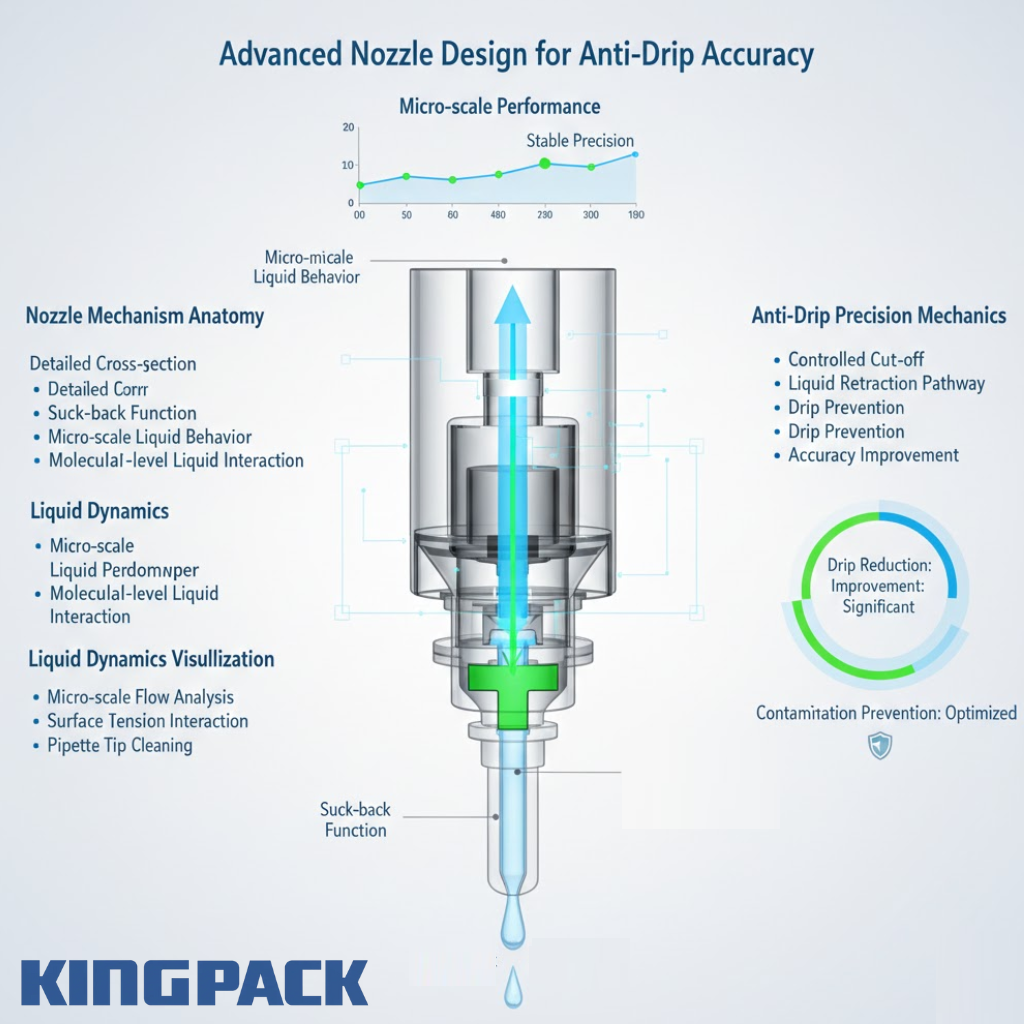
Clean cut-off supports both accuracy and hygiene. Pipette tips remain dry before sealing, which reduces residue transfer and improves downstream consistency. Over long production runs, this nozzle behavior plays a major role in maintaining ±1% micro-dose accuracy without relying on overfill as a safety margin.
Process Optimization for Spot-On Filling Lines
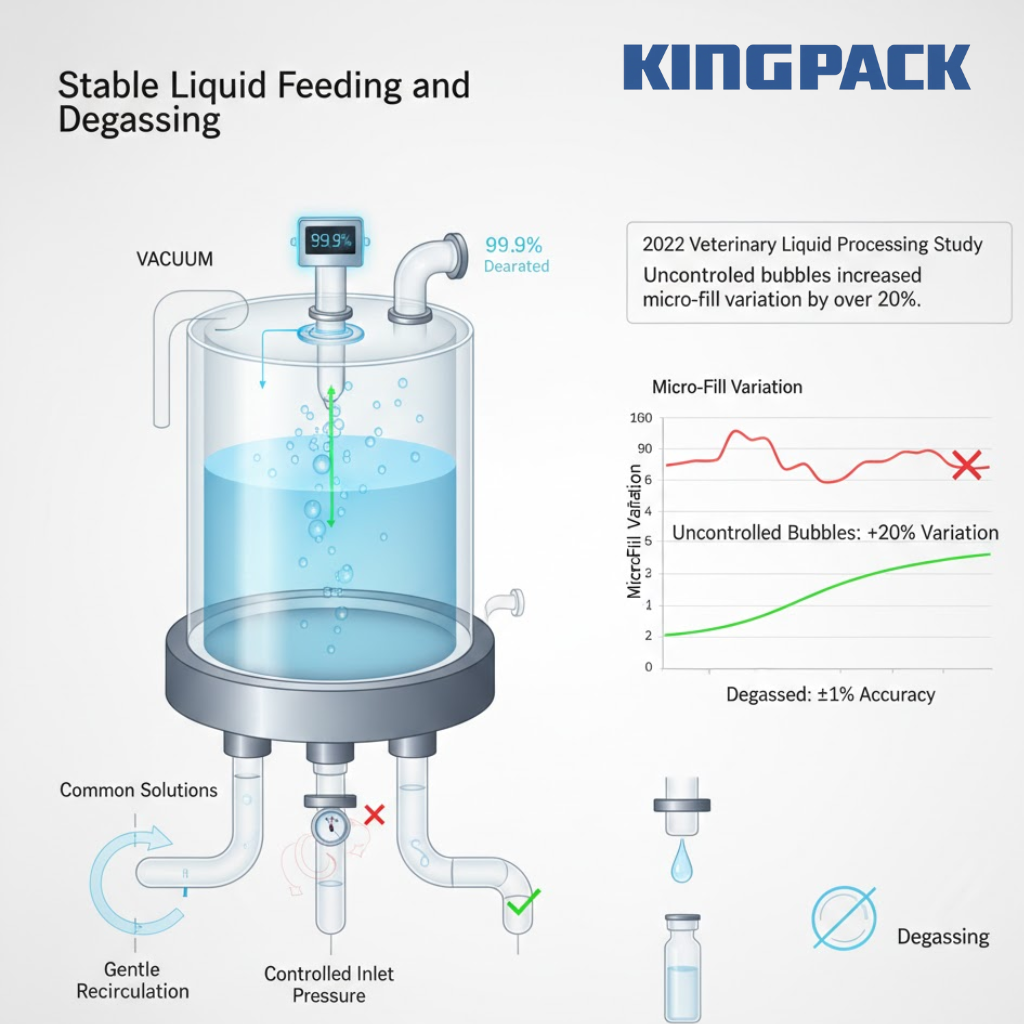
Trapped air is a major cause of variation in spot-on filling. Bubbles compress during dosing and expand afterward, which alters the delivered volume. This problem increases at micro-dose levels. Stable feeding with vacuum degassing removes air before the liquid reaches the pump.
Temperature control is just as critical. Viscosity changes with temperature, which affects flow and cut-off. Temperature-controlled tanks or heating jackets keep formulations stable, even when ambient conditions shift.
Container positioning also matters. Servo indexing places each pipette or bottle in the same position every cycle. This keeps nozzle depth consistent and reduces tailing or overfill.
The table below shows how process elements support micro-dose accuracy in spot-on filling lines.
| Process Element | Primary Risk Without Control | Optimization Approach | Impact on Accuracy |
| Liquid Feeding | Air entrainment | Smooth feed paths and degassing | Stable micro-volume delivery |
| Degassing | Bubble compression | Vacuum deaeration | Reduced dose variation |
| Temperature | Viscosity drift | Jacketed tanks or heaters | Consistent flow and cut-off |
| Container Positioning | Nozzle misalignment | Servo indexing | Repeatable dosing behavior |
In practice, stable spot-on filling depends on aligning several process conditions at once. The most critical factors include:
- Removing air before the liquid reaches the pump
- Maintaining constant liquid temperature during the run
- Holding containers in a fixed position at every fill cycle
When these conditions are met, micro-dose filling systems operate within tight tolerance bands without relying on overfill. This process-driven approach allows King Pack spot-on filling lines to maintain accuracy while reducing waste and protecting formulation integrity.
Accuracy Validation and Quality Control
High accuracy needs proof at the line, not assumptions. Validation tools and process monitoring protect dosing results across long runs.
- In-Line Check Weighing: Check weighing confirms each dose in real time. When deviations appear, the system flags the issue before large volumes are affected. Advanced setups link weighing data to dosing support functions, allowing automatic adjustment of fill settings to restore target values.
- Statistical Process Control: SPC monitors production speeds and dosing trends across batches. Gradual drift becomes visible early, which reduces rejects and limits damaged capsules or containers before they reach secondary handling.
- GMP Documentation for Veterinary Products: Regulated production requires full traceability. Systems with IQ / OQ Validation package support, product information logging, and In-Process Control records simplify audits and routine reviews. Automated data capture reduces manual errors and keeps compliance aligned with daily operation.
Recommended Reading: Automatic Case Packaging Machine — Intelligent Transformation of End-of-Line Packaging – King Pack Machinery
Typical Accuracy Comparison
The table below summarizes typical performance ranges observed in spot-on production.
| Filling Technology | Accuracy at 0.5 ml | Waste Risk | Maintenance |
| Gravity | ±5% or worse | High | Low |
| Pneumatic piston | ±3–4% | Medium | Medium |
| Servo piston | ±0.5–1% | Low | Medium |
| Peristaltic | ±0.5–1% | Low | Low |
How King Pack Designs High-Accuracy Spot-On Filling Lines
At King Pack, filling accuracy comes from how the entire system works together. Pumps, valves, and motion control are selected as part of one sanitary high precision filling setup. Stable flow rate, repeatable positioning, and controlled sealing define the final result.
Precision Micro-Dose Engineering
Each project starts with the formulation. Viscosity, solvent content, and temperature response influence the filling process and hardware choice.
Depending on product behavior, systems use servo technology with ball screw drive control, pneumatic valves, and dedicated filling stems. These elements support bottom-up fill and reproducible precision for micro fluid products in the 0.3–1 ml range, even when production speeds change.
Modular Pipette Filling Platforms
Spot-on lines often handle multiple SKUs with different volumes. Equipment must adapt without long downtime.
The modular platform supports fast recipe changes for 0.3 / 0.5 / 1 ml fills, smooth format changeovers for pipettes or small bottles, and expansion with In-Process Control or dosing support modules. A Main Indexer maintains container alignment through every cycle, protecting accuracy during high precision filling.
Integration with Plugging, Capping, and Packaging
Filling performance extends beyond the dosing station. Downstream mismatch leads to rejects and product loss.
King Pack integrates controlled nozzle insertion depth, servo-driven Capping modules, vacuum gripper handling, and a reject conveyor for off-spec units. This balanced integration preserves filling accuracy from dosing through final packaging.
Typical Accuracy Comparison in Spot-On Production
The table below summarizes practical performance observed in production environments.
| Technology | Accuracy at 0.5 ml | Waste Risk | Chemical Isolation | Maintenance |
| Gravity | ±5% or worse | High | Low | Low |
| Pneumatic piston | ±3–4% | Medium | Medium | Medium |
| Servo-driven piston | ±0.5–1% | Low | Medium | Medium |
| Peristaltic pump | ±0.5–1% | Low | High | Low |
For high-value parasite liquids, servo-driven and peristaltic systems consistently outperform legacy methods.
Recommended Reading: Tube Sealing and Coding Technology Guide 2026: Achieving High-Integrity Seals and Serialization Compliance – King Pack Machinery
Process Controls That Protect ±1% Accuracy
Beyond pumps and nozzles, a few process controls make the difference between short-term success and long-term stability.
Stable Liquid Feeding and Degassing
Air bubbles distort micro dosing. Degassing removes this variable.
Common solutions include:
- Vacuum deaeration tanks
- Gentle recirculation
- Controlled inlet pressure
Temperature Control for Stable Flow
Many formulations react fast to heat changes. Small shifts can change viscosity and disrupt flow rate. A controlled heated tank or sanitary reservoir helps keep material behavior steady across long runs. This matters even more in plants with seasonal temperature swings, where repeatability can drift without control.
Accurate Container Positioning
At micro volumes, position tolerance is very small. Servo technology and a precise Main Indexer place each container in the same spot every cycle. That level of control supports clean bottom-up fill, better filling stem alignment, and fewer sealing issues during high precision filling.
How to Choose a Pet Pipette Filling Machine
Equipment choice should match real dosing needs, not brochure claims. Micro fluid products demand proof at working volumes.
Key questions to review before selection:
- What is the lowest fill volume the system can handle with reproducible precision?
- Do solvents or oils require stainless steel or SUS316L product-contact parts?
- Does the filling process favor accuracy over production speeds?
- Will future SKUs need different flow rates or container formats?
A machine that performs well at 5 ml may struggle at sub-milliliter levels. Validation at target volume matters more than rated output.
FAQ – Spot-On Micro-Dose Filling Accuracy
Can you really achieve ±1% at 0.5 ml?
Yes. With servo-driven or peristaltic systems, stable feeding, and proper control, ±1% is achievable in continuous production.
Which pump is better for parasite drops?
Peristaltic pumps suit solvent-heavy formulations. Servo-driven pistons work well for oil-based products.
How do manufacturers reduce overfill in micro-dose filling?
By using precise pumps, anti-drip nozzles, and in-line check weighing with feedback correction.
Does viscosity affect accuracy?
Yes. Temperature and formulation control are essential to maintain consistent flow.
Can one line run different pipette sizes?
Yes. Modular platforms with recipe control support multiple sizes and volumes.
Closing Perspective
Spot-on treatments allow very little tolerance. At 0.5 ml, even minor variation has a real impact. Conventional filling methods often lack the control needed at this scale, which leads to waste and added risk.
Servo-driven and peristaltic filling systems bring dosing under tighter control. When combined with proper validation and in-process monitoring, ±1% accuracy becomes achievable on the production floor.
King Pack designs spot-on filling lines around this standard, focusing on repeatable output and stable operation. Precision lowers loss, supports compliance, and strengthens margins. Contact us to discuss your spot-on filling requirements and production goals.