 Skip to content
Introduction
Every square meter of factory floor space carries a cost. The equipment layout decision you make when selecting tube fillers is not just an engineering choice. It is a financial one that affects your production capacity, workflow efficiency, and room for future expansion.
Linear and rotary tube filler designs both deliver automatic tube filling and sealing capability, but they do it with very different footprints, speed profiles, and flexibility characteristics. This guide lays out the practical differences so you can match the right design to your facility, your product mix, and your production targets.
What Are Linear Tube Fillers
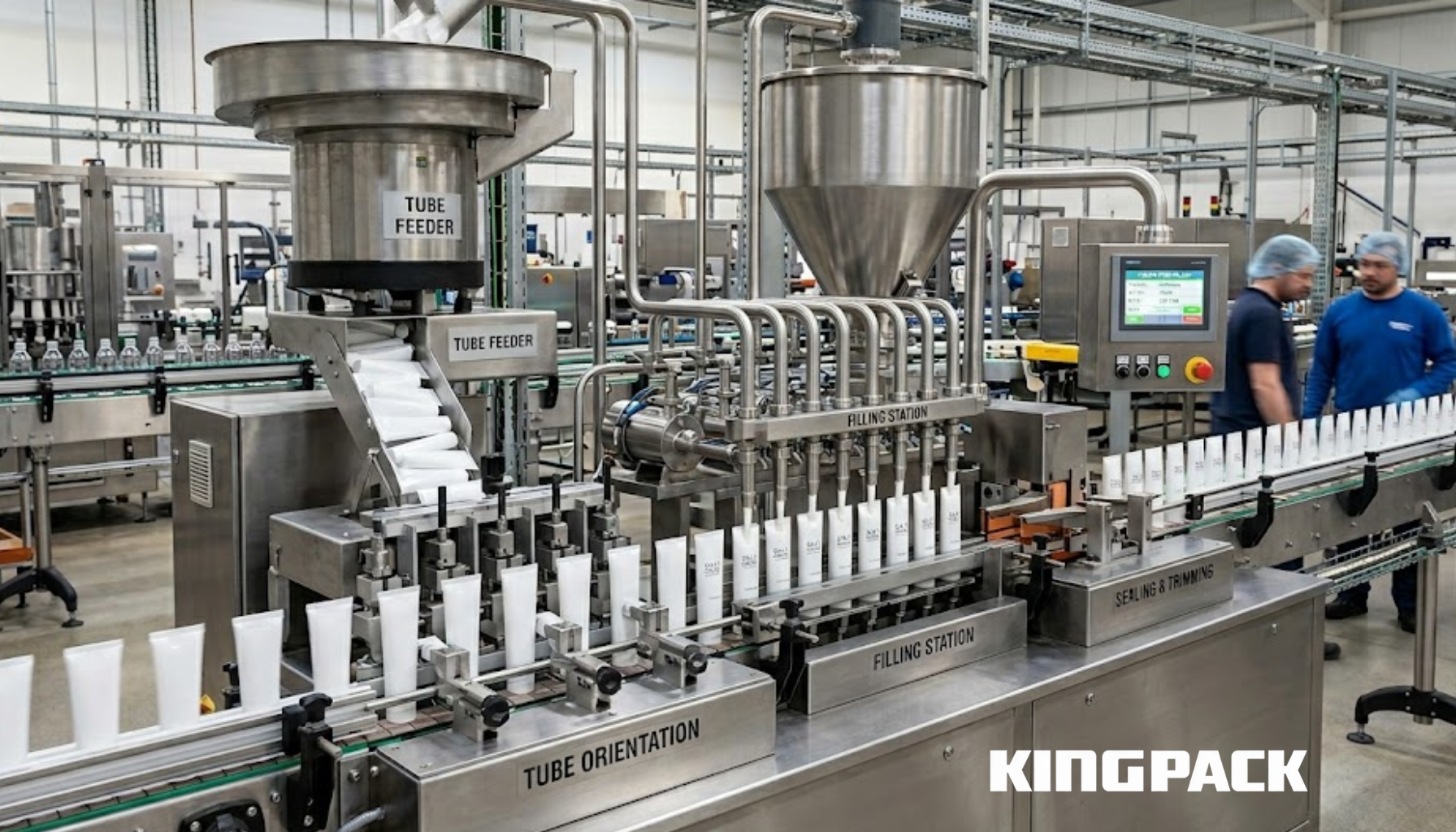
A linear tube filler moves tubes in a straight line through a sequence of fixed stations. Tubes enter at one end, pass through filling, sealing, and coding stations in succession, and exit at the opposite end. The machine’s length grows with the number of stations.
Advantages of linear design:
- More accessible stations for maintenance and cleaning along the full machine length
- Simpler mechanical structure that operators learn and troubleshoot faster
- Faster product changeovers since each station is independently accessible
- Lower entry cost compared to equivalent-speed rotary configurations
- Easier integration with upstream and downstream equipment on a straight production line
Limitations:
- Requires more floor length, which creates layout constraints in narrow facilities
- Top-end production speed is lower than a comparable rotary tube filler
- The start-stop indexing motion of linear systems creates brief pauses at each station, which caps sustained throughput
Linear tube fillers excel when product variety is high, changeovers are frequent, or when a facility prioritizes accessible maintenance over peak speed.
What Are Rotary Tube Fillers
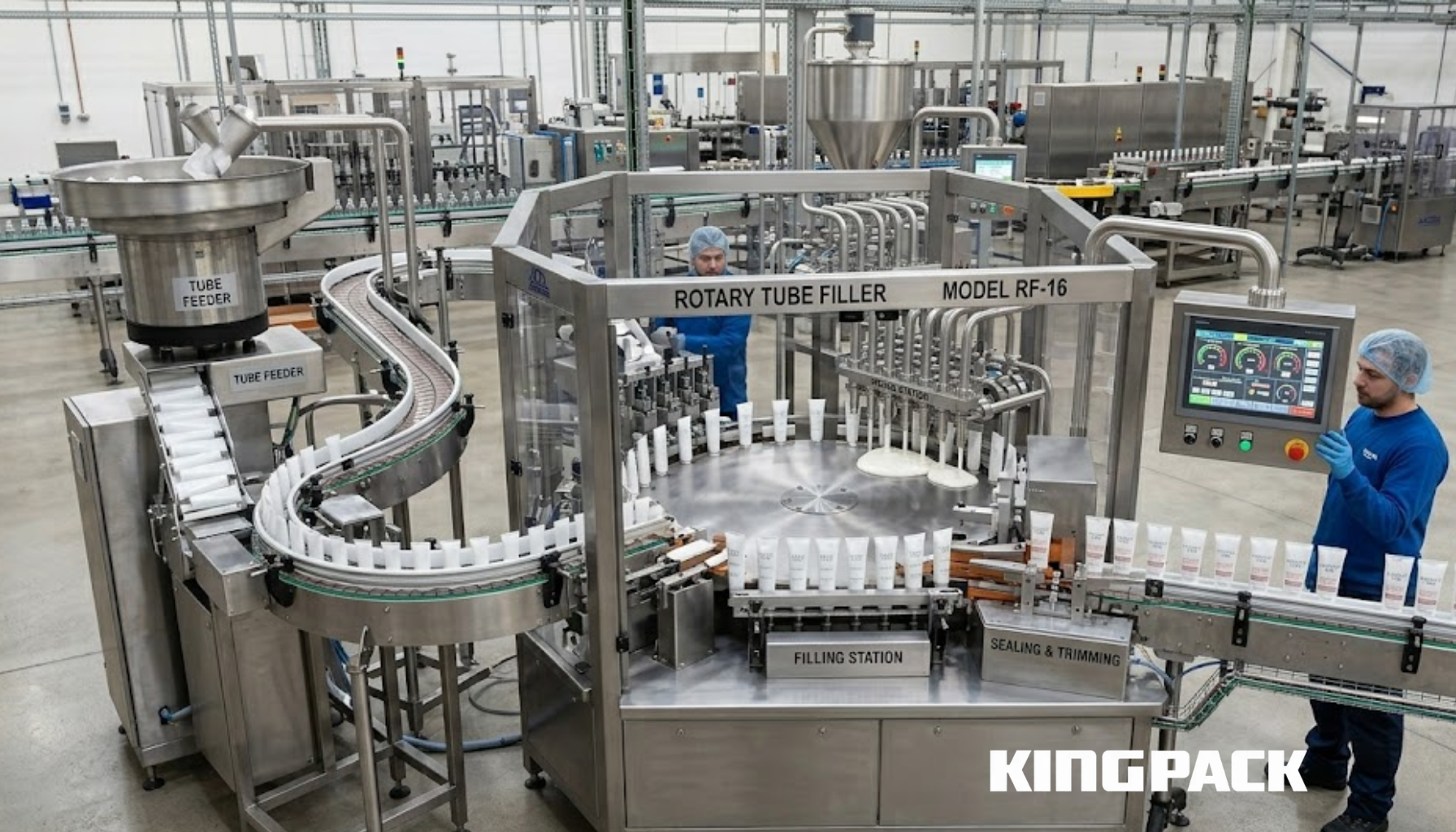
A rotary tube filler uses a circular indexing table. Tubes are loaded onto the table, which rotates them through all processing stations arranged around the circumference. Filling, sealing, coding, and discharge all happen within the circular footprint.
Advantages of rotary design:
- Compact footprint: all stations are contained within the table diameter, not spread along a line
- Higher sustained throughput because multiple stations operate simultaneously during each index cycle
- Continuous or near-continuous operation produces more consistent output at high speed
- Lower floor length requirement makes rotary designs well suited to square or compact production cells
Limitations:
- Higher mechanical complexity due to the rotating table and multiple simultaneous station operations
- Changeovers require adjustment of multiple stations across the table, which takes longer than linear changeovers
- Maintenance access to inner stations is more restricted
- Higher initial investment than a linear tube filler of equivalent capacity
For high-speed, standardized production runs where tube type and product do not change frequently, the rotary tube filler is the more productive configuration per square meter of floor space.
Space Utilization Comparison: Linear vs Rotary Plastic and Metal Tubes
According to Cushman and Wakefield, light industrial manufacturing facilities in the United States cost between $150 and $300 per square foot to build. Every square meter your tube filling and sealing machine occupies carries a real cost that compounds over the building’s lifetime. That makes machine footprint a genuine line item in production economics, not a secondary consideration.
| Factor | Linear Tube Filler | Rotary Tube Filler |
| Machine footprint | Long and narrow | Compact and circular |
| Floor length required | High (proportional to stations) | Low (contained in table diameter) |
| Floor width required | Low | Moderate |
| Maintenance access | High (full side access) | Limited (inner stations restricted) |
| Integration with linear conveyor | Direct and straightforward | Requires transfer mechanism |
| Suitable facility shape | Narrow, elongated production bays | Square or compact production cells |
A typical linear tube filler with filling, sealing, and coding stations may occupy a footprint of 4 meters to 6 meters in length by 1 meter to 1.5 meters in width. A rotary tube filler achieving higher speeds often fits within a 2 meter to 2.5 meter diameter, using significantly less linear floor space while producing more output per shift.
Maintenance space matters too. Linear machines allow technicians to walk the full length of the machine from either side. Rotary tables require reaching across the table structure for inner station access, which affects both maintenance time and ergonomics.
Production Efficiency and Throughput
Speed is where rotary tube fillers deliver their clearest advantage.
Our KPGFW-120D Double-Head Rotary Tube Filling and Sealing Machine achieves a rated speed of 120 tubes per minute through its rotary indexing design, with two filling heads operating simultaneously at each index. The double-head configuration effectively doubles output within the same circular footprint.
Linear designs at equivalent speed would require a proportionally longer machine to add the same number of stations. For a facility with limited length but adequate width, the rotary design is the more practical path to higher throughput.
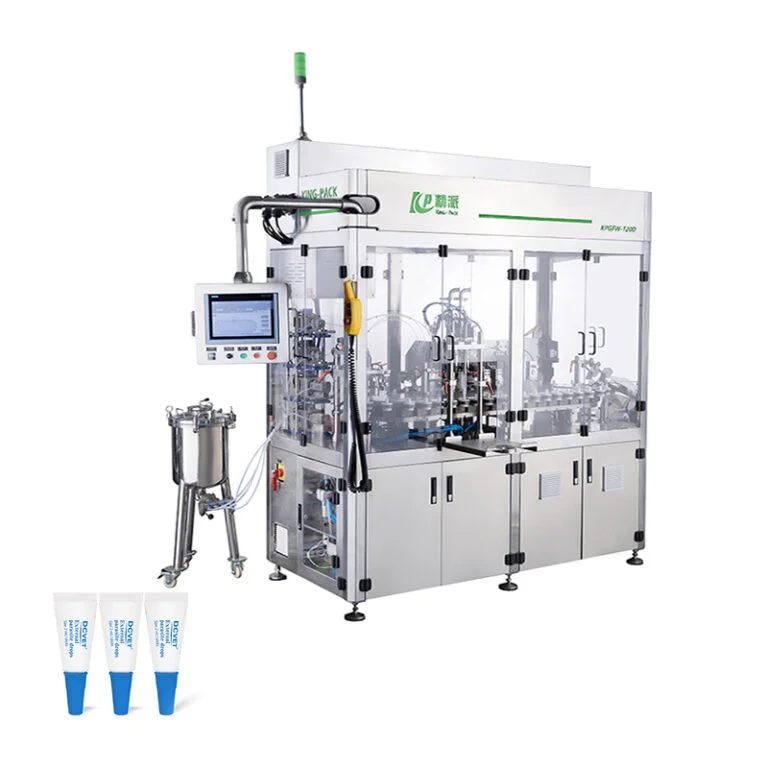
KPGFW-120D Double-Head Rotary Tube Filling and Sealing Machine – King Pack Machinery
Output stability matters as much as peak speed. Rotary systems maintain more consistent tube-to-tube timing because all stations operate in parallel. Linear systems that rely on single-station sequential operation have more variation in cycle-to-cycle timing, particularly at higher indexing speeds.
For high-volume pharmaceutical tube filling machine applications or cosmetic tube filling machine lines running standardized products at scale, rotary tube fillers deliver the better combination of speed and output consistency.
Flexibility and Product Changeover
Linear tube fillers hold a clear advantage here.
Because each station on a linear machine is independently accessible, changing tube diameter, fill volume, or sealing parameters requires adjustments to only the affected station. Operators can access each point directly without moving other components. Changeover times on well-designed linear systems run 20 to 40 minutes for a complete tube size change.
On a rotary tube filler, changeover involves adjusting the tube holders, filling nozzle position, and sealing station settings across the full table. Because stations are arranged around a central mechanism, some adjustments require partial disassembly. Changeover times are typically longer, running 45 to 90 minutes depending on machine complexity and tube size variation.
For a manufacturer running:
- Multiple tube diameters across different product lines
- Small to medium batch sizes with different products each day
- Contract packaging operations with varying client specifications
A linear tube filler is the operationally simpler and faster choice.
For a manufacturer running:
- Single tube format in high daily volume
- Long production runs with infrequent format changes
- Dedicated lines for specific pharmaceutical or cosmetic products
A rotary tube filler is the higher-throughput, better-value-per-unit investment.
Cost Considerations
| Cost Factor | Linear Tube Filler | Rotary Tube Filler |
| Initial purchase | Lower | Higher |
| Spare parts | Generally lower cost, simpler parts | Higher cost, more complex components |
| Changeover labor | Lower (faster changeovers) | Higher (longer changeovers) |
| Output per shift | Lower at equivalent speed ratings | Higher due to parallel station operation |
| Cost per unit at full speed | Higher | Lower |
| Footprint cost (rent/build) | Higher (more floor length) | Lower (compact footprint) |
The financial picture shifts depending on production scale. At lower volumes, the linear tube filler’s lower purchase price and changeover simplicity produce better economics. At higher volumes, the rotary tube filler’s lower cost per unit and compact footprint justify the higher capital outlay.
Payback period analysis for tube packaging line investments should include floor space cost as an explicit variable. A rotary machine that costs 30% more than a linear alternative but occupies 40% less floor space in a high-rent facility may reach payback faster when the full cost picture is considered.
Automation and Integration
Both linear and rotary tube fillers integrate with fully automated production lines. The integration approach differs.
Linear tube fillers connect directly to linear conveyor systems, which is the standard configuration in most pharmaceutical and cosmetic packaging lines. Upstream tube feeders and downstream cartoning machines connect at the ends of the machine with minimal mechanical complexity.
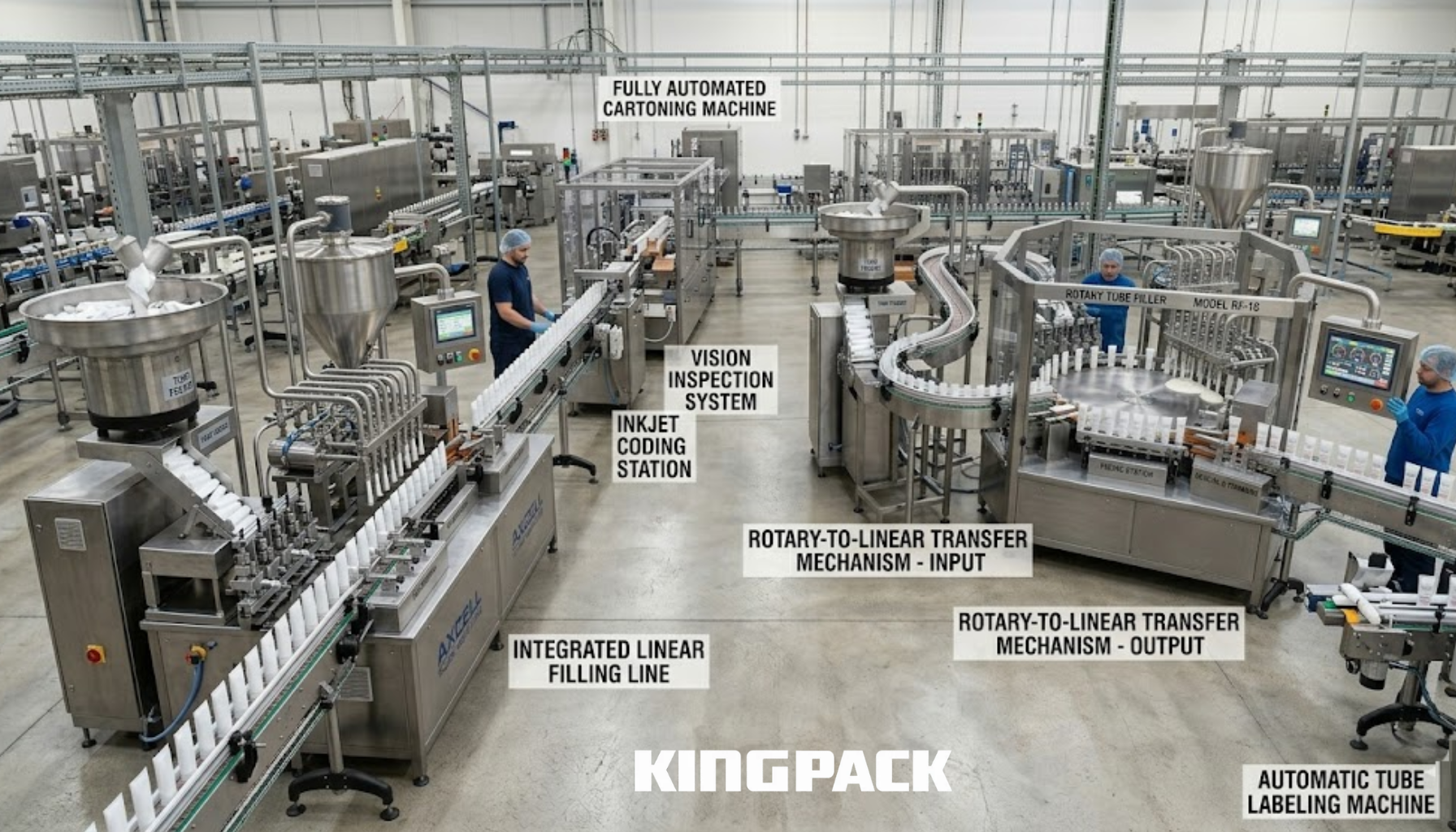
Rotary tube fillers require transfer mechanisms at the input and output points where the circular motion transitions to the linear flow of the broader production line. These transfers are standard engineering solutions, but they add components and require coordination during line commissioning.
For facilities planning future expansion, linear systems are easier to extend by adding stations. A linear tube filler can accept additional coding, inspection, or labeling stations by lengthening the machine body. Rotary systems are more constrained by the table diameter and the number of available station positions.
When to Choose a Linear Tube Filler
Choose a linear tube filler when your operation is characterized by:
- Moderate production volumes (up to 60 to 80 tubes per minute sustained)
- High product variety requiring frequent format changes
- Facilities with limited floor width but available length
- Operations where maintenance simplicity reduces dependence on specialized technicians
- Budget constraints that make the lower initial investment important
When to Choose a Rotary Tube Filler
Choose a rotary tube filler when:
- High-speed output is the primary production requirement (80 tubes per minute and above)
- Available floor space is limited and compact footprint is the priority
- Production runs are standardized with infrequent format changes
- The product line is dedicated to specific tube types in pharmaceutical or cosmetic applications
- Total cost per unit over the machine’s lifetime is the primary financial metric
Common Layout Planning Mistakes
Most post-installation issues in tube packaging lines come from a few avoidable layout decisions.
Ignoring maintenance space. Tube fillers and related packaging equipment need proper clearance for servicing and cleaning. Limited access slows down services and affects long-term performance. Both linear and rotary systems require space around the container flow path for part replacement and routine checks.
Overlooking future expansion. Many facilities install equipment based only on current demand. This creates limits when production grows. A wide selection of machines may be available later, but without space planning, upgrades become difficult. Layout should support added units such as piston, auger, or overflow systems for different product types like creams, pastes, or semi viscous liquids.
Poor workflow design. Inefficient movement between stages increases handling time and contamination risk. Tubes should move in a direct path from storage to filling, then to secondary packaging. Cross-traffic between areas handling different products or open container stages reduces efficiency and control.
How to Optimize Your Factory Layout with the Right Tube Filler
Start with a full production flow review. Track how tubes and containers move through each stage. The goal is to create a smooth path that reduces handling and supports consistent output.
Match machine size to available space. Compare floor area with equipment dimensions and production needs. The ideal setup fits the space without restricting access or workflow. This step also helps when selecting from a wide selection of machines built for different speeds and applications.
Plan automation early. Future integration with feeders, inspection systems, and packaging equipment should be part of the initial layout. This avoids costly changes later.
If there are questions about layout or machine selection, technical teams can assist with planning and provide the right information. A detailed request can help define the best configuration, and a supplier can offer a quote based on production needs and product type.
Why King Pack Tube Filling Solutions
We supply both linear and rotary tube filler configurations across the full speed range required by pharmaceutical, cosmetic, food, and chemical tube packaging operations.
Our linear systems address mid-volume operations and multi-product facilities where changeover speed and accessibility are the priority. Our rotary systems address high-speed, compact-footprint requirements where output per square meter of floor space is the key metric.
All our automatic tube filling machine configurations maintain fill accuracy at ±1% to ±2.5% across sustained production runs. Product contact surfaces are SUS 304 stainless steel. Control systems support PLC-based batch data logging for GMP-compliant pharmaceutical tube filling equipment applications.
We also provide layout planning support during the project consultation phase. Before you commit to a machine configuration, our engineering team can review your facility dimensions, production targets, and workflow requirements to recommend the tube filler design that maximizes your available space.
Our complete tube filling and sealing machine range covers both plastic hose sealing and metal tube folding applications in linear and rotary configurations.
Conclusion
Linear and rotary tube fillers both deliver reliable automatic tube filling and sealing performance. The right choice comes down to three variables: how much floor space you can allocate, how fast you need to produce, and how often your product mix requires changeovers.
Linear tube fillers offer flexibility, accessibility, and lower upfront cost. Rotary tube fillers deliver higher throughput and compact footprint. For many pharmaceutical and cosmetic tube packaging lines, the rotary design produces more output per square meter of floor space, which justifies the higher investment at production volumes where that output advantage matters.
Getting that balance right from the start avoids the cost of retrofitting, relocating equipment, or constraining production growth because the layout cannot accommodate new capacity.
Contact King Pack to design a tube filling solution that maximizes your factory floor space while optimizing production efficiency. Reach our team at kpfillingmachine.com/contact.
