 Skip to content
Hot sauce bottling equipment must match sauce viscosity, particle size, fill temperature, bottle geometry and closure type. A reliable line normally combines sanitary product handling, filling, capping, labeling, coding and inspection; the filler should not be selected in isolation.
Hot Sauce Bottling Equipment at a Glance
| Sauce / requirement | Typical equipment choice | What to verify |
|---|---|---|
| Thin, filtered hot sauce | Flowmeter, gravity or pump filler | Foam, temperature and fill-level consistency |
| Thick sauce or visible particles | Servo piston filler with large product path | Maximum particle size, shear and nozzle cut-off |
| Hot-fill process | Heated hopper and hot-fill-compatible conveyor line | Bottle temperature, cap seal, cooling and container deformation |
| Retail bottles with multiple caps | Format-adjustable capper and labeler | Cap torque, neck finish, label position and coding area |
Information Needed for a Line Proposal
- Target bottles per minute and fill-volume range
- Required fill accuracy and acceptable product giveaway
- Viscosity, temperature, particle size and recipe change frequency
- Bottle, cap and label drawings or physical samples
- Food-contact material, washdown or CIP requirement
- Optional unscrambler, capper, induction sealer, labeler, coder and checkweigher
Request a hot sauce bottling line proposal from KING PACK, or explore our filling and packaging solutions.
Hot sauce production has evolved from a niche specialty to a global commercial sector driven by a consumer appetite for bold, diverse, and ethnic flavors. The packaging operation for this condiment is not merely a final step; it is a critical process that ensures product integrity, extended shelf life, and compliance with rigorous food safety standards. The choice of bottling equipment must therefore be highly specialized.
At KING PACK, we provide advanced filling and packaging systems engineered specifically to handle the unique characteristics of hot sauce: varying viscosities, high particulate content, and corrosive acidity.
This guide examines every essential component of a successful hot sauce bottling line, from container selection to high-speed line integration, helping producers secure both efficiency and lasting product quality.
How to Choose the Right Bottle for Hot Sauce
Container selection affects product compatibility, filling temperature, closure performance, transport safety and shelf presentation. Bottle material and geometry should be verified against the actual recipe, process temperature, required shelf life and distribution conditions.
Considerations for Material Type
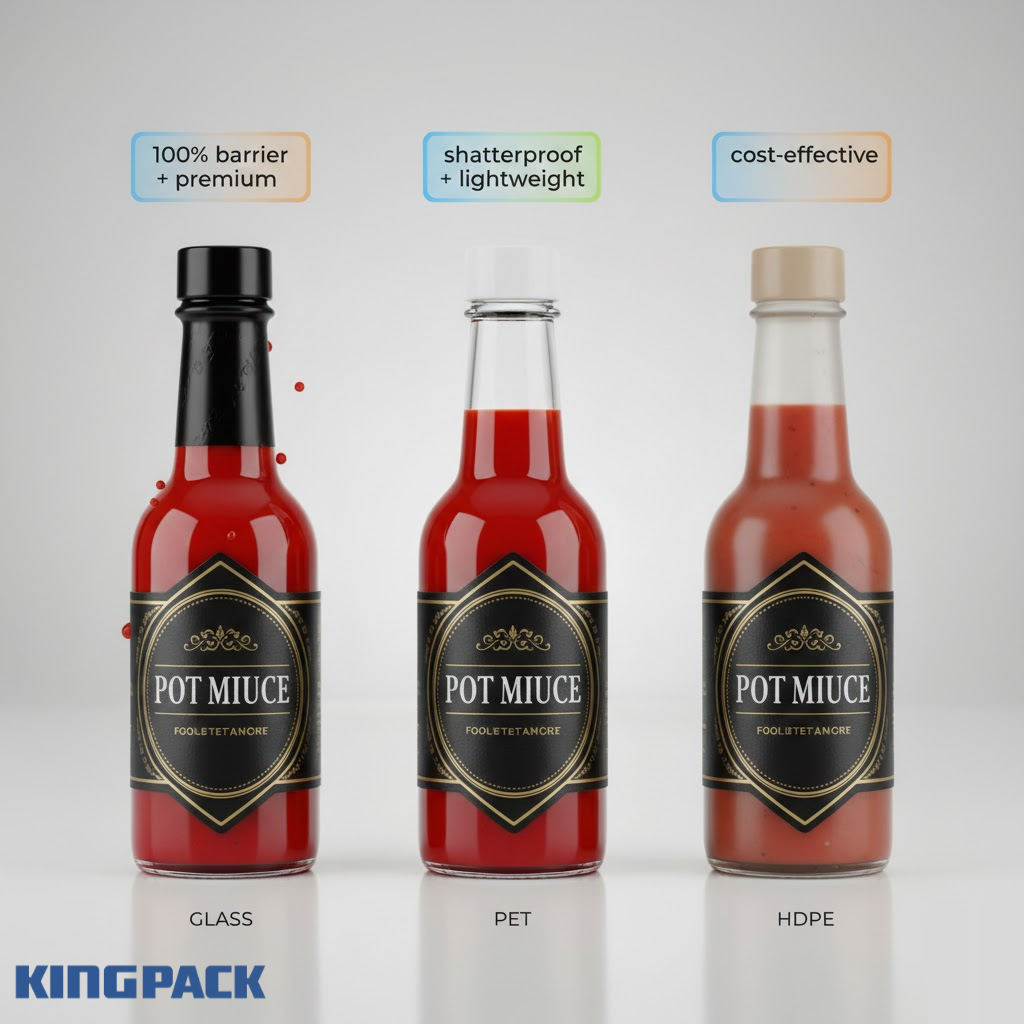
Choosing the right bottle material is critical for maintaining hot sauce quality and shelf life. The material affects durability, chemical compatibility, and consumer perception. Here are main material options:
- Glass: Provides strong barrier performance and a premium appearance. Confirm thermal-shock resistance, bottle quality and closure compatibility when the process uses hot filling.
- PET plastic: Is lightweight and shatter resistant. The selected grade must be compatible with the sauce, oxygen-barrier requirement and intended fill temperature.
- HDPE plastic: Offers durability and chemical resistance for some formats. Confirm barrier performance, closure fit and product compatibility through packaging trials.
Ultimately, the investment in high-quality packaging material, particularly food-grade glass or specialized high-barrier PET, protects the flavor profile of the hot sauce and assures consumers of product integrity until consumption.
Recommended Reading: Automatic Case Packaging Machine — Intelligent Transformation of End-of-Line Packaging – KING PACK Machinery
Considerations for Bottle Size & Shape
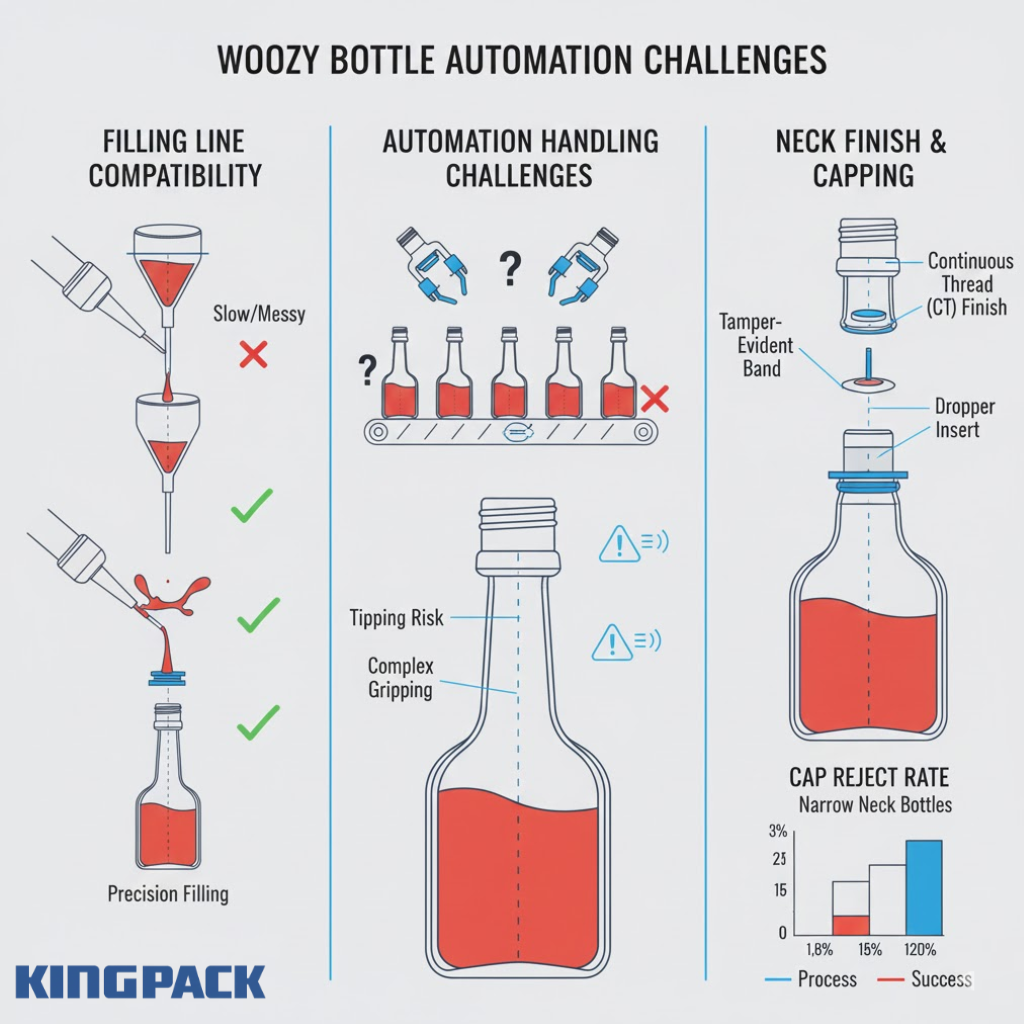
The physical dimensions of the bottle affect consumer perception, line efficiency, and handling logistics. The distinct “woozy” bottle shape is iconic in the hot sauce industry, suggesting tradition and artisanal quality.
But it presents unique challenges for high-speed automated lines that require stable, consistent surfaces for gripping and capping. Furthermore, the size must reflect market segmentation, with small single-serving bottles targeting travel or samples, and larger bottles serving retail or bulk use.
- Standard Sizes: The most common sizes are 5 oz (150 ml), 10 oz (300 ml), and 12 oz (355 ml), providing instant consumer familiarity.
- Neck Finish: A narrow bottle neck is often used to restrict the flow of liquid, which requires specialized neck handling systems on the filling machine to maintain stability during high-speed operation.
- Aesthetics / shelf appeal: Custom shapes can differentiate the brand but may require dedicated guides, star wheels or change parts on the bottling line.
Choosing a bottle size and shape should be a measured decision that balances brand visibility with the operational complexity it introduces to the bottling line, prioritizing a shape that can be efficiently handled by automatic filling, capping, and labeling equipment.
Filling Technologies for Hot Sauce
The texture and consistency of hot sauce can vary dramatically—from thin, vinegar-based sauces to thick, chunky varieties laden with pepper seeds, fruit pulp, or garlic. Selecting the correct filling technology is the most important mechanical decision in designing the production line. KING PACK specializes in offering filling solutions tailored to this complexity.
Gravity, Flowmeter or Overflow Filling for Thin Sauces
Volumetric fillers are ideal for thin, smooth sauces like vinegar-based hot sauces or pureed pepper liquids. They measure and dispense a fixed volume into each container, ensuring consistent portioning at high speeds without damaging the product. These systems are reliable, cost-efficient, and designed for continuous production in retail or bulk packaging lines.
| Filler Type | Key Advantage | Best Applications | Typical Throughput |
| Gravity Filler | Uses gravity and timed dispensing | Low-viscosity sauces without particulates | Not suitable for thick sauces or large particles |
| Overflow Filler | Controls the visible fill level | Thin, filtered sauces in clear bottles | Product return, foaming and temperature must be tested |
Volumetric fillers maintain consistent fill levels, which is critical for brand aesthetics and packaging uniformity. By matching the filler type to your sauce’s viscosity and bottle size, you reduce product waste and improve line efficiency.
Piston Filling: For Thick Sauces, Chunks & High Viscosity
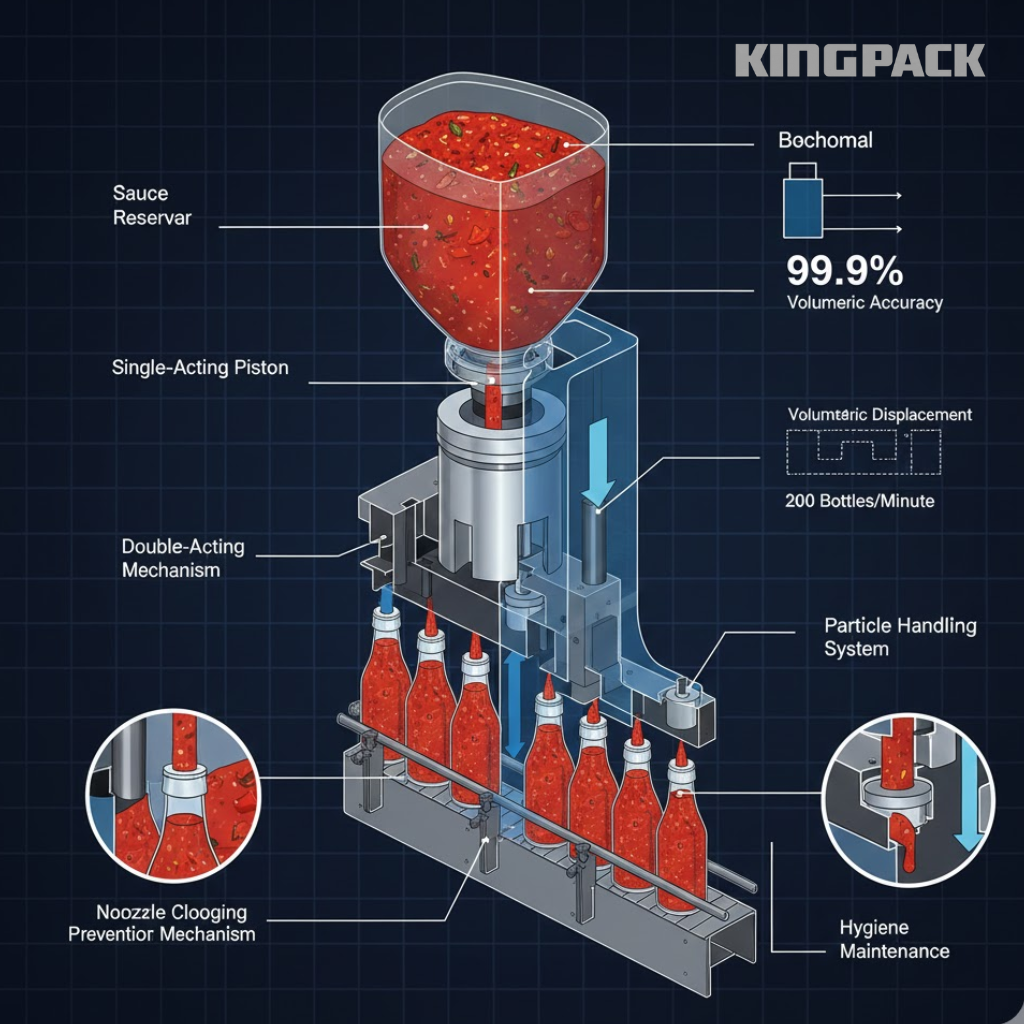
Piston fillers are built to handle high-viscosity sauces, purees, or chunky condiments containing seeds, pulp, or solids. They work by mechanically pushing a set volume of product into the container, providing precise, repeatable fills regardless of thickness. This ensures even portion control and prevents nozzle clogging or inconsistent fills.
| Filler Type | Key Advantage | Best Applications | Typical Throughput |
| Single-Acting Piston | Controlled volumetric dosing | Thick sauces, pastes or pepper-based hot sauces | Output depends on fill volume, viscosity and nozzle size |
| Multi-Acting Piston | Supports multiple filling cycles | Chunky or semi-solid sauces | Verify particle clearance, shear, cut-off and cleaning |
Piston filling is often suitable for high-viscosity or particulate sauces that are difficult to handle with gravity-based systems. Actual performance depends on product testing, piston sizing, nozzle selection, cut-off control and cleaning design.
Sealing, Capping & Labeling in the Bottling Line
Once the hot sauce is precisely filled, the integrity of the packaging rests on the sealing, capping, and final labeling processes.
Sealing That Protects & Preserves
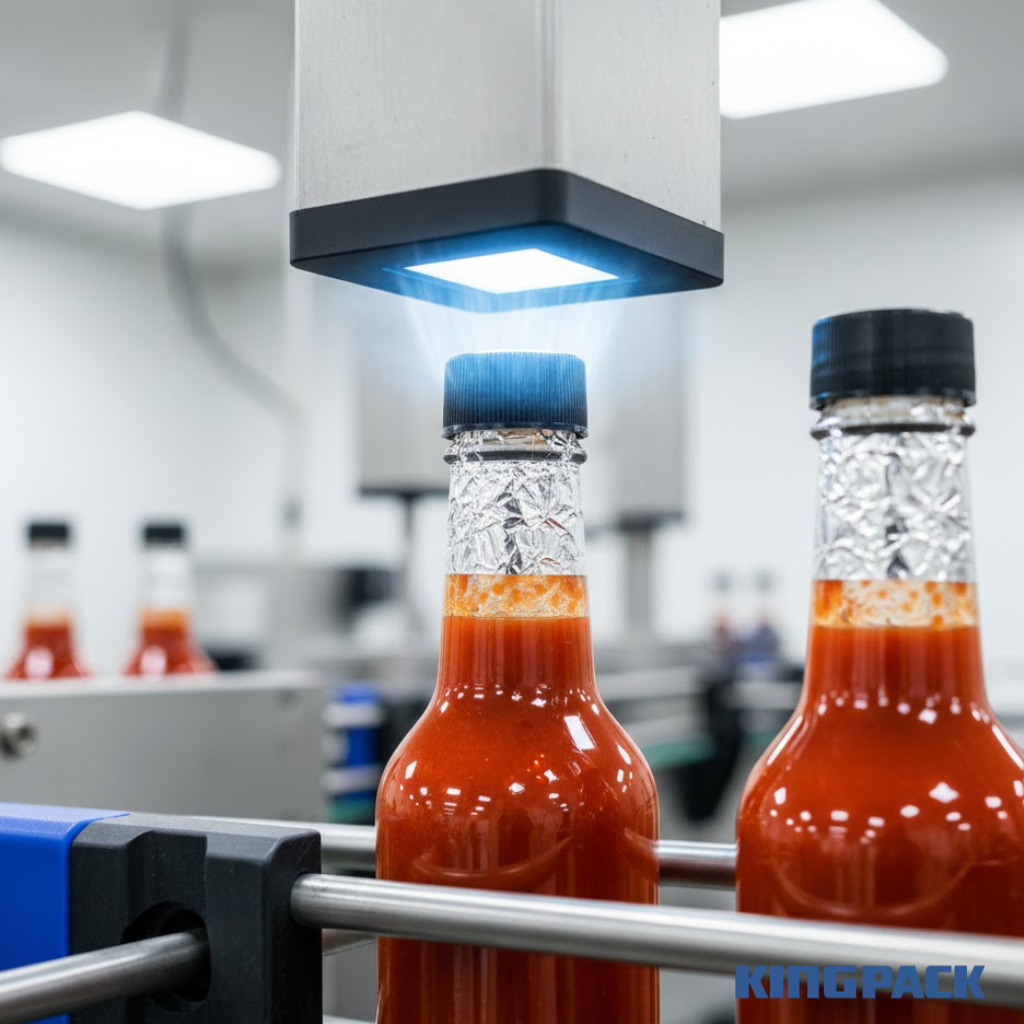
KING PACK integrates induction sealing into their lines. When a cap is applied, an induction coil bonds a foil liner to the bottle rim, creating a hermetic seal.
This seal is critical for:
- Preventing oxygen loss
- Avoiding leakage or contamination
- Giving your product a professional, tamper-evident finish
Capping Options: Screw, Chuck, Spindle
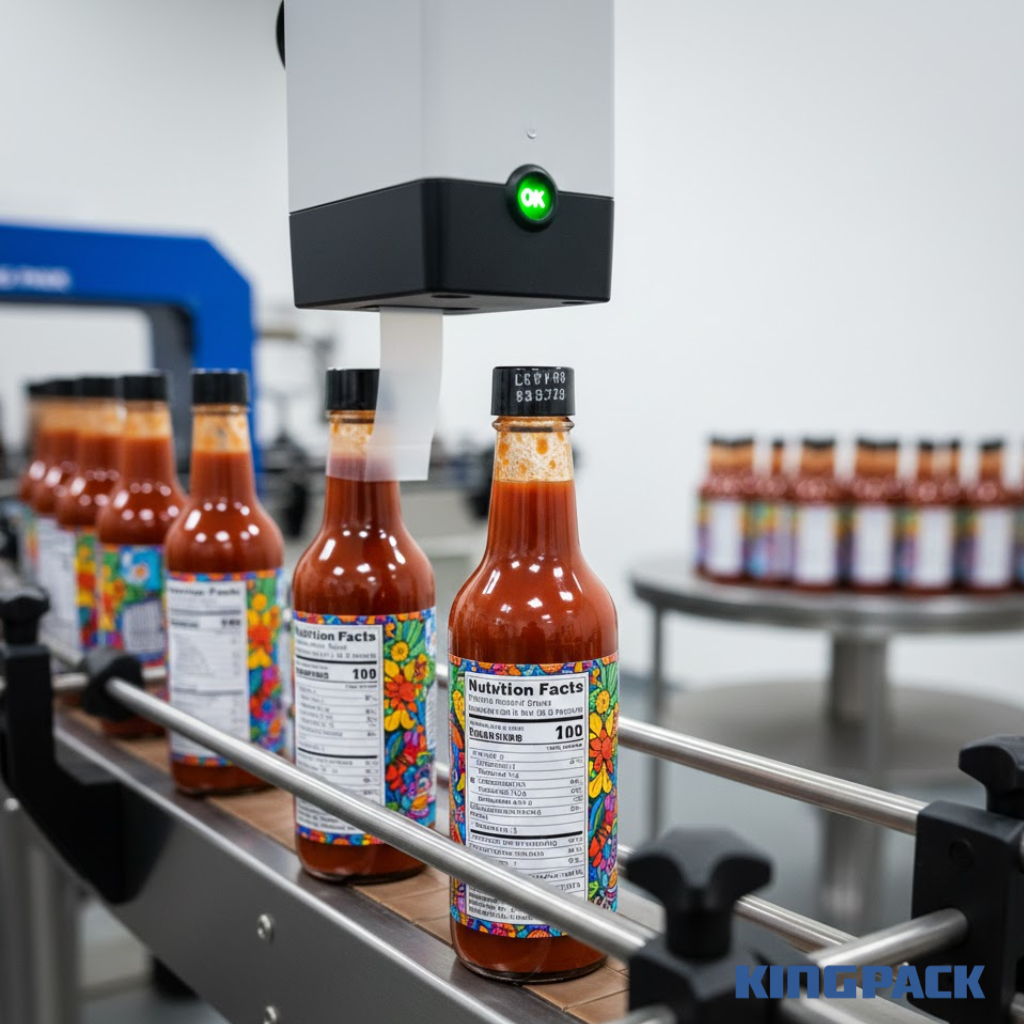
Your choice of cap drives the capping tech. KING PACK supports:
- Spindle cappers — ideal for threaded caps with high-speed lines
- Chuck cappers — precise pneumatic or servo heads grip and rotate
- Snap cappers — for press-on caps or specialty lids
Torque control is built in, so every bottle is closed tightly enough to prevent leaks — but not so tight that customers struggle.
Labeling & Coding: Brand Meets Compliance
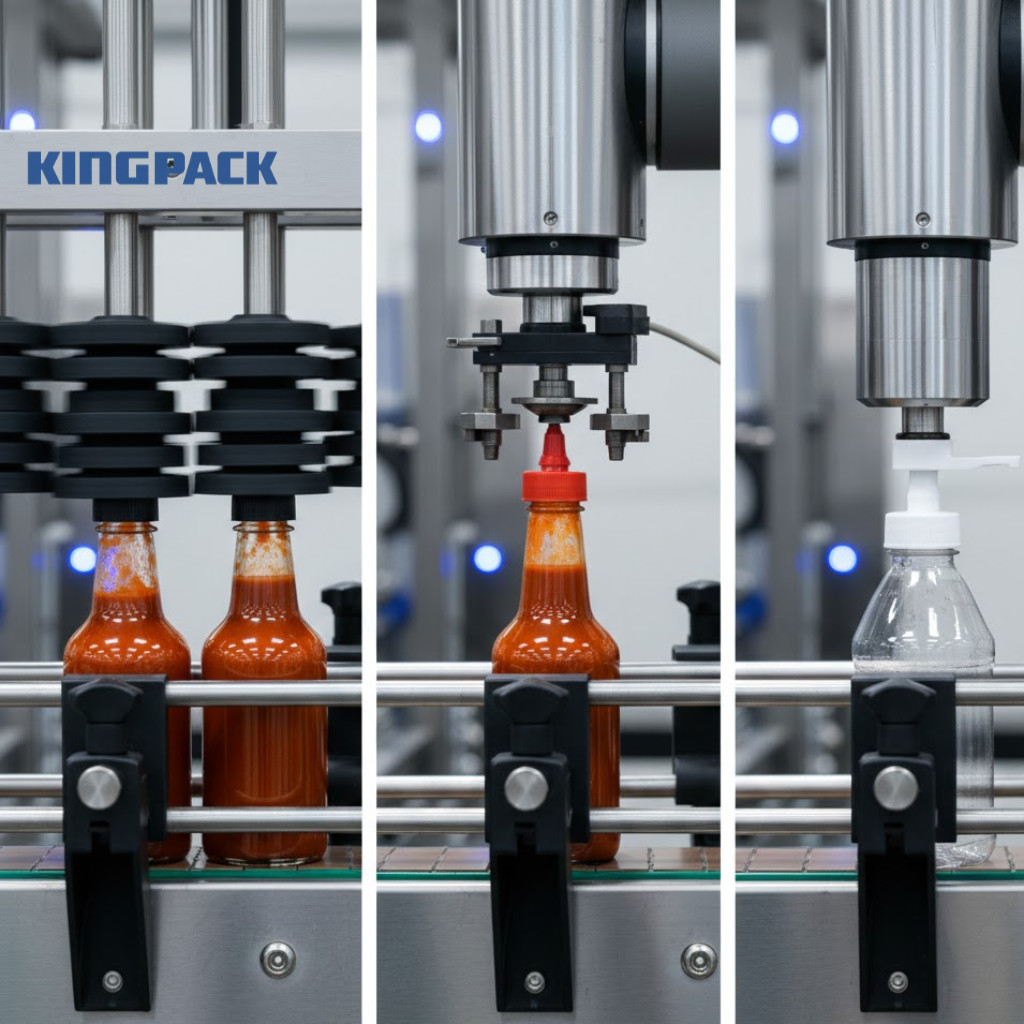
Labeling is your moment to shine — and KING PACK’s systems support a variety of styles:
- Wrap-around labels for standard cylindrical bottles
- Front/back panels for nutrition or brand messaging
- Tamper-evident or shrink-band labels for security
They also offer vision inspection to catch misaligned or missing labels, ensuring quality before your products leave the line.
Automation Levels & Line Integration
Selecting the appropriate level of automation ensures a packaging line meets current production demands while allowing for future growth.
Manual / Benchtop Solutions
Manual or benchtop hot sauce bottling solutions are ideal for small-scale producers, craft brands, or startups entering the market. Operators perform the filling, capping, and labeling tasks by hand, giving full control over each batch while requiring minimal investment in machinery.
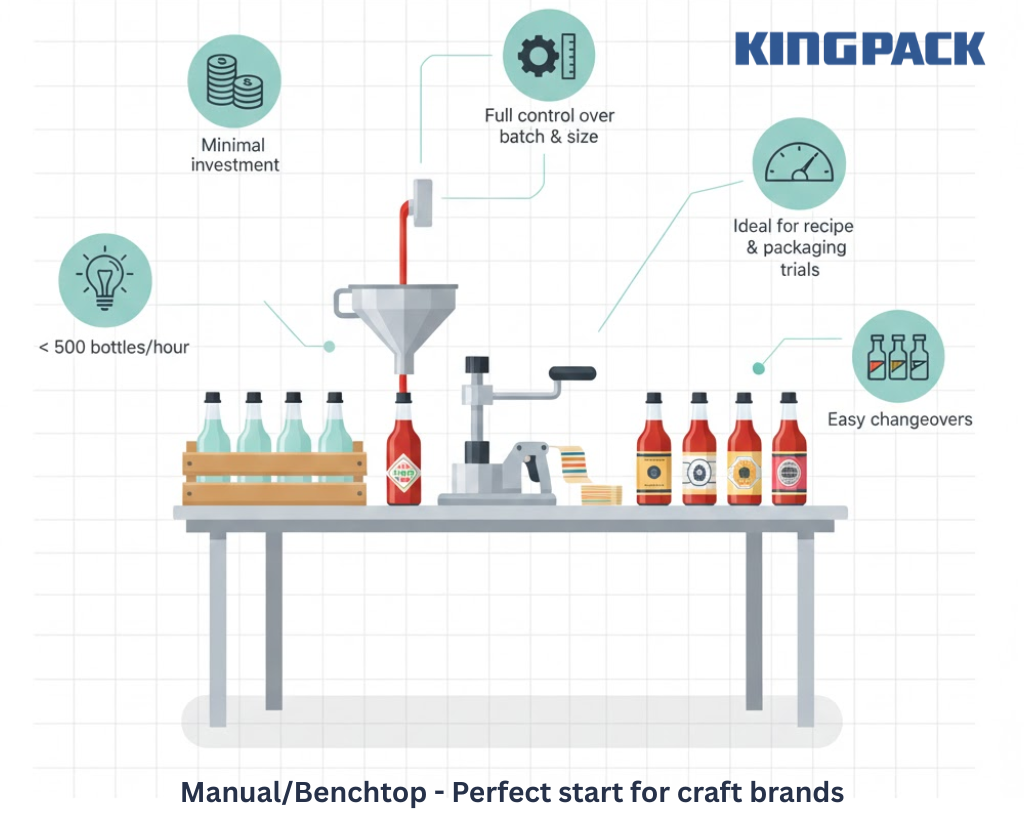
These systems are best suited for low-volume production and frequent recipe or format changes. Actual output depends on fill volume, product handling and operator workflow, while the lower investment helps small brands validate products before adding automation.
Semi-Automatic Lines
Semi-automatic lines strike a balance between efficiency and operator control. Machines perform the precise filling, sealing, and capping functions, while an operator handles bottle loading, unloading, and occasional adjustments.
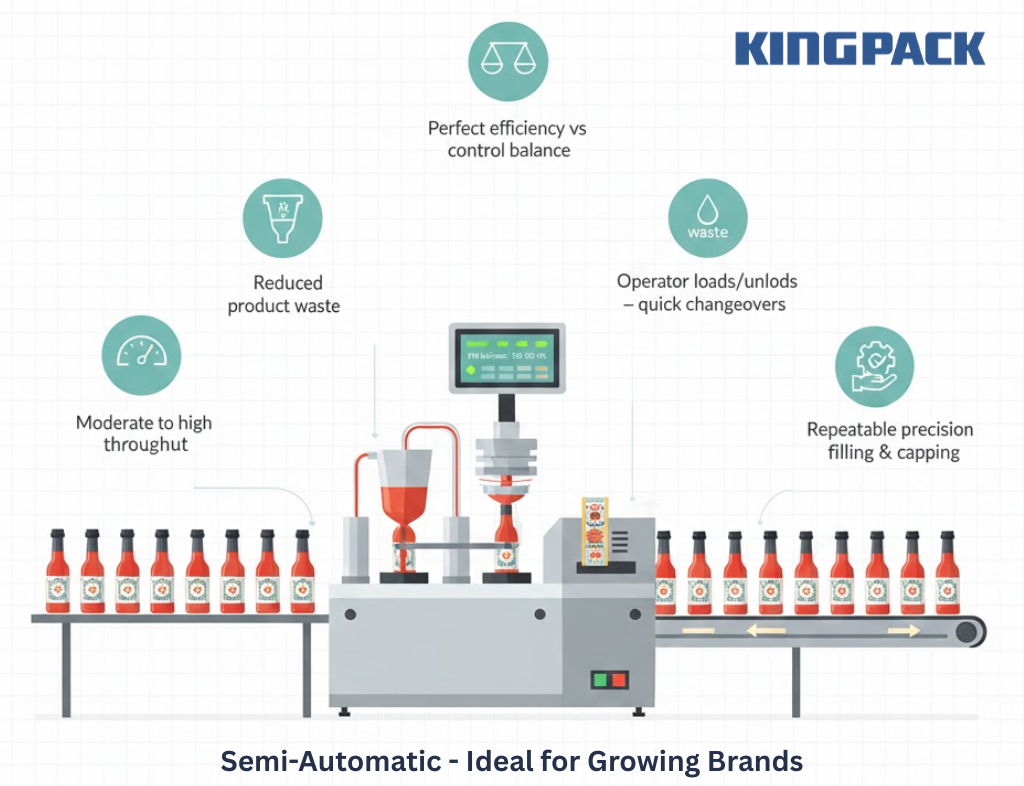
This setup works well for growing businesses that need higher throughput than manual lines can provide. Semi-automatic systems improve consistency, reduce product waste, and support moderate production volumes without the full investment of a fully automatic line.
Fully Automatic Lines
Fully automatic hot sauce lines are engineered for high-volume, commercial production. These turnkey systems manage the entire process autonomously, from unscrambling and feeding bottles to filling, capping, labeling, and final case packing.
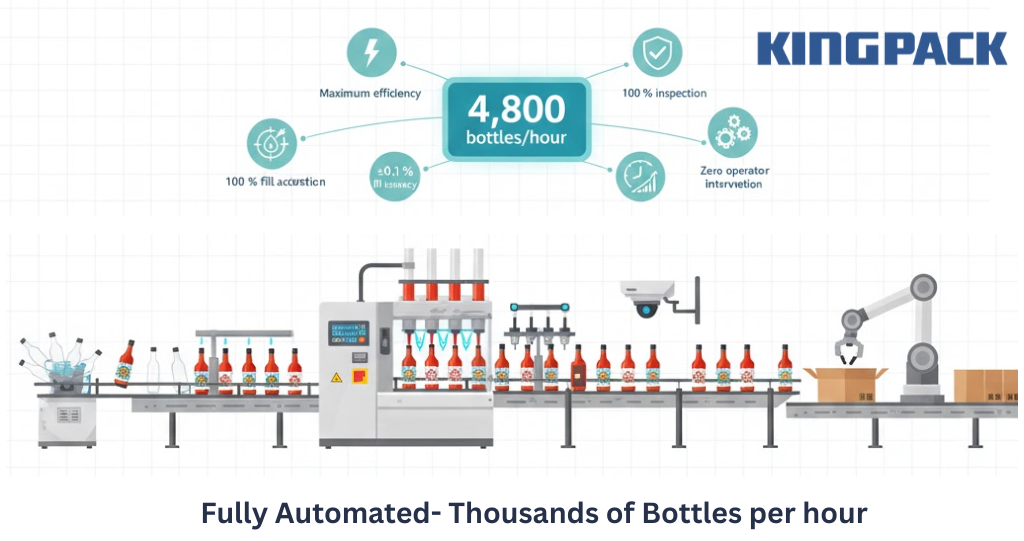
Fully automatic lines can coordinate bottle feeding, filling, capping, labeling, coding and inspection. Required output should be confirmed from the bottle range, fill volume, sauce characteristics, changeover plan and upstream and downstream equipment.
Key Considerations When Buying a Hot Sauce Bottling Machine
Purchasing a bottling machine is a substantial investment that requires careful evaluation against four key criteria to support long-term value and operational fit.
Viscosity & Consistency of Your Sauce
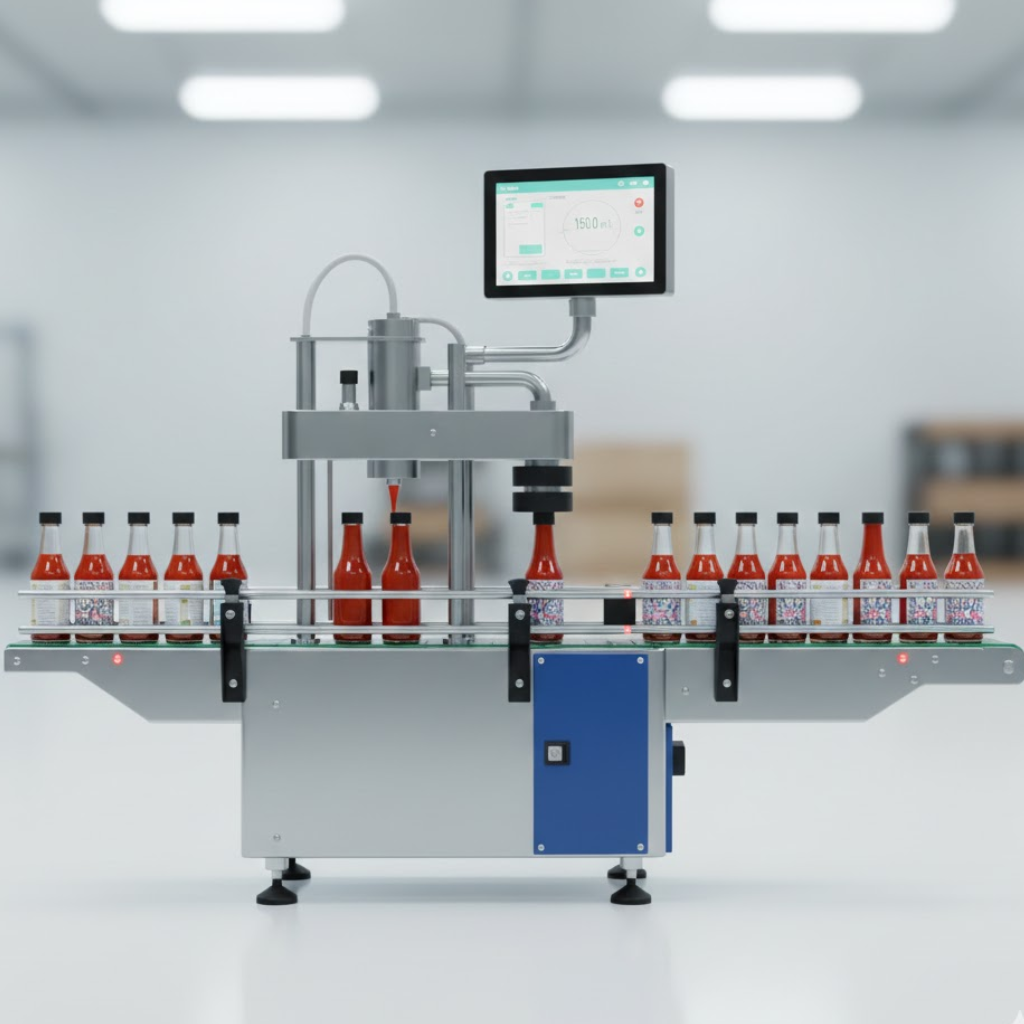
Matching the machine technology to the product rheology is paramount.
- Thin, runnier sauces (low-viscosity) require volumetric or overflow filling for speed and visual consistency.
- Thick, chunky sauces (high-viscosity) require the power and precision of piston or pump fillers. Failure to select the correct technology will result in either inconsistent fills or damage to the product particulates.
Container Size, Material and Compatibility
A machine must offer flexibility to handle your current and prospective product portfolio. If you package your signature sauce in a 5 oz glass woozy bottle and your commercial bulk product in a 64 oz PET jug, the machine should be designed with the format flexibility to switch between these specifications quickly and easily. KING PACK specializes in highly adaptable platforms to mitigate future compatibility issues.
Budget & Return on Investment
While automated systems require a higher initial investment, the long-term ROI is realized through significant operational savings.
- Reduced Product Giveaway: High-precision fillers cut product loss, which is critical for expensive, high-quality ingredients.
- Increased Throughput: Automation allows higher bottles per minute (BPM) output, facilitating market expansion and meeting large order fulfillment demands.
- Labor Savings: Moving from semi-automatic to fully automatic drastically reduces manual labor costs and error rates.
Future Expansion & Scalability
A wise investment is protected by the ability to scale. Look for machines built on modular designs that permit additional components—like extra filling nozzles, secondary cappers, or inspection systems—to be integrated later. This ensures your line can grow organically with your business, without needing a complete overhaul as production demands increase.
Recommended Reading: Multilane Packing Machines – High‑Speed Multichannel Sachet & Stick‑Pack Solutions | KING PACK – KING PACK Machinery
Real-World Use Cases & Industry Relevance
KING PACK’s sauce bottling equipment is designed to serve diverse market segments with tailored configurations.
Food & Condiment Manufacturers
Large-scale food producers need uninterrupted, high-speed performance. KING PACK delivers automatic sauce filling machines and rotary bottle filling machines that operate continuously, achieving peak production capacity.
These filling lines can combine stainless product-contact components, automated conveyors, sensors and servo control. The final duty cycle and output should be validated against the production schedule, cleaning plan and maintenance requirements.
Craft Hot Sauce Producers
Artisanal and small-batch producers prioritize accuracy over speed. KING PACK offers semi-automatic sauce fillers and piston filler machines that handle high-viscosity products with precision.
Linear fillers and volumetric piston fillers provide accurate dosing, while quick-change designs support multiple product lines. This setup works well for hot fill applications, chunky salsas, or specialty condiments.
Related Sauce and Condiment Applications
The same equipment platform can be configured for BBQ sauce, ketchup, salsa, marinades and dressings, but filler and nozzle selection must follow the actual product rather than the product name alone.
- Smooth, free-flowing sauces: Flowmeter, gravity, overflow or pump filling may be suitable after testing flow behavior and foaming.
- Thick or particulate sauces: Piston or positive-displacement filling with an adequately sized product path can reduce bridging and inconsistent cut-off.
- Sachets and pouches: These formats use a different packaging platform and dosing arrangement from a bottle line.
Final configuration should be verified using product, bottle, cap and label samples. Specify fill temperature, pH, maximum particle size, cleaning procedure and food-contact requirements before equipment design is finalized.
Hot Sauce Bottling Equipment FAQ
Which filler is suitable for thick or chunky hot sauce?
A servo piston or positive-displacement pump filler is often a good starting point. The final choice depends on viscosity, maximum particle size, fill volume, temperature and the required nozzle cut-off.
Does hot sauce always require hot filling?
No. The filling method must follow the validated recipe, pH, preservation process and food-safety plan. When hot filling is required, bottles, closures, product paths and downstream cooling must all be compatible with the specified temperature.
Can one line handle both glass and plastic bottles?
It can when the machine is designed for the required bottle dimensions, neck finishes and stability. Change parts, conveyor guides, cap handling and hot-fill compatibility should be confirmed with samples.
How should a sauce bottling line be sized?
Use daily output, available production time, expected downtime, changeover frequency, fill-volume range and future demand. Balance the filler, capper, labeler and inspection equipment as one line rather than sizing each machine separately.
Plan Your Hot Sauce Bottling Line
The right hot sauce bottling equipment combines the filling technology, sanitary product path, container handling, capping, labeling and inspection needed for the actual product and package. Product trials and container samples help confirm the design before production.
Send KING PACK your sauce characteristics, bottle and cap samples, fill-volume range and target output. Contact KING PACK for a tailored hot sauce bottling line proposal.
